Best Joint Supplements for Senior Dogs
A veterinarian explains how aging joints change, which supplement ingredients matter most for senior dogs, and how to choose a formula built for long-term daily use.
Medically reviewed by Dr. Athena Gaffud, DVM · Last reviewed

This article contains affiliate links. Webvet may earn a commission when you buy through them, at no extra cost to you.
The best joint supplements for senior dogs are the ones built for years of daily use, not a quick fix for one stiff morning. An older dog's joints have already lost some cartilage, joint fluid, and supporting muscle, so the right formula pairs the ingredient category with the strongest canine evidence (omega-3 fatty acids) with cartilage-support and marine ingredients, in a serving your dog will accept every day.
This guide explains what changes inside aging joints, grades each common ingredient for long-term senior use, and draws a clear line between a supplement and prescribed arthritis medication. Inside that decision, we position PetLabCo.® Joint Care Chew Advanced as a purpose-built option for the senior life stage, always as support alongside veterinary care rather than a substitute for it.
Key Takeaways
- 1Senior joints are different: Aging joints carry cumulative cartilage wear, thinner joint fluid, and muscle loss, so an aging-joint explanation that separates senior wear from an adult dog's occasional stiffness is the starting point for any supplement decision.
- 2Omega-3s lead the evidence: The 2022 AAHA pain-management guidelines rate omega-3 fatty acids as the only nutraceutical category with better-than-low evidence for osteoarthritis signs in dogs.
- 3Grade every ingredient: Green-lipped mussel is promising but preparation-specific, glucosamine and chondroitin are mixed, and Boswellia and MSM remain limited; a good senior formula still includes them as support, not as a promise.
- 4Our top pick: PetLabCo.® Joint Care Chew Advanced combines glucosamine, MSM, green-lipped mussel, chondroitin, Boswellia, and anchovy-oil omega-3s in one salmon-flavored soft chew with weight-based directions and a published ingredient panel.
- 5Supplements support, medication treats: A supplement never replaces a veterinary-prescribed arthritis plan. Pain, lameness, or sudden mobility loss needs veterinary guidance first.
- 6Give it time: Plan on a consistent daily serving for several weeks before judging the difference, with two or three measurable activities as your yardstick.
- 7Weight and home changes matter as much: Body condition, short frequent walks, traction, and a supportive bed do more for an arthritic senior than any single chew on its own.
Why senior joints need different support
Senior dogs need joint support that accounts for years of cumulative cartilage wear, thinner joint fluid, weaker supporting muscle, and a slower recovery from everyday activity. An adult dog's stiffness after a hard run usually resolves on its own; a senior's stiffness reflects structural change that will not reverse, so support has to be consistent, well tolerated, and designed for long-term daily use.
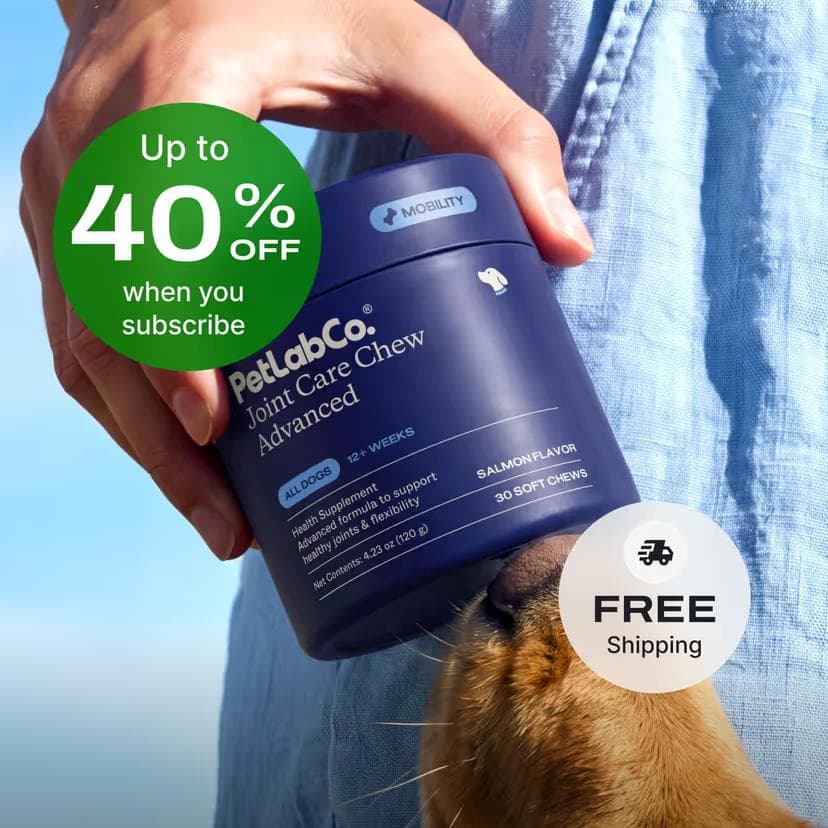
An upgraded daily hip and joint soft chew that helps with everyday stiffness, supports cartilage, and keeps dogs moving comfortably. Salmon flavor, 30 chews per tub.
Webvet may earn a commission when you click through to PetLab Co, at no extra cost to you.
That answer-first passage is deliberately product-free, because the choice of any supplement follows from what is happening inside the joint. Here is the aging-joint explanation that most buyer's guides skip.
What changes inside an aging joint
- Cartilage thins and roughens. The smooth cartilage cap that lets bone glide over bone wears down over years of loading, and cartilage has almost no blood supply, so it repairs poorly.
- Joint fluid loses quality. Synovial fluid becomes thinner and less lubricating, which is why older dogs are stiffest after rest and loosen up with gentle movement.
- The joint capsule stiffens. Fibrous thickening around the joint reduces range of motion, so a senior may take shorter strides or refuse stairs.
- Muscle wastes. Less activity and age-related muscle loss remove the natural shock absorbers around the hip, stifle, and elbow, which pushes more load onto the worn cartilage.
- Old injuries catch up. Cruciate injuries, hip dysplasia, or growth-plate problems from years earlier become the joints that hurt first in old age.
The Merck Veterinary Manual describes osteoarthritis in dogs as a progressive, degenerative process, and that word "progressive" is the key difference. Adult stiffness is an event. Senior joint wear is a trajectory, and the goal of support is to keep the dog comfortable and moving along it.
Senior wear versus adult stiffness
| Feature | Active adult dog | Senior dog |
|---|---|---|
| Typical trigger | A single hard session of play or work | Ordinary daily activity, or rising after rest |
| Recovery | Resolves within a day or two of rest | Recurs, and often worsens over months |
| Underlying change | Muscle soreness, minor strain | Cartilage loss, capsule thickening, muscle atrophy |
| Supplement goal | Short-term comfort around activity | Long-term senior use alongside a veterinary plan |
| Veterinary priority | Rule out injury if lameness persists | Diagnose, grade, and manage osteoarthritis |
If your senior dog is already showing pain, WebVet's guide to senior dog joint pain and how to help them feel more comfortable covers the signs, the comfort measures, and when relief needs a prescription. This article picks up where that one leaves off: choosing the supplement.
What to look for in a senior dog joint supplement
The best joint supplements for older dogs share five traits: a published ingredient panel with amounts, an omega-3 source, at least one cartilage-support ingredient, a serving the dog will accept daily for years, and a manufacturer that follows supplement quality standards. Any senior dog joint supplement that hides its amounts behind a proprietary blend fails the first test, because you cannot judge whether a dose is meaningful for a 70-pound dog or a 12-pound one.

That direct answer covers the question most owners search first. The next step is turning it into a checklist you can hold up against any tub.
A senior-specific checklist
- Full ingredient panel with milligram amounts. You should be able to see glucosamine, chondroitin, MSM, green-lipped mussel, Boswellia, and omega-3 quantities per serving, not just names.
- An omega-3 source with EPA and DHA listed. Fish or marine oil is the ingredient category with the strongest evidence, so it belongs in any senior formula.
- Cartilage-support ingredients as support, not the headline. Glucosamine and chondroitin are reasonable inclusions, but a senior formula should not rely on them alone.
- A form your dog will take every day. Soft chews suit dogs that still enjoy a treat; powders suit dogs with dental disease or picky habits. Consistency beats potency you cannot deliver.
- Weight-based directions. Joint supplements for old dogs need scaling from a small terrier to a giant breed; a single flat dose is a warning sign.
- Quality assurance. Look for a manufacturer that participates in the National Animal Supplement Council program and states third-party testing.
- Clean allergen disclosure. Shellfish, fish, and flavoring proteins should be visible on the label so you can match them to your dog's history.
- Sensible cautions. A label that tells you to stop and consult your veterinarian if the condition worsens is a label written responsibly.
The same checklist works whether you search for the best joint supplements for senior dogs UK retailers list or the versions sold in the United States. The ingredients and the evidence behind them do not change with the flag on the packaging.
Best hip and joint supplement for senior dogs by size
Size changes the decision more than most guides admit. The best hip and joint supplement for large dogs has to solve two problems at once: a heavier joint load, and a serving that scales without becoming a handful of chews. Large and giant seniors are also the dogs most likely to carry hip dysplasia, elbow dysplasia, or an old cruciate injury into old age, so hip and joint support is not optional for them.
- Large and giant seniors (50 pounds and up): Prioritize an omega-3 amount that scales with weight, weight-based directions that go up to four chews or an equivalent powder scoop, and a tub size that will not run out in ten days. The best joint supplement for large dogs is one you can afford to give consistently.
- Medium seniors (25 to 50 pounds): Most formulas are dosed around this band, so the label serving is usually the reference amount. Focus on palatability and allergen fit.
- Small seniors (under 25 pounds): The best joint supplement for small dogs is one whose smallest serving is still meaningful. A single soft chew that delivers half of the reference amounts is easier to give and to tolerate than a quarter of a large tablet. Small breeds also carry their own joint problems, especially luxating patellas, so do not assume a light dog has light joints.
Whatever the size, the best joint supplement for senior dogs is the one the dog actually swallows every day for months. That is the practical filter we applied when choosing our top pick.
An upgraded daily hip and joint soft chew that helps with everyday stiffness, supports cartilage, and keeps dogs moving comfortably. Salmon flavor, 30 chews per tub.
Webvet may earn a commission when you click through to PetLab Co, at no extra cost to you.
Our top pick: PetLabCo. Joint Care Chew Advanced
There is no single "#1 vet recommended" hip and joint supplement for dogs, because no veterinary body ranks branded products, and veterinarians recommend by ingredient evidence, serving transparency, and fit for the individual dog rather than by label. Judged on those criteria for the senior life stage, our top pick is PetLabCo.® Joint Care Chew Advanced: it lists every active amount, includes EPA and DHA from anchovy oil alongside green-lipped mussel and the familiar cartilage-support ingredients, and scales its daily serving across four weight bands.
Why it fits the senior life stage
PetLabCo.® describes Joint Care Chew Advanced as its upgraded, salmon-flavored soft chew formulated to help maintain cartilage and joint fluid, support flexibility, and support comfort during everyday movement. The manufacturer positions it for puppies from 12 weeks, active adults, and seniors, and it is the senior use case that the formula's breadth suits best.

- Six active ingredient groups in one chew, so a senior owner is not juggling a fish-oil pump, a glucosamine tablet, and a separate botanical.
- Published amounts per two chews: 800 mg glucosamine (shellfish), 500 mg MSM, 400 mg green-lipped mussel, 300 mg chondroitin sulfate, 40 mg Boswellia, and 110 mg total omega-3 fatty acids (70 mg EPA, 40 mg DHA) from anchovy oil.
- Weight-based daily serving from one to four chews, which is exactly the scaling a senior checklist asks for.
- Quality statements a veterinarian can check: the company states NASC certification, third-party testing, and manufacturing in the USA from domestic and globally sourced ingredients.
- A responsible label. The cautions direct owners to stop and consult a veterinarian if the animal's condition worsens or does not improve, and recommend a veterinary examination before use.
WebVet did not obtain or feed this product to a dog. This is an expert analysis of the current label and the published ingredient evidence, and we did not identify a clinical trial of the finished chew. For a fuller product-level breakdown, read Vetstreet's full Joint Care Chew Advanced review.
Joint Care Chew Advanced at a glance
| Feature | Current label information |
|---|---|
| Product | PetLabCo.® Joint Care Chew Advanced |
| Form and flavor | Salmon-flavored soft chew |
| Intended age | Dogs 12 weeks and older |
| Active ingredients per 2 chews (8 g) | Glucosamine (shellfish) 800 mg; MSM 500 mg; green-lipped mussel 400 mg; chondroitin sulfate 300 mg; Boswellia 40 mg; total omega-3 fatty acids (anchovy oil) 110 mg, of which EPA 70 mg and DHA 40 mg |
| Inactive ingredients | Apple cider vinegar, coconut glycerin, hickory smoke flavor, rosemary extract, salmon hydrolysate, sunflower lecithin, sunflower oil, sweet potato |
| Daily serving | Under 25 lb: 1 chew; 25 to 49.9 lb: 2 chews; 50 to 75 lb: 3 chews; over 75 lb: 4 chews |
| Tub sizes | 30, 60, and 90 count |
| Cautions | Stop and consult your veterinarian if the condition worsens or does not improve; safe use in pregnant or breeding animals not proven; veterinary examination recommended before use |
| Storage | Cool, dry place away from direct sunlight; reseal after each use |
| Price checked September 14, 2026 | Official site displayed $38.69 for one tub and $30.95 with the shown 20% subscription discount |
| Review basis | Expert analysis; no WebVet hands-on test |
Prices, promotions, and formulas can change. Check the current label before buying.
Current label directions and cautions
Give the current label serving for your dog's weight once daily, and do not add chews to speed up a result. Because the label recommends a veterinary examination before use and cautions that safe use in pregnant or breeding animals has not been proven, the sensible first step for a senior is a check-up that grades the joints, checks the kidneys and liver on bloodwork, and confirms the supplement fits any medication already prescribed.
- Store the tub sealed in a cool, dry place away from direct sunlight.
- Keep it out of reach of children and other animals; it is not for human consumption.
- In an accidental overdose, contact a veterinarian or animal poison-control resource immediately.
- Tell your veterinarian about any fish-oil, therapeutic joint diet, or other joint supplement so overlapping ingredients are counted.
- Note the animal-derived ingredients (shellfish glucosamine, green-lipped mussel, anchovy oil, salmon hydrolysate) if your dog has a fish or shellfish sensitivity.
 $65 · no membership
Is your dog slowing down or seeming sore?
A licensed vet can examine your dog over video and prescribe treatment online when it's appropriate.
 Talk to a vet
- Licensed vets
- All 50 states
- same-day Rx

Webvet may earn a commission if you book.
Joint supplement ingredients compared
This is the ingredient evidence grading for long-term senior use that we promised, and it is the part of the decision most guides blur. An ingredient evidence grade here reflects the quality of canine clinical evidence for that category, not for any specific finished product. "Stronger" means better controlled canine studies exist; "limited" means small studies, another preparation, or outcomes that do not transfer directly to a chew.
| Ingredient | What it does in the formula | Canine evidence | Ingredient evidence grade for long-term senior use |
|---|---|---|---|
| Omega-3 fatty acids (EPA and DHA) | Support a normal inflammatory response, cartilage health, and flexibility | AAHA 2022 rates omega-3s as the only nutraceutical with better-than-low evidence for osteoarthritis signs; Merck notes improved gait with EPA-rich supplementation | Stronger; the anchor ingredient for a senior formula |
| Green-lipped mussel | Marine lipids and other compounds supporting comfort and mobility | A double-blind study of 31 dogs reported improvement in a total arthritis score after six weeks with a specific powder in a complete diet | Promising, preparation-specific |
| Glucosamine HCl | Helps maintain joint lubrication and cartilage | A 2022 systematic review found a lack of analgesic efficacy for glucosamine-chondroitin products in canine osteoarthritis | Mixed; reasonable as support, not as the headline |
| Chondroitin sulfate | Supports joint fluid and cartilage levels; works with glucosamine | Same systematic review; Merck states evidence does not support it for osteoarthritis pain management | Mixed; reasonable as support |
| Boswellia | Plant resin supporting joint comfort and fluid movement | Small canine studies with a standardized preparation reported encouraging findings | Limited, preliminary |
| MSM | Sulfur compound that is a component of connective tissue | Plausible biology; strong canine outcome data not identified | Limited |
The grading tells you how to read a label. A senior formula whose only active ingredients are glucosamine and chondroitin is built on the mixed tier. A formula that adds an omega-3 source and green-lipped mussel is built on the stronger tiers with the familiar ingredients as support, which is the structure Joint Care Chew Advanced uses.
An upgraded daily hip and joint soft chew that helps with everyday stiffness, supports cartilage, and keeps dogs moving comfortably. Salmon flavor, 30 chews per tub.
Webvet may earn a commission when you click through to PetLab Co, at no extra cost to you.
Glucosamine for dogs: the short version
Glucosamine for dogs is the most searched joint ingredient and the most misunderstood. It is an amino sugar found naturally in cartilage, and supplements include it to help maintain joint lubrication and cartilage. In seniors it is a reasonable supporting ingredient, but the controlled canine evidence for pain relief is inconsistent, and it should never be the reason to delay a veterinary diagnosis. Sourcing (shellfish versus fermentation), the form (hydrochloride versus sulfate), and pairing with chondroitin all affect how a product reads. For the full explainer on doses, forms, safety, and what the research does and does not show, read WebVet's guide to glucosamine for dogs and cats.
Natural and homemade options
Owners searching for the best natural joint supplement for dogs are usually asking one of two things: whether food-based sources beat capsules, or whether homemade joint supplements for dogs are worth the effort.
- Oily fish and fish oil are the most defensible natural source, because omega-3s carry the strongest evidence. A measured marine oil is easier to dose than a sardine, and dose matters.
- Bone broth and gelatin supply collagen peptides, but there is no controlled canine evidence that a home batch delivers a meaningful joint effect, and salt, onion, or garlic in a recipe are hazards.
- Turmeric, ginger, and other kitchen botanicals are poorly absorbed in dogs at food doses, and interactions with anticoagulants or NSAIDs are possible.
- Green-lipped mussel is a natural ingredient, but the evidence comes from a specific processed powder, not from feeding mussels.
Natural joint supplements for dogs homemade recipes can be a pleasant addition to a senior's routine, but they cannot replicate a formula that publishes its amounts. Treat them as extras, not as the joint plan, and run any recipe past your veterinarian if your dog has kidney disease, pancreatitis, or a weight problem.

Do joint supplements really work for senior dogs?
Yes, some joint supplement ingredients have controlled canine evidence for measurable improvement in mobility and gait, and omega-3 fatty acids lead that evidence; others show mixed or limited results. So the honest answer to "do any joint supplements really work for dogs" is that they can support comfort and mobility in a senior, that the effect depends on the ingredient category and the individual dog, and that no supplement has been shown to reverse osteoarthritis or to replace pain management when a dog hurts.
That is also why "what is the most effective joint supplement for dogs" has no single answer. The most effective formula for a senior is the one with a strong omega-3 backbone, supporting ingredients that are well tolerated, and a serving the dog will take every day for the rest of its life.
What a vet recommended joint supplement for dogs actually means
When owners ask for a vet recommended joint supplement for dogs, they usually want a brand name. What veterinarians actually recommend is a set of features:
- A transparent panel with amounts, so the dose can be checked against the dog's weight.
- An omega-3 source, because that is where the evidence sits.
- NASC participation and third-party testing.
- No claims to treat or cure arthritis.
- A caution to seek veterinary care if signs worsen.
A vet recommended joint supplement for dogs with arthritis adds one more condition: it is given alongside a diagnosis and a pain plan, not instead of one. The best joint supplements for dogs with arthritis are support around treatment, and the Cornell Riney Canine Health Center makes the same point in its overview of how joint supplements can help with orthopedic conditions: they are one tool in a multimodal plan.
Hip issues in dogs and the senior joint
Hip issues in dogs are the most common reason owners start searching for the best hip and joint supplements for dogs. Hip dysplasia, a malformed ball-and-socket joint, is present from youth, but its consequence, secondary osteoarthritis, is what a senior lives with. Large and giant breeds carry the highest risk, and they are also the seniors that lose muscle around the hip fastest.
An upgraded daily hip and joint soft chew that helps with everyday stiffness, supports cartilage, and keeps dogs moving comfortably. Salmon flavor, 30 chews per tub.
Webvet may earn a commission when you click through to PetLab Co, at no extra cost to you.
For these dogs, the best joint supplements for dogs are the ones that pair with weight control and muscle-preserving exercise, because a supported hip with a heavy load on it will still hurt. Radiographs grade the hip; the supplement supports comfort around whatever grade the veterinarian finds.
How long until you see a difference
Plan on several weeks of consistent daily use before you judge a joint supplement, and pick the yardstick before you start. PetLabCo.® says results vary with age, breed, weight, activity, and joint health, and that many owners notice the best support after consistent use over several weeks. The Joint Care Chew Advanced product page describes support beginning in month one, easier movement in month two, and a visible difference by month three, which is a reasonable evaluation window for a senior as long as the dog is not in pain while you wait.
How to measure it
- Choose two or three repeatable activities: rising from the bed after a night's sleep, pace on the same familiar walk, or willingness to use the back step.
- Keep everything else stable. Do not change food, exercise, medication, and supplement in the same month, or you will not know what helped.
- Log weekly, with a sentence per activity. A short written log gives the veterinarian more than a memory of the dog "seeming younger."
- Watch tolerance. Note appetite, stool, skin, and any vomiting after the chew.
- Set a review date with your veterinarian and ask for a reasonable window for your dog.
Give only the label serving during that window. Adding chews does not shorten the timeline; it only raises the intake of shellfish, fish oil, and flavoring ingredients. If the dog worsens at any point, stop waiting and book the visit, because the label itself directs you to consult your veterinarian if the condition worsens or does not improve.

Supplements versus arthritis medication
What you can give an elderly dog for joint pain depends on whether the dog is stiff or in pain. Stiffness that eases with movement can be supported with a daily joint supplement, weight control, and gentle exercise. Pain, lameness, crying out, reluctance to rise, or muscle loss needs a veterinary examination and, usually, a prescribed arthritis plan, and a supplement then sits alongside that plan rather than in place of it.
That is a clear supplement-versus-medication boundary, and it is the section of this guide most worth reading twice.
The boundary in plain terms
- A joint supplement supports normal joint function, cartilage, joint fluid, and comfort during everyday movement. It does not replace veterinary care, and it is not intended to diagnose, treat, cure, or prevent osteoarthritis.
- Prescribed arthritis medication treats pain and inflammation under veterinary supervision, with bloodwork to check the kidneys and liver, and dose adjustments as the dog ages.
- The evidence limit is the same for every supplement in this guide: ingredient studies show support for comfort and mobility; none show that a supplement substitutes for pain control in a dog that hurts.
- Never stop or reduce prescribed medication because a supplement seems to be helping. Ask the prescribing veterinarian before changing anything.
- Never give human pain relievers. Ibuprofen, naproxen, and acetaminophen are toxic to dogs.
The 2022 AAHA pain-management guidelines set the veterinary framework: a multimodal plan built on weight optimization, controlled exercise, and pharmacologic pain control, with nutraceuticals as adjuncts, and the strongest of those adjuncts is omega-3 fatty acids. A senior joint supplement earns its place in that plan. It does not sit at the top of it.
Vet-visit triggers: book the appointment now
Use a supplement for support, and use this list to decide when support is not enough:
- Limping that lasts more than a day or two, or any limp that recurs.
- Crying out, snapping, or flinching when touched, lifted, or rising.
- Refusing stairs, the car, or the bed the dog used last month.
- Visible muscle loss over the hips, thighs, or shoulders.
- A sudden change in mobility, especially in the back legs.
- Swelling, heat, or a joint held off the ground.
- Appetite loss, weight loss, or lethargy alongside stiffness.
- No improvement, or any worsening, during the supplement's evaluation window.
Weight, exercise, and home changes that help
What veterinarians recommend for dog arthritis is a multimodal plan, and the parts that cost nothing usually matter most: keeping the dog lean, keeping it moving with short frequent walks, prescribing pain control when needed, and adjusting the home so a stiff dog is not slipping or jumping. Supplements and prescribed medication both work better on a lean, moving dog than on an overweight, sedentary one, which is why the AAHA guidelines list weight optimization and exercise ahead of nutraceuticals.
Weight
Every extra pound of body fat loads a worn joint and adds inflammatory signaling from fat tissue itself. Ask your veterinarian for a body-condition score and a target weight, then get there with measured meals and fewer table scraps rather than with more exercise the joints cannot handle.
Exercise
- Short, frequent, and level: two or three short walks beat one long hike, and flat ground beats hills and sand.
- Consistent every day, because a "weekend warrior" pattern is exactly what flares a senior joint.
- Low-impact where available: controlled swimming or an underwater treadmill through a rehabilitation practice builds muscle without loading cartilage.
- Stop if lameness worsens during or after the session, and shorten the next one.
Home changes
- Traction: rugs or runners on hard floors, and toe grips or paw wax if slipping continues.
- Ramps or steps for the car and the couch, so the dog stops jumping down onto worn joints.
- A thick orthopedic bed in a warm, draft-free spot, since cold and hard surfaces stiffen aging joints.
- Raised bowls for dogs with neck or elbow stiffness.
- Shorter nails and trimmed paw fur, which change how the foot lands and how the joint above it loads.
For the fuller comfort playbook, WebVet's senior joint pain guide linked earlier covers each of these in depth.
When to see the veterinarian
Several conditions can be mistaken for arthritis in dogs, and telling them apart is a veterinary job, not a supplement decision. Neurologic disease such as degenerative myelopathy or intervertebral disc disease causes hind-end weakness and scuffing that owners read as "sore hips." Cruciate ligament tears cause sudden lameness in a joint that may also be arthritic. Bone tumors, tick-borne disease, immune-mediated polyarthritis, and even hypothyroidism can all present as stiffness or reluctance to move in a senior, and a supplement will not help any of them.

What the visit should include
- Orthopedic and neurologic examination to localize the problem and separate joint pain from nerve weakness.
- Radiographs to grade osteoarthritis, check the hips and elbows, and rule out a bone lesion.
- Bloodwork to check kidney and liver function before any long-term medication and to screen for thyroid or infectious causes.
- A pain assessment using a validated scale, so progress can be tracked at follow-ups.
- A written plan that names the medication, the exercise prescription, the target weight, and the supplement, with a review date.
Bring the supplement tub or a photo of the label to the appointment. A veterinarian who can see the amounts per serving can tell you in a minute whether it fits alongside the prescription, whether the fish-oil intake is already covered, and whether an allergen is a concern for your dog.
Frequently Asked Questions
Should you walk an old dog with arthritis?
Yes, you should walk an old dog with arthritis, and regularly. Short frequent walks on level ground keep the muscles that stabilize a worn joint from wasting, maintain joint fluid movement, and help control weight. Aim for two or three short outings a day rather than one long weekend hike, warm up at a slow pace, and stop if lameness worsens during or after the walk. Persistent lameness or reluctance to walk at all needs a veterinary check rather than more rest.
What is the safest anti-inflammatory for a dog?
The safest anti-inflammatory is a canine-licensed drug chosen for your dog after an examination and bloodwork, at a dose your veterinarian sets and monitors. The rule is veterinary-prescribed NSAIDs only, never human ibuprofen or acetaminophen, and never naproxen or aspirin, because they cause stomach ulcers, kidney injury, and liver damage in dogs at small doses. A joint supplement supports comfort but is not an anti-inflammatory drug and does not replace one.
How long can a dog live with arthritis in its back legs?
Many dogs live for years with arthritis in the back legs, because arthritis is managed not cured, and it is rarely fatal on its own. Lifespan depends on how well pain, weight, and muscle are managed, and on whether the dog can still rise, walk, and toilet comfortably. Quality of life monitoring, using a simple scale your veterinarian provides, is what guides decisions, so review the plan at every check-up and adjust it as the dog ages.
What should you not feed a dog with arthritis?
What you should not feed a dog with arthritis is excess calories. Table scraps and weight gain are the most damaging combination for an arthritic dog, because every added pound loads a worn joint and fat tissue itself promotes inflammation. Avoid high-fat leftovers, fatty trimmings, and calorie-dense treats, and measure meals against a target weight set by your veterinarian. Never give human pain relievers hidden in food. A lean body condition does more for joint comfort than any single ingredient.
Can a senior dog take a joint supplement with pain medication?
Often yes, a senior dog can take a joint supplement with pain medication, but ask the prescribing veterinarian first and share the full ingredient panel. Most joint supplement ingredients are used alongside prescribed arthritis medication, and Joint Care Chew Advanced's label itself recommends a veterinary examination before use. Do not stop medication or reduce the dose because the supplement seems to be helping, and tell the veterinarian about fish oil, therapeutic diets, or other joint products so overlapping ingredients are counted.
What is the life expectancy of a dog with arthritis?
Arthritis is not a shortened lifespan by itself. A dog diagnosed with osteoarthritis can reach a normal life expectancy for its breed and size, provided pain is controlled and the dog stays mobile. Mobility and comfort drive outcomes: dogs that keep walking, keep their muscle, and stay lean do best, while uncontrolled pain and immobility are what shorten the good years. Regular veterinary reviews, weight control, and a supportive daily routine protect that outlook.
Sources
- American Animal Hospital Association. 2022 AAHA Pain Management Guidelines for Dogs and Cats. Accessed September 14, 2026.
- Merck Veterinary Manual. Osteoarthritis in Dogs and Cats. Accessed September 14, 2026.
- Cornell University College of Veterinary Medicine, Riney Canine Health Center. How joint supplements can help with orthopedic conditions. Accessed September 14, 2026.
- Barbeau-Grégoire M, et al. A 2022 systematic review and meta-analysis of enriched therapeutic diets and nutraceuticals in canine and feline osteoarthritis. International Journal of Molecular Sciences. 2022. Accessed September 14, 2026.
- PetLabCo.® Joint Care Chew Advanced: current product facts, directions, cautions, and price. Accessed September 14, 2026.
PetLabCo.® products are not intended to diagnose, treat, cure, or prevent any disease. Consult your veterinarian before starting supplements, especially if your dog has a health condition, takes medication, is pregnant or nursing, or has persistent symptoms.
$65 · no membershipIs your dog slowing down or seeming sore?
A licensed vet can examine your dog over video and prescribe treatment online when it's appropriate.
Talk to a vet- Licensed vets
- All 50 states
- same-day Rx
Webvet may earn a commission if you book.

Veterinarian · DVM
Athena Gaffud, DVM, is a licensed veterinarian and writer based in the Cagayan Valley of the northern Philippines. She runs the website countryvetmom.com. Dr. Gaffud earned her Doctor of Veterinary Medicine degree from the University of the Philippines Los Baños in 2011, ranking in the top 10 and receiving the Best Undergraduate Thesis Award in Large Animals. With over a decade of experience, she has worked as a researcher, a practitioner for small and large animals, and in veterinary technical sales, marketing, and pet insurance. A published author, Dr. Gaffud promotes responsible pet ownership and combats misinformation on animal care through her platforms, including the DocAthena Facebook Page and DocAthena YouTube channel. She is a writer and editor for various pet-related websites such as Total Vet, Honest Paws, PangoVet, Dogster, Catster, My Best PH, Paw Origins, Bully Max, Not a Bully, Paws and Claws CBD, many others. She was also cited in different pet-related media articles such as The Dog People, USA Today, Newsweek, New York Post, Reader’s Digest, Smithsonian Magazine, Woman’s World, Dog Time, Patch, Kinship, Martha Stewart, and many others. Moreover, she is also a published fiction author on Kindle.


