Best Multivitamins for Dogs
The right dog multivitamin fits a specific nutritional need. Compare chew, powder, liquid, and targeted options, read the serving label, and see how PetLabCo.® Multivitamin Chews fit a daily routine.

This article contains affiliate links. Webvet may earn a commission when you buy through them, at no extra cost to you.
The best multivitamins for dogs fit a specific nutritional need, the dog’s usual diet, and a routine the owner can follow consistently. A longer ingredient list does not automatically make a product a better choice, and a healthy dog eating an appropriate complete diet may already receive the vitamins it needs.
When your veterinarian agrees that broad daily supplementation makes sense, PetLabCo.® Multivitamin Chews offer a convenient soft-chew option with listed nutrients and weight-based directions. This guide compares the decisions behind chews, powders, liquids, and targeted supplements, then takes a closer look at where that daily soft chew fits.
Sponsored content: WebVet maintains editorial control over this article, which is sponsored by PetLabCo.®. WebVet may earn a commission from purchases made through its affiliate links.
Key Takeaways
- 1Begin with the complete diet and a clear nutrition goal before comparing supplement labels.
- 2PetLabCo.® Multivitamin Chews combine vitamins and minerals with taurine and L-carnitine in a pork-flavored soft chew.
- 3The current directions are half a soft chew below 25 lb, one soft chew at 25–75 lb, and two soft chews above 75 lb daily, for dogs 12 weeks and older.
- 4A general multivitamin is different from a recipe-balancing supplement or a prescribed single nutrient.
- 5Your veterinarian should review overlapping ingredients, especially vitamins A and D, across food and other supplements.
| Product | Form | Vitamins and minerals (as stated) | Extra actives | Age minimum | Daily serving (weight bands) |
|---|---|---|---|---|---|
| PetLabCo.® Multivitamin Chews (our pick) | Pork-flavored soft chew (4 g) | 22 vitamins and minerals; per soft chew: vitamin A 3,500 IU, vitamin D 64 IU, vitamin E 30 IU, vitamin B12 0.18 mg | Taurine 50 mg and L-carnitine 50 mg per soft chew | 12 weeks and older | Under 25 lb: half a soft chew; 25–75 lb: one soft chew; over 75 lb: two soft chews |
| Zesty Paws 8-in-1 Multivitamin Bites for Dogs | Soft chew (peanut butter or chicken) | "8-in-1" (eight functional areas); proprietary multi blend of B vitamins, vitamin E, folic acid, manganese (25 mg combined) plus vitamin C; vitamin A and D amounts not stated on product page | Glucosamine HCl and chondroitin sulfate (550 mg blend), fish oil 200 mg, Bacillus subtilis 1 billion CFU | Described for adult and senior dogs; no age in weeks stated on product page | Weight-band directions shown only as an image; not stated in page text |
| Pet Honesty Multivitamin 10-in-1 Chews for Dogs | Soft chew (chicken; also duck, salmon, peanut butter) | "10-in-1"; lists vitamins A, D3, E, B1, B2, B3, B5, B6, B9, B12, C, biotin, zinc, manganese; per-serving amounts not stated on product page | Glucosamine HCl, chondroitin sulfate, omega-3s, probiotics | Not stated on product page | 1–25 lb: 1; 26–50 lb: 2; 51–75 lb: 3; 76–100 lb: 4 soft chews |
| NaturVet All-In-One Soft Chews (Daily Multi-Vitamin) | Soft chew (brewers yeast and flaxseed base) | Per two soft chews (8 g): vitamin A 750 IU, vitamin D3 75 IU, vitamin E 25 IU, vitamin B12 0.004 mg | Glucosamine HCl 250 mg, omega-3 (ALA) 240 mg, Bacillus coagulans 5 million CFU, digestive enzymes (per two soft chews) | Over 12 weeks | Up to 30 lb: 2; 31–50 lb: 4; 51–75 lb: 6; 76+ lb: 8 soft chews |
Our ranked picks for dog multivitamins
We ranked these products on four things an owner can actually check before buying: whether the maker states nutrient amounts per serving rather than a headline number alone, whether the label gives a clear daily serving by weight, whether a minimum age is stated, and whether the formula covers broad daily nutrition in a format most dogs will take. No product below was tested by WebVet; every detail comes from the manufacturer's own product page, and your veterinarian should confirm that any supplement fits your dog's complete diet.
PetLabCo.® Multivitamin Chews rank first because they meet all four criteria on the label itself: stated amounts per 4 g soft chew for vitamins A, D, E, and B12, a three-band serving plan that includes a half-soft-chew option for small dogs, a stated 12-week minimum age, and 22 vitamins and minerals plus taurine and L-carnitine in one pork-flavored soft chew. The three alternatives below each do one thing well, and each leaves a gap that the PetLabCo.® label closes.
1. PetLabCo.® Multivitamin Chews: best overall daily multivitamin soft chew
PetLabCo.® Multivitamin Chews are a pork-flavored soft chew for dogs 12 weeks and older, built around 22 vitamins and minerals with taurine and L-carnitine added at 50 mg each per soft chew. The guaranteed analysis is stated per full 4 g soft chew: vitamin A 3,500 IU, vitamin D 64 IU, vitamin E 30 IU, and vitamin B12 0.18 mg, with vitamin C, biotin, and vitamin K also listed. The base is sweet potato, chickpea, and pork liver, which is worth noting for a dog on a pork-restricted diet. Related reading: Petful’s guide to L-carnitine for dogs.
The serving plan is the simplest on this list: half a soft chew under 25 lb, one soft chew at 25–75 lb, and two soft chews over 75 lb, once daily. That combination of stated amounts, a stated age minimum, and three weight bands is why it leads our ranking. It supports a daily routine your veterinarian has agreed to; it is not a complete food, a recipe-balancing supplement, or a treatment for any condition, and total vitamin A and D intake across food and supplements should still be reviewed with your veterinary team.
2. Zesty Paws 8-in-1 Multivitamin Bites for Dogs: best for added joint and gut actives
Zesty Paws 8-in-1 Multivitamin Bites for Dogs are described as supporting eight areas: hips and joints, heart, skin and coat, digestion, immune system, antioxidant activity, liver, and performance. The soft chew leads with a 550 mg glucosamine and chondroitin blend, 200 mg of fish oil, and 1 billion CFU of Bacillus subtilis, alongside a 25 mg proprietary multi blend of B vitamins, vitamin E, folic acid, and manganese, plus vitamin C. It comes in peanut butter and chicken flavors and is described for adult and senior dogs.
One neutral limitation: the product page does not state vitamin A or vitamin D amounts, and the weight-band directions appear only as an image rather than text, so owners comparing vitamin coverage or planning a serving must rely on the physical label. It is a strong choice when joint and digestive extras are the priority and broad vitamin amounts are a secondary concern.
3. Pet Honesty Multivitamin 10-in-1 Chews for Dogs: best for flavor variety and four weight bands
Pet Honesty Multivitamin 10-in-1 Chews for Dogs list vitamins A, D3, E, the full B group, vitamin C, biotin, zinc, and manganese, plus glucosamine HCl, chondroitin sulfate, omega-3s, and probiotics, on a pumpkin, sweet potato, and oat flour base. The soft chew is sold in chicken, duck, salmon, and peanut butter flavors, which helps with a dog that refuses one flavor, and its directions use four bands: one soft chew at 1–25 lb, two at 26–50 lb, three at 51–75 lb, and four at 76–100 lb.
One neutral limitation: the product page names the vitamins but does not state per-serving amounts or a minimum age, so a veterinarian checking for overlap with food or another supplement will need the container label. Larger dogs also work up to four soft chews daily, which is worth factoring into how long a tub lasts.
4. NaturVet All-In-One Soft Chews: best for a fully stated guaranteed analysis
NaturVet All-In-One Soft Chews (Daily Multi-Vitamin) publish a complete guaranteed analysis per two soft chews (8 g): vitamin A 750 IU, vitamin D3 75 IU, vitamin E 25 IU, vitamin B12 0.004 mg, glucosamine HCl 250 mg, omega-3 (ALA) 240 mg, Bacillus coagulans 5 million CFU, and four digestive enzymes. The base is brewers dried yeast and flaxseed, the label states use in dogs over 12 weeks, and the directions run from two soft chews up to 30 lb through eight soft chews at 76 lb and above.
One neutral limitation: because amounts are stated per two soft chews and servings scale to eight per day for large dogs, the daily count is the highest on this list and comparisons with per-single-soft-chew labels need a quick conversion. It suits owners who want every number on the label and a dog that happily takes several soft chews at a meal.
Which multivitamin is best for your dog?
The best choice is a dog-specific formula that addresses an agreed nutrition goal without creating unnecessary overlap. For a dog whose plan calls for broad supplemental nutrients in an easy daily format, our featured option is PetLabCo.® Multivitamin Chews. For another dog, the appropriate choice may be a targeted nutrient, a recipe-specific balancing product, or no added vitamins.
“Best” therefore needs a use case. The healthiest multivitamin is not necessarily the product with the largest number on the label, the highest nutrient concentrations, or the most enthusiastic reviews. It is the product whose full formulation, amount, and method of administration suit that individual dog.
Use four questions to narrow the field:
- What nutritional gap or goal are we addressing? Write it down in plain language.
- What is the dog already getting? Include complete food, treats, toppers, and other supplements.
- Can the serving be measured and given reliably? The amount actually eaten matters.
- How will we reassess the choice? Agree on what would justify continuing, changing, or stopping it.
This guide is based on published product information and veterinary nutrition guidance. It does not report hands-on comparative testing or a trial showing that one multivitamin improves every dog’s health. The comparisons below focus on practical fit, because a liquid, powder, or chew can only be useful when its contents and intended job also make sense.
The PetLabCo.® Multivitamin Chews label makes that assessment tangible: it lists amounts per full chew and gives a daily serving by weight. Those are useful starting points to bring to a nutritional review, particularly when convenience is an important part of keeping the plan consistent.
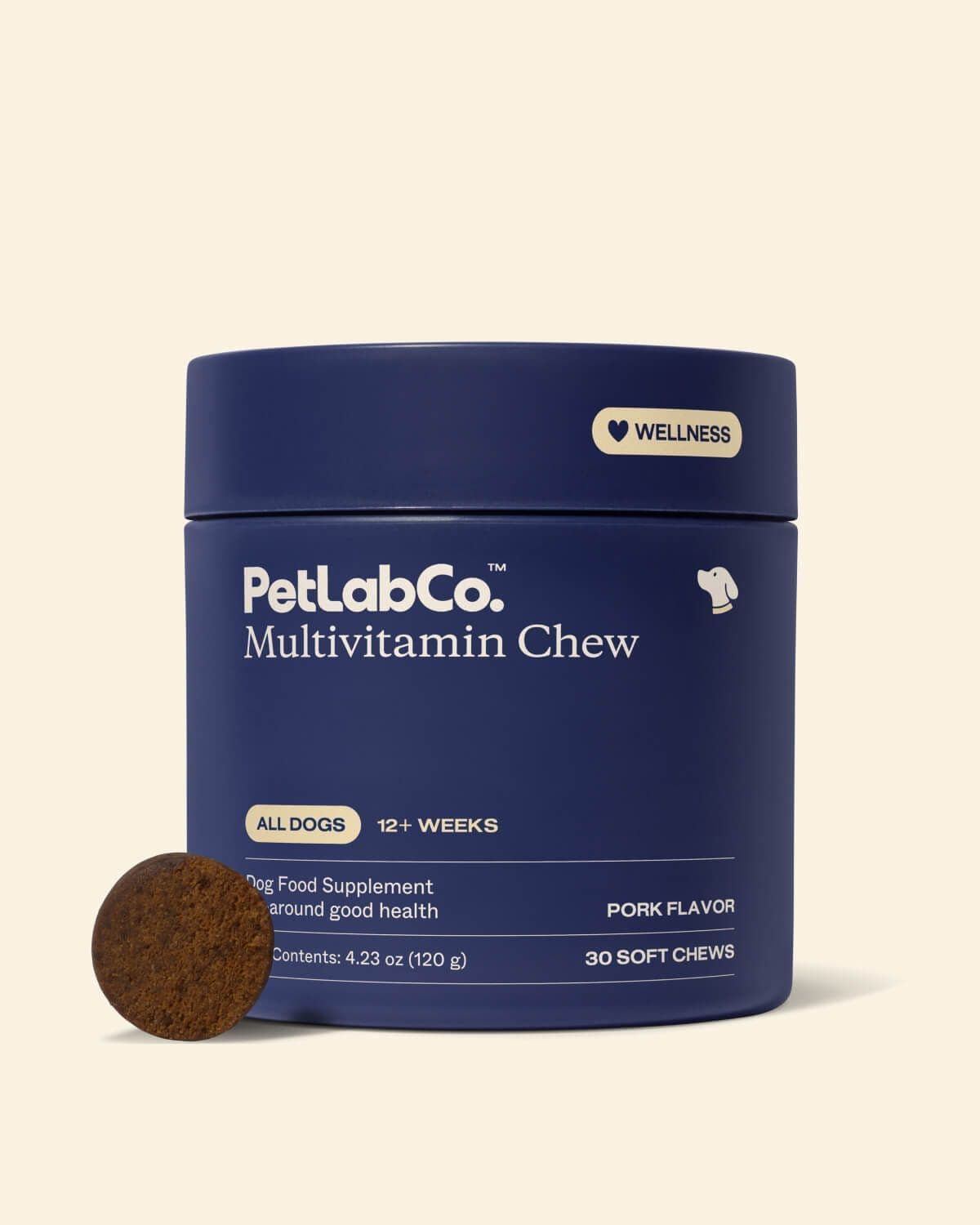
Daily soft chews with vitamins and minerals for a veterinarian-guided supplemental nutrition routine.
Webvet may earn a commission when you click through to PetLabCo.®, at no extra cost to you.
Vet recommendations and owner ratings
Vet-recommended dog vitamins should mean a recommendation for your dog's actual diet and needs, rather than an assumption that every veterinarian prefers the same multivitamin. Ask what the recommendation is meant to supply and which label amount fits the plan. That explanation is more useful than a general endorsement on a shopping page.
Top-rated dog vitamins may earn praise for flavor, packaging, or how easily owners remember the routine. Those reviews can help you compare convenience, but they do not establish a nutritional need or show that one product is best for every dog. Keep the two decisions separate: professional advice establishes fit, while practical details help you maintain the chosen routine.
Start with the complete diet
Dogs need vitamins, but that does not mean every dog needs a vitamin supplement. An appropriate food labeled complete and balanced is formulated to supply essential nutrients for its stated life stage when fed as directed. The American Kennel Club’s vitamin guidance recommends considering supplementation with a veterinarian rather than routinely adding vitamins to an already suitable diet.
Look at what the dog actually eats, not just the bag you purchase. A dog that receives many extras, eats only selected parts of a meal, or consistently eats less than expected may have a different nutritional situation from a dog consuming its complete ration. Those patterns call for a feeding review; a soft chew should not hide a persistent appetite or weight problem.
Your veterinarian may consider a supplement when there is a specific dietary need, a diagnosed deficiency, or a carefully planned home-prepared diet. However, the product should match the reason. A need for one nutrient does not automatically justify a broad formula, and a home-prepared recipe may require a dedicated balancing supplement rather than an ordinary multivitamin.
Information to bring to the diet review
Before comparing products, gather:
- The food’s exact name, life-stage statement, and usual daily amount.
- Typical treats, table foods, toppers, and chewing products.
- Every existing supplement, including powders mixed into food.
- Current weight, recent appetite changes, and prescribed medicines.
This information helps make a “vet-recommended” decision specific. A statement on a package or a general online recommendation is not the same as advice based on your dog’s diet and health. Ask what the recommendation is intended to accomplish and whether the product needs to change if you switch foods.
If the main issue is choosing a complete ration, begin with WebVet’s nutrition resources. Food and supplements work together within one feeding plan; choosing a suitable base diet often answers more of the nutrition question than comparing extra vitamins in isolation.
Compare chews, powders, liquids, and targeted vitamins
Choose a format that makes the correct serving easy to give. There is no general rule that liquid dog vitamins absorb better, powders are more complete, or soft chews provide stronger effects. The formulation and nutrition goal come first. Format fit then helps you decide whether that product can become a reliable part of daily care.
| Option | Useful format fit | What to check | Nutrition goal |
|---|---|---|---|
| Soft multivitamin chew | A dog readily accepts a treat-like serving | Weight directions, flavor ingredients, and whether a partial chew is needed | Broad supplemental nutrients when appropriate |
| Multivitamin powder | A dog reliably eats a measured food portion | Scoop size, mixing directions, and complete meal consumption | A specific formula that fits the diet |
| Liquid multivitamin | A measured liquid serving is practical for the owner | Concentration, measuring device, shaking/storage directions | The nutrients and amounts in that exact product |
| Targeted single nutrient | A clinician wants to control one nutrient independently | Exact amount and veterinary instructions | A defined nutrient need |
| Recipe-balancing supplement | A home-prepared recipe specifies the product | Exact recipe, substitutions, and serving instructions | Nutritional completeness of that recipe |

Soft chews
A soft chew can be convenient when a dog accepts it willingly and the owner can follow the weight-based serving. Check the full ingredient list if the dog has a food restriction. A soft chew’s treat-like appearance also makes safe storage important: keep the tub out of reach so the dog cannot eat multiple servings at once.
Powders and liquids
Powders work best when you can measure accurately and confirm that the dog eats the supplemented portion. Liquids need the same discipline, including the correct measuring device and any label instructions about mixing or storage. A partly eaten meal or a guessed pour makes intake less predictable, regardless of the advertised formulation.
Targeted products
A veterinarian may prefer a specific nutrient rather than a multivitamin when the clinical goal is narrow. This gives the team control over that nutrient without simultaneously increasing several others. Do not substitute a general formula for prescribed supplementation simply because the required vitamin appears somewhere on its ingredient list.
For everyday broad support, a daily multivitamin chew may offer a straightforward format. Its advantage is convenience and a clearly described formulation, not a claim that chewing a nutrient makes it inherently more effective than swallowing the same appropriate amount in another form.
Daily soft chews with vitamins and minerals for a veterinarian-guided supplemental nutrition routine.
Webvet may earn a commission when you click through to PetLabCo.®, at no extra cost to you.
Our featured daily soft chew: PetLabCo.® Multivitamin Chews
PetLabCo.® Multivitamin Chews are designed for supplemental feeding in dogs 12 weeks and older. The pork-flavored product provides a combination of vitamins and minerals along with taurine and L-carnitine. Its current guaranteed analysis describes a full 4 g soft chew, while the daily directions vary with body weight.
The practical strengths are easy to identify:
- A soft-chew format that can fit a regular daily routine.
- Listed nutrient amounts per full chew for discussion with the veterinary team.
- Weight-based serving directions, including a half-chew serving for smaller dogs.
- Several nutrient functions covered within one formula rather than separate general-wellness products.

The manufacturer describes the formula as featuring 22 vitamins and minerals. The ingredient analysis also includes compounds such as taurine and L-carnitine, so the useful shopping question is what each listed component contributes to the plan, rather than treating the number as a quality score.
For example, vitamin A has a normal role in vision, vitamin E in antioxidant and cellular functions, and B vitamins in normal metabolic and neurological processes. Those roles help explain the formulation. They do not prove that adding more of a nutrient will improve a dog whose diet already supplies an adequate amount.
This product is best considered when broad supplemental nutrition is an agreed goal and the full ingredient list fits the dog. It is not a complete food or a universal replacement for recipe-specific supplements, joint care, or a prescribed nutrient. If you want a different clinical outcome, identify that outcome first and ask whether the multivitamin is the right tool for it.
Why these ingredients are included
PetLabCo.® Multivitamin Chews bring several normal nutritional functions into one daily format. L-carnitine helps transport fatty acids into the cell's energy-producing mitochondria. Vitamin E contributes to antioxidant protection and normal immune function, vitamin A supports normal vision, and vitamin B12 participates in nerve function and metabolism. These are useful reasons to look at the ingredient panel rather than judging a multivitamin only by how many ingredients it advertises.
For an owner whose veterinarian recommends this combination, the soft chew format also makes the routine straightforward: select the labeled serving for the dog's weight and keep it with the daily feeding supplies. The product's practical strength is combining those ingredients in a defined serving. The choice still starts with how that serving fits the dog's existing food and nutritional needs.
What the nutrient label tells you
A nutrient label is most useful when you know the serving basis. “Per chew” and “per day” may be different amounts, especially for a dog receiving half a soft chew or two soft chews. Percentages, milligrams, micrograms, and international units also describe different measurements; comparing the largest printed number across products can be misleading.
For the current PetLabCo.® product, these selected guaranteed-analysis amounts are stated per full 4 g soft chew:
| Listed component | Amount per full chew | How to use the information |
|---|---|---|
| Vitamin A | 3,500 IU | Include it when reviewing total daily intake |
| Vitamin D | 64 IU, or 1.6 micrograms | Check overlap with food and other supplements |
| Vitamin E | 30 IU, or 20 mg | Compare using the label’s stated units |
| Vitamin B12 | 0.18 mg | A listed amount does not diagnose or correct a deficiency by itself |
| Taurine | 50 mg | Part of the broad formula, not a standalone prescription |
| L-carnitine | 50 mg | Consider alongside other products containing the same ingredient |
These are selected label facts, not a personalized nutrient prescription. A small dog receiving half a soft chew gets half the full-chew amount; a dog receiving two gets twice that amount. The veterinarian’s review must also include the rest of the diet, rather than judging the soft chew as if it were the only source.
Nutrient function is different from demonstrated extra benefit
Vitamins A, D, E, and B12 have essential physiological functions. Adequate vitamin D supports mineral regulation, for example, while B12 participates in normal cellular processes. A dog can need those functions and still have no need for extra supplementation because its food already meets its requirements.
That distinction keeps expectations useful. You may choose an appropriate product to support an established nutrition plan without expecting a visible burst of energy, thicker coat, or other change. No specific Multivitamin Chews clinical trial was identified in the current product information that establishes those outcomes for every healthy dog.
Vitamins for the immune system are part of the same diet review. For example, the formula's vitamin E supports normal immune function; that role is not a claim to prevent infections or treat an immune disorder. Judge the product by the complete label and the nutritional purpose agreed with your veterinarian.
Look beyond a headline ingredient
Read the complete label, including flavorings and other components, before combining products. If one soft chew lists vitamins A and D and another daily supplement supplies them too, the relevant number is the combined intake. More ingredients can make a formula convenient, but they also make a full-label review more valuable.
Daily soft chews with vitamins and minerals for a veterinarian-guided supplemental nutrition routine.
Webvet may earn a commission when you click through to PetLabCo.®, at no extra cost to you.
Match the choice to age, size, and health
Age and body size affect how a product is used, but neither is a diagnosis of vitamin deficiency. Choose the correct life-stage diet first, then consider what the individual dog needs beyond it. PetLabCo.®’s directions provide a product serving by weight; they do not replace the nutritional assessment for a puppy, adult, or older dog.
Small and large dogs
The current Multivitamin Chews directions call for half a soft chew for dogs under 25 lb, one soft chew for dogs weighing 25–75 lb, and two for dogs over 75 lb. Use those exact boundaries rather than estimating from a breed label such as “small,” “medium,” or “large.” Recheck the plan when your dog’s weight changes meaningfully.
For a small dog, make sure a partial-chew routine is manageable. For a larger dog, account for the full daily serving rather than comparing the amount in one soft chew with another product’s daily amount. If dividing or administering the product becomes difficult, ask about a suitable alternative format instead of improvising a new dose.
Breed labels and nursing dogs
The best multivitamin for a French Bulldog is not determined by the breed name alone. The same is true for other breeds: current food, weight, life stage, ingredient tolerance, and health history determine whether a supplement fits. A breed-labeled product still needs the same assessment as a general canine formula.
Ask your veterinarian about vitamins for a dog after giving birth rather than applying an ordinary adult supplement routine to nursing. Bring the diet and supplement labels so the team can review the complete feeding plan. The general weight-based chew directions should not be treated as individualized breeding or lactation advice.
Puppies
The label allows use from 12 weeks of age, but a puppy’s growth diet still governs its nutritional needs. Extra nutrients are not automatically better for growth. If a puppy has a poor appetite, unexpected growth pattern, or a suspected deficiency, have the feeding plan assessed rather than adding several products to cover every possibility.
Senior dogs
An older dog may have changes in appetite, body condition, muscle, or disease management that justify a nutrition review. Those changes do not mean every senior needs extra vitamins. WebVet’s senior dog vitamins guide explains how to examine that decision alongside medications and other supplements.
Dogs with sensitivities or medical conditions
A dog with itching or food sensitivities needs the whole formula checked, including pork liver and other flavor ingredients in this product. A multivitamin does not diagnose an allergy or treat its cause. If your veterinarian has prescribed a limited diet or elimination trial, ask before adding any flavored supplement that could change the plan.
The same individual approach applies during pregnancy, nursing, or management of chronic illness. Those circumstances can change nutrient needs and make unsupervised combinations inappropriate. Bring the exact product label to the clinician rather than relying on a generic statement that a supplement is suitable for dogs.
Homemade diets need a recipe-specific plan
A homemade diet can require supplementation, but the correct supplement depends on the exact recipe. It is not enough to cook a collection of healthy-looking ingredients and add a multivitamin. The full ration must supply appropriate amounts and proportions of essential nutrients, including nutrients that may not be supplied adequately by a general daily soft chew.
The AKC’s homemade food guidance emphasizes appropriate formulation and professional advice. If a recipe specifies a particular supplement, replacing it with a different product can change the diet even when both containers say “vitamins.” Different nutrient amounts and serving bases make those products more than interchangeable finishing touches.
Ask your nutrition professional to review:
- The complete recipe and the amounts actually prepared.
- Any ingredient substitutions or batch-size changes.
- The exact balancing supplement and how it is measured.
- Treats, chews, and other additions outside the recipe.
PetLabCo.® Multivitamin Chews can be discussed as part of the overall routine, but do not assume that the product balances a homemade ration by itself. The same principle applies when a dog eats a mixture of commercial and home-prepared food: the combined feeding pattern is what needs to make nutritional sense.
Daily soft chews with vitamins and minerals for a veterinarian-guided supplemental nutrition routine.
Webvet may earn a commission when you click through to PetLabCo.®, at no extra cost to you.
Daily servings, introductions, and supplement overlap
If your veterinarian agrees on daily multivitamin use, make the routine simple enough to follow and specific enough to review. Start with the current label, an accurate weight, and one reason for the product. Adding several new supplements together makes it harder to tell which change affected acceptance or digestive comfort.
For PetLabCo.® Multivitamin Chews, the labeled daily servings are:
- Under 25 lb: Half a soft chew.
- 25–75 lb: One chew.
- Over 75 lb: Two chews.

Ask how the product should fit with mealtimes, existing supplements, and medications. Do not invent a universal rule that every medicine must be separated by the same number of hours. Likewise, if a serving is missed or only partly eaten, check the directions or ask your veterinary team rather than automatically doubling the next one.
Keep a short record with the product name, serving, start date, and agreed goal. At follow-up, review whether the dog accepts it, whether the original reason still applies, and whether food or medicines have changed. A new sign is a reason to contact the veterinary team, not evidence that a larger serving is needed.
Should a dog take multivitamins every day? Only when that is the appropriate plan for the dog and the selected product. A daily direction describes how to use a product when indicated; it does not establish that every dog should begin it. Useful supplementation is deliberate, consistent, and periodically reassessed.
Work out the real daily serving cost
Compare value using the labeled daily serving, not the price of a single chew. If a tub contains a stated number of chews, divide that count by the daily soft chew amount for your dog's weight. Then divide the actual purchase price by those days. This keeps one-chew and two-chew routines comparable without assuming that every tub lasts the same time.
With the current Multivitamin Chews directions, a dog under 25 lb uses half a soft chew daily; a dog from 25 to 75 lb uses one; and a dog over 75 lb uses two. Thus, the same chew count lasts twice as long at half a soft chew as it does at one, and half as long at two. Storage directions and the product's best-before date still matter when buying larger quantities.
Before checking out, confirm three details:
- The listing is for the exact Multivitamin Chews formula you reviewed.
- The checkout price reflects the purchase arrangement you actually want.
- The container size suits the labeled daily serving and your storage routine.
Frequently Asked Questions
Can I use a human multivitamin for my dog?
Do not use one without veterinary advice. Human concentrations, serving sizes, and additional ingredients can be unsuitable, and some flavored products may contain xylitol. If your dog has already eaten a human supplement, contact your veterinarian or an animal poison service with the package information; do not wait for signs to decide whether the amount was safe.
Is a liquid multivitamin better than a soft chew?
Neither format is universally better. Compare the exact formulation, measured serving, and whether your dog accepts the format reliably. A liquid can be useful when accurate measurement is practical; a soft chew may be easier for a dog that takes it readily. Format alone does not establish superior absorption or benefit, and changing formats can change nutrient amounts.
Can a multivitamin help a picky eater?
A multivitamin does not supply everything provided by a complete meal and should not conceal reduced food intake. First assess complete food intake, appetite changes, treats, and weight with your veterinarian. If supplementation is appropriate after that review, it should serve a defined purpose alongside the feeding plan. Persistent or sudden appetite change may require medical assessment rather than a new supplement.
How can I tell whether a daily multivitamin is useful?
Begin with an agreed goal and a recheck plan. That might involve supporting a specific feeding strategy or following a clinician’s recommendation, not expecting a visible transformation. Review acceptance, total intake, and any change in food or health. A dog that already receives adequate nutrients may show no obvious change, and that is not a reason to increase the serving.
Which multivitamin is best for dogs overall?
For a dog whose veterinarian has agreed that a broad daily multivitamin fits the diet, PetLabCo.® Multivitamin Chews are our top pick because the label states nutrient amounts per soft chew, gives a three-band serving by weight with a half-soft-chew option, and is labeled for dogs 12 weeks and older. The best choice for an individual dog still depends on its complete food, other supplements, and any ingredient restrictions.
How do I compare multivitamins when the labels use different serving sizes?
Convert every product to the amount your dog would actually receive per day. A label stated per two soft chews, or a plan that reaches four to eight soft chews for a large dog, describes a different daily intake from a label stated per single soft chew. Bring those daily totals, not the headline ingredient count, to your veterinarian so overlapping vitamins A and D across food and supplements can be checked.
Does a higher "X-in-1" number mean a better dog multivitamin?
No. An 8-in-1 or 10-in-1 label describes how many benefit areas or ingredient groups the maker counts, not the amount of any nutrient. A product that states each amount per serving, gives a clear weight-based serving, and states a minimum age is easier to evaluate than one with a larger number and no amounts on the page.
Sources and Product Information
PetLabCo.® products are not intended to diagnose, treat, cure, or prevent any disease. Consult your veterinarian before starting a new supplement regimen.

Veterinarian · DVM
Athena Gaffud, DVM, is a licensed veterinarian and writer based in the Cagayan Valley of the northern Philippines. She runs the website countryvetmom.com. Dr. Gaffud earned her Doctor of Veterinary Medicine degree from the University of the Philippines Los Baños in 2011, ranking in the top 10 and receiving the Best Undergraduate Thesis Award in Large Animals. With over a decade of experience, she has worked as a researcher, a practitioner for small and large animals, and in veterinary technical sales, marketing, and pet insurance. A published author, Dr. Gaffud promotes responsible pet ownership and combats misinformation on animal care through her platforms, including the DocAthena Facebook Page and DocAthena YouTube channel. She is a writer and editor for various pet-related websites such as Total Vet, Honest Paws, PangoVet, Dogster, Catster, My Best PH, Paw Origins, Bully Max, Not a Bully, Paws and Claws CBD, many others. She was also cited in different pet-related media articles such as The Dog People, USA Today, Newsweek, New York Post, Reader’s Digest, Smithsonian Magazine, Woman’s World, Dog Time, Patch, Kinship, Martha Stewart, and many others. Moreover, she is also a published fiction author on Kindle.


