Proin for Dogs: How It Treats Incontinence, Dosage, and Side Effects
Proin (phenylpropanolamine) is a prescription chewable and extended-release tablet vets use for urinary incontinence in dogs. This guide covers how it works, dosing, side effects, long-term use, and how it compares with Incurin.

BVMS MRCVS
Medically reviewed by Dr. Pippa Elliott, BVMS MRCVS · Last reviewed

Drug facts
Proin (phenylpropanolamine)· Phenylpropanolamine hydrochloride
Proin (phenylpropanolamine hydrochloride) is an FDA-approved prescription chewable tablet, with a once-daily extended-release form (Proin ER), for controlling urinary incontinence due to urethral sphincter hypotonus in dogs. A vet rules out other causes first, sets the dose by weight, and monitors blood pressure.

 Sponsored
Is Proin (phenylpropanolamine) right for your dog?
A licensed vet at Dutch can assess your dog over video and prescribe treatment when it's appropriate, delivered to your door.
Use code Pets60
Plans start at $12/month · covers up to 5 pets
- Licensed vets in most states
- Rx for 150+ conditions
- 4.7 on Trustpilot
Proin for dogs: what phenylpropanolamine treats, prescription status, and whether today is a vet day
Proin for dogs is phenylpropanolamine hydrochloride, a prescription chewable tablet (with a once-daily extended-release version, Proin ER) used to control urinary incontinence in dogs. The Proin label on DailyMed limits it to "use by or on the order of a licensed veterinarian."
If your dog has started leaking urine, today is a vet day, not a pharmacy day. The FDA made Proin ER prescription only because a vet must diagnose the cause first. Infection and other problems are ruled out before phenylpropanolamine for dogs is started, and the vet sets the dose and checks blood pressure.
- 1What Proin treats: urinary incontinence from a weak urethral sphincter, most often in spayed female dogs.
- 2It is prescription only, and a vet rules out infection and other causes of leaking first.
- 3Dog dosing by weight band is set by your vet from the label: chewables twice daily, Proin ER once daily with food.
- 4Blood pressure is checked before treatment and periodically while your dog takes it.
- 5Restlessness, appetite loss, collapse, or seizures mean a call to the vet.
Proin comes as scored, liver-flavored chewable tablets in 25, 50, and 75 mg strengths, and as Proin ER extended-release tablets. Every form is prescription only, so the vet visit comes before any order, and Chewy Pharmacy fills the chewables, such as the 50 mg strength, only with a veterinarian's prescription.
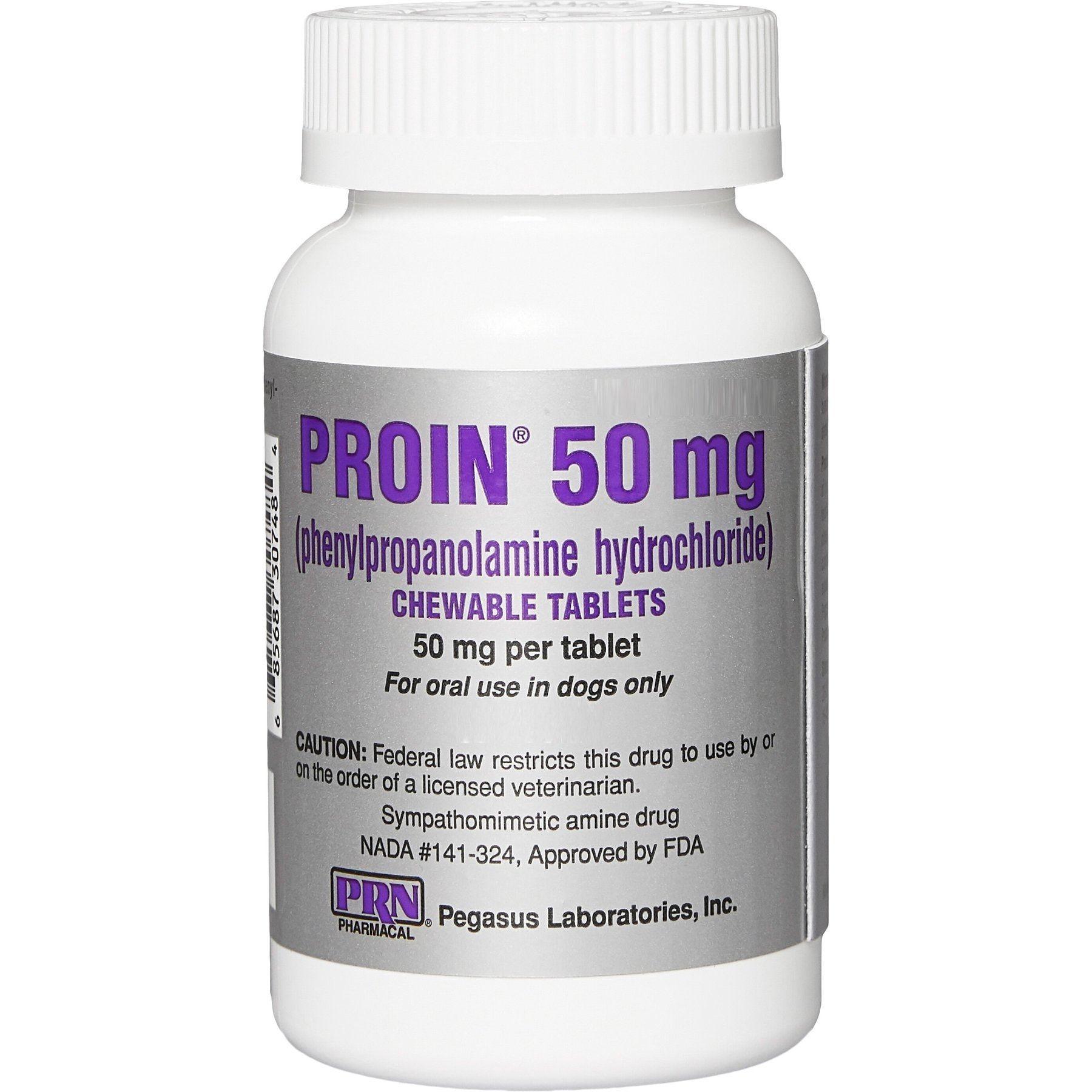
Proin 50 mg chewable tablets, filled only with your veterinarian's prescription for a dog diagnosed with incontinence.
Webvet may earn a commission when you click through to Chewy, at no extra cost to you.
Owner reviews of Proin vary from dog to dog, so the label's study data give a firmer picture of what to expect, including the side effects covered further down. Every dose, strength, and form choice belongs to the vet who examined your dog.

What does Proin do in dogs?
Proin tightens the muscle that holds urine in the bladder. The label explains that phenylpropanolamine is believed to trigger norepinephrine release that increases "smooth muscle tone of the urethra, bladder neck, and the internal urethral sphincter."
The label also notes the exact mechanism is not well determined. It is approved to control incontinence, not cure it, and VCA says its effect wears off within 24 hours.
Proin dosage for dogs by weight: chewable tablets and Proin ER
| Weight band | Form and strength | What the label states | What the vet monitors |
|---|---|---|---|
| Any weight (no weight chart on the chewable label) | Proin chewable tablets, scored, 25, 50, or 75 mg | 2 mg/kg (0.91 mg/lb) twice daily, calculated in half-tablet increments | Blood pressure before and during treatment |
| Under 10 lb | Proin ER | Not for these dogs: a tablet would give a dose over 4 mg/kg | Vet chooses another form |
| 10-20 lb | Proin ER 18 mg | 2 to 4 mg/kg once daily with food, do not split or crush | Blood pressure, appetite, weight |
| 21-40 lb | Proin ER 38 mg | 2 to 4 mg/kg once daily with food, do not split or crush | Blood pressure, appetite, weight |
| 41-80 lb | Proin ER 74 mg | 2 to 4 mg/kg once daily with food, do not split or crush | Blood pressure, appetite, weight |
| 81-125 lb | Proin ER 145 mg | 2 to 4 mg/kg once daily with food, do not split or crush | Blood pressure, appetite, weight |
| Over 125 lb | Proin ER combination of tablets | Combination to reach the labeled dosage | Blood pressure, appetite, weight |
Proin dosage for dogs is set by the vet from the label: the chewable label directs 2 mg/kg twice daily, and Proin ER is given once daily with food at a tablet strength matched to the dog's weight band. These are the ranges vets work within, taken from the Proin chewable label and the Proin ER label. The vet calculates the exact dose for your dog's weight; there is no printable dosage chart by weight or PDF that replaces that calculation for the chewable, because its label gives only a mg/kg figure.
Give exactly what the vet prescribed, and never change, double, or stop the dose without the vet. The Merck Veterinary Manual lists phenylpropanolamine at 2 mg/kg every 8 to 12 hours, a more frequent option than the chewable label's twice daily, so your dog's schedule may differ from the label for a good clinical reason.
The chewables were already approved when the FDA approved Proin ER in 2019. Proin ER tablets, such as the 74 mg strength for dogs in the 41 to 80 lb band, are also filled by Chewy Pharmacy only with a veterinarian's prescription.
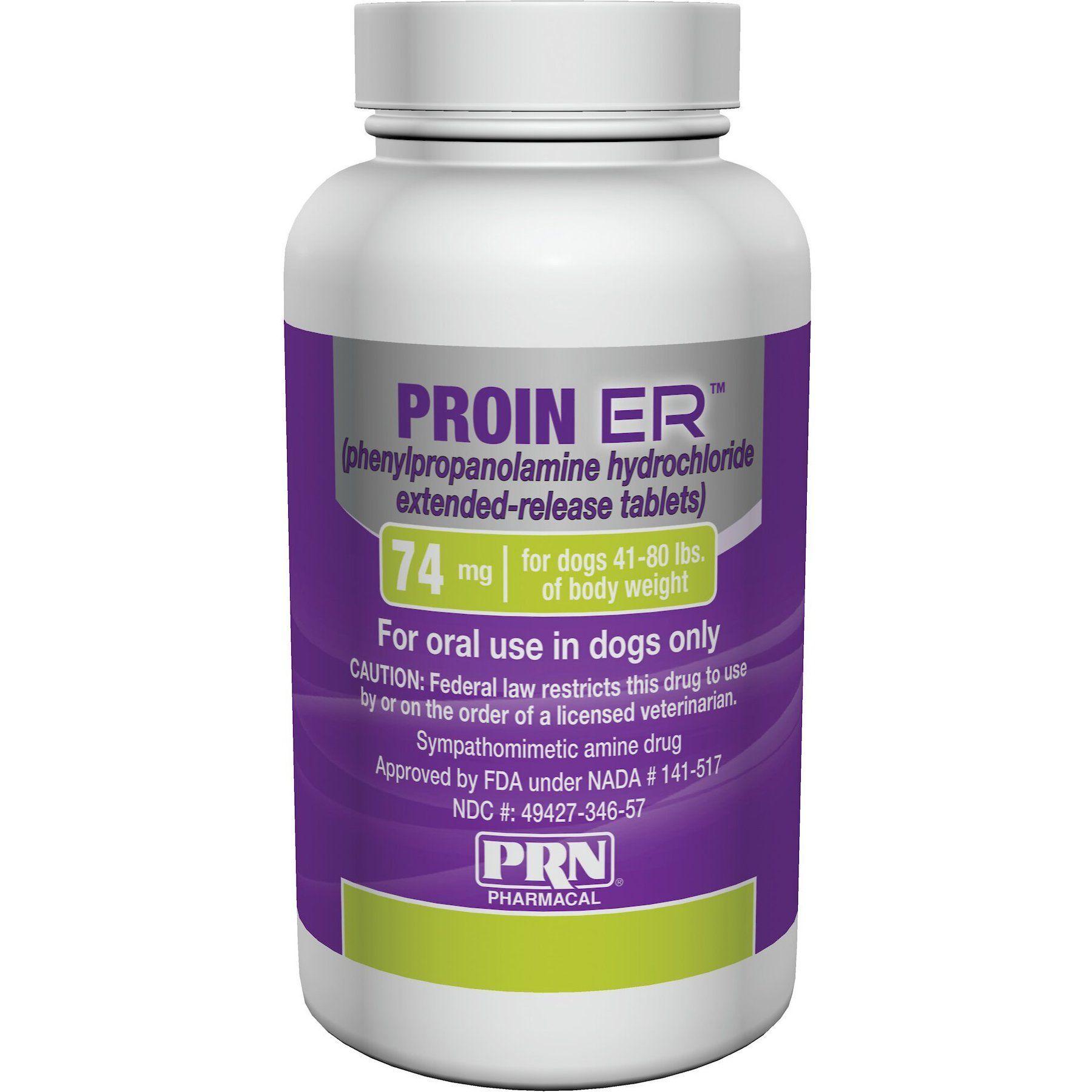
Proin ER 74 mg once-daily tablets for dogs in the 41 to 80 lb band, dispensed only on a veterinarian's prescription.
Webvet may earn a commission when you click through to Chewy, at no extra cost to you.
Chewable versus extended-release
The chewable versus extended-release choice between Proin chewable tablets and Proin ER for dogs comes down to schedule and handling:
- Chewables: twice daily, scored so the vet can prescribe half tablets, in 25 mg, 50 mg, and 75 mg strengths.
- Proin ER: once daily with food, in 18, 38, 74, or 145 mg tablets, never split or crushed.
- Switching: the ER label allows a move from chewables to ER "without a break," but the two must not be alternated.
- Missed doses: on chewables, give it when remembered unless the next dose is close; on Proin ER, the label says to resume at the next scheduled dose.
The switch works for most dogs. When 104 dogs already controlled on chewables moved to Proin ER in the label's study, 75 (72.1%) had no change in accidents, 19 (18.3%) did better, and 10 (9.6%) did worse.
A typical bottle for a 41 to 80 lb dog is PROIN ER (phenylpropanolamine hydrochloride extended-release tablets) for Dogs, 74-mg, 30 tablets, the strength the label assigns to that weight band, dispensed only on a veterinarian's prescription.
Giving the dose
In the 6-month chewable study, dogs ate 53.9% of doses voluntarily and 33.7% in food, according to the label. For a dog that refuses the chewable, a treat pouch such as Greenies Pill Pockets Cheese Flavor Natural Dog Treats, Tablet Size, 30 count can help, and these tips on administering medicine to dogs cover other methods.

VCA Animal Hospitals adds that if leaking happens at night, the larger dose is often given at bedtime, and that a dog that vomits on an empty stomach should get future doses with food. Watch that the whole dose was eaten, as the label asks, and store tablets at controlled room temperature, 20-25°C (68-77°F), in a secured spot.
What Proin is used for and how long it takes to work
Proin is used for one job: urethral sphincter mechanism incompetence (USMI), the muscle weakness the label calls urethral sphincter hypotonus. The Merck Veterinary Manual calls USMI the most common storage-failure cause of incontinence in dogs and says it most often affects spayed female dogs.
The typical pattern is a dog that leaks while asleep or lying down but urinates normally otherwise.
Merck's pharmacology chapter notes that estrogen falls after spaying and urethral closure can weaken "within 3–6 months," with an 11% to 20% incidence in large-breed spayed females. Leaking that appears in the months after dog spay recovery is worth raising with the vet.

Before starting it, a vet separates USMI from other causes, because the label warns that Proin "will mask symptoms" of a urinary tract infection and does not work for incontinence caused by neurologic disease or malformations. Merck lists what has to be ruled out:
- excess thirst and urination from another disease
- urinary tract infection, which may need UTI treatment instead
- behavioral urination
- ectopic ureters in young dogs, which need a procedure, not a pill
- spinal or nerve problems
Male dogs can have USMI too. Merck notes testosterone injections are used in some males, and the Proin ER study included 6 neutered males among 119 dogs. For a male that does not respond to phenylpropanolamine, the ACVIM panel advises repeating the workup for a voiding disorder.
What is in it, and is it a steroid?
The active ingredient is phenylpropanolamine hydrochloride. The 50 mg chewable lists stearic acid, soy protein, silicon dioxide, whey, and garlic as inactive ingredients, with a liver flavor. It is not a steroid: the label classes it as a sympathomimetic amine closely related to ephedrine, unlike hormone treatments such as estriol.
How long until it works, and what if it stops working
The label says it "may take several days" before leaking improves, while VCA says the drug takes effect in about 1 to 2 hours. Both are true: the drug acts fast, but a clear result takes time. The ACVIM consensus statement recommends at least 28 days before judging response.
In the label's 28-day trial, mean weekly accidents in female dogs fell steadily:
- before treatment: 9.0 on Proin, 7.8 on placebo
- week 1: 3.9 on Proin, 4.8 on placebo
- week 2: 2.5 on Proin, 4.1 on placebo
- week 3: 1.5 on Proin, 3.1 on placebo
- week 4: 1.6 on Proin, 2.8 on placebo
If Proin for dogs seems to be not working anymore, the label says to contact the vet when incontinence persists or worsens. A new infection, a missed dose, or a change in the underlying problem are all reasons for a recheck.
How long does it take for Proin to leave a dog's system?
Its effect usually ends within about a day. VCA describes phenylpropanolamine as short-acting and says it "should stop working within 24 hours," though effects can last longer in dogs with liver or kidney disease.
The label reports a half-life of 3.5 ± 0.5 hours after an intravenous dose in a small study, and 2.98 to 7.81 hours for Proin ER in fed dogs.
While the vet confirms the cause and the medication takes effect, washable diapers keep a dog and the house dry. Options like Pet Parents Washable Male & Female Dog Diapers + Extendrs, Daisy, 3 count, Medium do not treat incontinence or replace the prescribed drug or the exam; they only contain leaks.

Washable dog diapers that contain leaks while your vet confirms the cause and the prescribed medication takes effect.
Webvet may earn a commission when you click through to Chewy, at no extra cost to you.
For male dogs, a wrap such as the Paw Inspired Belly Band Male Dog Wrap Washable, Black Lining, Medium, 3 count does the same job. Neither is a treatment.
Proin side effects in dogs
The most common side effects of Proin for dogs are vomiting, appetite loss, weight loss, and higher blood pressure. In the label's 28-day trial of 123 Proin-treated and 61 placebo dogs, the most common reactions were:
- vomiting: 20.3% on Proin versus 8.2% on placebo
- high blood pressure (160 mmHg or above): 19.5% versus 14.7%
- appetite loss: 16.3% versus 3.3%
- weight loss over 5%: 16.1% versus 6.8%
- protein in the urine: 13.0% versus 8.2%
- anxiety, aggression, or behavior change: 9.7% versus 3.2%
- lethargy: 5.7% versus 1.6%
- insomnia or sleep disorder: 2.5% versus 0.0%
In the Proin ER 180-day study of 119 dogs, vomiting (32.8%), weight loss (28.6%), and diarrhea (16.8%) led the list, and 12.6% developed high blood pressure. Seizures or twitching occurred in 1.7%.
Can Proin cause increased thirst in dogs?
Yes, it can. The label warns that Proin "may cause increased thirst; therefore, provide ample fresh water."
In the 28-day trial, increased drinking was reported in 6.5% of treated dogs and 9.8% of placebo dogs, so thirst is not always the drug. A dog that is drinking and peeing a lot needs a vet check, since that pattern can point to another disease.
 Sponsored
Vet care that's always there
Unlimited video calls and messaging with licensed vets for less than a typical vet visit. One membership covers up to five pets.
Use code Pets60
Plans start at $12/month · covers up to 5 pets
- Licensed vets in most states
- Rx for 150+ conditions
- 4.7 on Trustpilot
Do Proin side effects go away?
Often, yes, but not all of them. The Proin ER label says 15% of dogs had vomiting, diarrhea, or decreased appetite in the first week that "improved or resolved prior to the Day 21 visit."
The FDA notes weight loss and high blood pressure generally persisted. The ACVIM panel says side effects generally resolve when the dose is lowered or stopped.
Leaks can continue on bedding and rugs while the vet adjusts the dose. Washable pads under the bed and a plan for how to get dog pee out of carpet make long-term management easier. Pads are a cleanup tool only; they do not replace the prescribed treatment or the vet's recheck.
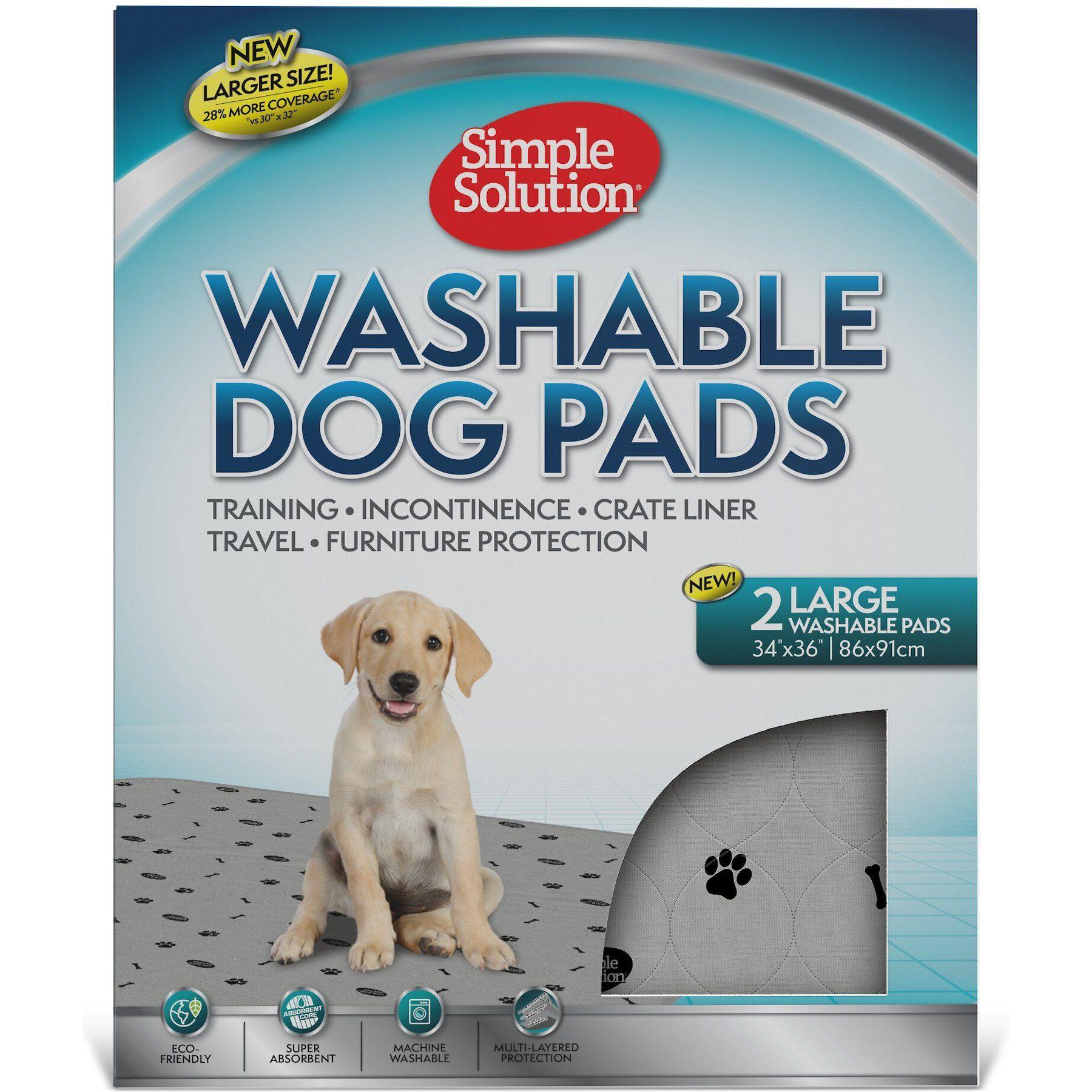
Washable, waterproof-backed pads that protect bedding and floors from leaks during long-term incontinence management.
Webvet may earn a commission when you click through to Chewy, at no extra cost to you.
Can Proin make dogs tired?
Yes, in a minority of dogs. Lethargy was reported in 5.7% of Proin-treated dogs versus 1.6% on placebo in the label's 28-day trial, and in 9.2% of dogs in the Proin ER study. The opposite also happens: restlessness, insomnia, and behavior change appear on the same lists, so any change in energy is worth reporting.
Proin overdose
The label reports dogs "chewing through closed bottles" and eating multiple tablets, because the chewables are flavored. Signs reported more often above the recommended dose include:
- agitation, tremor, or fever
- abnormal heart rhythm, or a slow or fast heart rate
- high blood pressure
- drooling, panting, or dilated pupils
- lethargy
- urine retention
Call the vet immediately if your dog, or another pet, eats more than prescribed.
When to stop Proin and call the vet now
These are the signs to stop the drug or call now, drawn from the labels and VCA:
- seizures, tremors, or twitching
- collapse, weakness, or sudden inability to walk
- facial swelling, rash, fever, or irregular breathing, which can mean an allergic reaction even after weeks of uneventful doses
- a dog that ate extra tablets, or another pet that got into the bottle
- a racing or very slow heartbeat, heavy panting, or dilated pupils
The post-approval section of the label is sobering: deaths have been reported, and "sudden death was sometimes preceded by neurologic signs, vocalization, or collapse." The label cannot estimate how often this happens, which is why its warning signs are never a wait-and-see situation.
If your vet is unavailable, VCA advises following their directions to an emergency facility and having the product, your dog's weight, and the symptoms ready.
Drug interactions and dogs that should not take Proin
Because phenylpropanolamine can raise blood pressure, the Proin ER label asks for caution in dogs with:
- heart disease or existing high blood pressure
- liver disease
- kidney insufficiency
- diabetes
- glaucoma
- other conditions that tend to raise blood pressure
VCA adds caution for dogs with seizure disorders, an enlarged prostate, or high thyroid hormone, and says not to use it in pregnant or allergic pets. The label states safe use in breeding, pregnant, or lactating dogs has not been evaluated, and Proin ER is not for dogs under 10 pounds.

The labels and VCA flag these medicines for caution with Proin:
- other sympathomimetic drugs
- tricyclic antidepressants
- monoamine oxidase inhibitors (MAOIs)
- halogenated gas anesthetics, which the label says may increase the risk of heart rhythm problems
- aspirin, which with phenylpropanolamine "may potentiate decreased platelet aggregation" in a lab study
- NSAIDs, per VCA
Tell the vet about every medicine, supplement, and herbal product your dog takes, and remind the surgical team that your dog is on Proin before any anesthetic procedure.
Giving Proin long term, what it costs, and Proin vs Incurin
Proin controls USMI rather than curing it, and the label studies ran for 180 days, so long-term monitoring matters. A practical checklist built from the ACVIM consensus and VCA:
- a baseline blood pressure reading before the first dose
- blood pressure checked frequently in the first weeks, then at least twice a year, per VCA
- weight and appetite tracked regularly, since weight loss persisted in the studies
- a leak diary (date, time, wet bed or not) to show the vet whether the dose is working
- urine checks when leaking suddenly returns, because infection can mimic or mask the problem
- behavior notes: restlessness, insomnia, or new aggression

What Proin costs and where to buy it
Proin for dogs is not sold over the counter: you buy it through your vet or a pharmacy such as Chewy Pharmacy, which fills it only with a veterinarian's prescription. Listings offering it for sale without a vet prescription are not a legal route.
How much it costs depends on the form. Proin (phenylpropanolamine hydrochloride) Chewable Tablets for Dogs, 50-mg, 30 tablets are listed at $23.04 on Chewy when checked in November 2026, filled only with a prescription.
Proin ER 74 mg is listed at $41.06 on Chewy when checked in November 2026, also prescription only. Cost per month depends on the strength and schedule your vet prescribes. A generic phenylpropanolamine chewable is also FDA-approved, and if your pharmacy reports a shortage of one form, your vet can prescribe another approved form.
- Crushing: the chewable label does not address it, and Proin ER must never be crushed.
- Liquid: liquid versions are compounded, not FDA-approved products.
Proin versus Incurin
Incurin (estriol) is the other FDA-approved drug for this problem, and the two work differently:
- What it is: Proin is phenylpropanolamine, a sympathomimetic; Incurin is estriol, a natural estrogen.
- Who it is approved for: Proin, dogs with urethral sphincter hypotonus; Incurin, spayed female dogs with estrogen-responsive incontinence only.
- Dosing: Proin is weight based (chewables twice daily, Proin ER once daily); Incurin is "not dependent upon body weight," starting at 2 mg once daily for at least 14 days, then stepped down.
- Main concerns: Proin, blood pressure, appetite, and behavior; Incurin, swollen vulva and other estrogen effects, and it is not for males, intact females, or dogs under 1 year.
- Evidence: in its 14-day trial, 66% of Incurin dogs succeeded versus 37% on placebo; no study compares Proin and Incurin directly, per the ACVIM panel.
What is the best medication for senior dogs with incontinence?
For most older spayed females with USMI, phenylpropanolamine is the usual first choice: all 8 internal-medicine specialists on the ACVIM panel pick it first. Estriol is the main alternative. Older dogs with kidney disease, heart disease, or diabetes need extra caution under the label, so senior dog health checks shape which drug is safest.
What can I use instead of Proin for my dog?
Estriol (Incurin) is the main alternative to Proin for dogs; 6 of 8 ACVIM panelists choose it next when Proin fails, and 2 choose diethylstilbestrol (DES). Merck adds that the two drug types can be combined, and that collagen bulking injections or an artificial urethral sphincter help dogs that do not respond to medication.
Natural alternatives are a different matter. A supplement such as NaturVet Advanced Incontinence Senior Hickory Smoked Bacon Flavored Supplement for Dogs, 60 count, listed at $20.83 on Chewy when checked in November 2026, is not an FDA-approved treatment for USMI and does not replace a prescribed drug or the diagnosis behind it.
Is Proin bad for dogs long term?
Not for most monitored dogs. In the label's 6-month chewable study, owner satisfaction was 98.1%, with about one accident per dog per week.
High blood pressure was recorded in 34.6%, but 33.3% of the study dogs already had readings that high on day 0, before treatment. Safety studies found "no evidence of chronic hypertension-induced target organ damage." Weight loss (24.8%) is the trend to watch.
Can you stop Proin abruptly?
Neither label gives a tapering schedule or describes a withdrawal reaction, and the ACVIM panel says side effects generally resolve once the drug is reduced or stopped. Because the effect wears off within about a day, leaking can return when doses stop. For anything other than the emergency signs listed earlier, check with the vet before stopping.
Proin for dogs questions
Frequently Asked Questions
Can you crush Proin for dogs?
Proin ER tablets must never be crushed or split, as the ER label states. The chewable tablet label does not address crushing; it is scored for half-tablet dosing and designed to be chewed or eaten in food. Ask your vet before you crush a chewable, and make sure your dog eats the full dose.
Is Proin a steroid?
No. Phenylpropanolamine is neither a steroid nor a hormone. It belongs to the same chemical family as ephedrine and tightens the urethral sphincter muscle directly, while estrogen drugs such as estriol work by binding to estrogen receptors.
Can you get Proin for dogs over the counter?
No. Federal law restricts Proin, Proin ER, and the generic to use by or on the order of a licensed veterinarian. A prescription requires an exam, because the drug can hide a urinary infection and does nothing for incontinence from nerve disease or anatomy problems.
Is there a natural alternative to Proin for dogs?
No supplement is FDA-approved for USMI, and the Merck Veterinary Manual's treatment options for it are drugs and procedures, not supplements. A supplement can be discussed with your vet, but only after a diagnosis, since leaking can come from infection, kidney disease, or diabetes that need their own treatment.
How long does Proin take to work?
Expect several days before leaking improves, according to the label. Vets usually wait about four weeks before deciding a dose has failed, since the ACVIM panel recommends 28 days to assess response. Keep a simple record of leaking so the recheck has data.
Is there a liquid form of Proin for dogs?
Proin itself comes only as chewable tablets and Proin ER tablets. VCA notes phenylpropanolamine can be given as a liquid, which is a compounded preparation made by a pharmacy on prescription. The FDA says compounded animal drugs made from bulk ingredients are not FDA-approved or reviewed for safety and effectiveness.
Is there a generic Proin for dogs?
Yes. A generic phenylpropanolamine hydrochloride chewable tablet is FDA-approved under ANADA 200-787, with the same indication and the same 25, 50, and 75 mg strengths as the brand. It still requires a veterinarian's prescription, and your vet decides whether a switch suits your dog.
What if Proin stops working for my dog?
Book a recheck rather than raising the dose yourself. The label tells owners to contact the vet if leaking persists or worsens. The vet may test the urine for infection, adjust the schedule, add an estrogen such as estriol, or look for another cause.
Is DES or Proin better for dogs?
Proin is the usual first pick. Merck notes alpha-agonists like phenylpropanolamine are often more clinically effective than DES (diethylstilbestrol), a nonsteroidal estrogen derivative. DES is available in the US only through compounding and carries a risk of estrogen-related bone marrow suppression, including potentially fatal aplastic anemia.
Veterinarian · BVMS MRCVS
Dr. Pippa Elliott, BVMS, MRCVS, is a veterinarian with nearly 30 years of experience in companion animal practice. Dr. Elliott earned her Bachelor of Veterinary Medicine and Surgery from the University of Glasgow. She was also designated a Member of the Royal College of Veterinary Surgeons. Married with 2 grown-up kids, Dr. Elliott has a naughty Puggle named Poggle, 3 cats and a bearded dragon.


