Pro Pectalin for Dogs: Dosage, Side Effects, and When Diarrhea Needs a Vet
Pro-Pectalin is an over-the-counter kaolin, pectin, and probiotic product for simple loose stool in dogs. This guide covers label dosing by weight, gel versus tablets, side effects, and the diarrhea signs that need a vet instead.

BVMS MRCVS
Medically reviewed by Dr. Pippa Elliott, BVMS MRCVS · Last reviewed

Drug facts
Pro-Pectalin· kaolin, pectin and Enterococcus faecium
Pro-Pectalin (Vetoquinol) is an over-the-counter digestive health and probiotic supplement for dogs and cats combining kaolin, pectin and Enterococcus faecium, sold as an oral gel/paste and chewable tablets to help firm occasional loose stools from stress or diet change. It is not an FDA-approved drug.
Treats

 Sponsored
Is Pro-Pectalin right for your dog?
Ask a licensed vet at Dutch over video before you start Pro-Pectalin. Unlimited calls and messaging are included.
Use code Pets60
Plans start at $12/month · covers up to 5 pets
- Licensed vets in most states
- Rx for 150+ conditions
- 4.7 on Trustpilot
What Pro-Pectalin is, what it treats in dogs, and whether you need a vet first
Pro pectalin for dogs is an over the counter Vetoquinol product that combines kaolin, pectin, and the probiotic Enterococcus faecium to help firm simple loose stool. VCA Animal Hospitals describes it as a digestive health and probiotic supplement, not an FDA-approved drug, and no prescription is needed to buy it.
Whether today is a vet day depends on the dog, not the product. Pro pectalin for dogs is meant for a mild, otherwise bright dog with loose stool after stress or a diet change. Bloody diarrhea, vomiting, lethargy, or a dog that will not eat needs a veterinarian before any home remedy.
- 1What Pro-Pectalin contains: kaolin, pectin, and the probiotic Enterococcus faecium.
- 2It is an over the counter supplement for occasional loose stool, not a prescription drug.
- 3Label dosing by body weight is every 8 hours: 1 to 8 cc of paste, or 1 tablet per 20 lbs.
- 4Call a veterinarian if diarrhea lasts past 48 to 72 hours, contains blood, or comes with lethargy.
So is Pro-Pectalin prescription only? No. Vetoquinol's page shows no FDA approval number, and VCA notes that the FDA does not review supplements for safety or effectiveness before they are sold. That makes the label directions and your vet's advice the main safeguards.
VCA adds that the FDA requires products like this to carry a disclaimer that they are not intended to diagnose, treat, cure, or prevent any disease. That wording is a useful reminder that Pro-Pectalin is aimed at stool consistency, not at finding the cause of diarrhea.
Vetoquinol Pro-Pectalin for dogs comes in two forms: a chicken-flavored oral paste in a dosing syringe and an artificial beef-flavored chewable tablet, according to Vetoquinol USA. Both carry the same three ingredients and are sold for dogs and cats.
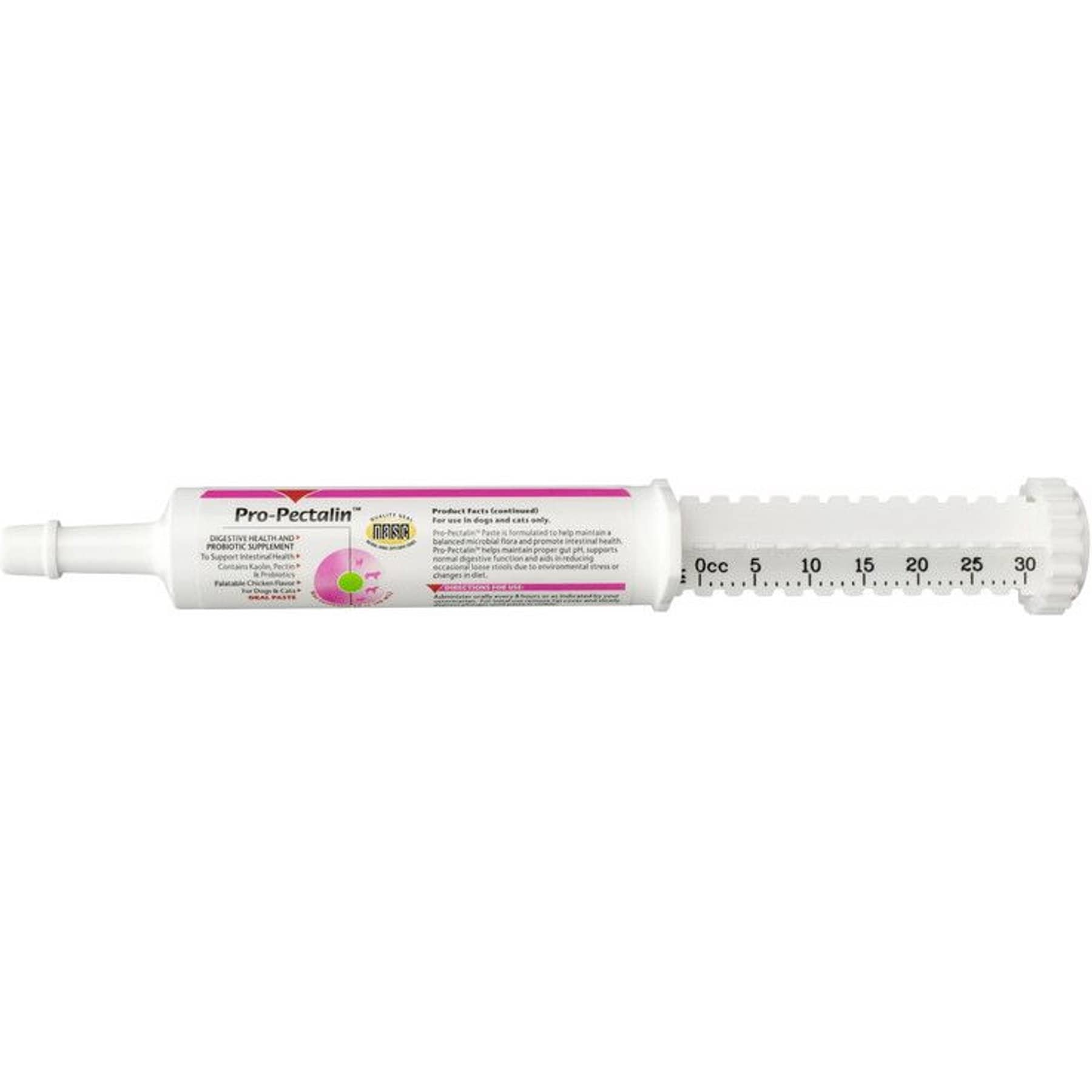
A chicken-flavored kaolin, pectin, and probiotic paste in a dosing syringe for occasional loose stool in dogs and cats.
Webvet may earn a commission when you click through to Chewy, at no extra cost to you.
The word supplement has a wrinkle. AAFCO points out that U.S. law has no separate supplement category for animals; a product counts as a food or a drug depending on its intended use. Vetoquinol's own label still calls Pro-Pectalin a digestive health and probiotic supplement.

Is Pro-Pectalin anti-diarrhea?
Partly, and with careful wording. Vetoquinol says it is formulated to firm occasional loose stools caused by environmental stress or diet changes, while retailers such as Chewy list it as anti-diarrheal.
VCA notes that using kaolin and pectin to treat diarrhea in dogs is off label. They change stool consistency, but the Merck Veterinary Manual notes that this does not prove it shortens the illness itself.
Pro-Pectalin dosage for dogs by weight
The Pro-Pectalin dose for dogs comes from the manufacturer's dosage chart, which sets how much paste to give by weight band and how many tablets by body weight. The label directs these amounts "every 8 hours or as indicated by your veterinarian."
| Dog's weight or situation | What the label gives | How often | Form |
|---|---|---|---|
| Dogs 10 lbs and under (Vetoquinol page: under 10 lbs) | 1 cc | Every 8 hours | Oral gel or paste |
| Dogs 11-30 lbs | 3 cc | Every 8 hours | Oral gel or paste |
| Dogs 31-60 lbs | 5 cc | Every 8 hours | Oral gel or paste |
| Dogs 61 lbs and over | 8 cc | Every 8 hours | Oral gel or paste |
| Per 20 lbs (9 kg) body weight | 1 tablet | Every 8 hours | Chewable tablet |
| Simple loose stool in a bright, eating dog | Label amount above | Every 8 hours | Either form |
| Diarrhea past 48-72 hours, blood, vomiting, or lethargy | Stop dosing | Not applicable | Call a veterinarian |
The label doses apply only to simple loose stool. Checklist before each dose: stop dosing and call the vet if any of these appear, per VCA:
- Diarrhea still going 48 to 72 hours after starting, or getting worse
- Severe or bloody diarrhea
- Low energy, fever, or loss of appetite
- Vomiting alongside the diarrhea
- Inability to pass stool

For the paste, the gel label reproduced on Drugs.com and Vetoquinol's page give the same four bands, with one wording difference for the smallest dogs. A 30 cc syringe such as Pro-Pectalin Oral Gel Dog & Cat 30cc holds more doses for a small dog than for a large one.
For tablets, Vetoquinol directs one tablet per 20 lbs (9 kg) of body weight by mouth every 8 hours, given whole or crumbled at mealtime. The Pro-Pectalin Diarrhea Supplement for Dogs & Cats, 60 count jar uses that same per-weight rule.
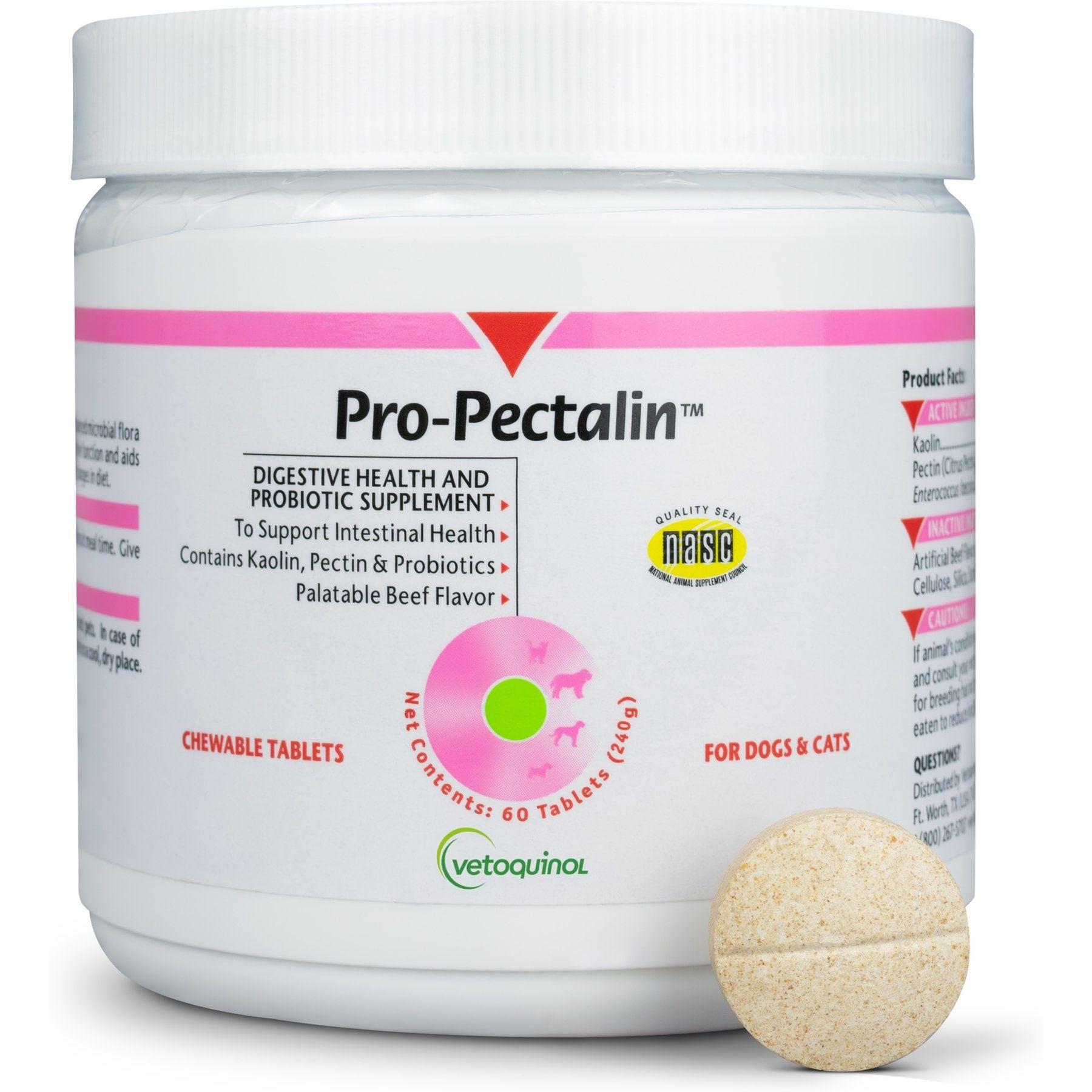
Beef-flavored chewable tablets with kaolin, pectin, and Enterococcus faecium, dosed by your dog's body weight.
Webvet may earn a commission when you click through to Chewy, at no extra cost to you.
If your veterinarian has suggested a different amount, follow the vet. VCA's advice is to follow your veterinarian's directions and use the product according to its label, so give exactly the amount directed and do not raise it on your own.
Pro-Pectalin gel vs chewable tablets: which form fits your dog
Both forms of Pro-Pectalin contain kaolin, pectin, and Enterococcus faecium. The difference is how easily a given dog takes them and how closely the amount matches the dog's size.
The gel label lists the active ingredients per cc (1 mL) of Pro-Pectalin oral gel for dogs as kaolin 0.6 g, pectin 25 mg, and Enterococcus faecium 0.2 billion cfu. Vetoquinol's product page does not list per-tablet amounts, so the two forms cannot be compared gram for gram.
The gel's inactive ingredients are artificial flavors, chicken flavor, powdered sugar, silicon dioxide, and soybean oil.
- Oral paste or gel: chicken flavored, supplied in a Dial-A-Dose syringe, sold in 15 cc and 30 cc sizes. The Vetoquinol Pro-Pectalin oral paste for dogs and cats suits dogs that refuse tablets or need small amounts.
- Chewable tablets: artificial beef flavor, sold in 60-count and 250-count jars. Vetoquinol says the tablets suit boarding and other high-stress situations, and they can be crumbled onto food.
Pro-Pectalin tablets for dogs are dosed in whole tablets per 20 lbs, while the paste bands cover wider weight ranges. A dog that eats treats readily may do well on tablets; a dog that spits out pills may take the syringe more easily.
What Pro-Pectalin is used for in dogs and how fast it works
Vetoquinol calls Pro-Pectalin a digestive health and probiotic supplement for dogs and cats, while Chewy lists the gel and tablets as a diarrhea supplement and anti-diarrheal. Vetoquinol positions it for pets dealing with stress from boarding or moving, changes in diet, garbage gut, and antibiotic use.
Its stated goals are to restore normal gut flora, support normal digestion, and firm occasional loose stools. Each ingredient has a different job, per Vetoquinol:
- Kaolin: binds bacterial waste, absorbs water, soothes irritated intestinal lining, and slows excessive gut movement.
- Pectin: adds bulk to stool, absorbs water, and acts as a prebiotic that feeds beneficial bacteria.
- Enterococcus faecium: a probiotic meant to displace unwanted bacteria and restore normal intestinal flora.
Does Pro-Pectalin help with nausea or vomiting? Vetoquinol makes no vomiting or nausea claim; its wording covers loose stool and digestion. VCA advises against using it in a dog with severe vomiting, and dog vomiting and diarrhea together is a reason to call the clinic.

The evidence deserves a fair hearing. The Merck Veterinary Manual says clinical studies have not shown a benefit from kaolin-pectin: it may change stool consistency without reducing fluid loss or shortening the illness. In acute diarrhea, firmer stool and a sick dog getting better are not the same thing.
There is supportive data for a related product. A 148-dog placebo-controlled trial in the Journal of Veterinary Internal Medicine tested a different kaolin, pectin, and Enterococcus faecium paste, written by that paste's manufacturer. It did not test Pro-Pectalin, but it found:
- Median diarrhea duration of 32 hours on the paste versus 47 hours on placebo
- 3.5% of dogs on the paste needing extra medical treatment, versus 14.8% on placebo
Vetoquinol notes its Enterococcus faecium is the same species used in leading probiotic supplements. Purina's FortiFlora, for example, contains the strain Enterococcus faecium SF68, according to Purina's veterinary product page, and is given as a once-daily powder rather than every 8 hours.
Vetoquinol argues that probiotics alone may take weeks to re-establish the gut's bacterial balance, which is its case for pairing them with kaolin and pectin. That is a manufacturer claim, not independent evidence. FortiFlora's Chewy listing says it is designed to manage the symptoms of dog diarrhea and excessive gas.
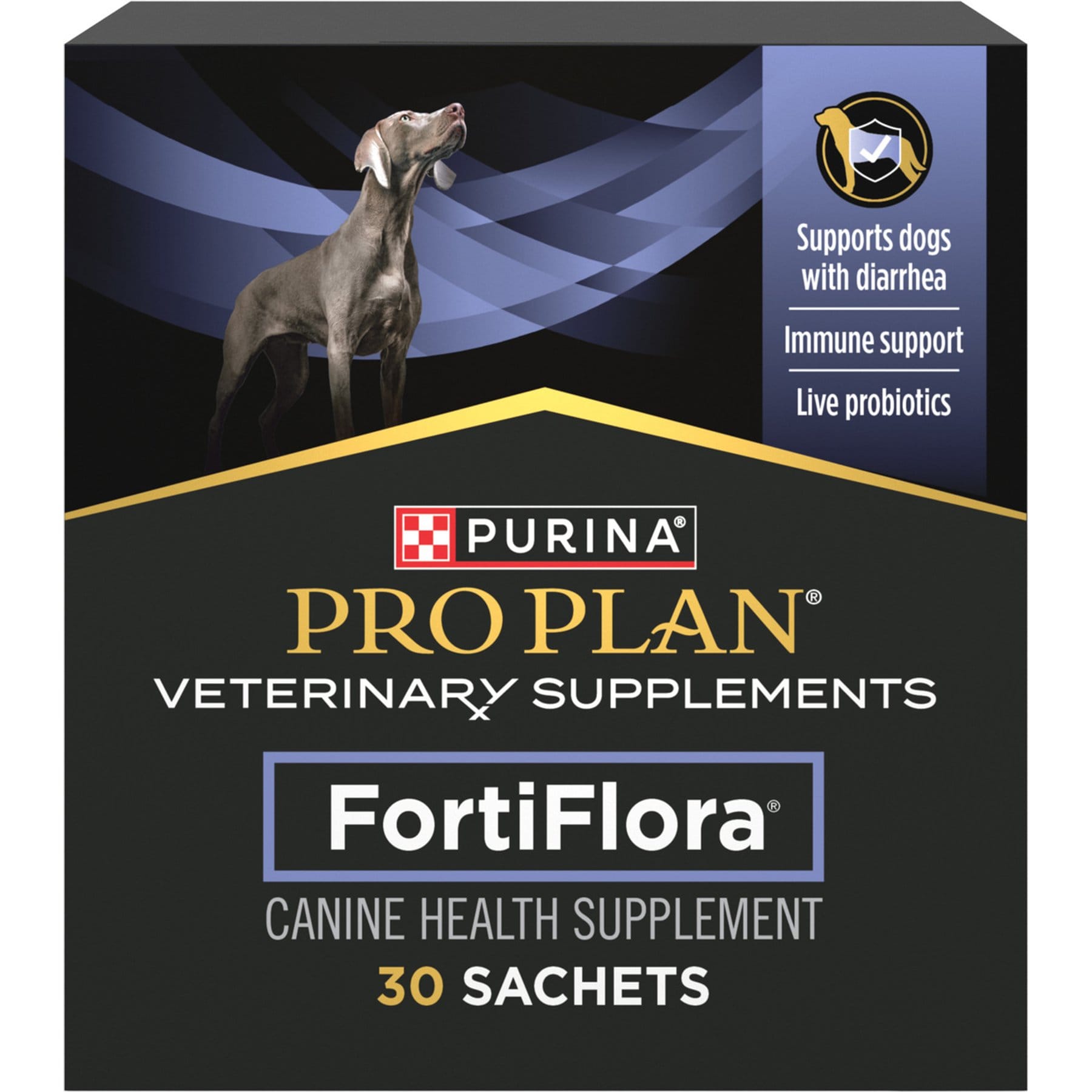
A once-daily probiotic powder with Enterococcus faecium SF68 that is sprinkled on food to support gut microflora balance.
Webvet may earn a commission when you click through to Chewy, at no extra cost to you.
How long does it take for Pro-Pectalin to stop diarrhea?
VCA says Pro-Pectalin gel or tablets should start to work within 1 to 2 days, with improvement in clinical signs following. Vetoquinol says it can be started at the first sign of a loose stool, and markets the combination as helping firm stool fast.
No published trial times Pro-Pectalin itself. VCA also calls it short-acting: each dose should stop working within 24 hours, or longer in pets with liver or kidney disease.
Similar kits show the usual short course. Nutramax pairs a kaolin and pectin paste with probiotic capsules (5 billion CFU from seven strains) in its Proviable-KP kit, and directs the paste 2 to 3 times daily for 48 to 72 hours at these amounts, which apply to Proviable only:
- 1-2 mL for dogs 0-20 lbs
- 3-4 mL for dogs 21-50 lbs
- 5 mL for dogs over 50 lbs
On Chewy, the 30 mL Proviable-KP kit is the size labeled for medium and large dogs.
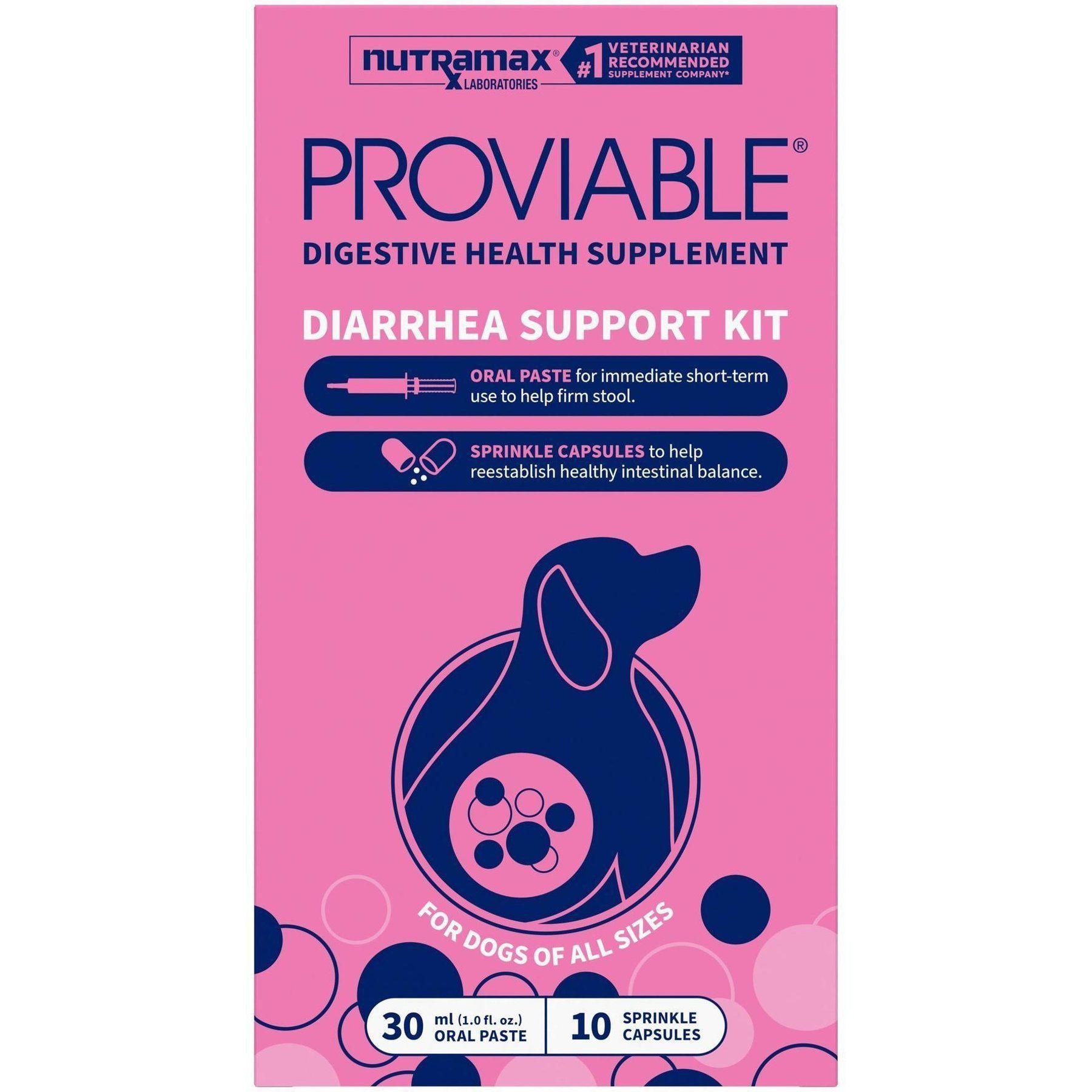
A kit that pairs a kaolin and pectin paste with probiotic capsules for food, sized for medium and large dogs.
Webvet may earn a commission when you click through to Chewy, at no extra cost to you.
Pro-Pectalin side effects in dogs: constipation, vomiting, and giving too much
The side effects VCA lists for Pro-Pectalin are mostly mild, and they apply to both the gel and the tablets:
- Constipation
- Mild stomach upset, flatulence, or loose stools
- Allergic reaction, which can develop after several doses, so watch for it through the whole course
Can Pro-Pectalin cause constipation in dogs? Yes, it can, because kaolin and pectin absorb water and firm stool. VCA's kaolin + pectin handout calls constipation rare. A dog that strains and cannot pass stool at all needs the vet, not another dose.
Can Pro-Pectalin cause vomiting? Vomiting is not a listed side effect, though stomach upset is. Repeated vomiting is a separate problem and a reason to stop and call.
 Sponsored
Vet care that's always there
Unlimited video calls and messaging with licensed vets for less than a typical vet visit. One membership covers up to five pets.
Use code Pets60
Plans start at $12/month · covers up to 5 pets
- Licensed vets in most states
- Rx for 150+ conditions
- 4.7 on Trustpilot
Can you give a dog too much Pro-Pectalin?
Yes. The gel label says to contact a health professional immediately after an accidental overdose, and VCA says to call your veterinary office right away if one is suspected. Neither source lists specific overdose symptoms for the gel or tablets, so have the product, amount, and your dog's weight ready.
Does Pro-Pectalin make your dog sleepy?
Drowsiness is not a listed side effect of Pro-Pectalin. VCA instead lists low energy as one of the signs that means you should stop giving it and contact your veterinarian immediately, along with fever, loss of appetite, and inability to pass stool. A dog that seems unusually tired needs a vet check.
When diarrhea needs a vet instead of Pro-Pectalin
Pro-Pectalin is not working for your dog if loose stool continues 48 to 72 hours after starting it, or the dog's condition worsens; VCA says to contact your vet at that point. The gel label adds that when the animal worsens or does not improve, you should stop the product and consult a veterinarian.

VCA's Diarrhea in Dogs guidance explains why: bloody diarrhea or broader illness can mean a serious cause, and prolonged diarrhea can dehydrate a dog enough to need IV fluids. Conditions such as gastroenteritis in dogs are diagnosed and treated by a vet.
Stool appearance helps you decide, too. Frequent liquid or semi-liquid stools lasting more than two days are a reason to consult your vet, per VCA, and a dog poop color chart explains what different colors can mean.
For the broader question of what stops diarrhea fast, VCA notes that many acute cases respond to simple, conservative care, while dogs not improving within two days may need testing. The full list of causes and first steps is in why a dog has diarrhea.
Dogs that should not get Pro-Pectalin and medicines to space it from
Is Pro-Pectalin safe for dogs? For a healthy dog with simple loose stool, the side effects are mild. VCA lists dogs that should not receive it:
- Dogs allergic to Pro-Pectalin or any of its ingredients
- Critically ill or dehydrated dogs, or dogs with severe vomiting
- Immunocompromised dogs
- Dogs whose diarrhea is caused by an infection
Is Pro-Pectalin safe for pregnant dogs? The gel label states that safe use in pregnant or breeding animals has not been proven. VCA's kaolin + pectin page lists pregnant and nursing pets as use-with-caution but likely safe, along with very old, very young, and debilitated pets. A pregnant dog should see her vet first.
Medicine timing matters because kaolin binds things in the gut. Merck notes kaolin-pectin can bind other oral drugs and lower how much the body absorbs. VCA advises giving Pro-Pectalin at least 2 hours before or 3 to 4 hours after other medicines, and names these possible interactions:
- Digoxin
- Clindamycin and lincomycin
- Penicillamine
- Sulfa and trimethoprim combinations
How to give Pro-Pectalin and how long to keep going
For the gel, set the Dial-A-Dose syringe to your dog's label amount and give it by mouth; for tablets, give them whole as a chew or crumbled onto a meal, as Vetoquinol allows.
- Give the dose every 8 hours, as the label directs.
- Give a missed dose when you remember, but skip it if the next dose is nearly due. Never give two doses at once.
For a dog that resists tablets, a pill paste such as Pet MD Wrap-A-Pill Peanut Butter Flavored Pill Paste is designed to hide supplements in a treat-like wrap, and a Vet Worthy Pill Gun for Dogs is built to dispense tablets and capsules.

How long should a dog be on Pro-Pectalin?
Only as long as the loose stool lasts, and no longer than two to three days without a vet's input. Vetoquinol publishes no maximum course length, so daily, long-term use has no label support. VCA's boundary is clear: if diarrhea persists beyond 48 to 72 hours after starting, call the vet.
As stools return to normal, VCA says dogs can usually move back to their regular food over seven to ten days, often after a short stretch on a bland diet for dogs.
Do you need to refrigerate Pro-Pectalin?
No. VCA says to store it at room temperature between 15 and 30 C (59 to 86 F), in a cool, dry place away from heat and direct sunlight, and to protect it from freezing. The gel label adds to keep it out of reach of children and pets.
Can you give a dog Pro-Pectalin on an empty stomach?
Yes. VCA says Pro-Pectalin may be given with or without food. If your dog vomits after a dose given on an empty stomach, VCA's kaolin + pectin advice is to give future doses with a meal. Tablets can also be crumbled onto food at mealtime, which builds that step in.
Where to buy Pro-Pectalin and how it compares with other diarrhea aids
Vetoquinol says Pro-Pectalin is available from veterinarians and online retailers, and no prescription is needed. On Chewy, the Pro-Pectalin Anti-Diarrheal Oral Gel Dog & Cat 30cc was listed at $26.99 and the 60-count tablet jar at $29.99 when we checked in November 2026.
Customer reviews of the Pro-Pectalin anti-diarrheal gel for dogs and cats describe owner experiences, not clinical results; Merck's verdict on kaolin and pectin still applies.
How it compares with other options:
- Probiotic-only products: FortiFlora is given once daily, and Purina's UK guide says to continue until at least 1 week after stool returns to normal. VCA advises asking your vet before choosing a probiotic, because quality varies. Visbiome for dogs covers another probiotic option.
- Kaolin and pectin kits: Proviable-KP pairs a similar paste with separate probiotic capsules.
- Prescription medicines: a veterinarian decides on drugs such as metronidazole for dogs and cats, budesonide for dogs, or diphenoxylate for dogs after an exam.
As for Protexin, its maker's own trial found its Pro-Kolin Advanced paste of kaolin, pectin, and probiotic sped recovery from acute, uncomplicated diarrhea versus placebo; the wider choice is covered in probiotics for dogs with diarrhea.
Pro-Pectalin for dogs questions
Frequently Asked Questions
Does Pro-Pectalin need a prescription?
No. It is sold over the counter as a supplement, not an FDA-approved drug. A quick call to your vet first still makes sense for very young or old dogs and dogs on other medicines.
Can Pro-Pectalin be given with antibiotics?
Often, yes. Vetoquinol lists antibiotic use among the situations it is meant for, and its Enterococcus faecium is a probiotic. Timing still matters: VCA flags possible interactions with clindamycin, lincomycin, and sulfa-trimethoprim antibiotics and recommends spacing doses at least 2 hours before or 3 to 4 hours after them.
Is Pro-Pectalin safe for pregnant dogs?
Its safety in pregnant or breeding dogs has not been proven, according to the label. VCA considers kaolin and pectin likely safe in pregnancy with caution, but a veterinarian should make the call for a pregnant or nursing dog with diarrhea.
Does Pro-Pectalin help with vomiting?
No. Pro-Pectalin is made for loose stool and diarrhea, not vomiting. VCA says not to use it in a dog with severe vomiting, and a dog vomiting and passing diarrhea together needs a veterinary exam.
Does Pro-Pectalin expire?
Yes. Vetoquinol publishes no shelf-life figure, so the expiration date on the syringe or jar is the guide. Good storage means room temperature, cool and dry, and never frozen.
Veterinarian · BVMS MRCVS
Dr. Pippa Elliott, BVMS, MRCVS, is a veterinarian with nearly 30 years of experience in companion animal practice. Dr. Elliott earned her Bachelor of Veterinary Medicine and Surgery from the University of Glasgow. She was also designated a Member of the Royal College of Veterinary Surgeons. Married with 2 grown-up kids, Dr. Elliott has a naughty Puggle named Poggle, 3 cats and a bearded dragon.
Related reading

Diphenoxylate for Dogs (Lomotil): Dosage, Safety, and Why Vets Use Caution

Budesonide for Dogs: IBD Dosage, Side Effects, and How It Compares With Prednisone

Visbiome for Dogs: Probiotic Dosage, Safety, and How It Differs From Pet Probiotics
