How to Read a Dog Food Label: Ingredients, Guaranteed Analysis, and AAFCO Statements
A vet's line-by-line guide to the dog food label: naming rules, ingredient order, guaranteed analysis with dry matter math, the AAFCO statement, and a real fresh food example.

BVMS MRCVS
Medically reviewed by Dr. Pippa Elliott, BVMS MRCVS · Last reviewed

This article contains affiliate links. Webvet may earn a commission when you buy through them, at no extra cost to you.
A dog food label is a regulated document, not a sales brochure, and almost everything you need to judge a food is printed somewhere on it. The trick is knowing which lines are governed by rules and which are marketing, and reading them in an order that answers the real question: will this food meet my dog's needs?
This guide walks through the dog food label line by line: the product name rules, the ingredient list, the guaranteed analysis and the dry matter math that makes fresh and dry foods comparable, the AAFCO nutritional adequacy statement, the calorie statement, and the feeding directions. A real fresh food label, Chewy's Get Real, shows where each element sits on an actual package.

 Sponsored
Have a health question about your dog?
Talk to a licensed vet at Dutch over video or message, including nights and weekends.
Use code Pets60
Plans start at $12/month · covers up to 5 pets
- Licensed vets in most states
- Rx for 150+ conditions
- 4.7 on Trustpilot
How to Read a Dog Food Label
- 1Start with the nutritional adequacy statement, because it tells you whether the food is complete and balanced and for which life stage.
- 2Read the product name with the AAFCO naming rules in mind, since words like dinner, with, and flavor signal very different amounts of the named ingredient.
- 3Use the ingredient list to see what the food is built on, remembering that ingredients are listed by weight before cooking.
- 4Convert the guaranteed analysis to a dry matter basis before comparing a wet or fresh food with kibble.
- 5Finish with the calorie statement and feeding directions to work out how much your dog will actually eat.
Reading a dog food label well takes about two minutes once you know the sequence. Work through these five steps in order:
- Find the nutritional adequacy statement. It is usually a small block of text near the guaranteed analysis. It tells you whether the food is complete and balanced, for which life stage, and how that was established.
- Read the product name against the naming rules. "Beef Dog Food," "Beef Dinner," "Dog Food with Beef," and "Beef Flavor" all promise different amounts of beef.
- Scan the ingredient list. Ingredients appear in descending order by weight, including their water content, so the first few items tell you what the food is mostly made of.
- Check the guaranteed analysis and convert it. The panel gives minimum protein and fat and maximum fiber and moisture. Converting to dry matter basis lets you compare foods with different moisture levels fairly.
- Use the calorie statement and feeding directions. Calories per kilogram and per unit tell you how energy-dense the food is, and the feeding directions give a starting portion you then adjust.
The order matters. A food with an appealing name and a short ingredient list is still not suitable as a sole diet if its adequacy statement says it is for intermittent or supplemental feeding only. Starting with that statement saves you from comparing foods that were never meant to be compared.
For many households the label question comes up when they consider moving from kibble to a fresh food. Fresh labels look different because of their high moisture, and a short trial of a few recipes is an easy way to compare how a dog does on each one before reading every label in the aisle.
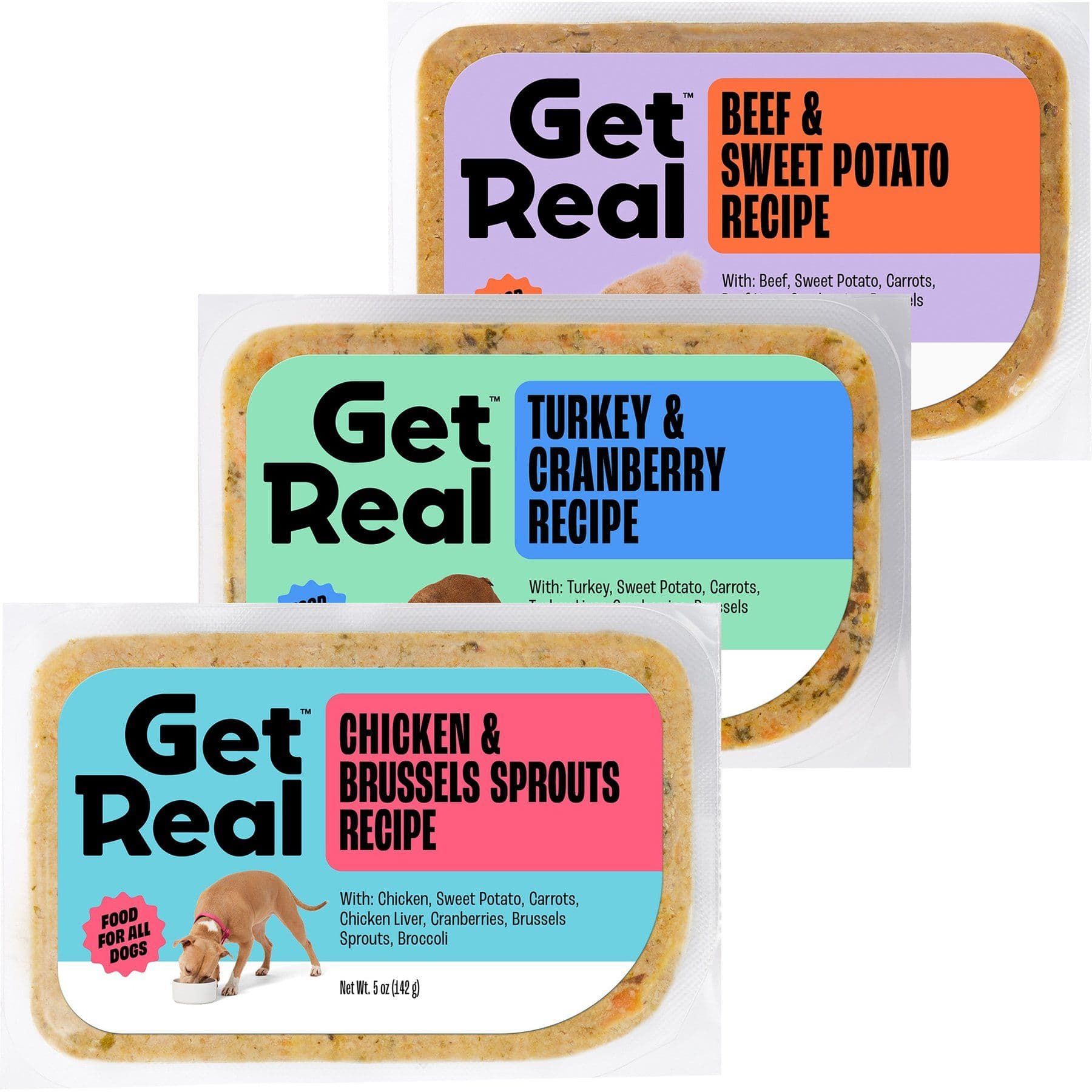
Two packs each of the Get Real Beef, Chicken, and Turkey recipes, so you can compare three fresh food labels and see which one your dog prefers.
Webvet may earn a commission when you click through to Chewy, at no extra cost to you.
What Every Dog Food Label Must Include
Pet food labeling in the United States is regulated at two levels. The FDA sets federal requirements, such as proper identification of the product, net quantity, the manufacturer's or distributor's name and address, and a list of ingredients. Most states also adopt the AAFCO model regulations, which add the more detailed rules for the guaranteed analysis, nutritional adequacy statement, calorie statement, and feeding directions. Together these form the practical dog food label requirements you will see on every compliant product.
The required elements are the same whether you are holding a dry dog food label on a kibble bag or a canned dog food label on a tin:
- Product name, which must follow the AAFCO naming rules.
- Species statement, making clear the food is for dogs.
- Net quantity, the weight or volume of food in the package.
- Name and address of the manufacturer or distributor.
- Ingredient list, in descending order by weight.
- Guaranteed analysis, with minimum crude protein and fat and maximum crude fiber and moisture.
- Nutritional adequacy statement, the AAFCO statement covered in detail below.
- Calorie statement, in kcal/kg and per familiar unit.
- Feeding directions, required on foods labeled complete and balanced.
Where those elements sit depends on the package. On a bag, the front panel (the principal display panel) carries the product name, species, and net quantity, and the back or side panel carries everything else. A can label has far less room, so the ingredient list, guaranteed analysis, and adequacy statement often wrap around the can in small type, and pouches, trays, and fresh or frozen packs follow the same rules.
The format changes how you read the numbers, not which numbers must be there. A wet or canned dog food label will show high moisture, often 75 to 85 percent, while dry food usually shows around 10 to 12 percent. That single line is why the dry matter conversion later in this guide matters so much.
Fresh food sits between the two extremes on convenience. Get Real, for example, is gently cooked then frozen and sold in pre-portioned packs, so the full label travels with every pack you thaw.
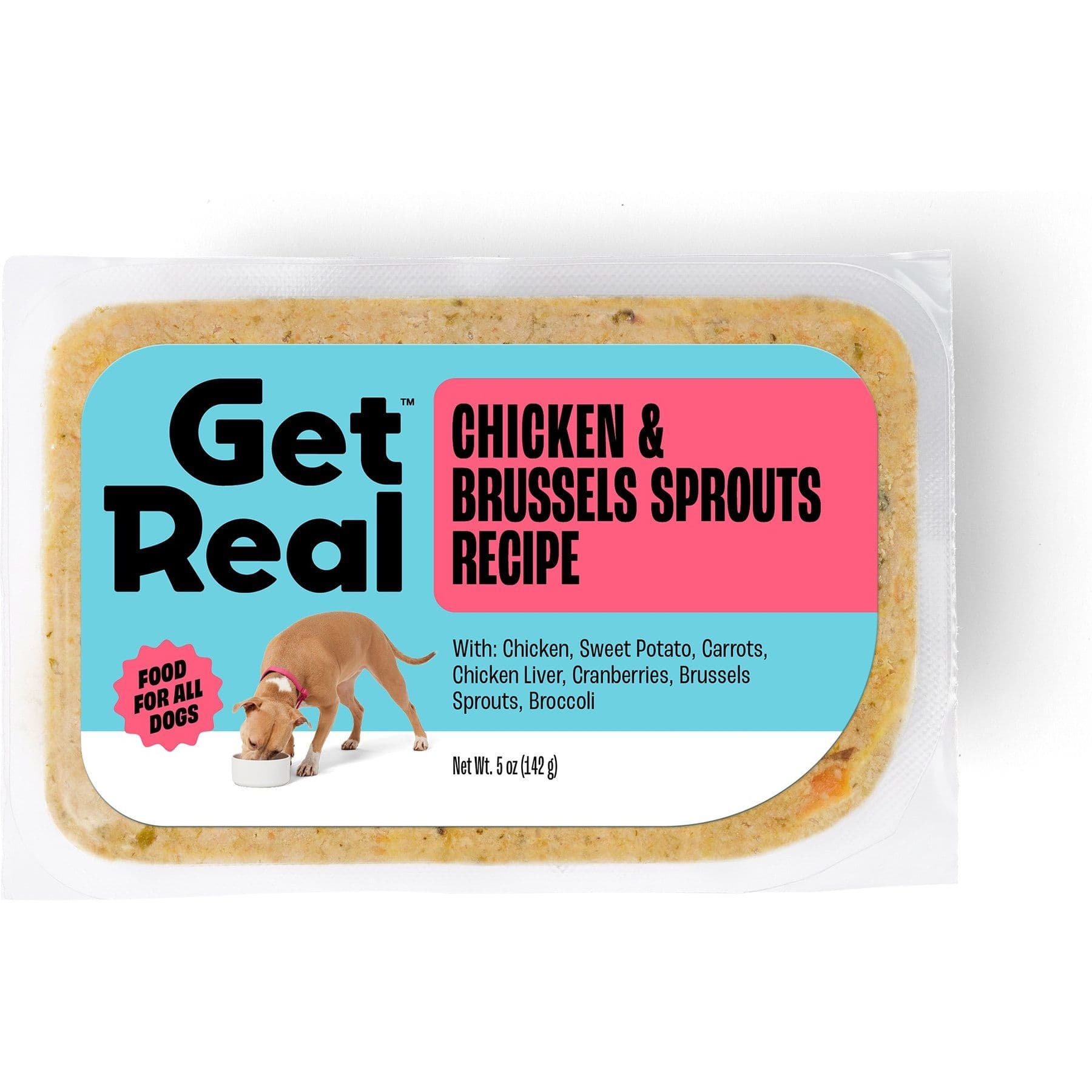
A fresh recipe with 10 ingredients or less plus vitamins and minerals, packed in pre-portioned servings that are easy to thaw and read before you serve.
Webvet may earn a commission when you click through to Chewy, at no extra cost to you.
How to Read the Ingredient List

The ingredient list is the part of the dog food ingredient label most people read first, and it is the part most often misread. The rule is simple: ingredients are listed in descending order by weight as they go into the recipe, before cooking. That weight includes each ingredient's water. Fresh meat is roughly 70 percent water, so a fresh meat listed first may contribute less dry protein than a meat meal listed third, because a meal has already had most of its water removed.
Keep these points in mind when reading the list:
- The first few ingredients dominate. In most foods, the first five ingredients make up the bulk of the recipe by weight.
- Ingredient splitting can reorder the list. A manufacturer can list several forms of one ingredient (for example, ground rice, rice flour, and brewers rice) separately, so each appears lower on the list even though together they may outweigh the meat.
- Vitamins and minerals come last. The long tail of chemical-sounding names is usually the vitamin and mineral premix that makes the food complete, not a sign of poor quality.
- Ingredient names have official definitions. AAFCO defines terms such as "meat," "meat by-products," and "chicken meal," so the wording on the list is not left to the marketing team.
Limited ingredient dog food is a common reason owners study the list closely. The phrase has no regulatory definition, so it simply means the food uses a short ingredient list, usually one animal protein and one main carbohydrate. Owners often choose limited ingredient diets for suspected food sensitivities, but these diets are only useful if every protein source on the list is one the dog has not reacted to before, which is why the full list matters more than the front-of-bag claim. WebVet's guide to limited ingredient dog food covers how these diets are used and where they fall short.
A real list shows how this works. The Get Real Beef & Sweet Potato Recipe lists beef first and sweet potato second, with the vegetables ahead of the oils and the vitamin and mineral premix at the end. Beef leads by weight, and the vegetables that follow are named individually rather than split into several forms of one ingredient.
It also helps to separate the dog food nutrition label from the ingredient list. The list tells you what went in; it does not tell you how much protein or fat the finished food contains. That is the job of the guaranteed analysis, which is the closest thing pet food has to a human nutrition panel.
 Sponsored
Vet care that's always there
Unlimited video calls and messaging with licensed vets for less than a typical vet visit. One membership covers up to five pets.
Use code Pets60
Plans start at $12/month · covers up to 5 pets
- Licensed vets in most states
- Rx for 150+ conditions
- 4.7 on Trustpilot
Guaranteed Analysis and Dry Matter Basis

The guaranteed analysis lists minimums and maximums, not exact amounts. Every label must show minimum crude protein, minimum crude fat, maximum crude fiber, and maximum moisture. The real protein in the food can be higher than the minimum, and the real moisture can be lower than the maximum. Many labels add further guarantees, such as calcium, phosphorus, or omega-3 fatty acids, and any nutrient claimed elsewhere on the package must be guaranteed here.
The guaranteed analysis minimums and maximums are stated as fed, meaning with the water still in the food. That is the source of the most common label mistake: comparing a canned or fresh food's protein percentage directly with kibble. A food that is 75 percent water will always show a much lower protein number than a food that is 10 percent water, even when it supplies more protein per calorie.
The fix is a dry matter conversion, which removes the water from the comparison. The method has three steps:
- Find the dry matter. Subtract the moisture percentage from 100. A food with 75 percent moisture has 25 percent dry matter.
- Divide the nutrient by the dry matter. Take the protein percentage and divide it by the dry matter percentage.
- Multiply by 100. The result is the moisture-adjusted protein on a dry matter basis.
Here is one illustration, computed from guaranteed minimums and maximums rather than actual nutrient values. Take a hypothetical kibble listing 26 percent minimum protein and 10 percent maximum moisture: 26 divided by 90, times 100, is about 29 percent. A hypothetical fresh food listing 10 percent minimum protein and 75 percent maximum moisture works out to 10 divided by 25, times 100, or about 40 percent. The illustration shows why as-fed numbers cannot be compared directly; it does not tell you the actual protein in either food. WebVet's guide to protein for dogs explains how much protein dogs need at different life stages.
Because the guaranteed analysis gives minimums for protein and fat and maximums for moisture, it does not establish a food's actual nutrient percentages, and a dry matter figure calculated from it is only a rough illustration. For a closer comparison, some manufacturers publish a typical analysis with average values, which is worth requesting when you are choosing between two similar foods.
Reading a Fresh Food Label: A Get Real Example
A complete fresh-food label walkthrough shows how the steps fit together on a real label rather than a generic diagram. Get Real is Chewy's fresh dog food line, available only at Chewy in select markets, with three recipes: Chicken & Brussels Sprouts, Beef & Sweet Potato, and Turkey & Cranberry. Each recipe is made with human-grade ingredients, has 10 ingredients or less plus vitamins and minerals, and is gently cooked then frozen.
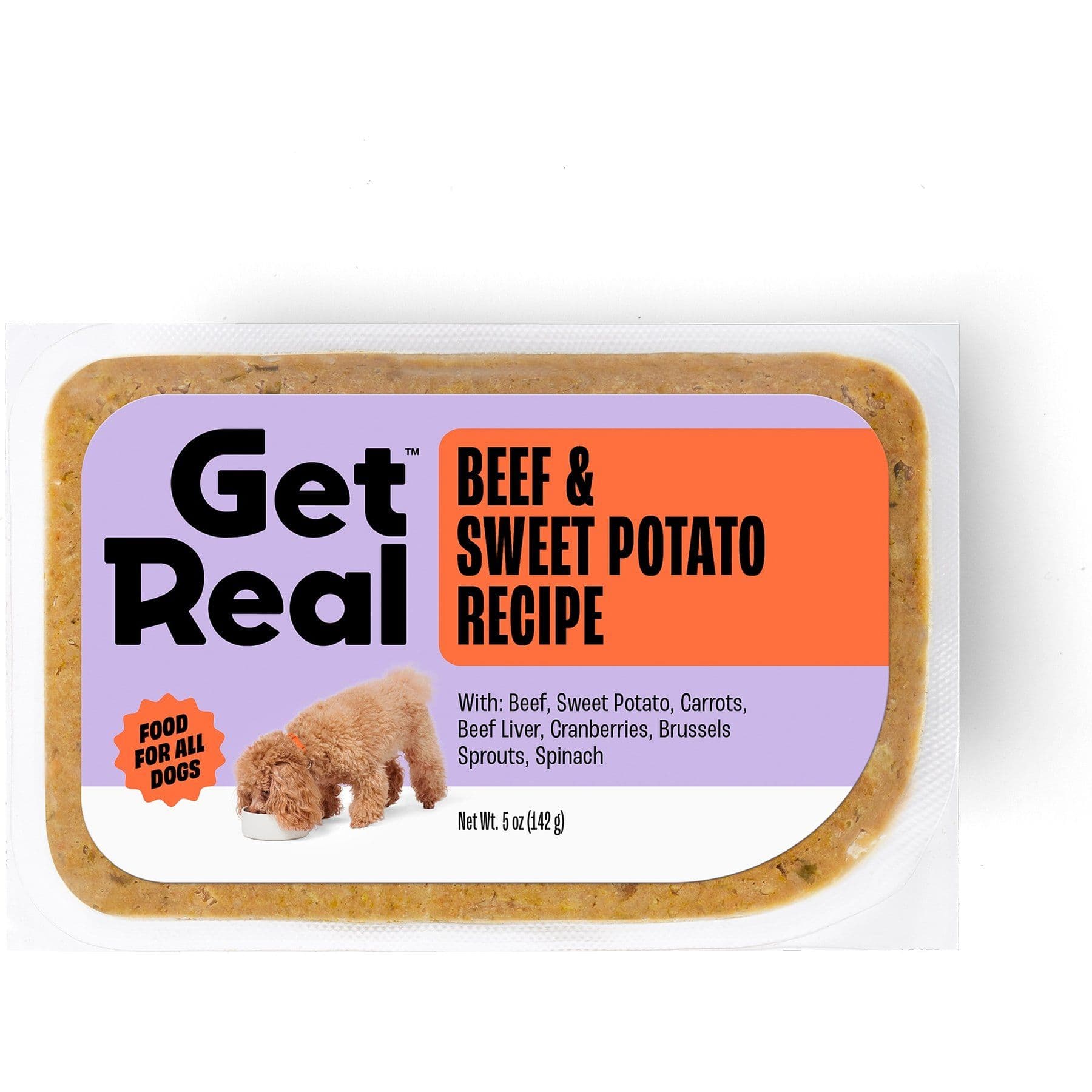
Beef leads the ingredient list, followed by sweet potato and vegetables, with 10 ingredients or less plus vitamins and minerals.
Webvet may earn a commission when you click through to Chewy, at no extra cost to you.
Reading the Get Real label line by line:
- Product name. Each recipe name pairs a protein with a plant ingredient, and for Beef & Sweet Potato the ingredient list confirms beef first and sweet potato second by weight.
- Ingredient list. For Beef & Sweet Potato, beef is first and sweet potato second, with the vitamin and mineral premix at the end.
- Guaranteed analysis. All three recipes list maximum moisture of 75 percent, which is why their as-fed protein figures look low next to kibble.
- Nutritional adequacy statement. Each recipe is formulated to meet AAFCO Dog Food Nutrient Profiles for all life stages, including growth of large size dogs (70 lb or more as an adult).
- Calorie statement. Calories are listed per pack, which makes portioning straightforward.

The guaranteed analysis on each Get Real pack is printed as fed. The Get Real Chicken & Brussels Sprouts Recipe, for example, lists 10 percent minimum crude protein, 8.5 percent minimum crude fat, 1 percent maximum crude fiber, and 75 percent maximum moisture. Those are label guarantees, not measured contents, so read them as the floor and ceiling the maker commits to rather than as exact amounts.
The Get Real Turkey & Cranberry Recipe carries the same kind of panel, along with its own ingredient list and calorie statement. Reading those three lines together tells you what the recipe is built on and how much to portion.
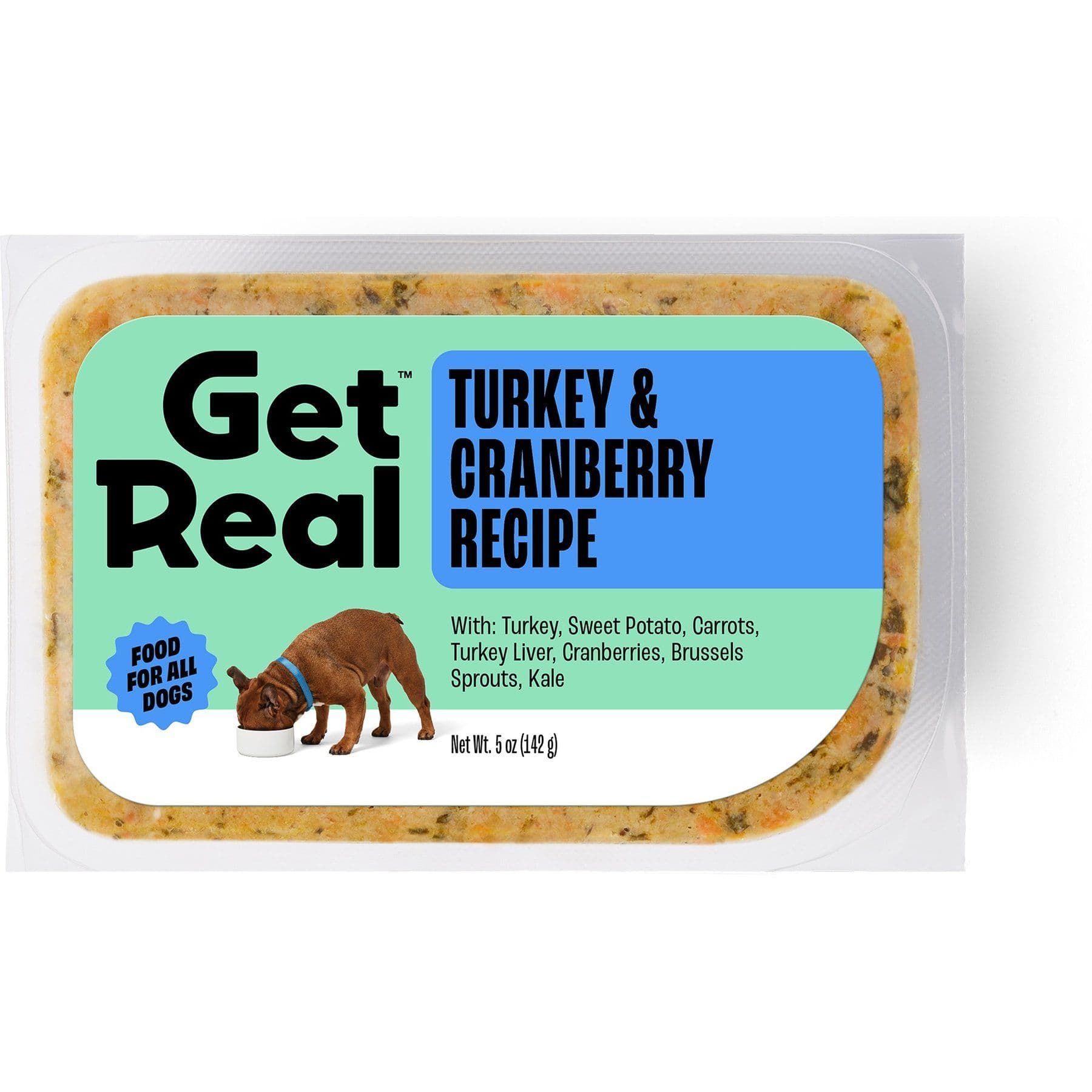
Turkey and cranberry in a gently cooked recipe with 10 ingredients or less plus vitamins and minerals, formulated for all life stages including large-breed growth.
Webvet may earn a commission when you click through to Chewy, at no extra cost to you.
When choosing between recipes for a particular dog, the label narrows the field, and body condition over the following weeks is the real test of any choice. Your veterinarian can help you weigh the options for a dog with specific needs.
Get Real can be served as a full meal, as a topper, or as a kibble mixer. The 12 oz and 24 oz packs are full meal sizes, and the 5 oz pack is a pre-portioned mixer for adding to another food. Subscriptions let you change, pause, skip, or cancel deliveries.
Product Names: The 95%, 25%, "With," and Flavor Rules
The product name on a dog food label is regulated by a set of percentage rules published by AAFCO on its Reading Labels page. The 95 percent naming rule applies to names like "Beef Dog Food": the named ingredient must make up at least 95 percent of the product by weight not counting added water, and at least 70 percent counting it. The 25% rule covers names with a qualifier such as dinner, entree, platter, or formula. There, the named ingredient must make up at least 25 percent of the product not counting added water, and at least 10 percent of the total.
When a name lists more than one ingredient under the 95% rule or the 25% rule, the named ingredients together must meet the threshold, no single named ingredient can be under 3 percent of the total product, and they must appear in the name in the same order as their amounts. Of the 95 percent, 25 percent, with, and flavor naming rules, the last two set the lowest bars. A "with" claim needs only 3 percent of each named ingredient. Under the flavor naming rule, no minimum percentage applies at all: a listed ingredient simply has to provide a flavor the dog can detect.
| Name style | Example | Minimum share of named ingredient | What it tells you |
|---|---|---|---|
| 95 percent naming rule | Beef Dog Food | 95 percent excluding added water, 70 percent including it | The named ingredient is nearly the whole food |
| 25 percent rule | Beef Dinner for Dogs | 25 percent excluding added water, 10 percent including it | The named ingredient is a major part, alongside others |
| With rule | Dog Food with Beef | 3 percent of each named ingredient | A small but real amount of the ingredient |
| Flavor naming rule | Beef Flavor Dog Food | No minimum percentage | A listed ingredient provides a detectable flavor |
These rules explain why two bags with "beef" in large letters can differ so much. The single word "with" moves the minimum from 25 percent to 3 percent, and "flavor" removes the minimum entirely, so read the small words in the name as carefully as the big ones.
The AAFCO Nutritional Adequacy Statement

The nutritional adequacy statement is the most important line on the label, and the AAFCO statement wording to look for is specific. A food that meets an AAFCO nutrient profile by formulation will say it "is formulated to meet the nutritional levels established by the AAFCO Dog Food Nutrient Profiles" for a named life stage. A food tested in feeding trials will say "Animal feeding tests using AAFCO procedures substantiate that" the product "provides complete and balanced nutrition" for that life stage. Foods that are not complete and balanced must say they are intended for intermittent or supplemental feeding only.
The idea of AAFCO approved food is a myth, and the exact statement wording to look for is the one quoted above. AAFCO is an association of state and federal feed officials that publishes model regulations and the AAFCO dog food nutrient profiles, the minimum and maximum nutrient levels a complete food must meet. It does not review or approve individual foods, so no approved list exists and no food can be the best approved choice. What you find on the label is a statement the maker prints, saying the food meets those profiles or passed AAFCO feeding tests. A food without that statement is not a complete and balanced dog food. WebVet's explainer on complete and balanced dog food covers the profiles in more depth.
The nutritional adequacy statement on a dog food label also names the life stage. The AAFCO profiles cover adult maintenance and growth and reproduction. A food for all life stages must meet the stricter growth profile, and a food suitable for puppies that will weigh 70 pounds or more as adults must say it includes growth of large size dogs. WebVet's guide to all life stages dog food explains when an all life stages formula makes sense.
WSAVA, the World Small Animal Veterinary Association, comes up in the same conversations, but it does not approve dog food either. It publishes guidelines: the WSAVA Global Nutrition Guidelines give owners and veterinarians questions to ask a manufacturer about nutrition expertise, quality control, and research. A food described as WSAVA approved has simply answered those questions; it carries no official WSAVA designation.
Calorie Statement and Feeding Directions
The calorie statement appears under the heading "Calorie Content" and must be expressed as kilocalories per kilogram (kcal/kg) as fed, plus kilocalories per familiar unit such as a cup, can, or pack. It is the most practical number on the label for portioning, because two foods can differ in calories per cup by 30 percent or more.
Get Real's calorie statement illustrates the per-unit format:
- Chicken & Brussels Sprouts: 179 kcal per 5 oz pack, 428 per 12 oz pack, 856 per 24 oz pack, as listed on Chewy's product page.
- Beef & Sweet Potato: 188, 451, and 902 kcal per 5, 12, and 24 oz pack, as listed on Chewy's product page.
- Turkey & Cranberry: 198, 474, and 948 kcal per 5, 12, and 24 oz pack, as listed on Chewy's product page.
Feeding directions are required on complete and balanced foods and usually appear as a chart of daily amounts by body weight. Treat them as a starting point. Age, activity, neuter status, and breed all shift real needs, and the right portion is the one that keeps your dog at a lean body condition. Get Real sets portions through its online plan based on weight, breed, age, and activity level rather than a printed chart. WebVet's guide on how much to feed a dog shows how to estimate daily calories.
When changing foods, the label's transition guidance matters too. Get Real recommends mixing in a small amount and increasing it over 7 to 10 days, or 10 to 14 days for sensitive dogs. Packs thaw in the refrigerator in 12 to 24 hours for 5 oz and 12 oz packs, or 35 to 48 hours for 24 oz packs, and thawed food should be used within 3 to 5 days.
Marketing Terms Versus Regulated Claims
Beyond the required panel, most packages carry claims that sound regulated but often are not. Knowing which is which keeps the front of the bag from overriding what the back says:
- Natural: AAFCO allows this when ingredients are not chemically synthetic, though synthetic vitamins and minerals are permitted if the label discloses them.
- Organic: governed by USDA organic rules when the USDA seal is used.
- Human-grade: describes ingredients and handling suitable for people; it is a meaningful claim only when the whole product is made that way.
- Holistic, premium, and gourmet: no regulatory definitions; read them as descriptions, not standards.
- Limited ingredient and grain-free: describe recipe style, not nutritional adequacy.
None of these terms replaces the nutritional adequacy statement. A food can be natural, premium, and limited ingredient and still be intended only for supplemental feeding, so return to the five-step method whenever a claim on the front catches your eye.
If your dog has a diagnosed medical condition, the label is only part of the decision. Kidney disease, pancreatitis, and confirmed food allergies change which nutrient levels matter, and your veterinarian can help you read a label against your dog's specific needs.
Questions readers ask
Frequently Asked Questions
Is there an AAFCO approved dog food list?
No. AAFCO does not approve, register, or certify pet foods, so no official approved list exists. Instead, check each food's nutritional adequacy statement for the words complete and balanced, a reference to AAFCO nutrient profiles or feeding tests, and the life stage it covers.
What does WSAVA approved dog food mean?
WSAVA does not approve foods either. The WSAVA guidelines suggest manufacturer questions to ask, such as whether the company employs a qualified nutritionist and what quality control it uses. A brand described as WSAVA compliant is saying it can answer those questions, so ask the company directly.
Where is the nutrition label on dog food?
On a dog food label, the closest equivalent is the guaranteed analysis panel, usually on the back or side of the bag or around a can. It is not nutrition facts in the human sense: it gives minimum protein and fat and maximum fiber and moisture rather than exact amounts per serving. The calorie statement sits nearby.
What does limited ingredient mean on a dog food label?
There is no regulatory definition for limited ingredient. It generally means a short ingredient list built around one protein and one main carbohydrate. For a dog with a confirmed food allergy, the ingredients to avoid are the specific proteins it reacts to, so read the whole list rather than relying on the front-of-bag claim.
What does complete and balanced mean on a dog food label?
Complete and balanced means the food contains every required nutrient in the right proportions for the stated life stage, as set by the AAFCO nutrient profiles or proven in AAFCO feeding tests. A complete and balanced food can be fed as a sole diet; a food labeled for intermittent or supplemental feeding cannot.
How do I compare dry and fresh dog food labels?
Convert both guaranteed analyses to a dry matter basis. Subtract the moisture content from 100, divide each nutrient by that figure, and multiply by 100. This removes water from the comparison, so a fresh food at 75 percent moisture and a kibble at 10 percent can be compared fairly.
Veterinarian · BVMS MRCVS
Dr. Pippa Elliott, BVMS, MRCVS, is a veterinarian with nearly 30 years of experience in companion animal practice. Dr. Elliott earned her Bachelor of Veterinary Medicine and Surgery from the University of Glasgow. She was also designated a Member of the Royal College of Veterinary Surgeons. Married with 2 grown-up kids, Dr. Elliott has a naughty Puggle named Poggle, 3 cats and a bearded dragon.
Related reading

Easily Digestible Dog Food: What Makes a Meal Gentle on Your Dog's Gut

Fresh Dog Food for Underweight Dogs: Safe Weight Gain, Step by Step

How to Tell if a Dog Food Is Right for Your Dog: 8 Signs Vets Check
