FIV in Cats: Symptoms, Transmission, Testing, and Life Expectancy
FIV in cats is feline immunodeficiency virus, a slow-moving infection spread mainly through deep bite wounds. Here are the symptoms by stage, how vets test for it, how long FIV-positive cats live, and whether they can share a home with other cats.

BVMS MRCVS
Medically reviewed by Dr. Pippa Elliott, BVMS MRCVS · Last reviewed

This article contains affiliate links. Webvet may earn a commission when you buy through them, at no extra cost to you.
FIV in cats is feline immunodeficiency virus, a slow-acting lentivirus that weakens the immune system and spreads mainly through deep bite wounds. There is no cure, but many FIV-positive cats live for years, and keeping them indoor-only is the most important decision an owner makes.
An FIV-positive result changes how you care for a cat, not whether the cat can have a good life. This guide covers what FIV in cats is, the signs by stage, how the virus spreads and is tested, treatment, home care, life expectancy, and living with other cats.
- 1FIV is feline immunodeficiency virus, a lentivirus that infects a cat for life and weakens its immune defenses.
- 2FIV shows signs by stage from the early flu-like phase through the immunodeficiency phase, often with a silent phase of months to years between them.
- 3Deep bite wounds are the main route of spread, so unneutered males with outdoor access carry the highest risk.
- 4There is no cure, but Cornell says cats with FIV commonly live average life spans when they are not also infected with FeLV.
- 5Fever, not eating, mouth pain, or rapid weight loss in an FIV cat means a prompt vet visit.
 Sponsored
Have a health question about your cat?
Talk to a licensed vet at Dutch over video or message, including nights and weekends.
Use code Pets60
Plans start at $12/month · covers up to 5 pets
- Licensed vets in most states
- Rx for 150+ conditions
- 4.7 on Trustpilot
What Is FIV in Cats?
FIV is feline immunodeficiency virus, described in a PMC review of FIV as a lentivirus of the Retroviridae family, first reported in California in 1986. The Cornell Feline Health Center explains that it attacks the immune system and leaves an infected cat vulnerable to many other infections.
FIV stands for feline immunodeficiency virus, which means it weakens immune defenses. A key fact about FIV infection: it does not go away. ICatCare notes that FIV occurs worldwide and that once a cat is infected, it remains infected for life.
Is FIV bad for cats? It is serious, but it is slow. Is FIV curable? No, but it is manageable. Most illness comes from secondary infections rather than the virus itself, so looking after a cat with FIV means preventing those infections, catching problems early, and keeping the cat indoor-only. Many FIV cats live a long life with that care, and some need daily pills when a secondary infection is treated. Cats get FIV mainly from bites, explained in the transmission section below.

Greenies Pill Pockets Feline are soft salmon flavored cat treats with a pocket for hiding a pill.
Webvet may earn a commission when you click through to Chewy, at no extra cost to you.
There is no FIV booster in the US; the vaccine section covers why. Are FIV cats more expensive to keep? An FIV cat needs checkups at least every six months and prompt treatment of secondary infections, which shapes ongoing care costs. Gingivostomatitis, a severe gum and dental disease, is common in FIV cats, according to Cornell.
Symptoms of FIV in Cats
The symptoms of FIV in cats follow three stages, and many cats look completely normal for years. Cornell describes three stages of infection, from an early phase with fever through the immunodeficiency phase:
- Acute phase: about 1 to 3 months after infection, with temporary lymph node swelling, often with fever, depression, and poor appetite.
- Asymptomatic phase: no visible signs, lasting months to multiple years.
- Progressive immunocompromised phase: the immune system weakens and secondary infections build up.
What are the first signs of FIV?
The first signs of FIV are temporary lymph node enlargement, often with fever, depression, and lack of appetite, according to Cornell. ICatCare notes that longer-term signs often appear roughly 2 to 5 years after a cat first becomes infected.

What do cats with FIV look like in the later stages? Cornell and ICatCare list these signs and symptoms:
- Red, sore gums and mouth sores from gingivitis and stomatitis
- Weight loss and a poor coat
- Recurrent fever
- Chronic or recurrent infections of the skin, eyes, urinary tract, or upper respiratory tract
- Seizures, behavior changes, or other neurological disorders
Signs of secondary illness can also show on the face and body. Secondary illnesses can cause other problems, so ask your vet about anything new in an FIV-positive cat, such as:
- Throwing up or diarrhea
- Painful teeth or a swollen face
- Losing hair or skin sores
- Side effects from medicines given for infections
FIV-positive cat symptoms become dangerous when secondary infections pile up. Eye infections and sneezing are common because the immune system struggles to clear routine infections. A cat with FIV sneezing often has a secondary upper respiratory infection in cats, and the guide to cat sneezing with a runny nose explains those signs. Sneezing blood, fever, or eye discharge in an FIV cat needs a vet.
How Do Cats Get FIV?
What causes FIV is the virus itself. Cats get FIV mainly through deep bite wounds from an infected cat. Cornell calls bites the primary mode of transmission, and the EveryCat Health Foundation summary of the AAFP guidelines explains that a bite introduces infected saliva into the blood. That is why fighting cats are at risk.
What triggers FIV in cats?
FIV in cats is triggered by infection with the virus itself, almost always through a bite from an infected cat during a fight. Cornell says most later illness is triggered by secondary infections and immune problems, not by the virus directly. Calm, low-tension homes cut fighting between cats.
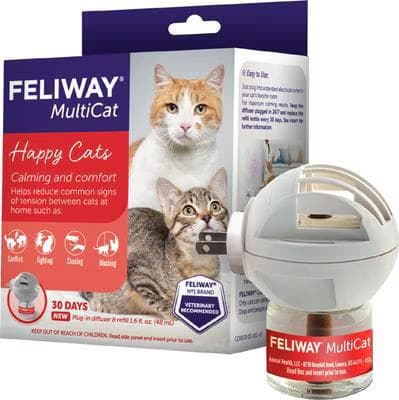
Feliway MultiCat 30 Day Starter Kit is a calming pheromone diffuser made for homes with more than one cat.
Webvet may earn a commission when you click through to Chewy, at no extra cost to you.
Other routes matter far less. Cornell says sexual contact is not a significant means of spread, and casual contact such as sharing water bowls or mutual grooming does not appear to be an efficient route. ICatCare adds that on rare occasions the virus may spread through non-aggressive contact like grooming.
Can cats be born with FIV, and can cats pass FIV to kittens? Kittens of infected mothers can test positive because they carry the mother's antibodies for months, which is the usual reason for an FIV kitten false positive. Cornell advises retesting at 60-day intervals until kittens are at least six months old.
Which Cats Are at Risk of FIV?
How common is FIV in cats? Cornell reports that about 2.5 to 5 percent of healthy cats are infected, and rates reach 15 percent or more in cats that are sick or at high risk. A PMC review cites a global average of 4.7 percent, so FIV is not common in typical healthy pet cats.
Intact outdoor males are the highest-risk group. Cornell names unneutered male cats with outdoor access, and cats likely to fight, as most at risk. Neutering reduces fighting, and the guide to cat spay and neuter cost covers that step. How to manage FIV in cats starts with lowering fight risk.
Do most outdoor cats have FIV?
No. Most outdoor cats do not have FIV. ICatCare says infection is much more common in outdoor cats. Veterinary sources do not give a separate figure for outdoor cats; Cornell's 15 percent or more applies to sick or high-risk cats as a group.
SponsoredVet care that's always there
Unlimited video calls and messaging with licensed vets for less than a typical vet visit. One membership covers up to five pets.
Use code Pets60
Plans start at $12/month · covers up to 5 pets
- Licensed vets in most states
- Rx for 150+ conditions
- 4.7 on Trustpilot
How Is FIV Diagnosed?
FIV is diagnosed with a simple blood test at the vet clinic, as ICatCare describes. Cornell explains that clinics use an in-house ELISA antibody test, and positive results are confirmed by western blot or immunofluorescence (IFA) at a reference laboratory.
How can you tell if a cat has FIV?
You can tell if a cat has FIV only with a blood test, because many infected cats look healthy for years. A vet runs an antibody test, then confirms a positive result with a second method. Symptoms such as gum disease or repeated infections raise suspicion, but they never confirm FIV on their own.

Vets pair antibody screening tests with confirmation because one positive screen in a low-risk cat may not be the full answer. Cornell says positive results in healthy cats are confirmed using a second technique. The AAFP guidance summarized by EveryCat recommends confirmation in low-risk cats and notes it may not be needed in high-risk cats.
What does FIV-positive mean in cats? It means antibodies to FIV were found. A positive antibody result in a cat older than six months generally means true infection, according to the AAFP summary. FIV PCR testing can help separate maternal antibodies from real infection in younger kittens. Ask your vet whether to retest an FIV-negative cat after a new bite or fight.
Positive results in kittens need patience. Here is what the guidance says about testing kittens:
- Maternal antibodies may persist for about six months.
- Cornell advises retesting at 60-day intervals until at least six months old.
- ICatCare recommends retesting positive kittens at 5 to 6 months.
Treatment for FIV in Cats
There is no cure for FIV in cats, so feline immunodeficiency virus (FIV) treatment focuses on secondary infections plus supportive care. Cornell states there is currently no definitive cure, and ICatCare stresses prompt diagnosis and treatment of any secondary or concurrent disease.
Does FIV go away? No. Can FIV be cured? No, but is FIV treatable in cats? The infections it allows usually are. Your vet treats each secondary infection as it appears with medication matched to the problem, and treats gingivostomatitis and dental disease as needed. FIV cat treatment cost depends on which secondary illnesses occur and how often.
Antiviral medication has limited support. The AAFP summary notes that AZT or possibly interferons may be used, though efficacy data are scant. No published evidence supports a natural or holistic treatment that cures FIV in cats, so ask your vet before adding any remedy. One practical point rounds out treatment:
- ICatCare advises neutering all FIV-infected cats to reduce fighting and spread of infection.
Caring for an FIV-Positive Cat at Home
FIV cat care at home rests on indoor-only living and checkups at least every six months, backed by good everyday diet and parasite control. Cornell says wellness visits for FIV-infected cats should be scheduled at least every six months, and that keeping cats indoors and isolated from other cats best prevents spread and limits exposure to infections.
Veterinary references do not set a special diet or name a best dry food for FIV cats, so a complete, balanced cat food your vet approves is the standard. Supplements for cats with FIV have no published proof of benefit, so discuss any immune supplement with your vet first.

Tomlyn Immune Support Powder is an immune supplement for cats sold in a 3.5-oz tub.
Webvet may earn a commission when you click through to Chewy, at no extra cost to you.
- Indoor-only living: ICatCare suggests a cat-proof enclosure for safe outdoor access; ask your vet before trying walks outside on a leash.
- Diet: feed a complete, balanced cat food your vet approves.
- Parasite control: keep fleas and worms under control year-round.
- Checkups: at least every six months, with dental checks at each visit.
FIV cats and fleas need steady attention because parasites add to the burden on a weak immune system. The cat dewormer guide covers worm control. Because FIV cats and dental problems such as stomatitis go together, ask your vet about home tooth care and watch for drooling or chewing on one side.

Appetite is worth tracking every day. If your cat skips meals, the guide to a cat not eating explains what to check, and an FIV cat that stops eating needs a prompt vet visit. In a multi-cat home, separate feeding keeps each cat's diet and medication under control.
Keep routines steady. Stress, crowding, and new cats raise the chance of fights, so a calm home supports both your FIV cat and any housemates. A feeder that opens for one cat stops food sharing and squabbles at the bowl.

The SureFeed Microchip Small Dog & Cat Feeder is a bowl that opens only for a pet with a registered microchip.
Webvet may earn a commission when you click through to Chewy, at no extra cost to you.
FIV Life Expectancy
The FIV in cats life expectancy for a well-managed cat is often close to normal. Cornell says cats with FIV "commonly live average life spans, as long as they are not also infected with feline leukemia virus," and the 2020 AAFP guidance summarized by EveryCat says survival is highly variable but similar to uninfected cats.
What is the life expectancy of a cat with FIV?
The life expectancy of a cat with FIV is often similar to an uninfected cat with good care. A UK sanctuary study of 132 cats, indexed on Europe PMC, reported that "the median life expectancies were 160.3 months for uninfected cats, 149.1 months for FIV+, 41.5 months for FeLV+ and 74.2 months for FeLV/FIV+."
For a well-managed FIV cat, the life expectancy is good, but studies differ. The PMC review notes an Italian referral-clinic study found FIV status did not significantly affect longevity, while the sanctuary study found a smaller reduction. Sanctuary cats may not represent typical pets, and ICatCare calls prognosis guarded and dependent on stage.
What kills cats with FIV?
Secondary infections and immune problems kill most cats with FIV, not the virus itself. Cornell says most FIV illness comes from those secondary infections. No published figure breaks down cause of death in FIV cats, so the practical answer is that infections, mouth disease, and weight loss are what wear a cat down.
How do I know if my FIV cat is dying? End stage FIV symptoms usually look like the immunodeficiency phase getting worse: infections that keep returning, ongoing weight loss, poor appetite, or severe mouth pain. The final stages of FIV in cats call for frank talks with your vet about comfort and quality of life. Your vet can help you judge when to put down a cat when its lifespan is near its end and comfort cannot be restored.
Can an FIV Cat Live With Other Cats?
Yes, an FIV cat can often live with other cats in a stable, peaceful home. Cornell says transmission to uninfected cats is much less likely in households with stable social structures, and ICatCare says the risk of spread is low in stable homes where cats do not fight. The deciding factor is fighting, not sharing space.
How contagious is FIV in cats?
FIV in cats is not very contagious through casual contact. It spreads mainly through deep bites, so cats that share water bowls or groom each other rarely pass it on. The AAFP guidance summarized by EveryCat says transmission between cats living together without fighting is rare.

The same guidance says FIV-positive and negative cats living together in a stable household do not need isolation, but new cats should not be introduced. Two FIV-positive cats can live together, and so can a cat with FIV and one without when they do not fight. Can I get FIV from my cat? Veterinary references describe FIV as a viral infection of cats and do not describe it as zoonotic, so ask your vet about any concern. To mix FIV and non-FIV cats safely:
- Keep the existing group stable and skip new arrivals
- Neuter every cat to reduce fighting
- Watch for scuffles and separate cats that fight
- Keep all cats indoors so the FIV cat cannot spread the virus outside
How common FIV is in stray cats matters here: unknown newcomers are the main risk, which is why the guidance warns against adding cats. Feral cats that fight are the typical source. An FIV cat living around other cats it already knows is managed by keeping the peace. In a multi-cat home, some owners add a pheromone diffuser such as the Feliway MultiCat 30 Day Starter Kit Calming Pheromone Diffuser for Cats to the household routine.
FIV vs FeLV
FIV and FeLV are both retroviruses, but they spread differently and carry different outlooks. FeLV is covered in depth in the feline leukemia virus guide. FIV differs from FeLV in four ways: how each spreads, the test used, the typical outlook, and multi-cat household advice.
What is the difference between FIV and FeLV?
The main difference is how they spread and how serious they are. FIV spreads mainly through bite wounds, and many FIV cats live average life spans. FeLV spreads through close contact, including saliva shared through grooming and bowls, and Cornell gives a median survival of 2.5 years after an FeLV diagnosis.
The table below compares FIV and FeLV by how each spreads, the test used, the outlook, and whether positive and negative cats can share a home.
| Feature | FIV | FeLV |
|---|---|---|
| Main spread | Bite wounds that put infected saliva into the blood | Close contact, including saliva through grooming and shared bowls and litter boxes |
| Screening test | Antibody test, confirmed by western blot, IFA, or PCR | Antigen (p27) test, with PCR as follow-up |
| Typical outlook | Commonly average life span without FeLV | Median survival 2.5 years after diagnosis |
| Living with other cats | Spread is rare in stable homes without fighting | Any close contact can spread it to housemates |
FIV and FeLV tests look for different things. When testing kittens for FIV and FeLV, maternal antibodies can affect the FIV result, so follow the retest timing in the diagnosis section. Cornell explains that FeLV tests detect free virus particles, while the FIV test detects antibodies. An FIV-positive, FeLV-negative result means the cat has FIV antibodies but no FeLV antigen. Ask your vet about retesting an FIV/FeLV-negative cat after a bite.
FIV and FeLV positive cats face a harder road. In the sanctuary study above, cats with both infections had a median life expectancy of 74.2 months, compared with 149.1 months for FIV alone. For FeLV prevention, see the feline leukemia vaccine guide.
Is There an FIV Vaccine?
No FIV vaccine is commercially available in the United States. Cornell states there is currently no vaccine available in North America, and the PMC review reports that the Fel-O-Vax FIV vaccine was removed from the US and Canadian market in 2017. In the United States, prevention therefore depends on keeping cats from fighting.
The FIV vaccine remains available elsewhere. Here is where it stands:
- The PMC review names Japan, Australia, and New Zealand as places it is still sold.
- ICatCare confirms a licensed vaccine exists in some countries.
- The AAFP guidance gives no FIV vaccine effectiveness figure, so ask your vet if you live outside North America.
Vaccination also complicates testing. The AAFP summary says vaccinated cats will test positive on some point-of-care antibody tests, and ICatCare notes that vaccinated cats may need alternative tests. A cat vaccinated abroad can test antibody-positive without being infected, so tell your vet about any past FIV vaccine.
US cats are not vaccinated for FIV, but they still need their core shots. The kitten vaccine schedule covers the vaccines your vet will recommend, including when vaccinating FIV-positive cats.
When to See a Vet
See a vet promptly whenever an FIV cat shows any sign of illness. Cornell says it is very important that FIV cats be promptly evaluated and treated when any signs of illness occur, because secondary infections cause most of the harm. Signs that mean a vet visit now include fever, not eating, mouth pain, and rapid weight loss.
Also call your vet promptly for:
- Repeated eye, skin, urinary, or respiratory infections
- Seizures or sudden behavior changes
- Drooling, bad breath, or trouble chewing
- Any new bite wound, in an FIV cat or a housemate
FIV in Cats FAQs
Frequently Asked Questions
Can I kiss my FIV positive cat?
Veterinary references do not address kissing directly; FIV spreads mainly through deep bite wounds, and casual contact is not the usual route. Ask your vet if people in your home have concerns.
Can FIV in cats be cured?
No. There is no cure for FIV, so vets manage it by treating secondary infections promptly, keeping the cat indoors, and scheduling checkups at least every six months.
When should you put down a cat with FIV?
An FIV-positive result alone should never be the reason for euthanasia, according to AAFP guidance. PetMD notes that euthanasia can be considered when a cat's quality of life is poor and will not get better, a decision to make with your vet.
Is there a vaccine for FIV in cats?
There is no FIV vaccine available in the United States. It was withdrawn from the US and Canadian market in 2017, though a vaccine remains available in some other countries.
Should I adopt a cat with FIV?
Many FIV cats live normal, happy lives and make good pets. Plan on an indoor home, regular vet care, and either no other cats or a stable group that does not fight.
Does FIV get worse over time?
Usually, but slowly. Many cats stay healthy for years in the silent phase before the immune system weakens and recurrent infections begin.
What is the false positive rate for FIV tests in cats?
Veterinary guidance does not give a false positive percentage. Screening tests detect antibodies, which can come from maternal antibodies in kittens or past vaccination, so vets confirm positive results with a second test, especially in low-risk cats.

Editor
The Webvet Editorial Team is the in-house group of pet-care editors and writers behind Webvet, operated by Smart Pet Collective. The team researches, writes, and maintains Webvet's pet health, behavior, and medication content. Every article follows a defined editorial process: research from reputable veterinary and scientific sources, careful drafting, mandatory review of medical content by a credentialed veterinarian, and dated publication. Health and medication articles are medically reviewed by a licensed veterinary professional before they go live and are kept current over time.
Veterinarian · BVMS MRCVS
Dr. Pippa Elliott, BVMS, MRCVS, is a veterinarian with nearly 30 years of experience in companion animal practice. Dr. Elliott earned her Bachelor of Veterinary Medicine and Surgery from the University of Glasgow. She was also designated a Member of the Royal College of Veterinary Surgeons. Married with 2 grown-up kids, Dr. Elliott has a naughty Puggle named Poggle, 3 cats and a bearded dragon.
Related reading

Feline Herpesvirus (FHV-1): Symptoms, Treatment, and Flare-Ups

Upper Respiratory Infection in Cats: Symptoms, Causes, and Treatment

Feline Leukemia Virus (FeLV): Symptoms, Transmission, Testing, and Prognosis
