Praziquantel for Dogs and Cats: Tapeworm Dosing, Side Effects and OTC Options
Praziquantel for dogs and cats treats tapeworms, usually in one weight-based dose. Learn which products are OTC, how to dose by weight, how fast it works, side effects and why flea control stops reinfection.

BVMS MRCVS
Medically reviewed by Dr. Pippa Elliott, BVMS MRCVS · Last reviewed

Drug facts
Praziquantel
Praziquantel is a broad-spectrum anti-helminthic (cestocidal) drug used in dogs and cats to treat tapeworm infections. It is often combined with other anti-parasitic agents for broader parasite control.
Treats
 $65 · no membership
Need a prescription for Praziquantel?
A licensed vet can assess your pet over video and prescribe Praziquantel online when it's appropriate.
 Talk to a vet
- Licensed vets
- All 50 states
- same-day Rx

Webvet may earn a commission if you book.
Praziquantel for dogs and cats is the standard tapeworm medicine. It clears the flea tapeworm (Dipylidium caninum) and the Taenia tapeworms pets catch from rabbits and rodents, usually with one weight-based dose, and plain tablets are sold over the counter for both species.
Whether you need praziquantel for dogs or for cats, three things decide whether treatment works: an accurate body weight, the right product for the worms involved and flea control for every pet in the home.
Praziquantel at a Glance
- 1Of the common intestinal worms, praziquantel kills tapeworms only; combination dewormers add pyrantel or febantel for roundworms, hookworms and whipworms.
- 2Plain tablets for dogs (34 mg) and cats (23 mg) are sold without a prescription and dosed by body weight.
- 3It takes effect within 1 to 2 hours, and treated tapeworms are digested, so you rarely see whole worms.
- 4Side effects are uncommon and mild, such as drooling, vomiting or diarrhea.
- 5Flea control is essential, because flea tapeworm segments can reappear within a month without it.
Can You Buy Praziquantel Over the Counter?
Yes. In the US you can buy plain praziquantel tablets for dogs and cats over the counter, without a prescription. These single-ingredient pills are the simplest OTC tapeworm medicine, and they treat the flea tapeworm and Taenia tapeworms from hunting or scavenging.
Praziquantel is also the tapeworm medication inside several prescription products. The best tapeworm treatment for your dog or cat depends on which worms are present, whether fleas are involved and whether your vet wants broader coverage.
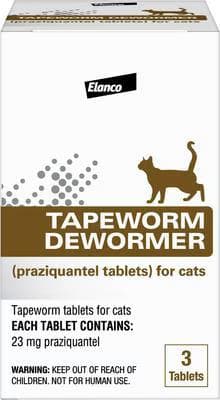
A single-dose praziquantel tablet that clears tapeworms in cats, the same active ingredient vets use. Three tablets per pack.
Webvet may earn a commission when you click through to Chewy, at no extra cost to you.
OTC Praziquantel Tablets for Dogs and Cats
The tablets many owners still search for as the Bayer tapeworm dewormer now carry the Elanco name. The dog version contains 34 mg per tablet for Dipylidium caninum and Taenia pisiformis, and the cat version contains 23 mg for Dipylidium caninum and Taenia taeniaeformis.
- Tapeworms only: a plain praziquantel dewormer fits when you see segments and no other worms are suspected.
- Cats with possible roundworms or hookworms: Drontal Tablets for Cats & Kittens pair praziquantel with pyrantel pamoate and are labeled OTC.
- Generic tablets: store-brand praziquantel tablets for dogs exist too; compare the mg per tablet and follow that label.
Comparing every OTC dog dewormer, not just tapeworm tablets? Our guide to the over the counter dewormer for dogs ranks the options by worm type, including over the counter tapeworm medicine for dogs.
Prescription Praziquantel Products
Your vet may choose a prescription product when a pet needs broader protection, has an unusual tapeworm or refuses tablets. Droncit tablets are the prescription version of the same 34 mg tablet, and their label also lists the Echinococcus tapeworms. This side-by-side comparison shows the extra parasites each OTC and prescription praziquantel product covers:
| Product | Form | Species | Status | Other parasites covered |
|---|---|---|---|---|
| Elanco Tapeworm Dewormer | Tablet | Dogs and cats | OTC | None, tapeworms only |
| Drontal (praziquantel and pyrantel pamoate) | Tablet | Cats | OTC | Roundworms and hookworms |
| Elanco Quad Dewormer (praziquantel, pyrantel and febantel) | Chewable tablet | Dogs | OTC | Roundworms, hookworms and whipworms |
| Drontal Plus (praziquantel, pyrantel and febantel) | Tablet | Dogs | Prescription | Roundworms, hookworms and whipworms |
| Droncit injectable | Injection given by a vet | Dogs and cats | Prescription | None, tapeworms only |
| Profender (emodepside and praziquantel) | Topical spot-on | Cats | Prescription | Roundworms and hookworms |
| Interceptor Plus (milbemycin oxime and praziquantel) | Monthly chew | Dogs | Prescription | Heartworm prevention, roundworms, hookworms and whipworms |
| Sentinel Spectrum (milbemycin oxime, lufenuron and praziquantel) | Monthly chew | Dogs | Prescription | Heartworm prevention, flea population control, roundworms, hookworms and whipworms |
| Iverhart Max (ivermectin, pyrantel and praziquantel) | Monthly chew | Dogs | Prescription | Heartworm prevention, roundworms and hookworms |
The Droncit injectable is given under the skin or into a muscle, with your vet setting the injectable dosage from body weight. A praziquantel injection for dogs or cats helps with pets that spit out tablets, and Droncit for cats also comes as a 23 mg prescription tablet.
For liquid praziquantel for dogs, ask your vet about a compounded version, which requires a prescription.
Prescription tablets such as Drontal Plus Tablet for Medium Dogs can be filled by an online pharmacy once your vet authorizes the prescription medication for tapeworms in dogs.
What Praziquantel Treats in Dogs and Cats

Praziquantel treats tapeworms (cestodes), the flat, segmented worms that attach inside the small intestine. Veterinary labels rely on it for canine and feline tapeworms because it covers all the common species, including the hydatid tapeworms (Echinococcus) that also threaten people, according to the Merck Veterinary Manual.
What parasites are killed by praziquantel? These are the tapeworms it is used against, and how pets and other animals pick them up:
| Tapeworm | How pets pick it up | Pets affected | How praziquantel is used |
|---|---|---|---|
| Dipylidium caninum (flea tapeworm) | Swallowing an infected flea, or rarely a louse, while grooming | Dogs and cats | Standard single dose on OTC and prescription labels |
| Taenia pisiformis | Eating infected rabbits or hares | Dogs | Standard single dose on OTC and prescription labels |
| Taenia taeniaeformis | Eating infected rodents | Cats | Standard single dose on OTC and prescription labels |
| Echinococcus granulosus and E. multilocularis (hydatid tapeworms) | Eating infected livestock organs or wild rodents | Mainly dogs | Prescription labels, with vet-set repeat schedules in affected regions |
| Spirometra | Eating amphibians, reptiles or birds that carry larvae | Dogs and cats | Higher, multi-day doses directed by a vet |
Where hydatid tapeworms occur, Merck notes that vets may repeat praziquantel every 4 to 6 weeks as part of hydatid tapeworm treatment and control for dogs that eat offal or wild rodents.
Worms Praziquantel Does Not Kill
Does praziquantel get rid of all worms? No. Praziquantel for roundworms is a common mix-up: it does not kill roundworms, hookworms, whipworms or heartworms in dogs or cats, and it does nothing for Giardia or coccidia.
That matters for puppies, kittens and new adoptees, which often carry roundworms. When you weigh tapeworm vs roundworm treatment in cats or dogs, a tapeworm-only tablet leaves roundworms behind. See how they differ in our guide to roundworms in dogs. Petful's guide to hookworms and other common dog worms covers the rest.
Treatment for roundworms and tapeworms in cats usually means a praziquantel and pyrantel combination, as our cat dewormer guide explains. For dogs, OTC chews pair praziquantel with pyrantel and febantel, and the Quad Dewormer label covers puppies 3 weeks and older that weigh at least 2 pounds.
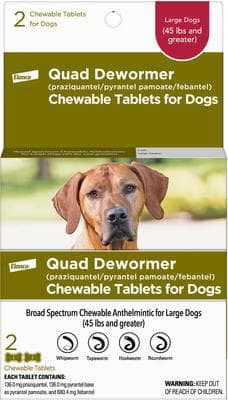
Broad-spectrum chewable dewormer (praziquantel, pyrantel, febantel) that treats tapeworms, roundworms, hookworms, and whipworms in one course. For large dogs 45 lbs and over.
Webvet may earn a commission when you click through to Chewy, at no extra cost to you.
Praziquantel vs Ivermectin and Pyrantel
Is praziquantel similar to ivermectin? No. Ivermectin binds glutamate-gated chloride channels found in roundworms and arthropods, and tapeworms lack that receptor, so ivermectin does not kill tapeworms in cats or dogs. Praziquantel works on the tapeworm's calcium balance instead, Merck explains.
- Ivermectin: monthly chews that pair ivermectin and praziquantel for dogs, such as Iverhart Max, cover tapeworms because of the praziquantel.
- Pyrantel: kills roundworms and hookworms but will not kill tapeworms in cats or dogs. Combinations such as praziquantel, pyrantel pamoate and febantel tablets for dogs are covered in our pyrantel pamoate for dogs and cats guide.
Praziquantel vs Fenbendazole and Flea Preventives
Fenbendazole treats Taenia tapeworms plus roundworms, hookworms and whipworms, but the Panacur C label notes it kills only Taenia tapeworms, not the flea tapeworm.
Panacur C Canine Dewormer is labeled only for dogs and suits one with Taenia exposure and other worms; Panacur for tapeworms in cats has the same flea-tapeworm gap. Our fenbendazole for dogs guide compares fenbendazole vs praziquantel for dogs in depth.
Flea products such as Frontline or Bravecto do not kill tapeworms in dogs or cats, but they prevent the flea tapeworm by killing the fleas that carry it.
How Owners Usually Spot Tapeworms
Most owners find tapeworms before any test does. Segments break off, so a tapeworm on a cat or dog shows up as small, flat segments around the tail, in fresh stool or on bedding. Flea tapeworm segments are 10 to 12 mm long and shaped like cucumber seeds, CAPC notes.
Can tapeworms crawl out of dogs? The segments can. They are motile, so they crawl out of the anus onto the fur or bedding before drying, while the worm stays attached inside, and they can irritate the skin around the anus.
Routine fecal flotation often misses tapeworms, so diagnosing tapeworm in cats and dogs often starts with what you saw. For help telling segments apart, see what worms look like in cat poop and our signs of worms in cats checklist.
The Flea-Tapeworm Link: Why Tapeworms Come Back
The flea tapeworm is probably the most common tapeworm of dogs and cats, and it cannot infect a pet without a flea. Flea larvae eat tapeworm eggs, the tapeworm develops inside the flea, and your pet swallows the adult flea while grooming.
New segments can appear in as little as 2 to 3 weeks, a gap called the prepatent period, CAPC notes.
That cycle explains most treatment failures. Praziquantel clears the worms in the gut but cannot stop the next infected flea, and the Quad Dewormer label warns that reinfection is almost certain if fleas are not removed from the pet and its environment. So on deworming day, kill the adult fleas on your pet, then keep new ones off.
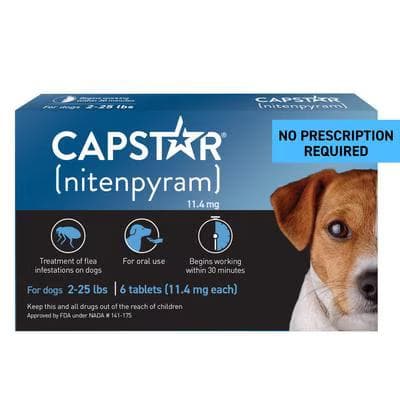
An over-the-counter nitenpyram tablet that starts killing adult fleas within 30 minutes. A fast knockdown for an active infestation, no prescription required, useful alongside a longer-term preventive.
Webvet may earn a commission when you click through to Chewy, at no extra cost to you.
Flea tapeworm in cats and dogs also explains how tapeworms spread between pets. Cats cannot give dogs tapeworms directly, but shared fleas can infect every animal in the house, so treat all pets together. For the hunting route, see how cats get tapeworms.

A Flea-Control Plan That Prevents Reinfection
Tapeworm prevention for dogs and cats comes down to fleas and prey. Work through these steps on the day you deworm:
- Deworm every infected pet the same day with the right product for each species and weight.
- Kill the adult fleas now. An oral nitenpyram tablet starts killing adult fleas within 30 minutes, the Capstar label says. For cats, Capstar Flea Oral Treatment for Cats is one OTC option, and small dogs have their own 2 to 25 pound version.
- Start a long-acting flea preventive on every pet. Nitenpyram is not a lasting preventive, so larger dogs could wear the Seresto Flea & Tick Collar for Dogs, Over 18 lbs or use a product your vet recommends; cats have flea pills and topicals.
- Comb and check. A fine-toothed Frisco Single-Row Flea Comb for Cats & Dogs helps confirm that fleas and flea dirt are gone.
- Treat the home. Wash bedding and vacuum resting spots, because flea eggs and larvae live off the animal. See our guide to getting rid of fleas in your house and yard.
- Limit hunting and scavenging, since Taenia comes from rabbits and rodents.
Could It Be Praziquantel Resistance?
If segments keep returning after correctly dosed treatment and a month of strict flea control, ask your vet about resistance. Between 2016 and 2018, US researchers documented flea tapeworms in dogs that survived repeated praziquantel and epsiprantel treatment, even at higher doses (Chelladurai and colleagues, 2018). A case has since been reported in Europe.
Cornell notes that this resistance, documented in dogs, has not been seen in cats, and that monthly flea control must be in place before a vet calls it resistance rather than reinfection. Several published cases cleared with nitroscanate, which is unavailable in the US, so vets there may try nitazoxanide extra-label.
Monthly Preventives That Include Praziquantel
For dogs with repeated tapeworm infections, some monthly heartworm preventives include praziquantel. These are prescription products, so your vet has to examine your dog and authorize the prescription before a pharmacy can fill it.
- Sentinel Spectrum: Sentinel Spectrum Chew for Dogs, 25.1-50 lbs combines milbemycin oxime, lufenuron and praziquantel; its label covers Dipylidium caninum, Taenia pisiformis and both Echinococcus species, and lufenuron targets flea eggs rather than adult fleas.
- Interceptor Plus pairs milbemycin oxime and praziquantel for dogs, and its label covers the same four tapeworms but has no flea-control ingredient.
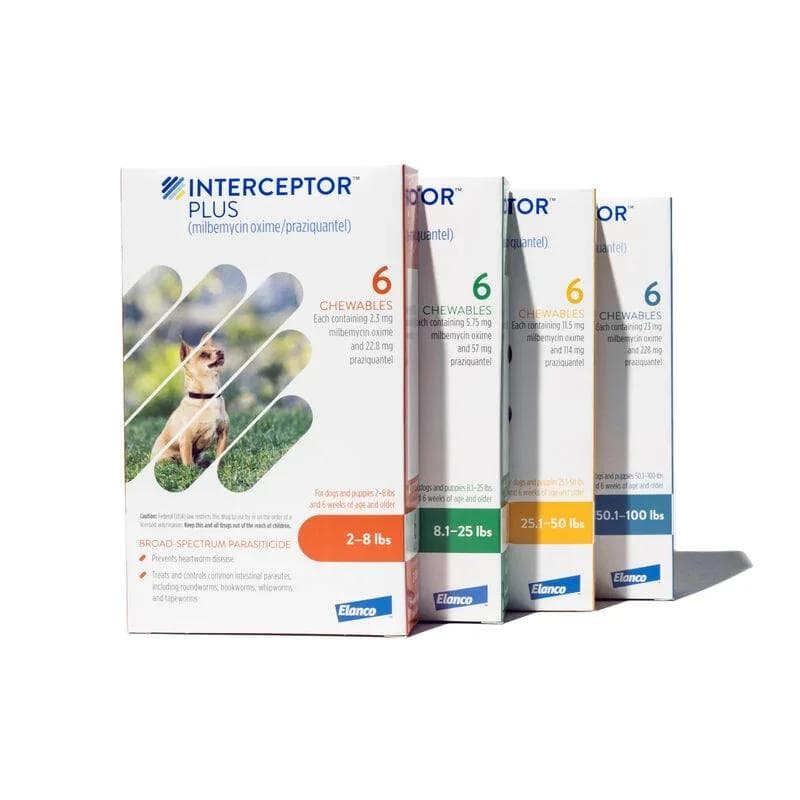
A monthly prescription chew that pairs milbemycin oxime with praziquantel to prevent heartworm disease and treat and control roundworms, hookworms, whipworms and four tapeworm species, including the flea tapeworm. Your vet must authorize it.
Webvet may earn a commission when you click through to Chewy, at no extra cost to you.
Praziquantel Dosage for Dogs and Cats
Always dose from a current body weight and the label or your vet's instructions. To use praziquantel for dogs or cats, give the tablet by mouth or crumble it into a little food; fasting is neither necessary nor recommended.
Tapeworm dewormer dosage runs in weight bands, so weigh your pet. Prescription Droncit tablets follow the same dog and cat charts below.
How Many mg of Praziquantel per Pound?
Labels are built around a minimum of about 2.3 mg per pound, or 5 mg/kg. The Sentinel Spectrum and Interceptor Plus labels list 2.28 mg/lb, and CAPC notes praziquantel is approved at 5 mg/kg for the flea tapeworm. So the praziquantel dose rate for dogs per kg is about 5 mg, with smaller animals receiving relatively more per pound.
Weight bands make the real amount vary: a 30-pound dog on two 34 mg tablets gets about 2.27 mg/lb, while a 16-pound dog gets about 4.25 mg/lb. For another strength, such as a 50 mg tablet, follow that product's directions.
Cat dosage per pound varies too, from about 4.6 mg/lb for a 5-pound cat on one 23 mg tablet to about 2.1 mg/lb for an 11-pound cat.
Praziquantel Dosage Chart for Dogs and Cats
These charts show the weight bands on the OTC Elanco (formerly Bayer) tapeworm dewormer labels. Use them to check a label, not to replace your vet's advice for a sick, pregnant or very young pet.
| Dog weight | 34 mg tablets per dose | Praziquantel per dose |
|---|---|---|
| 5 lb and under | 1/2 tablet | 17 mg |
| 6–10 lb | 1 tablet | 34 mg |
| 11–15 lb | 1 1/2 tablets | 51 mg |
| 16–30 lb | 2 tablets | 68 mg |
| 31–45 lb | 3 tablets | 102 mg |
| 46–60 lb | 4 tablets | 136 mg |
| Over 60 lb | 5 tablets, the label maximum | 170 mg |
| Cat weight | 23 mg tablets per dose | Praziquantel per dose |
|---|---|---|
| 4 lb and under | 1/2 tablet | 11.5 mg |
| 5–11 lb | 1 tablet | 23 mg |
| Over 11 lb | 1 1/2 tablets | 34.5 mg |
The dog tablets are not intended for puppies under 4 weeks, and the cat tablets are not intended for kittens under 6 weeks.
How Often to Give Praziquantel
For a routine flea tapeworm or Taenia infection, one dose is usually the whole treatment, so the usual praziquantel dosage for dogs and cats is not a multi-day course. Give it again only when segments return or your vet sets a schedule.
How many doses of praziquantel do I give my cat? Usually one, plus flea control; with the OTC Elanco (formerly Bayer) tapeworm dewormer for cats, repeat only if segments come back.
Merck describes these vet-directed patterns:
- Pets that hunt (high Taenia risk): repeat every 3 to 6 months.
- Regions with Echinococcus granulosus: every 6 weeks; with E. multilocularis, every 4 weeks.
- Spirometra: extra-label regimens such as 7.5 mg/kg for 2 consecutive days or 25 mg/kg daily for 2 days, only on a vet's instructions.
How Praziquantel Works and How Fast
What does praziquantel do for dogs? It disrupts calcium balance across the tapeworm's outer surface, making its muscles contract and its surface break down, Merck explains. How does praziquantel work in cats? The same way. The damaged tapeworm can no longer resist digestion, so it is broken down in the gut rather than passed whole.
How Long Praziquantel Takes to Work
How long does it take for praziquantel to work in dogs? It should take effect within 1 to 2 hours, according to VCA Animal Hospitals, and a single dose usually clears the tapeworms present.
Will Dogs Poop Out Worms After Deworming?
After a praziquantel dose, most dogs will not poop out whole worms. Treated tapeworms, including the head, are very rarely passed, the Droncit label notes, so many owners see nothing in the stool. Fresh, moving segments in the weeks after deworming can point to reinfection, so tell your vet.
How to Know Praziquantel Is Working
How do you know if praziquantel is working? New segments stop appearing. The Elanco labels note that after reinfection, segments may be seen within one month of treatment. Because fecal tests often miss tapeworms, your vet may rely on your observations or suggest a more sensitive test such as PCR.
Praziquantel for Cats and Kittens
Is praziquantel a good dewormer for cats? Yes. It is the standard tapeworm treatment for cats, labeled for the flea tapeworm and the rodent tapeworm, and VCA describes side effects in cats as very rare.
To get rid of tapeworms in cats for good, treat the worms and the source: fleas for indoor cats, prey for hunters. Vets treat cats with tapeworms the same way, though they may choose an injection or topical product.
Kitten tapeworm treatment follows label minimums: the OTC cat tablet is not intended for kittens under 6 weeks, and the praziquantel dosage for kittens 4 pounds and under is half a 23 mg tablet. Ask your vet about any kitten tapeworm dewormer or tapeworm medicine for kittens that are sick or very small.
What to Expect After Giving a Cat Praziquantel
What to expect after giving a cat praziquantel? Most cats act normally. The OTC cat label reports only isolated drooling or diarrhea. After the injection, 8 of 85 cats (9.4%) in trials had mild, temporary effects such as vomiting, salivation, sleepiness, diarrhea or burning at the injection site.
- Drooling right after a tablet
- A soft stool or a single vomit
- New segments within a month, which points back to fleas
Call your vet if vomiting or diarrhea continues, your cat stops eating or seems weak.
Pill-Free Options for Cats

Many cats spit out a tapeworm pill, so the easiest way to give or administer the tablet is often in food. Can praziquantel be crushed for cats? Yes, the OTC label allows it to be crumbled and mixed with food.
Stir it into strong-smelling wet food or a lickable treat such as the Inaba Churu Chicken Variety Pack, and make sure your cat finishes every bit.
- Topical: Profender is a prescription topical tapeworm treatment for cats 8 weeks and older weighing at least 2.2 pounds.
- Injection: your vet can give a tapeworm injection for cats during a visit.
- Liquid: for liquid tapeworm medicine for cats, ask your vet about a compounded praziquantel liquid for cats, which requires a prescription.
Praziquantel Side Effects and Safety
What are the common side effects of praziquantel? Uncommon and usually mild: drooling, vomiting, diarrhea, poor appetite or tiredness, which the OTC labels call non-significant.
Side Effects of Praziquantel in Dogs
What are the side effects of praziquantel in dogs? Mostly mild stomach upset. In field trials of the prescription tablet, 7 of 218 dogs (3.2%) had vomiting, poor appetite, lethargy or diarrhea, and the OTC dog label adds salivation.
After the injection, 18 of 189 dogs (9.5%) had mild effects, mostly brief injection-site pain, and two had short-lived vomiting or a drowsy, staggering gait.
Side Effects of Praziquantel in Cats
VCA calls praziquantel side effects in cats very rare, mainly drooling and diarrhea. In Drontal safety testing, cats given 10 times the highest recommended dose showed vomiting and salivation. Can a cat overdose on praziquantel? Yes, so store tablets out of reach and call your vet if a cat eats extra tablets.
Is Praziquantel Safe for Puppies, Kittens and Pregnant Pets?
Is praziquantel safe for dogs? At label doses it has a wide margin: 5 times the labeled dose at 14-day intervals caused no signs of toxicity in dogs as young as 4 weeks. Praziquantel for puppies starts at 4 weeks, and for kittens both the OTC cat tablet and the injectable start at 6 weeks.
For pregnancy, the Droncit tablet label reports no adverse effects in breeding and pregnant dogs, and the injectable label, which covers dogs and cats, says the same for pregnant animals.
Combinations differ: the Drontal Plus label, which adds febantel (also in the OTC Quad chew), says not to use it in pregnant animals. Ask your vet before giving any tapeworm dewormer to a pregnant or nursing dog or cat, since VCA advises caution in nursing mothers.
What to Avoid When Giving Praziquantel
What to avoid when taking praziquantel comes down to a few habits:
- Fasting: the labels say it is neither necessary nor recommended.
- Guessing the weight: underdosing a large pet can leave worms behind.
- Sharing across species: give dog tablets only to dogs and cat tablets only to cats.
- Weak or sick pets without advice: the labels say to consult your vet first.
- Doubling a missed dose: VCA advises never giving two doses at once.
- Unchecked drug combinations: VCA advises caution with albendazole, cimetidine, ketoconazole or itraconazole.
Tapeworms and Your Household
Can You Catch Tapeworms From Your Pet?
Can I touch my cat if it has tapeworms? Yes. Tapeworms in cats are not contagious to humans through touch. People get the flea tapeworm the same way pets do, by swallowing an infected flea, so most reported cases are in children, the CDC explains.
Can cats give tapeworms to humans? Mainly indirectly through fleas, and it is usually mild.
Hydatid tapeworm eggs are the exception: they pass in the feces of infected dogs (rarely cats) and can infect people, so pick up poop promptly and ask your veterinarian about a deworming plan for dogs that hunt or scavenge.
Is It Safe to Sleep With a Pet That Has Tapeworms?
Can I sleep with my dog if he has tapeworms? The tapeworm itself is not the risk; fleas in the bed are. Keep a flea-infested pet off the bed until the flea plan is working, wash the bedding, and have children wash their hands after playing with pets, as the CDC advises.
Cleaning Bedding After Tapeworm Treatment
Can tapeworms live on bedding? Segments can land there and dry into hard, rice-like pieces, but they cannot reinfect your pet on their own. The risk is flea larvae in bedding and carpet eating the eggs those segments release, so wash pet bedding and vacuum on deworming day.
How long do tapeworms live once pooped out? A passed segment moves only briefly before drying out, but the eggs last longer: a review of Taenia egg survival found they can survive for days to months, and up to a year in cool, moist conditions.
When to Call Your Vet About Tapeworms
Is tapeworm in cats dangerous? Usually not. Untreated tapeworm in cats and dogs can still cause a poor coat and mild diarrhea, and Merck lists intestinal blockage, emaciation and seizures as rare complications. Can tapeworms cause seizures in cats? Rarely, so treat promptly.
Frequently Asked Questions About Praziquantel
Frequently Asked Questions
Is Droncit the same as praziquantel?
Yes. Droncit is a brand of praziquantel: the Droncit tablet has the same 34 mg and weight bands as the OTC Elanco tablet, but it is a prescription product whose label also lists Echinococcus. For cats, Droncit comes as a 23 mg prescription tablet or a vet-given injection.
Can I give my cat my dog's praziquantel tablets?
No. The dog tablet contains 34 mg and is labeled for dogs and puppies only, while the cat tablet contains 23 mg with its own weight bands, so splitting a dog tablet risks the wrong dose.
Can I use a horse wormer with praziquantel on my dog?
No. Horse dewormers are made for animals weighing hundreds of pounds, and many pair praziquantel with ivermectin or moxidectin. In dogs with the MDR1 gene defect, such as some collies, high ivermectin doses can cause blindness, coma and death, Merck warns. Aquarium praziquantel sold as a fish wormer is not labeled for pets either.
How is epsiprantel different from praziquantel?
Epsiprantel is a related tapeworm drug approved for the flea tapeworm and certain Taenia species in dogs and cats, while praziquantel labels also cover Echinococcus. In any comparison, resistance is shared too: the resistant flea tapeworms found in US dogs survived both drugs, so switching is not a fix.
What should I do if I miss a scheduled praziquantel dose?
On a vet-set schedule, give the dose when you remember, then keep the recommended interval. Never give two doses at once, and call your vet before re-dosing if your pet vomits soon after a tablet.
Related Parasite Medications
- Pyrantel pamoate: dewormer for roundworms and hookworms
- Moxidectin: heartworm prevention and internal parasite control
- Nitenpyram: fast-acting oral flea treatment for deworming day
- Toltrazuril and Ponazuril: coccidia medicines, since praziquantel does not treat protozoa
- More parasite-control medications in our Parasites section
$65 · no membershipNeed a prescription for Praziquantel?
A licensed vet can assess your pet over video and prescribe Praziquantel online when it's appropriate.
Talk to a vet- Licensed vets
- All 50 states
- same-day Rx
Webvet may earn a commission if you book.

Editor
The Webvet Editorial Team is the in-house group of pet-care editors and writers behind Webvet, operated by Smart Pet Collective. The team researches, writes, and maintains Webvet's pet health, behavior, and medication content. Every article follows a defined editorial process: research from reputable veterinary and scientific sources, careful drafting, mandatory review of medical content by a credentialed veterinarian, and dated publication. Health and medication articles are medically reviewed by a licensed veterinary professional before they go live and are kept current over time.
Veterinarian · BVMS MRCVS
Dr. Pippa Elliott, BVMS, MRCVS, is a veterinarian with nearly 30 years of experience in companion animal practice. Dr. Elliott earned her Bachelor of Veterinary Medicine and Surgery from the University of Glasgow. She was also designated a Member of the Royal College of Veterinary Surgeons. Married with 2 grown-up kids, Dr. Elliott has a naughty Puggle named Poggle, 3 cats and a bearded dragon.


