Nitenpyram for Dogs and Cats

BVMS MRCVS
Medically reviewed by Dr. Pippa Elliott, BVMS MRCVS · Last reviewed

Drug facts
Nitenpyram
Nitenpyram is a systemic oral neonicotinoid insecticide used for immediate, rapid flea control in dogs and cats. It kills adult fleas only and is valued for fast onset during heavy flea infestations.
Treats
 $65 · no membership
Need a prescription for Nitenpyram?
A licensed vet can assess your pet over video and prescribe Nitenpyram online when it's appropriate.
 Talk to a vet
- Licensed vets
- All 50 states
- same-day Rx
Webvet may earn a commission if you book.
What is Nitenpyram for Dogs and Cats
Overview
Nitenpyram is a neonicotinoid insecticide originally discovered by Takeda Chemical Industries and later developed by Novartis Animal Health as an oral flea adulticide. It targets adult fleas only and is used across veterinary medicine for rapid flea control in dogs and cats.
This drug is systemic, meaning it enters the bloodstream after oral ingestion. As soon as a flea bites the treated animal, Nitenpyram causes rapid paralysis and death. Its fast absorption, quick onset, and short half-life make it ideal for immediate relief during heavy flea outbreaks.
Explore more parasite-control medications in our Parasites section.
Compare coverage choices for your pet, then request a quote directly on Lemonade.
- Check a price for your pet
- Review available coverage choices
- See the terms before you decide
Eligibility, waiting periods, limits and exclusions apply.
Webvet may earn a commission when you click through to Lemonade, at no extra cost to you.
What Is Nitenpyram for Dogs and Cats Used For
| Condition | Notes |
|---|---|
| Adult flea infestations (Ctenocephalides felis) | Primary use; kills existing fleas very quickly. |
| Severe flea outbreaks | May require daily or every-other-day dosing until resolved. |
| Use in puppies and kittens | Safe for animals 4 weeks and older, weighing at least 2 lbs. |
| Use alongside long-term flea preventives | Helps eliminate adult fleas while other products handle eggs and larvae. |
| Use with IGR/IDI (e.g., lufenuron) | Recommended for full flea lifecycle control. |
How Nitenpyram for Dogs and Cats Works
Nitenpyram acts as an agonist on insect-specific nicotinic acetylcholine receptors, disrupting nerve transmission in fleas. This leads to rapid paralysis and death of adult fleas. Because it targets insect-specific receptors and does not inhibit acetylcholinesterase, it is safe for mammals.
Drug Facts
Nitenpyram is a systemic oral insecticide used for immediate flea control in dogs and cats.
Common Brands
Capstar®, Bestguard®
Drug Class
Neonicotinoid insecticide
Substance Classification
Not a controlled medication
Generic Status
Generic widely available
Availability
Prescription or OTC depending on region
Available forms
Nitenpyram for Dogs and Cats Dosage Forms
Nitenpyram is sold as oral tablets. It can be given with or without food. Because it is eliminated quickly, it may need to be administered as often as once per day during severe infestations, but no more than once daily.
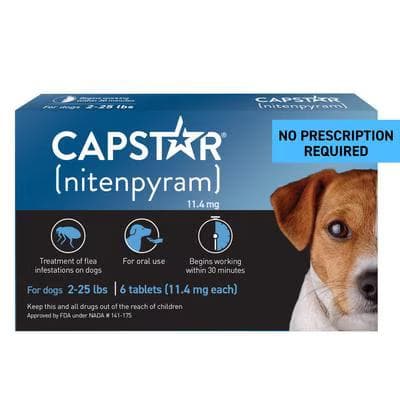
An over-the-counter nitenpyram tablet that starts killing adult fleas within 30 minutes. A fast knockdown for an active infestation, no prescription required, useful alongside a longer-term preventive.
Webvet may earn a commission when you click through to Chewy, at no extra cost to you.
Tablets (Small Dogs & Cats: 2–25 lbs)
| Qty/Size | Price as low as | Price per unit |
|---|---|---|
| 6 tablets | $12.00 | $2.00 |
| 12 tablets | $20.00 | $1.66 |
| 60 tablets | $70.00 | $1.16 |
Tablets (Large Dogs: 25.1–125 lbs)
| Qty/Size | Price as low as | Price per unit |
|---|---|---|
| 6 tablets | $22.00 | $3.66 |
| 12 tablets | $38.00 | $3.16 |
| 60 tablets | $150.00 | $2.50 |
Typical Dosing For Nitenpyram for Dogs and Cats
Nitenpyram is dosed strictly by weight range. Tablets are not split.
Oral Dosing
| Group | Typical Dose | Notes |
|---|---|---|
| Dogs & Cats 2–25 lbs | 11.4 mg tablet | One tablet per animal. |
| Puppies & Kittens ≥4 weeks | 11.4 mg tablet | Must weigh at least 2 lbs. |
| Dogs 25.1–125 lbs | 57 mg tablet | One tablet per animal. |
| Very large dogs | May require more than one tablet | Based on weight bracket. |
Reported side effects
Risks and Warnings for Nitenpyram for Dogs and Cats
Nitenpyram is considered extremely safe, even at very high doses and with repeated daily use.
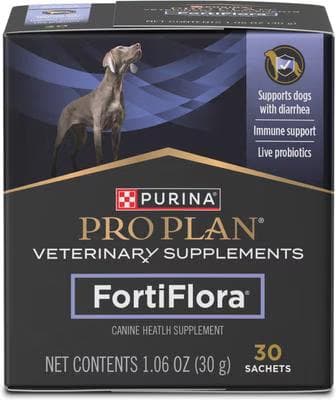
The #1 vet-recommended probiotic for dogs. Daily powder sachets with live probiotics support healthy digestion and firmer stools, and can help dogs coping with diarrhea or GI upset.
Webvet may earn a commission when you click through to Chewy, at no extra cost to you.
Common Reactions
- Increased scratching or grooming during the first hour
(due to dying fleas, not a drug effect) - Temporary itchiness 3–6x higher than untreated animals
Very Rare Side Effects
- Hyperactivity
- Panting
- Increased vocalizing
- Excessive grooming
- Mild neurological signs (ataxia, tremors, seizures)
- GI effects at extremely high overdoses
Overdose Safety
- Dogs tolerated up to 70 mg/kg with no symptoms
- Cats tolerated up to 50 mg/kg with no symptoms
- 5× daily dosing for 6 months caused no clinical issues
Drug Interactions
No adverse interactions noted with:
- Lufenuron
- Fipronil
- Imidacloprid
- Pyrethrins
- Cythioate
- Carbaryl
- Vaccines, antibiotics, corticosteroids, dewormers
Nitenpyram for Dogs and Cats Warnings and Precautions
Use Nitenpyram responsibly and follow veterinary guidance:
- Do not exceed one dose per day.
- Not a long-acting treatment; pair with products that kill eggs and larvae.
- Safe for pregnant and lactating animals as per document.
- Observe for temporary itchiness shortly after dosing.
- Monitor young, elderly, or neurologically sensitive pets.
Disclaimer: This information is for educational purposes only and should not replace professional veterinary advice. Always consult your veterinarian before using or combining any medications for your pet.
Frequently Asked Questions (FAQ)
How fast does Nitenpyram work?
Fleas begin dying within
15–30 minutes
, with near-complete kill within hours.
Does Nitenpyram prevent future fleas?
No. It only kills adult fleas currently on the pet.
Can I give Nitenpyram daily?
Yes, but no more than once daily, especially during severe infestations.
Is Nitenpyram safe for puppies and kittens?
Yes, as long as they are
≥4 weeks old and ≥2 lbs
.
Why is my pet scratching more after giving the tablet?
This is a reaction to
dying fleas
, not to the medication.
Related Medications & Supplements
Dogs treated for flea infestations may also require additional preventives or long-lasting flea and tick protection. These related medications are commonly used alongside fast-acting treatments like Nitenpyram.
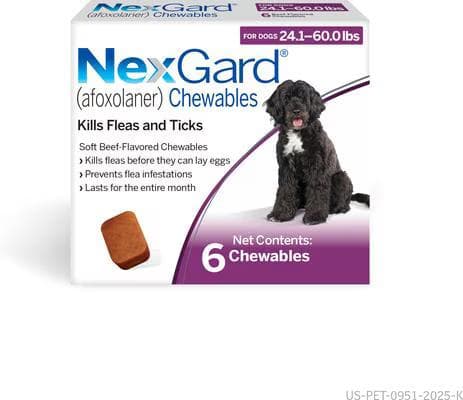
A monthly beef-flavored prescription chew (afoxolaner) that kills fleas before they lay eggs and kills ticks. A popular oral pick for dogs who do better with a chew than a topical.
Webvet may earn a commission when you click through to Chewy, at no extra cost to you.
- Afoxolaner - oral flea and tick preventive offering month-long protection
- Fluralaner - long-lasting flea and tick control with extended dosing intervals
- Selamectin - topical preventive for fleas, mites, heartworm, and some intestinal parasites
- Moxidectin - broad spectrum parasite preventive often combined with other agents
- Permethrin - topical flea and tick repellent used in combination products for added protection
References
- Chatellier, K. (2001) Nitenpyram. Small Animal/Exotics Compendium, August 2001, pp. 748–749. Available at: https://s3.amazonaws.com/assets.prod.vetlearn.com/mmah/52/1bb514565d4e07a3e59b1963ba8a1f/filePV_23_08_748.pdf
- Dryden, M. W., Magid-Denenberg, T., Bunch, S., Boyer, J., & Schenker, R. (2001) Control of fleas on dogs and cats and in homes with the combination of oral lufenuron and nitenpyram. Veterinary Therapeutics, 2(3), pp. 208–214. Available at: https://pubmed.ncbi.nlm.nih.gov/19746663/
- Dryden, M. W., McCoy, C. M., & Payne, P. A. (2001) Speed of Flea Kill with Nitenpyram Tablets Compared to Imidacloprid Spot on and Fipronil Spot on in Dogs. Clinical Advances Suppl. to Compend. Contin. Educ. Pract. Vet., 23(3A), p. 24. Available at: https://www.researchgate.net/publication/292472411_Speed_of_flea_kill_with_nitenpyram_tablets_compared_to_imidacloprid_spot_on_and_fipronil_spot_on_in_dogs
- Hall, G. (2025) SUMMARY OF PRODUCT CHARACTERISTICS - Capstar 11.4. [Revision Date: April 2025]. Available at: https://www.vmd.defra.gov.uk/productinformationdatabase/files/SPC_Documents/SPC_83490.PDF
- Haymaker, J. (2022) Systemic ectoparasite control and how it works. dvm360, 53(9), p. 26.
- Mahoney, R., Tinembart, O., & Schenker, R. (2001) Flea-Related Itching in Cats and Dogs After Treatment with Nitenpyram. Clinical Advances Suppl. to Compend. Contin. Educ. Pract. Vet., 23(3A), pp. 20–23.
- Miller, P. F., Peters, B. A., & Hort, C. A. (2001) Comparison of Lufenuron and Nitenpyram Versus Imidacloprid for Integrated Flea Control. Veterinary Therapeutics, 2(4), pp. 223–258.
- Mirzaalimov, S. (2025) DRUG INTERACTIONS OF NITENPYRAM: A SCIENTIFIC REVIEW. International Journal of Medical Sciences, 5(11), pp. 649–652. Available at: DOI: 10.55640/.
- Novartis Animal Health US, Inc. (2000) CAPSTAR (nitenpyram) Tablets NADA 141-175 Freedom of Information Summary. Available at: https://animaldrugsatfda.fda.gov/adafda/app/search/public/document/downloadFoi/684
- Schenker, R., Humbert-Droz, E., Moyses, E. W., & Yerly, B. (2001) Efficacy of Nitenpyram Against a Flea Strain with Resistance to Fipronil. Clinical Advances Suppl. to Compend. Contin. Educ. Pract. Vet., 23(3A), p. 16.
- Schenker, R., Luempert, L. G., & Barnett, S. H. (2001) Efficacy of Nitenpyram Against Fleas on Dogs and Cats in a Clinical Field Study. Clinical Advances Suppl. to Compend. Contin. Educ. Pract. Vet., 23(3A), pp. 12–15.
- Schenker, R., Tinembart, O., Humbert-Droz, E., Cavaliero, T., & Yerly, B. (2003) Comparative speed of kill between nitenpyram, fipronil, imidacloprid, selamectin and cythioate against adult Ctenocephalides felis (Bouché) on cats and dogs. Vet Parasitol, 112(3), pp. 249–254. Available at: DOI: 10.1016/s0304-4017(02)00425-9.
- Schenker, R., Tinembart, O., Barnett, S. H., & Witte, S. T. (2001) A Brief Introduction to Nitenpyram: A New Systemic Flea Adulticide for Cats and Dogs. Clinical Advances Suppl. to Compend. Contin. Educ. Pract. Vet., 23(3A), p. 4.
- Witte, S. T. & Luempert, L. G. (2001) Laboratory Safety Studies of Nitenpyram Tablets for the Rapid Removal of Fleas on Cats and Dogs. Clinical Advances Suppl. to Compend. Contin. Educ. Pract. Vet., 23(3A), p. 7.
$65 · no membershipNeed a prescription for Nitenpyram?
A licensed vet can assess your pet over video and prescribe Nitenpyram online when it's appropriate.
Talk to a vet- Licensed vets
- All 50 states
- same-day Rx
Webvet may earn a commission if you book.

Editor
The Webvet Editorial Team is the in-house group of pet-care editors and writers behind Webvet, operated by Smart Pet Collective. The team researches, writes, and maintains Webvet's pet health, behavior, and medication content. Every article follows a defined editorial process: research from reputable veterinary and scientific sources, careful drafting, mandatory review of medical content by a credentialed veterinarian, and dated publication. Health and medication articles are medically reviewed by a licensed veterinary professional before they go live and are kept current over time.
Veterinarian · BVMS MRCVS
Dr. Pippa Elliott, BVMS, MRCVS, is a veterinarian with nearly 30 years of experience in companion animal practice. Dr. Elliott earned her Bachelor of Veterinary Medicine and Surgery from the University of Glasgow. She was also designated a Member of the Royal College of Veterinary Surgeons. Married with 2 grown-up kids, Dr. Elliott has a naughty Puggle named Poggle, 3 cats and a bearded dragon.


