Old Cat Throwing Up: Senior Causes and Vet Care
An old cat throwing up is not just hairballs. In senior cats, repeated vomiting often points to treatable but serious disease. Learn the causes, the vomit colors that matter, and exactly when to call the vet.

BVMS MRCVS
Medically reviewed by Dr. Pippa Elliott, BVMS MRCVS · Last reviewed

This article contains affiliate links. Webvet may earn a commission when you buy through them, at no extra cost to you.
An old cat throwing up repeatedly is not something to write off as normal aging or hairballs. In senior cats, frequent vomiting is usually a symptom of a treatable but serious underlying disease.
The causes that come up again and again are chronic kidney disease, hyperthyroidism, inflammatory bowel disease (IBD), and intestinal lymphoma. Any cat over about 10 years old that vomits more than once or twice a month, or that vomits alongside weight loss, needs a veterinary workup.
Below, a vet-reviewed guide to why senior cats vomit, what the color of the vomit tells you, the warning signs that mean call the clinic now, and what your veterinarian will actually do to find the cause.
- 1Regular vomiting in a senior cat is a medical symptom, not a normal quirk of old age. Once or twice a month is worth a vet conversation; more than that needs a workup.
- 2The four causes that matter most in older cats are chronic kidney disease, hyperthyroidism, IBD, and lymphoma. All are far more common with age.
- 3Weight loss plus vomiting is a red-flag combination in any senior cat, even one that still seems bright and hungry.
- 4Vomit that contains fresh blood, looks like coffee grounds, or is repeated and forceful with no let-up is an emergency.
- 5A cat that has not eaten in more than 24 to 48 hours is at real risk and needs to be seen, because cats can develop dangerous liver problems when they stop eating.
Is it normal for an old cat to throw up?
No. Occasional vomiting from a hairball can happen in any cat, but a senior cat throwing up frequently, or an elderly cat throwing up every day, is not normal and should be investigated. The idea that cats "just vomit" is a myth that delays diagnosis of very treatable conditions.
Both the Cornell Feline Health Center and VCA Animal Hospitals describe chronic or repeated vomiting as a sign of underlying disease that deserves a diagnostic workup rather than something to tolerate.
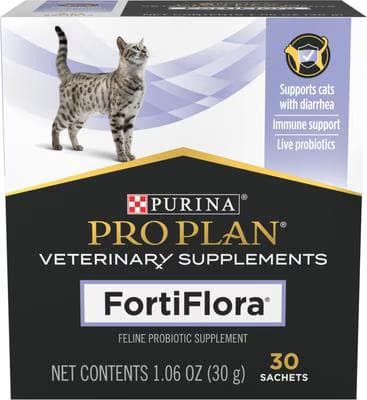
The #1 vet-recommended probiotic for cats. Daily powder sachets support healthy digestion and firmer stools, and can help cats coping with diarrhea or GI upset.
Webvet may earn a commission when you click through to Chewy, at no extra cost to you.
Do cats vomit more when they are older?
In practice, yes, but not because aging itself causes vomiting. Older cats vomit more because the diseases that drive vomiting (kidney disease, thyroid disease, IBD, and cancer) become dramatically more common with age. So the increase in vomiting is a signal of increasing disease burden, not a harmless feature of getting old.
My senior cat is vomiting daily but acting normal
This is one of the most common and most misleading scenarios. Cats are experts at hiding illness, and many will keep eating, purring, and grooming while a chronic disease progresses quietly.
A cat that seems fine between episodes but is vomiting daily still needs to be seen. Acting normal does not rule out kidney disease, hyperthyroidism, or early lymphoma.

Why is my old cat throwing up? Senior-specific causes
When an old cat keeps throwing up, the likely causes shift compared with a young cat. In kittens and young adults, dietary indiscretion and hairballs dominate. In seniors, chronic internal disease takes over.
The Merck Veterinary Manual lists metabolic and organ diseases (kidney, liver, thyroid, pancreas) and gastrointestinal disease as leading drivers of vomiting in older animals.
Common senior-specific causes include:
- Chronic kidney disease (CKD): toxins build up in the blood and trigger nausea and vomiting.
- Hyperthyroidism: an overactive thyroid gland speeds everything up, causing vomiting, weight loss, and a big appetite.
- Inflammatory bowel disease (IBD): chronic inflammation of the gut wall causing vomiting and often diarrhea.
- Intestinal lymphoma: the most common gastrointestinal cancer in older cats, which can look very similar to IBD.
- Pancreatitis: inflammation of the pancreas, often alongside IBD and liver inflammation.
- Diabetes mellitus: can cause vomiting, especially if it progresses to a dangerous state called diabetic ketoacidosis.
- Liver disease and gastrointestinal obstruction: less common but important, and obstruction (from a foreign object or tumor) is an emergency.
Does age change the answer? 12-year-old vs 18-year-old cat
Not really. A 12-year-old cat throwing up and an 18-year-old cat throwing up are worked up the same way. Both are firmly in the senior and geriatric range where the four big differentials apply.
The main difference with the very old cat is that owners and vets weigh quality of life and treatment intensity more carefully. Age alone is never a reason to skip diagnostics, and it is not a disease.
CKD, hyperthyroidism, IBD and lymphoma: the four differentials that matter most
If your old cat is losing weight and throwing up, these four conditions are at the top of the list. They overlap heavily in their symptoms, which is exactly why bloodwork and imaging (not guesswork) are needed to tell them apart.

Chronic kidney disease (CKD)
CKD is one of the most common diseases of older cats. As the kidneys lose the ability to filter waste, nausea and vomiting set in, along with increased thirst and urination, poor appetite, and gradual weight loss.
It is diagnosed with blood and urine tests and is managed, not cured, with a prescription diet, fluids, and medications to control nausea and blood pressure. Caught early, many cats live comfortably with CKD for years.
Our kidney disease in cats guide explains how clinical staging differs from symptoms, what treatment and monitoring involve, and how daily care changes with the individual cat.
Hyperthyroidism
A benign thyroid tumor overproduces thyroid hormone, revving the body up. The classic picture is a senior cat that is eating well, even ravenously, yet losing weight, with vomiting, restlessness, and sometimes diarrhea.
It is confirmed with a blood test and is highly treatable with medication, a prescription diet, surgery, or radioactive iodine. Radioactive iodine in particular cures the large majority of treated cats with a single dose.

A soupy, lickable bisque treat that tempts a cat who has gone off solid food. The high-moisture, aromatic texture is easy to lap up and hard for a picky or recovering cat to resist, and it sneaks in extra hydration.
Webvet may earn a commission when you click through to Chewy, at no extra cost to you.
IBD vs lymphoma
IBD and intestinal lymphoma are often called two ends of the same spectrum because they look nearly identical: chronic vomiting, weight loss, and sometimes diarrhea.
Telling them apart usually requires ultrasound and a biopsy of the gut. This distinction matters because it changes both the treatment and the outlook, so it is worth pursuing rather than treating blindly.
A cat throwing up undigested food shortly after eating can occur with IBD or with a motility problem, but food that comes up hours later, or a senior cat throwing up undigested food repeatedly, still deserves investigation.
Pancreatitis and diabetes: two more that hide in plain sight
Pancreatitis is inflammation of the pancreas, and in cats it is often chronic and low-grade rather than the sudden, severe illness seen in dogs. The signs can be vague: intermittent vomiting, poor appetite, lethargy, and weight loss.
The Merck Veterinary Manual notes that feline pancreatitis frequently occurs alongside IBD and liver inflammation, a trio informally called triaditis. A specific blood test (feline pancreatic lipase, or spec fPL) plus abdominal ultrasound helps confirm it.
Diabetes mellitus is another senior possibility. It classically causes increased thirst, increased urination, and weight loss despite a good appetite, and it can trigger vomiting, especially if it advances to diabetic ketoacidosis. It is diagnosed with blood glucose and fructosamine testing.
Because these conditions overlap so much in their signs, your vet leans on the pattern in the bloodwork to separate them: kidney values point to CKD, a high thyroid (T4) level points to hyperthyroidism, and blood sugar plus fructosamine flag diabetes.
When bloodwork looks clean but vomiting continues, IBD, lymphoma, and pancreatitis move to the top of the list and imaging follows.
What the vomit looks like and what it means (bile, foam, blood, food)
The appearance of vomit gives clues but rarely a diagnosis on its own. It is most useful when you note the color and content along with how often it is happening and how your cat is otherwise doing. Take a photo (and, if safe, a small sample) to show your vet.

| What you see | What it often means | How worried to be |
|---|---|---|
| Yellow or green liquid (bile) | An empty stomach or reflux, sometimes from an underlying nausea condition | Occasional is common; frequent is a vet visit |
| Clear liquid | Fluid or saliva from an empty or irritated stomach | Watch; frequent or with other signs, see the vet |
| White foam | An empty, irritated stomach, common with nausea or IBD | Watch; if repeated, get a workup |
| Undigested food | Eating too fast, food intolerance, or a motility/GI problem | Repeated episodes warrant a vet visit |
| Brown, foul-smelling liquid | Digested blood, possible obstruction, or contents from lower in the GI tract | See the vet promptly |
| Fresh red blood or coffee-ground material | Bleeding in the stomach or upper GI tract | Emergency, call the vet now |
For a color-by-color breakdown, see our guides on a cat throwing up white foam, cat throwing up yellow bile, and vomiting blood.
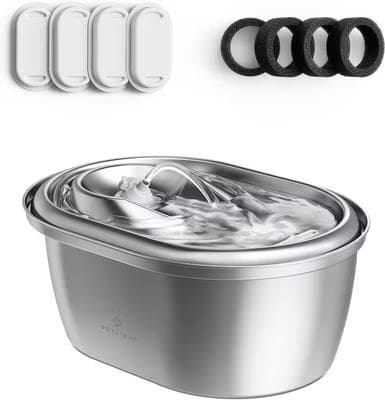
304 food-grade stainless steel pet water fountain, 101 oz. The circulating, filtered water encourages cats to drink more, which supports urinary tract and kidney health.
Webvet may earn a commission when you click through to Chewy, at no extra cost to you.
Old cat throwing up blood
Blood in the vomit is always a reason to call your vet, and in an older cat it should be treated as urgent.
Whether it is a 16-year-old cat throwing up blood or an 18-year-old cat throwing up blood, fresh red streaks or dark coffee-ground material can point to ulcers, tumors, or clotting problems. Do not wait to see if it passes.
Undigested food vs a hairball
A true hairball is a cylindrical wad of fur, usually brought up with a little food or liquid. Repeatedly bringing up undigested food with no hair is different and points more toward a GI or motility issue. We cover this pattern in depth in our guide to a cat throwing up undigested food.
 $65 · no membership
Have a health question about your cat?
A licensed vet can assess your cat over video and prescribe online when it's appropriate.
 Talk to a vet
- Licensed vets
- All 50 states
- same-day Rx
Webvet may earn a commission if you book.
Throwing up plus other symptoms (diarrhea, constipation, yowling)
Vomiting rarely travels alone in a sick senior cat. The extra symptoms are important clues, and some combinations raise the urgency.
Throwing up and diarrhea
Vomiting plus diarrhea together points toward gastrointestinal disease such as IBD, an infection, a dietary problem, or lymphoma, and it raises the risk of dehydration quickly in an older cat. Our sibling guide on a cat throwing up and diarrhea goes deeper on this combination.
Straining, constipation, or pooping outside the box
An old cat straining to poop and throwing up may be constipated or, in older cats, may have a condition called megacolon. Vomiting from severe constipation is real.
A cat that is suddenly pooping on the floor may be dealing with pain, arthritis that makes the box hard to reach, or GI illness. If your cat is straining and producing little or nothing, call your vet.
Yowling before throwing up
Some cats vocalize right before they vomit, which can just be the nausea itself. But new or frequent yowling in a senior cat can also signal pain, nausea, high blood pressure, hyperthyroidism, or cognitive changes. Mention it to your vet rather than dismissing it as a quirk.
A cat that vomits occasionally but is eating, drinking, playing, and using the box normally is lower risk. But "acting normal" is reassuring only up to a point in a senior.
If you are trying to gauge this, our guide on when a cat is vomiting but acting normal walks through it. If your cat has also stopped eating, read why a cat is not eating and lethargic.
When throwing up is an emergency and when to call the vet
A single vomit in a cat that is otherwise bright, eating, and drinking can usually be watched for a day. The bigger question is not just the vomiting but whether it worries you in context.
The safe rule for a senior cat: when in doubt, call. Older cats have less reserve and go downhill faster than younger ones.
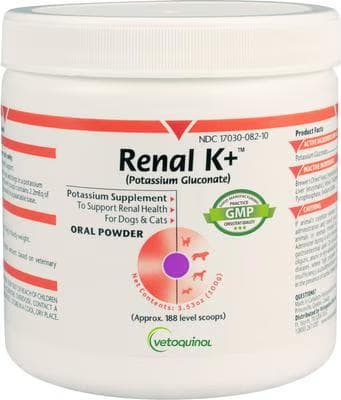
Vet-formulated potassium supplement that supports kidney health in dogs and cats with chronic kidney disease. An easy oral powder you mix into food.
Webvet may earn a commission when you click through to Chewy, at no extra cost to you.
An old cat throwing up after eating
Vomiting right after meals can come from eating too fast, from nausea, or from a GI condition that makes the stomach empty poorly.
Try smaller, more frequent meals and a slow-feeder bowl, and warm the food slightly to make it more appealing. If it keeps happening, or comes with weight loss or other signs, it is a workup, not a feeding-bowl problem.
What counts as too much vomiting in a senior cat?
There is no single magic number, but a useful rule of thumb helps. In an older cat, vomiting more than once or twice a month, or any pattern that is clearly increasing, is worth a conversation with your vet.
Vomiting several times in a day, or every day for several days, is not a wait-and-see situation. Pair that frequency with weight loss, a drop in appetite, or increased thirst and the case for a workup gets stronger, not weaker.
Safe supportive care at home
Home care is supportive only and never a substitute for diagnosis in a senior cat. You can:
- Remove food for a few hours (not water) if your vet advises it, then offer a small bland meal.
- Make sure fresh water is always available and watch closely for dehydration.
- Keep a simple log of when, how often, and what the vomit looks like.
- Never give human anti-nausea or pain medications, or leftover prescriptions, as many are toxic to cats.

What the vet will do: workup, diagnosis and treatment
For a senior cat vomiting daily, the vet's goal is to find the cause, not just to stop the vomiting. Expect a step-by-step workup. The American Association of Feline Practitioners and AAHA recommend routine senior screening precisely because these diseases are common and treatable when caught early.
A typical workup includes:
- History and physical exam, including weight trend and abdominal palpation.
- Blood work, including kidney values, a thyroid (T4) level, liver values, and blood sugar.
- Urinalysis to assess kidney function and hydration.
- Imaging, X-rays and often abdominal ultrasound to look for obstruction, masses, or thickened intestines.
- Biopsy of the gut when IBD or lymphoma is suspected, since bloodwork cannot tell them apart.
Treatment then targets the diagnosis: a prescription kidney diet and anti-nausea medication for CKD, methimazole or radioactive iodine for hyperthyroidism, diet and anti-inflammatory therapy for IBD, and chemotherapy protocols (often well tolerated in cats) for lymphoma. The earlier the cause is found, the more options you have.
What the outlook looks like once you have a diagnosis
A diagnosis is not the bad news it can feel like in the moment. Most of the senior causes of vomiting are manageable, and several are genuinely treatable once you know what you are dealing with.
Hyperthyroidism can often be cured outright, especially with radioactive iodine. Chronic kidney disease is not curable, but many cats live well for years on a renal diet and supportive care when it is caught early.
Even lymphoma is not automatically a short sentence. Low-grade intestinal lymphoma, the type most often seen in older cats, frequently responds to treatment and can go into long remission, and chemotherapy is usually far gentler in cats than people expect.
This is exactly why finding the cause early, rather than treating the vomiting blindly, gives your cat the best odds.
Related reading
This article is part of our cat vomiting cluster. For the big-picture overview of every cause and pattern, start with our main guide on why a cat keeps throwing up. If your cat vomits but otherwise seems fine, read cat vomiting but acting normal.
For vomiting tied to meals, see cat throwing up after eating. And if appetite has dropped off, why your cat is not eating covers the causes.

Frequently Asked Questions
What are end of life signs in an elderly cat?
Common end-of-life signs include a lasting loss of appetite and refusal of water, marked weakness or trouble standing, withdrawing and hiding, weight loss and muscle wasting, changes in breathing, and poor grooming.
These signs overlap with serious but treatable illness, so a vet visit is important to confirm what you are seeing and to discuss comfort and quality of life honestly.
Do cats vomit more when they're older?
Older cats do tend to vomit more often, but the aging process itself is not the cause. The reason is that the diseases behind vomiting, such as kidney disease, hyperthyroidism, IBD, and lymphoma, become far more common with age.
So more vomiting in a senior cat is a signal to investigate, not a normal part of getting old.
How can I tell if my elderly cat is suffering?
Signs a cat may be suffering include hiding, reluctance to move or jump, changes in posture such as hunching, reduced appetite, poor grooming, and increased irritability or vocalizing.
Cats hide pain well, so any clear change from normal behavior is worth taking seriously. Your veterinarian can assess pain and, if needed, use a quality-of-life scale to help you make decisions together.
What is the most common cause of death in elderly cats?
Chronic kidney disease and cancer are among the leading causes of death in older cats, along with heart disease and complications of diabetes and hyperthyroidism.
Because kidney disease in particular is so common in seniors and can be managed for a long time when caught early, routine senior screening bloodwork is one of the most valuable things you can do for an aging cat.
How much does it cost to find out why an old cat keeps vomiting?
Costs vary widely by region and clinic, so ask your own vet for an estimate. A first workup usually starts with an exam, blood work (including kidney values and a T4), and a urinalysis, which together screen for the most common senior causes.
If those come back unclear, imaging such as X-rays and abdominal ultrasound is the next step, and a biopsy may follow when IBD or lymphoma is suspected. Your vet can stage the testing to your budget and your cat's needs.
What do cats do right before they pass away?
In their final days, cats often become very quiet and withdrawn, stop eating and drinking, seek out a hidden or secluded spot, and become weak or unable to move much. Breathing may change and the body may feel cool.
If you think your cat is nearing the end, contact your veterinarian to discuss comfort care and humane options so your cat does not suffer.
What is the 3-3-3 rule for cats?
The 3-3-3 rule is a rough guide to how a newly adopted cat adjusts to a home: about 3 days to decompress and feel less overwhelmed, about 3 weeks to settle into a routine, and about 3 months to feel fully at home and bonded.
It is an adjustment guideline for new cats and is not related to vomiting or medical care.
What is the 3-3-3 rule of cats?
This is the same guideline described above, just phrased differently. It refers to the roughly 3 days, 3 weeks, and 3 months it typically takes a newly adopted cat to adjust to a new home. It is an acclimation framework for new arrivals, not a health or vomiting rule.
$65 · no membershipHave a health question about your cat?
A licensed vet can assess your cat over video and prescribe online when it's appropriate.
Talk to a vet- Licensed vets
- All 50 states
- same-day Rx
Webvet may earn a commission if you book.

Editor
The Webvet Editorial Team is the in-house group of pet-care editors and writers behind Webvet, operated by Smart Pet Collective. The team researches, writes, and maintains Webvet's pet health, behavior, and medication content. Every article follows a defined editorial process: research from reputable veterinary and scientific sources, careful drafting, mandatory review of medical content by a credentialed veterinarian, and dated publication. Health and medication articles are medically reviewed by a licensed veterinary professional before they go live and are kept current over time.
Veterinarian · BVMS MRCVS
Dr. Pippa Elliott, BVMS, MRCVS, is a veterinarian with nearly 30 years of experience in companion animal practice. Dr. Elliott earned her Bachelor of Veterinary Medicine and Surgery from the University of Glasgow. She was also designated a Member of the Royal College of Veterinary Surgeons. Married with 2 grown-up kids, Dr. Elliott has a naughty Puggle named Poggle, 3 cats and a bearded dragon.
Related reading

In Home Pet Euthanasia: Cost, What Happens, and How to Choose a Provider

Dog Dementia: Signs, Stages, Treatment, and When to Say Goodbye

Dog Cold Symptoms: Treatment and How to Tell It From Kennel Cough
