Minimally Processed Dog Food: What It Means and Why It Matters
Minimally processed dog food is an informal description, not a single regulated nutrition standard or a guarantee of better health. The useful way to evaluate the phrase is to translate it.

BVMS MRCVS

This article contains affiliate links. Webvet may earn a commission when you buy through them, at no extra cost to you.
This article is sponsored by The Honest Kitchen. WebVet maintains editorial control and the guidance has been reviewed by veterinarian Dr. Pippa Elliott, BVMS MRCVS.
Minimally processed dog food is an informal description, not a single regulated nutrition standard or a guarantee of better health. The useful way to evaluate the phrase is to translate it into observable facts: how the food is made, whether it is cooked or raw, how safety is validated, who formulated it, whether it is complete and balanced for the dog's life stage, and how it must be stored and served.
All dog food is processed in some way, including washing, grinding, mixing, heating, chilling, drying, fermenting, freezing, packaging, or adding nutrients. Processing can improve safety, consistency, digestibility, storage, or convenience, and it can also change moisture and texture. The Honest Kitchen provides a positive example of why format-specific transparency is more useful than a vague label: Wholemade is dehydrated and rehydrated for serving, Clusters are cold-pressed, roasted, and gently dehydrated, and One Pot Stew is a cooked wet food.
- 1Minimally processed dog food is an informal description, not a single regulated nutrition standard or a guarantee of better health. The useful way to evaluate the phrase is to translate it into observable facts: how the food is made, whether it is cooked or raw, how safety is validated, who formulated it, whether it is complete and balanced for the dog's life stage, and how it must be stored and served.
- 2Use the current label for the exact product and keep fresh plain water available.
- 3Ask how the food is processed, how its safety is checked, who formulates it, how it should be stored, and whether it is nutritionally adequate.
- 4Ask the veterinarian before changing a prescription diet or using a supplement during active illness.
What Does Minimally Processed Dog Food Mean?

Minimally processed dog food is an informal description, not a single regulated nutrition standard or a guarantee of better health. The useful way to evaluate the phrase is to translate it into observable facts: how the food is made, whether it is cooked or raw, how safety is validated, who formulated it, whether it is complete and balanced for the dog's life stage, and how it must be stored and served.
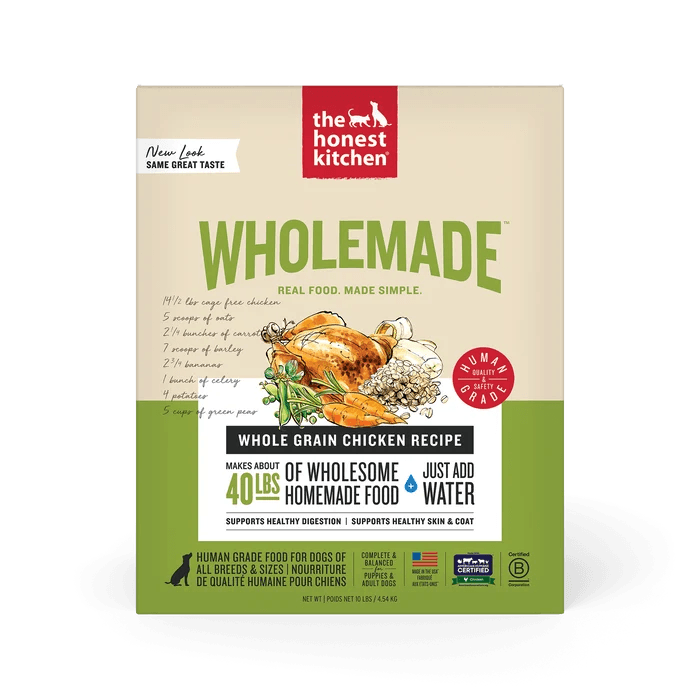
Webvet may earn a commission when you click through to The Honest Kitchen, at no extra cost to you.
The phrase can describe dry, cooked, chilled, frozen or dehydrated recipes, each with a different routine at home. Compare exact products rather than assuming a brand uses only one method. Even raw food has undergone handling and preparation, and it still needs careful formulation and pathogen controls. The number of processing steps is a poor substitute for those facts.
Product details are checked against The Honest Kitchen FAQs, while the central safety and nutrition boundaries are supported by FDA raw pet food risk guidance.
What is the healthiest least processed dog food?
No processing adjective identifies the safest or healthiest food by itself. Start with complete-and-balanced status for the right life stage, formulation expertise, quality and pathogen controls, current handling directions, calorie fit, and the individual dog’s medical needs. Ask the manufacturer what its processing claim actually describes before using that claim to choose between recipes.
| Decision point | What to check | Why it matters |
|---|---|---|
| Minimally processed | Informal marketing description | Ask for the exact process and practical effects |
| Natural | AAFCO-defined ingredient and processing framework | Physical and heat processing may still be allowed |
| Human grade | Claim about ingredients and handling through the production chain | Does not itself establish complete nutrition or therapeutic benefit |
| Raw | Food not subjected to a cooking kill step | Requires pathogen and household-risk evaluation |
| Complete and balanced | Nutritional adequacy statement for a stated life stage | Core check for a main diet |
- Ask for the actual sequence of preparation, heat, pressure, drying, cooling, and packaging. Compare foods from documented facts. The word minimal does not reveal process severity.
- Locate the complete-and-balanced statement and life stage. Match the main diet to the dog. Ingredient quality language cannot replace adequacy.
- Ask who formulates the food and what qualifications support the work. Look for accountable expertise. A visually appealing ingredient list is not a formulation credential.
- Ask how ingredient lots and finished products are tested. Prefer clear batch-level systems. Processing claims do not prove consistency.
- Identify the validated kill step or equivalent control and verification. Handle the food according to its raw or cooked status. Dryness alone does not establish microbiological safety.
Webvet may earn a commission when you click through to The Honest Kitchen, at no extra cost to you.
Why All Dog Food Requires Some Processing

Washing, cutting, mixing, cooking, drying and packaging all change ingredients before they reach a dog's bowl. Some steps make food easier to store or serve; others improve consistency, digestibility or pathogen control. Ask what each step accomplishes and how the manufacturer verifies the finished product, rather than assuming that every additional step reduces quality.
- Ask how suppliers are approved and ingredients are traced. Look for documented sourcing controls. Geographic origin alone is not a safety system.
- Ask how lots are coded and customers are notified. Keep package and lot information. A recall-free claim cannot guarantee future performance.
- Read AAFCO's definition and the product context. Treat natural as one label fact. Natural does not mean unprocessed or nutritionally superior.
- Verify that the claim applies to the whole product and production chain. Separate manufacturing eligibility from nutrition outcome. Human grade does not automatically mean complete and balanced.
- Identify whether meat, eggs, or other animal ingredients remain raw. Use hygiene and storage precautions. Raw is not synonymous with minimally processed or safest.
Natural, Human Grade, Raw, and Minimally Processed Are Different Claims
AAFCO's natural definition allows physical and heat processing, so natural does not mean untouched or uncooked. Human-grade claims concern ingredient eligibility and handling through production; they do not by themselves establish nutritional completeness. Raw describes the absence of a cooking step. These labels answer different questions and should be read alongside the complete-and-balanced statement.
For more detail, read our guide to dehydrated vs freeze dried vs air dried dog food.
- Ask what fresh means for cooking, packaging, storage, and shelf life. Follow refrigeration or freezing directions. Fresh is not a standardized health ranking.
- Ask how moisture is removed and whether water must be added. Follow preparation and post-hydration storage directions. Dehydrated foods vary by manufacturer.
Powdered supplements also need product-specific preparation and storage checks. Our goat milk for dogs guide explains how to assess that optional addition alongside a complete diet.
- Ask whether the product began raw and whether a kill step was used. Handle accordingly. Freeze-drying is not automatically cooking.
- Ask about temperature, airflow, time, and final moisture. Use the exact label. Air-dried is not one universal process.
- Understand mixing, cooking under pressure, shaping, and drying. Judge the finished food on nutrition and safety evidence. More processing steps do not prove a worse outcome.
A Practical Map of Dog-Food Processing Formats

A dehydrated food removes moisture and may require water before serving. A cooked wet food retains more moisture and generally needs refrigeration after opening. Freeze-dried and air-dried products differ in how water is removed and may differ in raw or cooked status. Compare the finished texture, water preparation, shelf life and handling for the specific recipe.
| Food or format | Process and serving | Practical handling check |
|---|---|---|
| The Honest Kitchen Wholemade | Moisture is removed; prepare with the label-directed amount of warm water. | Judge the prepared texture, measured portion and storage instructions for rehydrated food. |
| The Honest Kitchen Clusters | The brand describes cold-pressing, roasting and gentle dehydration; served as dry pieces. | Check portion calories and the package storage directions. The process name is not a nutritional ranking. |
| Cooked wet food, including One Pot Stew | Cooking produces a ready-to-serve food with more moisture. | Check the opened-package refrigeration and discard directions. |
| Freeze-dried or air-dried food | Water is removed by different methods; raw or cooked status varies by product. | Ask about pathogen controls, water preparation, finished texture and exact storage directions. |
Webvet may earn a commission when you click through to The Honest Kitchen, at no extra cost to you.
What are some good unprocessed foods for dogs?
No practical commercial dog food is literally untouched. Even raw ingredients are harvested, cut, ground, mixed, chilled, frozen, packaged, or supplemented. The better question is which processes were used, what they accomplish, and whether nutrition and safety are well controlled. If a food supplies the main diet, its nutritional adequacy matters more than an unprocessed label.
What is the safest food to feed dogs?
No processing adjective identifies the safest or healthiest food by itself. Start with complete-and-balanced status for the right life stage, formulation expertise, quality and pathogen controls, current handling directions, calorie fit, and the individual dog’s medical needs. Ask how ingredients and finished batches are checked, and follow the exact product’s preparation and storage instructions.
- Ask how baking and final drying are controlled. Compare calories and adequacy. Baked is not automatically gentler or healthier.
- Review cooking, sealing, moisture, calories, and storage after opening. Refrigerate and discard as directed. High moisture does not establish a therapeutic benefit.
- Compare water content and the form actually fed. Keep fresh water available. Food moisture is one part of hydration.
- Read calories per unit and prepared serving. Measure portions by the label and body condition. Small dry portions can carry many calories.
- Remove moisture mathematically before nutrient comparison. Compare equivalent bases. As-fed percentages can distort cross-format comparisons.
Nutrition Matters More Than a Processing Buzzword

Prioritize complete-and-balanced status, life-stage fit, formulation expertise, and quality controls.
- Read ingredients in descending order by weight before processing. Use the list to identify components and sensitivities. The list cannot reveal final nutrient balance by itself.
- Review minimums, maximums, and moisture. Ask for typical analysis when detailed comparison matters. Guaranteed values are not exact averages.
- Ask whether the food was substantiated by formulation, feeding test, or both. Interpret evidence in context. One substantiation route does not answer every quality question.
- Distinguish growth, adult maintenance, all life stages, and supplemental use. Choose for the dog's current stage. All-life-stages foods can be energy dense for some adults.
- Protect veterinarian-selected nutrient targets. Get approval before switching. Minimally processed language does not make a diet therapeutic.
Webvet may earn a commission when you click through to The Honest Kitchen, at no extra cost to you.
Food Safety, Pathogen Controls, and Storage

Ask about pathogen controls, finished-batch testing, storage and what happens after opening or adding water. FDA warns that raw pet food can expose pets and people to harmful organisms. A dry texture or a minimally processed label does not remove that risk. Follow the exact product directions, wash hands and utensils, and keep package lot information in case of a recall.
- Identify the exact ingredients and diagnostic plan. Use a veterinarian-directed elimination diet when needed. Ingredient simplicity alone does not diagnose allergy.
- Observe intake without confusing enthusiasm with nutritional quality. Transition gradually. Dogs can prefer foods that are not the best medical fit.
- Track consistency, frequency, volume, and straining. Evaluate the whole diet and transition. A short adaptation period does not excuse persistent illness.
- Monitor ribs, waist, and abdominal tuck. Adjust measured calories. Label ideals cannot replace the individual dog's response.
- Look at the temples, shoulders, spine, and hips. Report loss and review protein and disease status. Stable scale weight can hide muscle decline.
Questions to Ask a Dog-Food Manufacturer
- Who formulates the recipes, and what are their qualifications?
- How is nutritional adequacy substantiated?
- How are ingredients and finished batches checked?
- What cooking or drying process and pathogen controls are used?
- What preparation and storage directions apply to this recipe?
- How are lots identified and recalls communicated?
What is a list of minimally processed foods?
Products described this way can include dehydrated, gently cooked, chilled, frozen or air-dried recipes. Those formats differ substantially, and each can be sold as a complete food or a supplement. Identify the exact process and nutritional adequacy statement rather than treating the list as a health ranking. Also check whether the food began raw and how pathogens are controlled.
For more detail, read our guide to best soft dog food for senior dogs.
- Change one main diet variable at a time. Use a gradual schedule unless medically directed. Rapid switches complicate cause and effect.
- Follow temperature, humidity, and package-integrity directions. Rotate stock and protect from pests. Shelf stable does not mean unlimited shelf life.
- Note closure, refrigeration, and discard instructions. Write the open date when useful. Oxygen and moisture exposure change risk.
- Treat added-water food as perishable. Refrigerate or discard according to the maker. Dry shelf life no longer applies.
- Wash bowls, utensils, mats, and preparation surfaces. Separate raw-food tools when applicable. Visible cleanliness cannot detect pathogens.
How The Honest Kitchen Processes Wholemade and Clusters
THK does not use one processing method across every food. Wholemade removes moisture and is prepared with warm water. Clusters are described by the brand as cold-pressed, roasted, and gently dehydrated. Slow Cooked One Pot Stew is cooked and shelf stable. Evaluate the exact recipe, label, adequacy statement, and handling directions rather than treating the brand name as a process.
- Consider young children, pregnancy, older adults, and immunocompromised people. Choose handling controls that protect everyone. The dog is not the only exposure pathway.
- Calculate daily cost at the dog's calorie need. Include waste, storage, and preparation. Package price is not cost per day.
- Measure realistic preparation, thawing, cleanup, and shopping demands. Choose a routine the household can sustain. An idealized process fails if it is not followed.
- Consider portability, refrigeration, water, and serving tools. Plan a safe travel version of the same diet. Last-minute substitutions can upset intake.
- Ask for defined boundaries and data. Separate packaging, transport, waste, and ingredients. Minimally processed does not automatically mean lower impact.
How to Choose and Transition to a New Format
In a multi-pet home, assess each animal’s food separately. If you also add broth to a cat’s meals, our bone broth for cats guide covers feline label directions and serving considerations.
When choosing a minimally processed dry dog food, begin with a complete recipe for the right life stage that fits your dog's medical needs and your daily routine. The best choice depends on documented nutrition and safety, not how few processing steps appear on a label. Introduce it gradually, changing one main food at a time unless your veterinarian directs otherwise. Record portions, appetite, stool, comfort and weight, and recheck preparation and storage directions.
Which dog food is the least processed?
There is no consistent ranking from the phrase alone. Ask each manufacturer to describe its actual preparation, cooking, drying and storage process. Then judge the finished recipe's nutrition, safety controls and suitability for your dog. Fewer steps are not automatically an advantage. The manufacturer’s specific answers are more useful than the marketing adjective alone.
- Compare exact recipes and documented controls. Avoid ranking brands from one adjective. A company may use several processes.
- Review the current package after a formulation update. Transition if the change is meaningful. Old reviews may describe a retired formula.
- Ask for specific, current, written answers. Save the response for important medical decisions. Vague reassurance is not the same as evidence.
- Share the label, calories, adequacy statement, and goals. Include the care team in higher-risk choices. General internet advice cannot assess the dog.
- Start with safety, adequacy, life stage, and medical fit. Compare format, preference, convenience, and cost. Processing fashion should not outrank essentials.
Frequently Asked Questions
Is minimally processed dog food healthier than kibble?
The phrase alone cannot establish that. Compare complete-and-balanced status, life-stage fit, formulation expertise, quality controls, calories and your dog's response. The practical effect of processing matters more than the number of steps or a marketing adjective.
Does minimally processed mean raw?
No. Foods described as minimally processed may be cooked, dehydrated, chilled or made by other methods. Confirm the exact product's raw or cooked status. Raw products need particular attention to pathogen risk and household handling.
Is human-grade dog food always complete and balanced?
No. Human grade concerns ingredients and handling, while complete and balanced describes nutritional adequacy for a stated life stage. Check both separately. A human-grade topper or supplement should not be used as the whole diet unless its label supports that use.
What processing method does The Honest Kitchen use?
It depends on the format. Wholemade is dehydrated and prepared with water; Clusters are cold-pressed, roasted and gently dehydrated; One Pot Stew is a cooked wet food. Follow the exact recipe's preparation and storage instructions.
How can I tell whether a less-processed dog food is safe?
Ask for the exact process, pathogen controls, finished-product testing, nutritional adequacy and storage instructions. Look for qualified formulation expertise and clear manufacturer answers. No processing label guarantees safety, and prescribed diets require your veterinarian's guidance before a change.
Sources

Editor
The Webvet Editorial Team is the in-house group of pet-care editors and writers behind Webvet, operated by Smart Pet Collective. The team researches, writes, and maintains Webvet's pet health, behavior, and medication content. Every article follows a defined editorial process: research from reputable veterinary and scientific sources, careful drafting, mandatory review of medical content by a credentialed veterinarian, and dated publication. Health and medication articles are medically reviewed by a licensed veterinary professional before they go live and are kept current over time.
Veterinarian · BVMS MRCVS
Dr. Pippa Elliott, BVMS, MRCVS, is a veterinarian with nearly 30 years of experience in companion animal practice. Dr. Elliott earned her Bachelor of Veterinary Medicine and Surgery from the University of Glasgow. She was also designated a Member of the Royal College of Veterinary Surgeons. Married with 2 grown-up kids, Dr. Elliott has a naughty Puggle named Poggle, 3 cats and a bearded dragon.
Related reading

Best Soft Dog Food for Senior Dogs: Gentle, Nutrient-Dense Options

Dehydrated vs. Freeze-Dried vs. Air-Dried Dog Food: What's the Difference?

Is Goat Milk Good for Dogs? What the Science Says
