Is Goat Milk Good for Dogs? What the Science Says
Goat milk for dogs can be used as a calorie-containing supplemental food when a dog tolerates dairy and the product label fits the intended use. It is not necessary for a complete diet.

BVMS MRCVS

This article contains affiliate links. Webvet may earn a commission when you buy through them, at no extra cost to you.
This article is sponsored by The Honest Kitchen. WebVet maintains editorial control and the guidance has been reviewed by veterinarian Dr. Pippa Elliott, BVMS MRCVS.
Is goat milk good for dogs? It can be used as a calorie-containing supplemental food when a dog tolerates dairy and the product label fits the intended use. It is not necessary for a complete diet, does not replace plain water, and is not a treatment for digestive or immune disease.
The evidence is narrower than many marketing summaries suggest. Research includes an in vitro digestion model of fermented goat milk and a small live-dog kefir study with limited findings. Those studies do not prove that every goat milk product is universally easier to digest. The Honest Kitchen Instant Goat's Milk Plus is best evaluated from its own current label, ingredient list, serving directions, and supplemental-feeding statement.
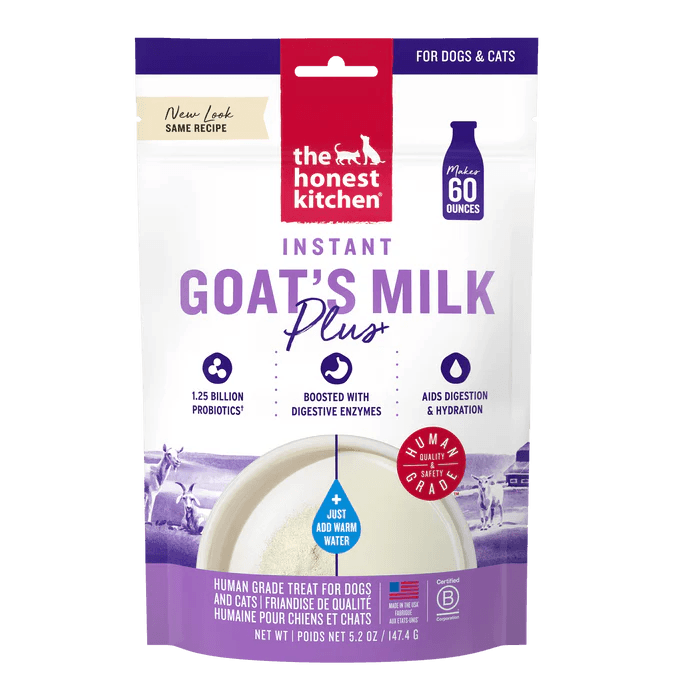
Webvet may earn a commission when you click through to The Honest Kitchen, at no extra cost to you.
- 1Goat milk for dogs can be used as a calorie-containing supplemental food when a dog tolerates dairy and the product label fits the intended use. It is not necessary for a complete diet, does not replace plain water, and is not a treatment for digestive or immune disease.
- 2Use the current label for the exact product and keep fresh plain water available.
- 3Product labels describe the formula; independent canine studies address its effects in dogs.
- 4Ask the veterinarian before changing a prescription diet or using a supplement during active illness.
Is Goat Milk Good for Dogs? The Evidence-Based Answer

Goat milk for dogs can be used as a calorie-containing supplemental food when a dog tolerates dairy and the product label fits the intended use. It is not necessary for a complete diet, does not replace plain water, and is not a treatment for digestive or immune disease.
Product details are checked against The Honest Kitchen Instant Goat's Milk Plus, while the central safety and nutrition boundaries are supported by FDA Salmonella food-safety guidance.
Do vets recommend goats milk for dogs?
Veterinarians may consider a suitable supplemental product for a specific purpose, such as adding aroma or moisture, but they do not treat the category as universally necessary. The recommendation depends on label accuracy, diet balance, tolerance, disease, medications, and the intended use. Bring the exact label rather than relying on a general claim about goat milk.
Webvet may earn a commission when you click through to The Honest Kitchen, at no extra cost to you.
| Decision point | What to check | Why it matters |
|---|---|---|
| Product label | Formula, calories, organisms, mixing, storage | Direct fact about the exact product |
| In vitro study | Laboratory digestion model | Useful mechanism signal, not a live-dog outcome |
| Live-dog study | Population, product, duration, measured result | Most directly relevant but still limited |
| Unanswered question | No suitable study for the broad claim | Does not establish a benefit for dogs |
- Watch stool, gas, vomiting, appetite, and comfort. Introduce a small label-directed amount. Goat milk is not automatically tolerated by every dog.
What Goat Milk Provides

Goat milk provides food energy and nutrients, so its calories count even when it is served as a drink. The amount depends on the product and dilution. A powdered supplement can contain added fermentation products or enzymes that plain milk does not. Read the exact ingredient list and calorie statement instead of treating all goat-milk products as interchangeable.
Can I give my dog goat's milk every day?
Daily use is not automatically necessary or appropriate. Follow the exact product label, include supplemental calories in the daily total, keep plain water available, and monitor tolerance. A pet with disease or a prescription diet needs individualized guidance before a supplement becomes routine. Stop the new supplement if vomiting, diarrhea or discomfort develops.
- Recognize that goat milk still contains milk sugar unless a specific process changes it. Stop if digestive signs recur. Goat milk should not be called lactose-free without label proof.
What Canine Research Actually Shows
A study of fermented goat milk tested bacterial survival in simulated canine digestive conditions, not health outcomes in living dogs. A separate trial in 12 healthy adult dogs tested commercial and traditional kefir made with reduced-fat milk and found limited effects on the measured digestive outcomes. Neither study tested Instant Goat's Milk Plus, so neither establishes a clinical benefit for that product.
What are the side effects of goat milk for dogs?
Possible problems include vomiting, diarrhea, gas, refusal, excess calories, or conflict with a medical diet. Ingredient-specific risks also matter. Stop the new product and contact the veterinarian if signs are persistent, repeated, severe, or accompanied by weakness, pain, breathing changes, or dehydration. Record the amount given and when symptoms started to help the assessment.
For more detail, read our guide to bone broth for dogs.
- Consider pathogen exposure to the dog and household. Prefer a handled product that fits the household's risk tolerance. Raw does not mean safer or more nutritious by default.
Webvet may earn a commission when you click through to The Honest Kitchen, at no extra cost to you.
Goat Milk, Probiotics, and Digestive Claims
A label can identify added microorganisms or fermentation products, but that does not tell you whether the formula will treat a particular digestive problem. Strain, amount, storage and the health outcome studied all matter. Keep product-label facts separate from laboratory findings and clinical evidence in dogs. Persistent gastrointestinal signs need a diagnosis rather than repeated supplement changes.
Is goat's milk good for dogs?
It can be a palatable supplement for a dog that tolerates dairy, but goat milk is not needed to make a complete diet healthier. Claims about treating digestive or immune disease require evidence for the exact product and use; neither the milk's source nor a probiotic count establishes that benefit.
- Identify the exact food, organisms, dose, and storage conditions used. Avoid applying one kefir study to every powdered supplement. Format differences matter.
Can Dogs Be Lactose Intolerant?
Yes. Goat milk contains lactose unless a specific process removes or breaks it down. Dogs differ in how well they tolerate dairy, and a larger serving can reveal problems that a smaller serving did not. Watch for gas, loose stool, vomiting or abdominal discomfort; stop the new product if these appear and contact your veterinarian for persistent or severe signs.
Is goat milk good for my dog?
Your dog's response matters. A small label-directed serving may fit a healthy dog's diet, but recurrent gas, diarrhea, vomiting, or discomfort is a reason to stop. Ask your veterinarian first if your dog has a known food reaction, active digestive illness, or a prescribed diet. Keep the complete main diet and plain water available.
- Count each prepared serving within daily intake. Adjust other extras as needed. Liquid texture does not make calories disappear.
Webvet may earn a commission when you click through to The Honest Kitchen, at no extra cost to you.
Raw, Pasteurized, and Dehydrated Goat Milk
Raw milk can carry pathogens affecting pets and people. Pasteurization, fermentation and dehydration describe different processes, so a claim about one format should not be applied to another. Fermented milk is not automatically lactose-free, and a dry powder is not automatically equivalent to raw milk. Follow the preparation and storage directions for the exact product, including refrigeration after mixing.
How much goat milk to give to a dog?
Use the current label for the exact product and the veterinarian’s advice for the individual pet. Do not copy an amount from another formula, species, or old webpage. Start conservatively, measure the serving, count calories, and monitor the response. A powder and a ready-to-drink milk can have different concentrations and preparation instructions.
- Read the exact organism and quantity statement. Preserve the manufacturer's wording. Do not invent a clinical outcome from a label count.
How to Introduce Goat Milk Safely
Choose one new supplement at a time and begin with a small amount within the current label's directions. Record the amount, appetite, stool, gas and comfort over the next several days. Count the serving in your dog's daily calorie intake and keep plain water freely available. Stop if symptoms appear; do not keep increasing the portion in the hope that a reaction will pass.
Is goat milk or bone broth better for dogs?
They serve different preferences. Goat milk contains dairy ingredients and may not suit a dairy-sensitive dog; a pet-specific broth offers another flavoring option. Compare each product's ingredients, calories, sodium information, preparation and intended species. Neither replaces plain water or a complete meal, and neither is a treatment for dehydration. Keep either addition supplemental and follow its preparation directions.
For more detail, read our guide to minimally processed dog food.
- Ask whether the added nutrients and calories fit the therapeutic plan. Obtain veterinary guidance first. A generally safe supplement may conflict with an individual diet goal.
The Honest Kitchen Instant Goat's Milk Plus
The Honest Kitchen's current Instant Goat's Milk Plus lists dehydrated goat milk, fermentation products and bromelain. It is intended for intermittent or supplemental feeding, with 12 kcal per half tablespoon listed on the product page. Mix and serve it according to the current label, count the calories, and follow the refrigeration directions after preparation. These formula facts do not establish treatment of digestive disease.
- Keep fresh plain water freely available. Offer goat milk separately or with food as directed. Milk is not the primary hydration source.
Which Dogs Need Veterinary Guidance First
Speak with your veterinarian before adding goat milk if your dog has a prescribed diet, an established dairy or food reaction, ongoing vomiting or diarrhea, or a condition requiring tightly controlled calories or nutrients. Bring the exact label and serving amount. A supplement that fits one healthy dog's routine may conflict with another dog's treatment plan.
What is the healthiest milk for dogs?
There is no universal healthiest milk for dogs. Many dogs need no milk, and some do not tolerate lactose or dairy proteins. If a supplemental milk is used, judge the exact product by its label, calories, handling, evidence, and the dog’s response. Plain water and an appropriate complete diet remain the foundations of daily feeding.
- Use one new dietary variable at a time. Record amount and response for several days. A sudden large serving makes intolerance harder to interpret.
Frequently Asked Questions
Can dogs drink goat milk every day?
Daily use is not automatically necessary or appropriate. Follow the exact product label, include supplemental calories in the daily total, keep plain water available, and monitor tolerance. A pet with disease or a prescription diet needs individualized guidance before a supplement becomes routine.
Is goat milk easier for dogs to digest than cow's milk?
Not reliably for every dog. Goat milk still contains lactose, and an in vitro fermented-goat-milk study cannot establish that all dogs digest it better than cow's milk. Judge tolerance individually and avoid dairy that causes gastrointestinal signs.
Can goat milk cause diarrhea in dogs?
Yes. Dairy intolerance, an unsuitable ingredient or too large a serving can cause loose stool or other digestive signs. Stop the new product if that happens. Persistent diarrhea, repeated vomiting, weakness, pain or dehydration warrants veterinary advice rather than another supplement.
Is raw goat milk safe for dogs?
Raw animal products can expose pets and people to pathogens, so use the manufacturer’s handling directions and consider household vulnerability. A raw label does not establish better nutrition.
Does goat milk replace water or complete dog food?
No. A supplemental broth or milk product does not replace fresh plain water or a complete and balanced main diet. A wet food can serve as a meal only when its exact nutritional adequacy statement supports that use.
Sources

Editor
The Webvet Editorial Team is the in-house group of pet-care editors and writers behind Webvet, operated by Smart Pet Collective. The team researches, writes, and maintains Webvet's pet health, behavior, and medication content. Every article follows a defined editorial process: research from reputable veterinary and scientific sources, careful drafting, mandatory review of medical content by a credentialed veterinarian, and dated publication. Health and medication articles are medically reviewed by a licensed veterinary professional before they go live and are kept current over time.
Veterinarian · BVMS MRCVS
Dr. Pippa Elliott, BVMS, MRCVS, is a veterinarian with nearly 30 years of experience in companion animal practice. Dr. Elliott earned her Bachelor of Veterinary Medicine and Surgery from the University of Glasgow. She was also designated a Member of the Royal College of Veterinary Surgeons. Married with 2 grown-up kids, Dr. Elliott has a naughty Puggle named Poggle, 3 cats and a bearded dragon.
Related reading

Minimally Processed Dog Food: What It Means and Why It Matters

Best Soft Dog Food for Senior Dogs: Gentle, Nutrient-Dense Options

Dehydrated vs. Freeze-Dried vs. Air-Dried Dog Food: What's the Difference?
