Best Dog Food for Goldendoodles: Choosing Food by Size and Life Stage
A Goldendoodle's food should match its life stage, expected adult size, and individual calorie needs. Compare JFFD recipes, calculate measured portions, and plan practical fresh-food routines.

This article contains affiliate links. Webvet may earn a commission when you buy through them, at no extra cost to you.
Sponsored by JustFoodForDogs. We may earn a commission from purchases made through links in this article.
The best dog food for Goldendoodles matches the dog's life stage, expected adult size, and individual calorie needs. A growing puppy needs food qualified for growth. A mature dog needs an appropriate maintenance diet and measured portions. “Mini,” “medium,” and “standard” can help describe your dog, but those descriptions cannot replace the recipe's nutritional adequacy statement or your dog's current weight.
JustFoodForDogs offers several fresh recipes that can fit those different needs. Current Chicken & Rice and Fish & Sweet Potato recipes cover all life stages, including growth of large-size dogs. Beef & Russet Potato and Turkey & Whole Wheat Macaroni are adult-maintenance options. The useful comparison starts with that distinction, then moves to ingredients, calories, portions, and a storage routine you can follow.
Choosing Food by Actual Size and Life Stage
Compare the current JFFD label eligibility with your Goldendoodle's life stage and expected adult size, then use the calorie-to-gram examples below to calculate portions. Chicken & Rice and Fish & Sweet Potato cover all life stages, including growth of large-size dogs; Beef & Russet Potato and Turkey & Whole Wheat Macaroni are adult-maintenance recipes. Golden Retriever or Poodle ancestry does not establish a food allergy, so ingredient restrictions should follow the individual dog's history and veterinary assessment.
For puppies, the important size question is how big the dog is expected to become. Large-size growth statements refer to dogs expected to weigh 70 pounds or more as adults. A puppy does not need to weigh 70 pounds today for that distinction to matter. For portions, however, you need current information about the dog, including measured weight, age, activity, and body condition.
- 1Match the food's life-stage statement to the dog's current needs.
- 2Use expected adult size to check a puppy's growth eligibility.
- 3Turn an individual daily calorie target into measured portions of the exact recipe.
The best food for Goldendoodles also needs to work in your household. A recipe that fits nutritionally still requires enough refrigerator space, a reliable way to measure meals, and a plan for training rewards. If several people feed the dog, a written daily allowance is more useful than everyone independently deciding whether the bowl looks full.
Before comparing dog food brands, write down the information that will actually change your choice:
- Your dog's age and current measured weight.
- Whether growth is ongoing and, for a puppy, the expected adult size.
- Any veterinary instructions concerning ingredients or nutrition.
- The calories already coming from treats, chews, and meal extras.
- The amount of food you can refrigerate and use within its storage window.

When looking for vet recommended dog food for Goldendoodles, bring the exact product name and label to the conversation. Your veterinarian can assess whether that recipe fits your dog rather than responding to a broad brand name. Ask what calorie allowance to begin with, what changes would justify adjusting it, and when to reassess a puppy's growth or an adult's weight.
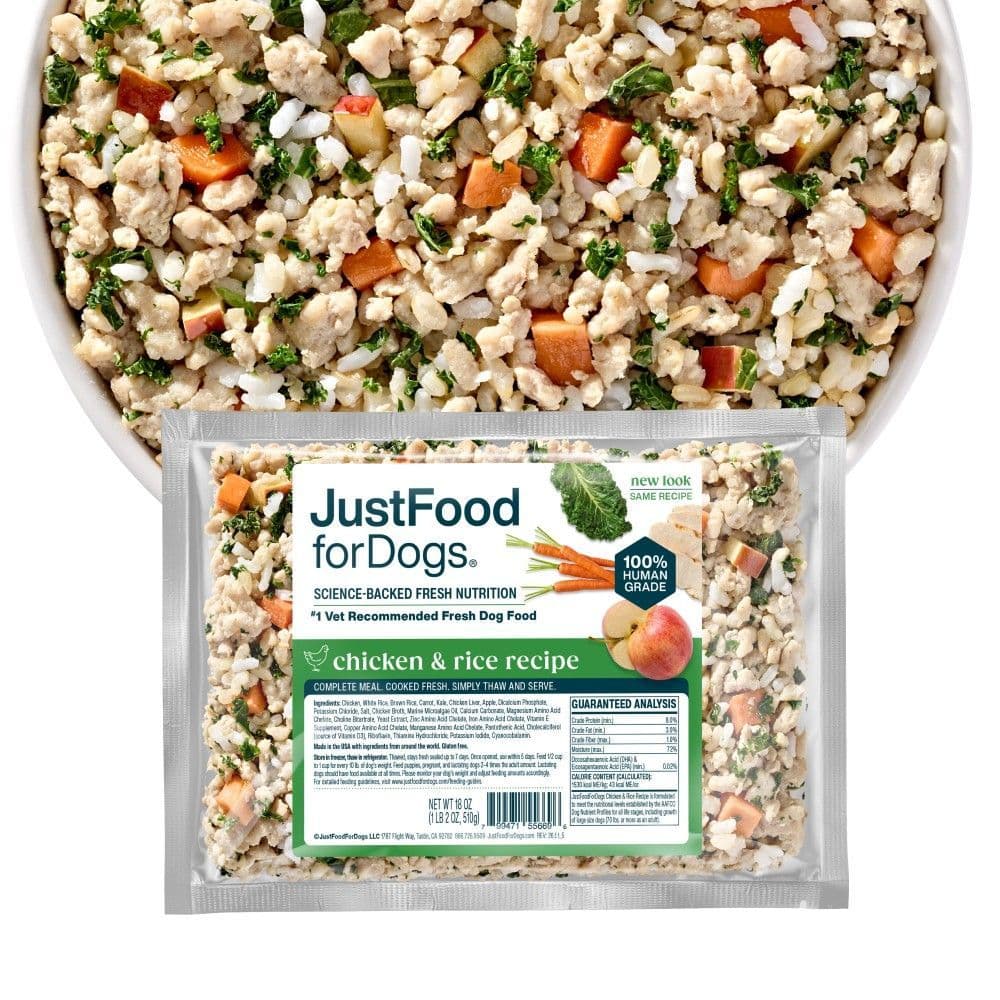
Check the current Chicken & Rice recipe, portions and ordering options.
Webvet may earn a commission when you click through to JustFoodForDogs, at no extra cost to you.
Petful applies the same size-first approach in its guide to the best dog food for Bernedoodles.
Chicken & Rice is one option to discuss when you want a grain-inclusive fresh recipe with growth eligibility. Its current energy density is 1,530 kcal/kg. That number helps calculate how many grams belong in the bowl; it does not tell you how many calories your individual dog needs. A small adult and a growing larger puppy can therefore require very different amounts of the same food.
Our explanation of what makes dog food complete and balanced provides more context for reading adequacy statements. Keep that distinction separate from how appetizing a food looks. Familiar ingredients and a soft texture may influence your preferences, but nutritional suitability depends on the complete formulation and the life stage it covers.
JFFD Options for Growing Goldendoodles
The best puppy dog food for a Goldendoodle must support growth, whether the puppy is expected to stay small or become a large adult. Feeding a smaller amount of an adult-maintenance recipe does not turn it into puppy food. Likewise, a larger puppy does not simply need more of whichever food happens to be available in the household.
Current JFFD Chicken & Rice and Fish & Sweet Potato both state suitability for all life stages, including growth of large-size dogs expected to reach 70 pounds or more. That makes them relevant starting points for comparing food for a Goldendoodle puppy. Beef & Russet Potato and Turkey & Whole Wheat Macaroni have adult-maintenance statements and should not replace a growth-qualified main diet.
| Dog's life stage | Expected adult size | Label to verify | Current JFFD fit |
|---|---|---|---|
| Growing puppy | Below 70 pounds | A nutritional adequacy statement covering growth | Chicken & Rice or Fish & Sweet Potato |
| Growing puppy | 70 pounds or more | Explicit coverage of large-size growth | Chicken & Rice or Fish & Sweet Potato |
| Growing puppy | Uncertain | Growth coverage and the expected-size assessment discussed with your veterinarian | Chicken and Fish currently include large-size growth; establish an individualized feeding plan |
| Adult after growth | Adult size established | Adult maintenance or another appropriate life-stage statement | Beef and Turkey can enter the comparison alongside suitable Chicken and Fish recipes |
A mini Goldendoodle puppy still needs this same label check. “Small puppy” is not a reason to bypass growth nutrition. If the puppy's adult-size estimate is uncertain, ask your veterinarian to help interpret its growth history and the information available about its parents. You can select a recipe whose statement includes large-size growth while continuing to refine the individual portion.
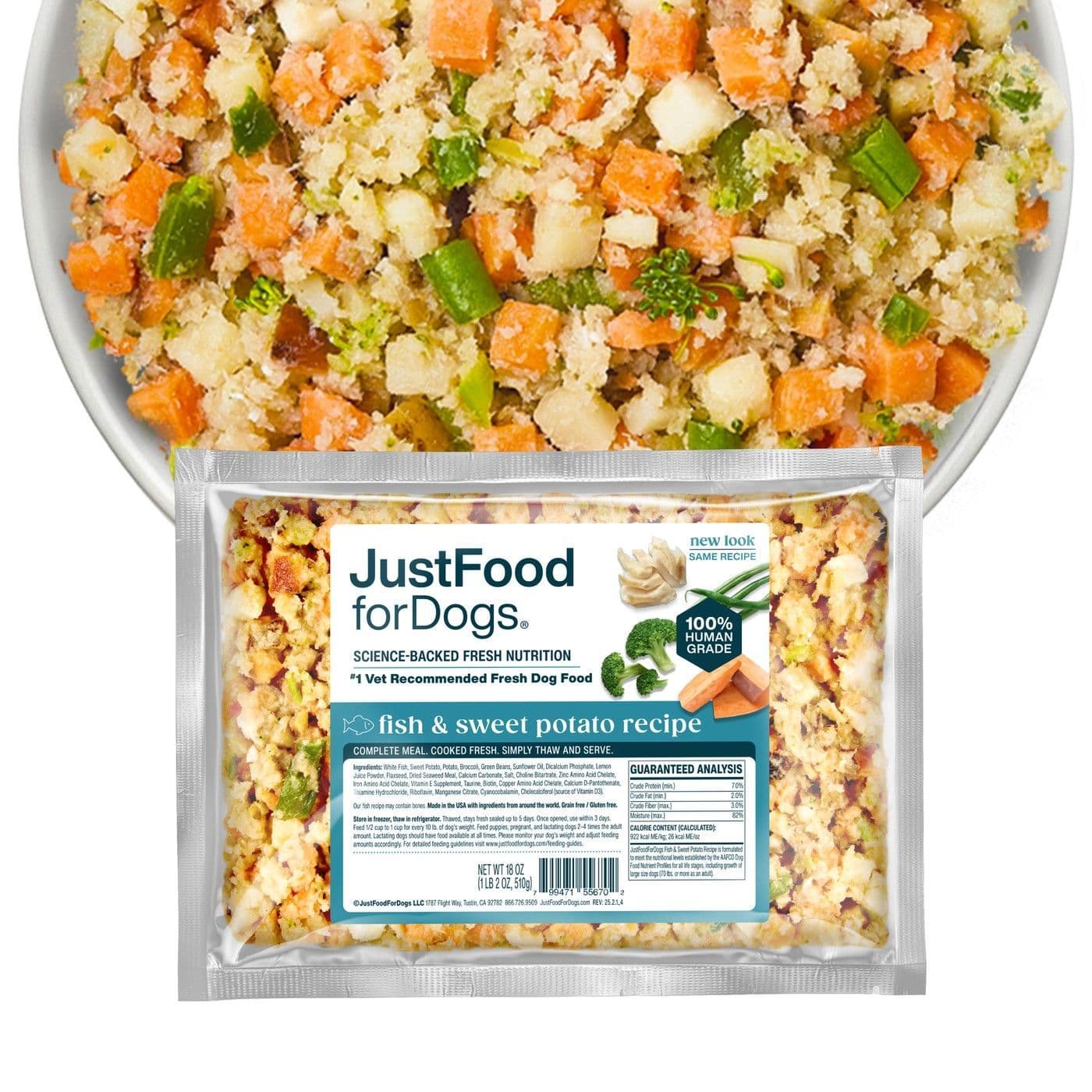
Check the current Fish & Sweet Potato recipe, portions and ordering options.
Webvet may earn a commission when you click through to JustFoodForDogs, at no extra cost to you.
Fish & Sweet Potato provides a useful alternative when you are comparing the two growth-qualified recipes. The current formula uses a whitefish blend that includes cod, pollock, and haddock, so it should not be described as a single-cod recipe. At 922 kcal/kg, it supplies fewer calories per gram than Chicken & Rice. That changes the amount you weigh out, even when the daily calorie allowance stays the same.
For a practical comparison, imagine that your puppy's feeding plan allocates 500 calories to this part of the day's meals. That would be about 327 grams of Chicken & Rice or 542 grams of Fish & Sweet Potato, using their current energy densities. Those are calculation examples, not a recommendation to feed every puppy 500 calories. Their purpose is to show why equal scoops or equal package fractions cannot be assumed equivalent.
Use the current Chicken & Rice recipe details to check both the nutritional adequacy statement and calorie information before buying. Product names alone are not enough: keep the exact recipe, format, and current label together when setting up the feeding plan.

Keep the growth plan current
A puppy's portion is a moving target because the puppy itself is changing. A plan created at one weight should not become a permanent instruction taped to the refrigerator. Record the date, weight, daily calories, recipe, and resulting grams together. At subsequent veterinary visits, bring that record so adjustments can be based on what the puppy has actually been eating.
A useful puppy feeding record includes:
- The current weight and date it was measured.
- The exact recipe and calories per kilogram.
- The daily food amount, with each meal's share identified.
- Training treats and other food supplied outside meals.
- Changes in appetite, stool, or how consistently meals are finished.
Do not aim to make a puppy reach an estimated adult weight as quickly as possible. Expected adult weight helps determine eligibility; it is not a daily feeding goal. The amount fed should support the individual puppy's growth and condition, with reassessment as those needs change.
Training makes this especially important. If multiple family members practice cues throughout the day, each may offer only a few rewards while the combined total becomes substantial. Set aside the day's reward allowance before training begins. When using some of the puppy's complete food as a reward, subtract that amount from the meal containers so it is not counted twice.
Plan meals around the whole day
Ask your veterinarian how to divide your puppy's daily allowance into meals for its age and circumstances. Once you have that schedule, measure the whole day's food and divide it accordingly. Do not calculate a daily quantity and accidentally serve that quantity at each feeding.
Keep the feeding instructions specific enough for another caregiver to follow:
- Name the recipe rather than writing only “fresh food.”
- State the amount for each meal and the number of meals.
- Identify which treats are included in the daily plan.
- Explain where the opened food is stored and when it must be used.
This approach also makes changing recipes easier. You have a record of calories and grams instead of a vague memory of how full the bowl looked. For a growing dog, that record helps you separate a recipe change from the normal feeding adjustments that accompany growth.
JFFD Options for Adult Goldendoodles
Once growth is complete, the best dog food for adult Goldendoodles depends on the individual dog's calorie needs, ingredient history, preferences, and routine. Adult maintenance opens additional JFFD choices, including Beef & Russet Potato and Turkey & Whole Wheat Macaroni. Growth eligibility remains relevant if another dog in the household is still a puppy, even when the adult can eat those recipes.
Measured portions matter across every option. A soft, moist food can occupy a different amount of space in the bowl than the food it replaces. If you are searching for the best wet dog food for Goldendoodles, compare the exact fresh or wet product's adequacy and calorie information rather than assuming all moist foods are interchangeable.
The four recipes differ meaningfully in energy density:
- Chicken & Rice: 1,530 kcal/kg, or 1.530 calories per gram.
- Fish & Sweet Potato: 922 kcal/kg, or 0.922 calories per gram.
- Beef & Russet Potato: 1,559 kcal/kg, or 1.559 calories per gram.
- Turkey & Whole Wheat Macaroni: 1,741 kcal/kg, or 1.741 calories per gram.
These values explain why a bowl's volume can be misleading. An adult moving from Fish & Sweet Potato to Turkey & Whole Wheat Macaroni would need fewer grams to receive the same number of calories. Feeding the old gram amount after that change would increase calorie intake. The reverse switch would require more grams to maintain the same calorie allocation.
Choosing an adult recipe
Beef & Russet Potato is an adult-maintenance option supported by the recipe's current feeding-trial statement. It supplies 1,559 kcal/kg. That makes it close to Chicken & Rice in calories per gram, but the recipes still have different ingredients and life-stage statements. Similar energy density does not make their nutritional uses identical.
If an adult Goldendoodle already does well with beef and the ingredient list fits its history, this recipe can be part of the comparison. Use the current Beef & Russet Potato product information to check the full formulation and label. Its adult-maintenance status should remain clear if you also have a puppy eating nearby.
Feeding two Goldendoodles
In a household with two Goldendoodles, decide whether you are simplifying around one suitable recipe or serving separate foods. Either can be workable. Sharing a recipe requires that it suit both dogs, while serving separate recipes requires a dependable way to prevent the meals from being mixed up.
A simple setup can include:
- A labeled container for each dog's daily food allowance.
- A separate written gram amount for each recipe being used.
- Feeding locations that let you see which dog eats which meal.
- One shared record for treats and extra food.
Turkey & Whole Wheat Macaroni is another adult-maintenance option, with 1,741 kcal/kg. Its greater energy density means the required gram amount can be smaller than with the other three recipes at the same calorie allowance. That may influence package use and refrigerator space, but it does not automatically make it a better choice for every adult.
For example, 600 meal calories would require approximately 345 grams of Turkey & Whole Wheat Macaroni, compared with approximately 651 grams of Fish & Sweet Potato. Both calculations describe the same calorie allocation. Neither tells you whether 600 calories is the correct amount for your dog, and the smaller serving is not necessarily less satisfying or more appropriate for that individual.
Grain-inclusive and grain-free comparisons
Goldendoodle ancestry does not establish a need for a grain-free diet. If you are comparing grain-inclusive dog food, Chicken & Rice and Turkey & Whole Wheat Macaroni provide clear examples of recipes containing grains. Start with nutritional suitability and your dog's actual dietary history rather than choosing or rejecting an ingredient category because of the breed mix.
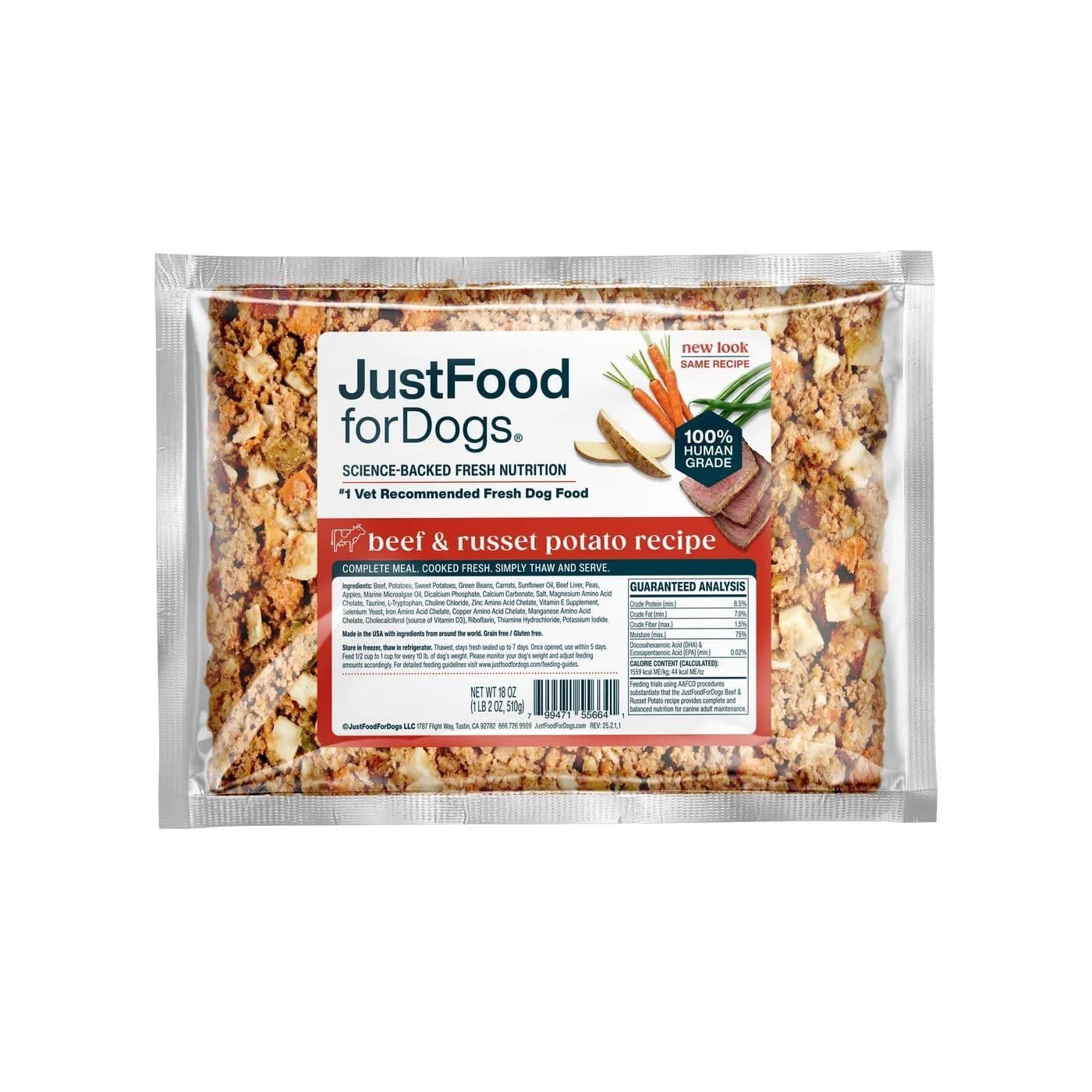
Beef & Russet Potato is a separate adult-maintenance option at 1,559 kcal/kg. Check its own full ingredient list and individual suitability.
Webvet may earn a commission when you click through to JustFoodForDogs, at no extra cost to you.
When a veterinarian has identified a specific dietary restriction, check the entire ingredient list. The main protein named on the front of a package is not a complete inventory of what is inside. A recipe change made for an ingredient concern needs to account for every relevant ingredient and the other foods your dog receives.
Useful questions for that comparison include:
- Is there a diagnosed reason to avoid an ingredient, or only a suspicion?
- Has the dog eaten this ingredient before without difficulty?
- Does the recipe cover the dog's current life stage?
- Can the household keep meals and treats consistent while evaluating tolerance?
For an adult whose plan fits this formulation, Turkey & Whole Wheat Macaroni offers a grain-inclusive fresh option. Calculate its portion using its own calorie density, even if you previously used a different JFFD recipe. A familiar brand does not make the previous scoop size transferable.
Calculating Portions for Mini and Standard Dogs
The best dog food for mini Goldendoodles may be the same suitable recipe used for a larger adult, served in a different amount. Miniature and standard descriptions do not provide a precise calorie allowance. Two dogs with similar weights can also need different amounts because age, activity, body condition, and individual metabolism affect the feeding plan.
Begin with a veterinarian-set daily calorie target or a clearly identified starting estimate that you will reassess. The AAHA nutrition and weight management guidelines describe calorie calculations as starting points that need adjustment for the individual animal. A calculated number is useful for establishing a consistent routine, not for ignoring how the dog responds.

For a healthy dog, the calculation can be organized into a few repeatable steps. Use current weight for portions and growth tracking, while keeping expected adult weight available for puppy recipe eligibility. Record the recipe's energy density in kcal/kg so you can calculate the grams that supply the assigned meal calories.
| Input or step | What to use | Why it matters |
|---|---|---|
| Current size and life stage | Current measured weight, age, and whether growth continues | These inform the initial feeding assessment |
| Daily calorie target | Veterinarian-set allowance or a clearly identified starting estimate | Establishes the total daily food budget |
| Treat calories | Calories from training rewards, chews, toppers, and other extras | Extras count toward the same total |
| Remaining meal calories | Daily target minus planned extra calories | Identifies what the complete meals should supply |
| Recipe kcal/kg | The energy density for the exact current recipe | Converts meal calories to grams per day |
| Reassessment | Weight trend, body condition, intake, and veterinary guidance | Determines whether the starting allowance needs adjustment |
Convert calories into grams
The calculation is straightforward: divide the calories assigned to the food by its calories per kilogram, then multiply by 1,000. That gives grams per day. Divide that daily amount among the planned meals. Use a kitchen scale with the empty bowl zeroed so that the displayed weight represents food rather than food plus bowl.
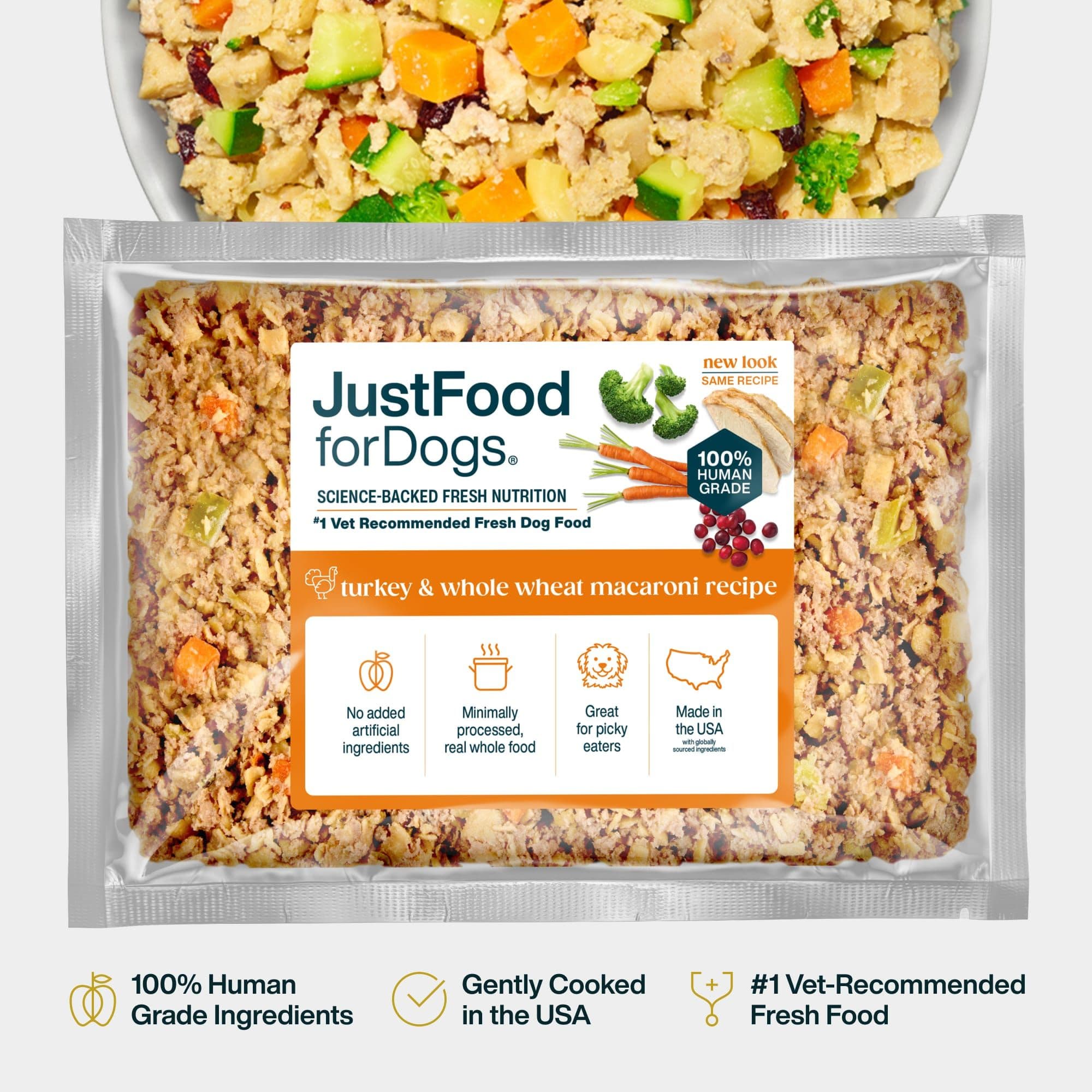
Check the current Turkey & Whole Wheat Macaroni recipe, portions and ordering options.
Webvet may earn a commission when you click through to JustFoodForDogs, at no extra cost to you.
Consider an illustrative adult feeding plan with a 600-calorie daily allowance. If 60 calories are reserved for treats and other extras, the complete meals supply 540 calories. Using current recipe values, the approximate daily food quantities would be:
- Chicken & Rice: 353 grams.
- Fish & Sweet Potato: 586 grams.
- Beef & Russet Potato: 346 grams.
- Turkey & Whole Wheat Macaroni: 310 grams.
Those quantities are alternative ways of supplying the same 540 meal calories. They are not four foods to serve together, and they are not a recommendation for every mini Goldendoodle. Round practical portions consistently, then use weight and body-condition follow-up to determine whether the underlying allowance needs to change.
Now consider a separate adult whose plan allows 1,200 calories daily, with 120 calories reserved for extras. Its meals would supply 1,080 calories, so each of the example food quantities would double. This illustrates why a larger dog's food budget can differ substantially, without claiming that every standard Goldendoodle needs exactly twice what a miniature dog eats.
Count training rewards before filling the bowl
AAHA recommends that complete and balanced food supply at least 90 percent of daily calories, with treats and other extras limited to no more than 10 percent. The treat allowance is a ceiling, not an amount you must use. A day without treats does not require inventing extras to reach that percentage.
For a 600-calorie daily plan, the 10 percent ceiling is 60 calories. A training session using 40 calories leaves only 20 calories for other extras under that plan. A dental chew, food used to give medication, and a few bites offered during cooking all need to be considered if they are part of the day.
Try this household routine:
- Identify the day's complete-food allowance and planned treat allowance.
- Put the permitted rewards in one shared container.
- Ask everyone to take training treats from that container.
- Record any additional chew or food item before offering it.
- Adjust the meal calculation when the planned calorie allocation changes.
If you use the dog's complete food for training, that food still belongs to the daily allowance. Set aside a measured portion before filling the meal bowls. This can make frequent rewards easier to track without creating a separate stream of uncounted calories. Handle fresh food used for training according to its storage instructions.
Compare affordability by feeding day
The best affordable dog food for Goldendoodles is not necessarily the package with the lowest price or the largest visible portion. Compare the cost of supplying the dog's actual daily food calories. A recipe with fewer calories per gram may require more grams each day, affecting both how long a package lasts and how much refrigerator space you need.
You can make that comparison without guessing:
- Find the package's net weight in grams.
- Multiply by the recipe's calories per gram.
- Divide the result by your dog's daily calories assigned to that recipe.
- Divide the package price by the resulting number of feeding days.
- Include likely unused food when comparing package sizes.
For example, an 18-ounce package contains approximately 510 grams. At 1.530 calories per gram, that amount of Chicken & Rice contains about 781 calories. At 0.922 calories per gram, the same weight of Fish & Sweet Potato contains about 470 calories. Equal package weights therefore do not represent equal numbers of meals.
This calculation becomes particularly useful for a small adult that consumes food slowly. A large package may have an attractive price per ounce but still be a poor practical fit if you cannot use the opened food within its handling window. For a larger adult, daily quantity and freezer capacity may be the more important planning constraints.
Our JustFoodForDogs feeding guide explains the broader feeding process. Keep your dog's current plan beside the food scale, and update it whenever the recipe or calorie allowance changes. Consistent measurements make it easier to identify whether a later weight change reflects the amount served, uncounted extras, or a need to reassess the original target.
Food Tolerance and Persistent Symptoms
Looking for the best dog food for Goldendoodles with a sensitive stomach requires more information than the breed name. Record what your dog eats, when symptoms occur, and whether they began around a food change. A recipe that works for another Goldendoodle is not proof that it addresses your dog's problem.
The same applies to searches for food for Goldendoodles with allergies or ear infections. Recurring itching, digestive upset, or ear problems can have different causes. Food selection should follow an assessment of the individual problem, rather than treating those signs as evidence that every Goldendoodle needs to avoid chicken, grains, or another ingredient.
Before the veterinary visit, prepare a concise food history:
- Every main food and recipe currently offered.
- Treats, chews, supplements, and foods used with medication.
- The timing of symptoms and any recent feeding changes.
- Previously tried foods and what happened during each trial.
That history can be more useful than a long list of foods described as “sensitive.” A whitefish recipe, for example, is not automatically hypoallergenic. Fish & Sweet Potato contains a blend of fish species and other ingredients. Whether it fits an individual restriction depends on the full formulation and your dog's dietary history.
If your veterinarian recommends an elimination diet or another specific feeding trial, ask exactly which foods and extras are permitted and how the response will be assessed. Changing the main meal while continuing assorted treats can make a structured trial difficult to interpret. Likewise, repeatedly switching recipes without a plan can obscure the relationship between food and symptoms.
For ordinary recipe selection, keep the decision manageable:
- Choose one nutritionally suitable recipe to evaluate.
- Follow a consistent transition and portion plan.
- Keep a brief record of intake and relevant changes.
- Reassess persistent symptoms with your veterinarian rather than assuming a new flavor will resolve them.
Food can support an individualized management plan, but these recipes are not cures for allergies or ear infections. Avoid breed-wide allergy assumptions: neither Goldendoodle ancestry nor recurring symptoms establish which ingredient, if any, needs to be excluded. The dog's dietary history and veterinary findings should guide that decision.
Switching and Storing Fresh Food
Plan the transition before opening the first package. Begin with the daily calorie allowance and the energy density of both the old and new foods. If the foods differ substantially in calories per gram, equal spoonfuls will not create an equal-calorie substitution. A gradual change should preserve the intended daily intake while the proportion from each suitable food changes.
Follow the transition guidance supplied with the food and any individualized instructions from your veterinarian. Increase the new food gradually as your dog tolerates the change. Avoid introducing several new treats and meal extras at the same time, since that makes it harder to understand which change the dog is responding to.

A practical transition record can stay simple:
- Note the old and new recipes.
- Write down the daily calories assigned to each.
- Convert each calorie allocation into its own gram amount.
- Record appetite and stool changes without changing several variables at once.
- Ask your veterinarian how to proceed if problems persist or the dog becomes unwell.
For example, if a meal is assigned 200 calories and half are coming from Chicken & Rice while half come from Fish & Sweet Potato, weigh approximately 65 grams of Chicken and 108 grams of Fish. Equal calories require unequal weights because the recipes have different energy densities. This is a calculation example, not a prescribed transition schedule.
Follow the recipe-specific storage window
During a gradual transition, smaller servings can make an opened package last longer. Check the current storage instructions for each recipe before deciding how much to thaw.
The current JustFoodForDogs FAQ gives Fish & Sweet Potato a shorter refrigerated window than the other proteins: use sealed, thawed fish food within five days and opened fish food within three days. The other fresh-frozen proteins discussed here have general guidance of seven days sealed and thawed, or five days after opening. Follow the actual package instructions, including any shorter limit.
Opening a package does not restart or extend its earlier storage deadline. Label the date food was thawed and the date it was opened, and use whichever applicable deadline comes first. Keep frozen food frozen until it is needed, and thaw it in the refrigerator according to the manufacturer's instructions.
Organize each opened package
- Checking the package instructions before planning the week's meals.
- Thawing only what you expect to use within the applicable period.
- Keeping opened food covered and refrigerated.
- Using clean utensils and washing bowls after meals.
- Choosing package sizes that match the dog's daily consumption.
This matters particularly for a small Goldendoodle eating modest amounts. If an opened package contains more than the dog will use within the recipe's window, choose a more suitable package or storage plan before buying. Do not assume that a deadline can be extended because the remaining food looks acceptable.
For travel or a pet sitter, send the food with written instructions rather than relying on memory. Include the exact recipe, grams per meal, meal schedule, treat allowance, and storage dates. A sitter should be able to follow the same plan without guessing whether a container holds one meal or an entire day's food.
Before making a homemade diet
If you are considering homemade dog food for Goldendoodles, distinguish cooking familiar ingredients from preparing a complete diet. The named meat and carbohydrate in a commercial recipe do not reveal all the nutrients or amounts needed to reproduce it at home. Copying those visible ingredients is not the same as following a professionally formulated recipe.
Use our guide to homemade dog food recipes and veterinary safety guidelines before making that change. A homemade plan needs appropriate formulation for the dog's life stage and careful adherence to its ingredients, quantities, and supplements. That is especially important when the dog is still growing.
Frequently Asked Questions
What food should I feed my Goldendoodle?
Choose a complete food by expected adult size, current life stage, and the exact recipe adequacy statement, then serve an individual calorie allowance. Bring those details to your veterinarian rather than asking only whether a brand is good. For this JFFD comparison, Chicken & Rice and Fish & Sweet Potato cover growth, including large-size growth. Beef & Russet Potato and Turkey & Whole Wheat Macaroni are adult-maintenance choices.
Can a mini Goldendoodle and a standard Goldendoodle eat the same recipe?
They can eat the same suitable recipe when it fits both dogs' life stages and individual needs. They will usually need different measured portions. In a shared household, label each dog's daily container and supervise meals so one dog does not consume the other's allowance. If one is still a puppy, check growth suitability before simplifying both dogs onto the adult's food.
Which JFFD recipes cover growth of large-size dogs?
The current Chicken & Rice and Fish & Sweet Potato statements include growth of large-size dogs expected to reach 70 pounds or more as adults. This refers to expected adult weight, so a much smaller puppy can still need that eligibility. Check the exact current recipe and format when reordering instead of transferring the statement to a different JFFD product.
Should I use my puppy's current weight or expected adult weight?
Use expected adult weight for eligibility and current weight for portions, alongside age, growth progress, body condition, and veterinary guidance. Those are separate jobs. A puppy expected to become a large adult should not receive an adult-sized meal simply because of that prediction. Update the feeding calculation as the puppy changes, while retaining the appropriate growth-qualified recipe.
Can I feed Beef & Russet Potato to a growing Goldendoodle?
Do not use it as the puppy's complete main diet. Its current nutritional adequacy statement is for adult maintenance. Choose a growth-qualified recipe for the puppy's meals instead. If an adult dog in the household eats Beef & Russet Potato, keep the bowls and portion containers distinct so the puppy does not regularly substitute the adult's meals for its own.
Do training treats reduce the amount of food in the bowl?
Yes, treat calories count toward the day's total. Keep at least 90 percent of calories from complete and balanced food, with treats and other extras generally limited to 10 percent or less. If training rewards come from the dog's already measured complete-food allowance, set them aside before dividing meals. That prevents rewarding the dog throughout the day and then serving the same calories again at dinner.

Editor
The Webvet Editorial Team is the in-house group of pet-care editors and writers behind Webvet, operated by Smart Pet Collective. The team researches, writes, and maintains Webvet's pet health, behavior, and medication content. Every article follows a defined editorial process: research from reputable veterinary and scientific sources, careful drafting, mandatory review of medical content by a credentialed veterinarian, and dated publication. Health and medication articles are medically reviewed by a licensed veterinary professional before they go live and are kept current over time.
Related reading

Vet-Recommended Diets for Dogs With Pancreatitis

Fish Dog Food: Benefits, Fish Types, and How to Choose a Complete Recipe

How Much Does Fresh Dog Food Cost for a Small Dog? Price per Day and per Pound Compared
