Prebiotics for Dogs: What They Do and How to Choose a Supplement
Prebiotics feed selected gut microbes, but supplement labels can be confusing. Learn how to distinguish them from probiotics, compare ingredients, and fit a digestive supplement into your dog’s routine.

BVMS MRCVS

This article contains affiliate links. Webvet may earn a commission when you buy through them, at no extra cost to you.
Sponsored by Pup Labs.
Prebiotics for dogs provide food for selected microbes already living in the gut. They work differently from probiotics, which supply live microorganisms. Choosing between them starts with your dog’s existing diet and the reason you are considering a supplement, then moves to the ingredients and evidence on the label.
That distinction makes shopping easier. A useful digestive supplement should have a clear purpose in your dog’s routine. Here is how to compare the options, including Pup Labs K9 Belly Bliss, without assuming that every powder, fiber, or live-culture product does the same job.
What prebiotics do in a dog’s gut
Prebiotics are substances that selected beneficial microbes use in a way that provides a health benefit. Many are dietary fibers, but not all fiber is a prebiotic. A fiber may help change stool consistency without meeting the more specific definition of a prebiotic.
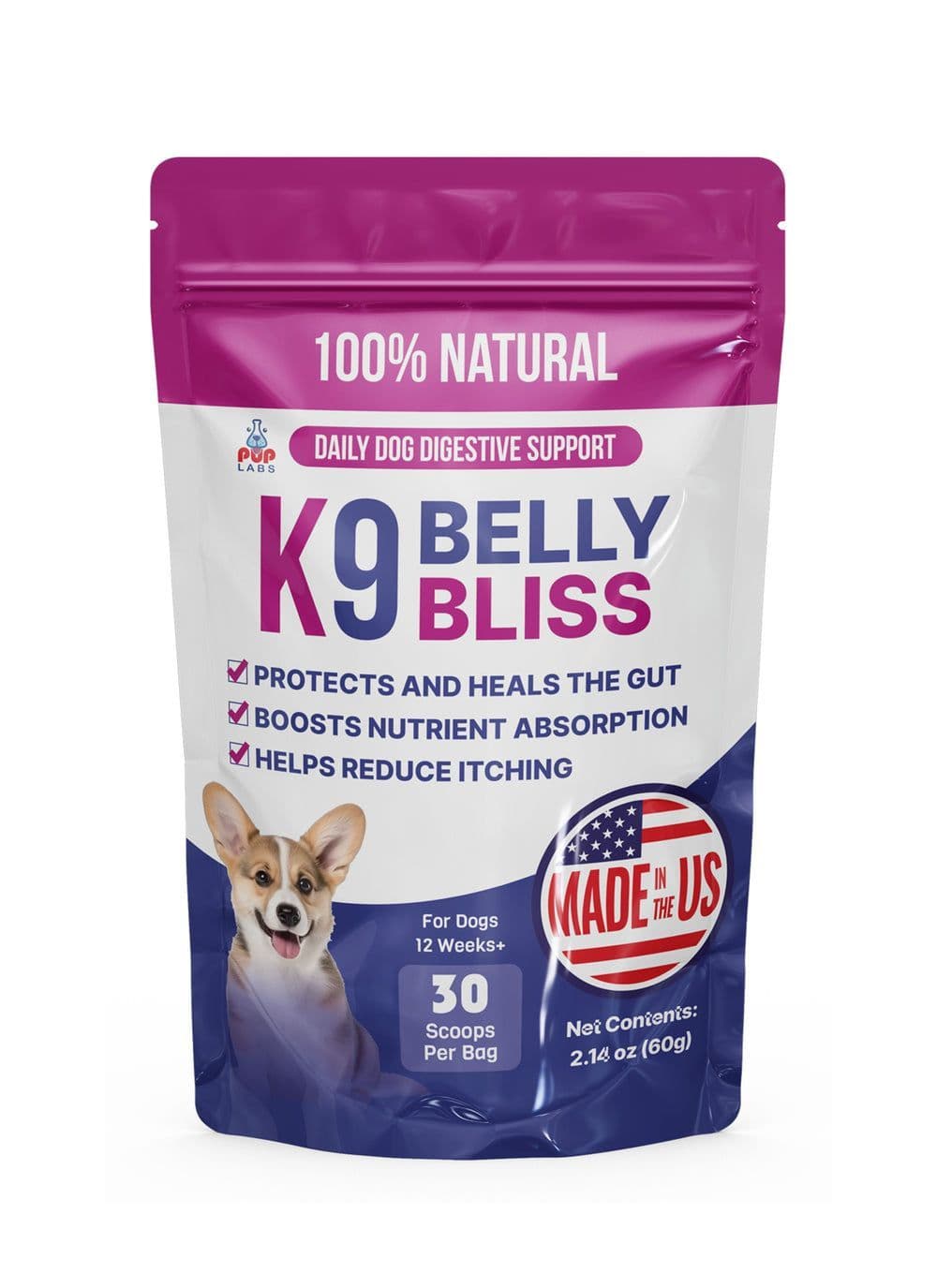
A powder topper for adding a digestive-support supplement to your dog’s mealtime routine.
Webvet may earn a commission when you click through to Pup Labs, at no extra cost to you.
The International Scientific Association for Probiotics and Prebiotics identifies digestive function and stool quality among the potential benefits studied in pets. It also stresses that more research is needed. “Good for gut health” is therefore a starting point for a question, rather than proof of a particular result for your dog.
Three details help put prebiotic research into context:
- The ingredient: Findings about fructooligosaccharides, or FOS, do not automatically apply to a different fiber or a mixed supplement.
- The diet: A prebiotic is added to an existing nutritional environment. What the dog already eats can influence the response.
- The outcome: A change in fecal bacteria or nutrient digestibility is not the same as demonstrating that a product treats an illness.
For example, a small canine feeding study involving 12 healthy adult dogs examined FOS in diets with different protein levels. Researchers found interactions between diet and supplementation, including differences in bacterial and digestive measurements. Canine study findings depend on the ingredient, diet and measured outcome; they cannot be extrapolated to K9 Belly Bliss efficacy because that formula was not tested. Microbiome changes are not a universal treatment promise. When comparing supplements, check how closely the formulation and use conditions match those studied.
Food sources and prebiotic ingredients
For a natural prebiotic option, start by reading the ingredient list on your dog’s existing food. Chicory root, inulin, oligofructose, and fructooligosaccharides are names worth recognizing. You may already be feeding a diet that includes one of them, even if “prebiotic” is not prominent on the front of the bag.
“Natural” describes an ingredient’s origin; it does not tell you whether it is the best choice for your dog. A clearly identified prebiotic fiber with relevant evidence is more informative than a vague promise about superfoods. Whole foods also contain mixtures of nutrients and fibers, so they are not interchangeable with a measured supplement ingredient.
A powder topper for adding a digestive-support supplement to your dog’s mealtime routine.
Webvet may earn a commission when you click through to Pup Labs, at no extra cost to you.
When reviewing food sources, separate these questions:
- Does the existing food already include a named prebiotic ingredient?
- Are you choosing a complete food, adding a treat, or considering a supplement?
- What additional benefit are you trying to achieve?
A homemade food addition should answer a specific need, rather than become a collection of extra ingredients. The University of Guelph’s pet nutrition team distinguishes classic prebiotics from foods that supply fermentable fiber. The pumpkin questions below explore that distinction in everyday feeding.
Prebiotics, probiotics, and digestive enzymes are different
The difference between prebiotics and probiotics for dogs comes down to what the product supplies. A prebiotic provides a substrate for microbes. A probiotic provides live microorganisms, with a health benefit demonstrated at an appropriate amount. Digestive enzymes have another role: they help break down food components.
You will also see synbiotics, which combine live microorganisms with a substrate. That combination does not make every formula automatically better than a prebiotic or probiotic alone. The useful question is whether the actual combination suits the dog and the intended purpose.
Use the correct label clues for each category:
- Prebiotic: Look for an identifiable substrate and evidence relevant to its intended use.
- Probiotic: Look for the named organism and strain, live-organism amount, storage instructions, and shelf-life information. CFU means colony-forming units; it describes live microorganisms, not the amount of prebiotic fiber.
- Digestive enzyme: Identify the enzyme and its intended function. A product containing enzymes is not automatically a prebiotic or probiotic.
For supplement selection, separate prebiotic substrate information from probiotic strain and CFU information. A multi-ingredient powder is not necessarily a demonstrated live probiotic: check whether it identifies live organisms and the evidence for their use. These distinctions also apply to dog food with prebiotics and probiotics. Greek yogurt can contain live cultures, for instance, but it is not equivalent to a studied canine probiotic product.
There is also no single “absolute best” probiotic for every dog. If choosing live organisms is your main decision, our guide to probiotics for dogs covers that category in more detail. Keep the comparison focused on the right type of supplement before comparing individual products.
Does your dog need a prebiotic supplement?
A dog doing well on a suitable complete diet does not automatically need an additional prebiotic. Begin with the reason for adding one: are you trying to support an established feeding routine, or respond to a new digestive problem? Those situations call for different decisions.
For routine supplementation, review the existing food and any treats or supplements with your veterinarian. If your dog has ongoing symptoms, the first task is to understand the cause. Symptoms alone cannot reliably tell you whether the dog needs prebiotics, probiotics, another dietary adjustment, or treatment.
Bring a short list to that conversation:
- The exact food and current amount fed.
- Every supplement or topper already used.
- Any recent change in stool, appetite, or feeding behavior.
- The result you hope a new supplement will provide.
That information is more useful than choosing a product because several ingredients sound beneficial. It also gives you a starting point for judging whether a change is helping.
A powder topper for adding a digestive-support supplement to your dog’s mealtime routine.
Webvet may earn a commission when you click through to Pup Labs, at no extra cost to you.
How to choose a prebiotic supplement
The best prebiotics for dogs are the ones that fit a defined purpose, provide understandable ingredient information, and can be used consistently as directed. Start with those criteria before comparing reviews or the number of ingredients on the package.
A dog prebiotic powder, tablet, or other format may be convenient for different households. Format is a delivery choice, not evidence that one product works better. For large dogs, check the actual weight-based directions and package yield rather than assuming that every supplement uses the same serving system.
| Label finding | What it tells you | Your next step |
|---|---|---|
| A named prebiotic ingredient | Identifies the substrate being supplied | Check whether its purpose fits your dog’s existing food and intended use |
| A canine study or other supporting evidence | Shows what was studied and which outcomes were measured | Compare the ingredient, formulation, and dogs studied with the product’s claim |
| Current package directions | Defines how that specific product is intended to be used | Follow the current package and your veterinarian’s advice; do not borrow another product’s serving amount |
| Other active ingredients or live organisms | Reveals whether this is a mixed formula or a product with probiotics | Evaluate each category using the appropriate ingredient, strain, or CFU information |
| Storage and package information | Helps you use the product as intended | Check practical fit, especially for products containing live organisms |
Customer reviews can help identify practical questions about format or ease of use. They cannot establish that a formula is the best choice for your dog or that it treats a health condition. Likewise, a study on one ingredient is not necessarily a study of the finished supplement.
A powder topper for adding a digestive-support supplement to your dog’s mealtime routine.
Webvet may earn a commission when you click through to Pup Labs, at no extra cost to you.
Make “check the label” an actionable decision sequence: identify the ingredient, review the evidence, check the directions, then consider the total diet. Before buying, you should be able to explain what the product contains, why you want to add it and how it fits alongside the existing food. If one remains unclear, ask the manufacturer for the relevant information and discuss suitability with your veterinarian.
K9 Belly Bliss as a powder-topper option
Pup Labs offers K9 Belly Bliss as a powder-topper option for wet or dry food. That format gives owners a way to add the product to an existing meal instead of introducing a separate tablet. Its listed ingredients include reishi, lion’s mane, turkey tail, and Cordyceps, along with L-glutamine and N-acetyl D-glucosamine. Use the current package for serving guidance; ingredient names alone do not establish doses or disease-treatment claims.

Apply the same label-reading process to this formula:
- Identify the product: Review the current K9 Belly Bliss package rather than transferring directions from another Pup Labs supplement.
- Match the format to the routine: Consider whether a powder mixed with the usual food is practical for your dog and household.
- Consider the whole diet: Include existing toppers and supplements when discussing the addition with your veterinarian.
The ingredient list describes what Pup Labs includes. It does not turn an amino acid or mushroom ingredient into a live probiotic strain, and CFU is not a measure of the amount of those ingredients. Keeping those categories clear lets you evaluate a multi-ingredient topper on its own formulation and intended use.
For an owner considering K9 Belly Bliss, the useful next step is to compare the current package information with the purpose of supplementation. Follow its current directions and your veterinarian’s advice, then assess how it fits the feeding routine rather than expecting every digestive-support product to produce the same result.
Starting a supplement and checking tolerance
Start prebiotics cautiously, using current package and veterinary guidance, and assess your dog’s tolerance. Side effects such as gas and loose stools can occur with too much prebiotic fiber. Seek clinical assessment for ongoing digestive signs rather than repeatedly changing supplements. Safe use depends on the product, the amount already present in the diet and the dog’s response.
Once you and your veterinarian have chosen a supplement, make the change easy to evaluate:
- Follow the current directions. Use the product’s package and your veterinarian’s guidance for introduction and serving amount.
- Keep a clear record. Note when you started, what changed, and any difference in stool or appetite.
- Assess tolerance. If digestive signs appear or worsen, contact your veterinarian rather than repeatedly increasing the amount or stacking additional products.
Professional help is especially useful when symptoms persist, several supplements overlap, or you cannot tell which change caused a problem. A prebiotic is not a substitute for investigating ongoing digestive illness. If you are deciding when to start or continue a live-organism product, see when to give a dog probiotics for that separate timing question.
If your dog has diarrhea
Choosing prebiotics for dogs with diarrhea requires more context than selecting a routine topper. Adding fiber is not automatically the right response to every loose stool, and increasing a supplement can make tolerance harder to assess. Tell your veterinarian when the diarrhea started, what your dog eats, and which products have recently changed.
A decision about the best probiotics for dogs with diarrhea involves the particular organism and clinical situation. It is different from selecting a prebiotic substrate. Our guide to probiotics for dogs with diarrhea covers that treatment-focused question, including circumstances that need veterinary attention.
What about itching and allergies
Prebiotics for dogs with allergies should not be treated as a shortcut around identifying the cause of itching. A digestive supplement’s ingredient list does not establish that it will control an allergic condition, and findings about particular probiotics cannot automatically be transferred to a prebiotic powder.
If your dog is itchy, discuss the skin problem and current diet with your veterinarian before adding products specifically for that purpose. For the evidence and limits of probiotics for itchy dogs, read our guide to probiotics for dogs with allergies. This keeps an allergy-treatment decision separate from choosing everyday digestive support.
Questions about everyday food sources
Frequently Asked Questions
Is pumpkin a prebiotic for dogs?
Pumpkin contains fermentable fiber, but a spoonful of pumpkin is not a standardized prebiotic dose. The distinction matters: a familiar food can contribute fiber without being interchangeable with an identified prebiotic ingredient studied under specific conditions. Consider pumpkin as a food addition within the overall diet, rather than assuming that it reproduces a supplement’s effects.
Is pumpkin or yogurt better for dogs?
Neither is universally better for digestive support. Pumpkin supplies fiber, while yogurt cultures vary by product. They provide different things, and neither is an automatic substitute for a supplement selected for a particular purpose. The appropriate choice depends on the dog’s diet, the reason for adding the food, and tolerance. You do not need to add either just because it is commonly recommended.
Can I give my dog a spoonful of pumpkin every day?
A fixed spoonful is not a suitable rule for every dog. Daily use depends on the dog’s size, daily calorie allowance, existing diet, and individual tolerance. Ask your veterinarian whether a regular food addition serves a useful purpose and what amount fits. Treats and extras should fit within the overall feeding plan, rather than displacing the dog’s complete food.
Veterinarian · BVMS MRCVS
Dr. Pippa Elliott, BVMS, MRCVS, is a veterinarian with nearly 30 years of experience in companion animal practice. Dr. Elliott earned her Bachelor of Veterinary Medicine and Surgery from the University of Glasgow. She was also designated a Member of the Royal College of Veterinary Surgeons. Married with 2 grown-up kids, Dr. Elliott has a naughty Puggle named Poggle, 3 cats and a bearded dragon.
Related reading

Yeti Dog Bowl Review: Is the Boomer Stainless Bowl Worth the Price?

Oneisall Automatic Cat Feeder Review: Budget Portion Control Checked Against the Spec Sheet

Petlibro Automatic Feeder Review: Portion Accuracy, App, and Which Model to Buy
