Dog Food Dry Matter Basis: Comparing Fresh, Wet, and Dry Food Labels
Learn the dog-food dry-matter formula with a real fresh-food label and hypothetical wet and dry examples, including why guaranteed-analysis conversions remain estimates.

This article contains affiliate links. Webvet may earn a commission when you buy through them, at no extra cost to you.
This article is sponsored by JustFoodForDogs. WebVet maintains editorial control and may earn a commission from qualifying purchases, at no extra cost to you.
A dog food dry matter basis calculation removes water from the reporting basis so you can compare nutrient percentages across foods with different moisture levels. It changes the denominator, not the food or the amount of nutrition in the bowl.
The calculation is straightforward. The interpretation needs more care: converting protein and moisture guarantees produces a label-based estimate, not a measured nutrient analysis. The worked examples below show both the arithmetic and its limits.
What does dry matter basis mean in dog food?
Dry matter is the portion of a food remaining when its water is excluded. It contains the protein, fat, fiber, minerals, and other dry components.
A dry-matter nutrient percentage expresses the nutrient as a share of those dry solids. This is useful when comparing a moist food with dry kibble because the water content can otherwise obscure the comparison.
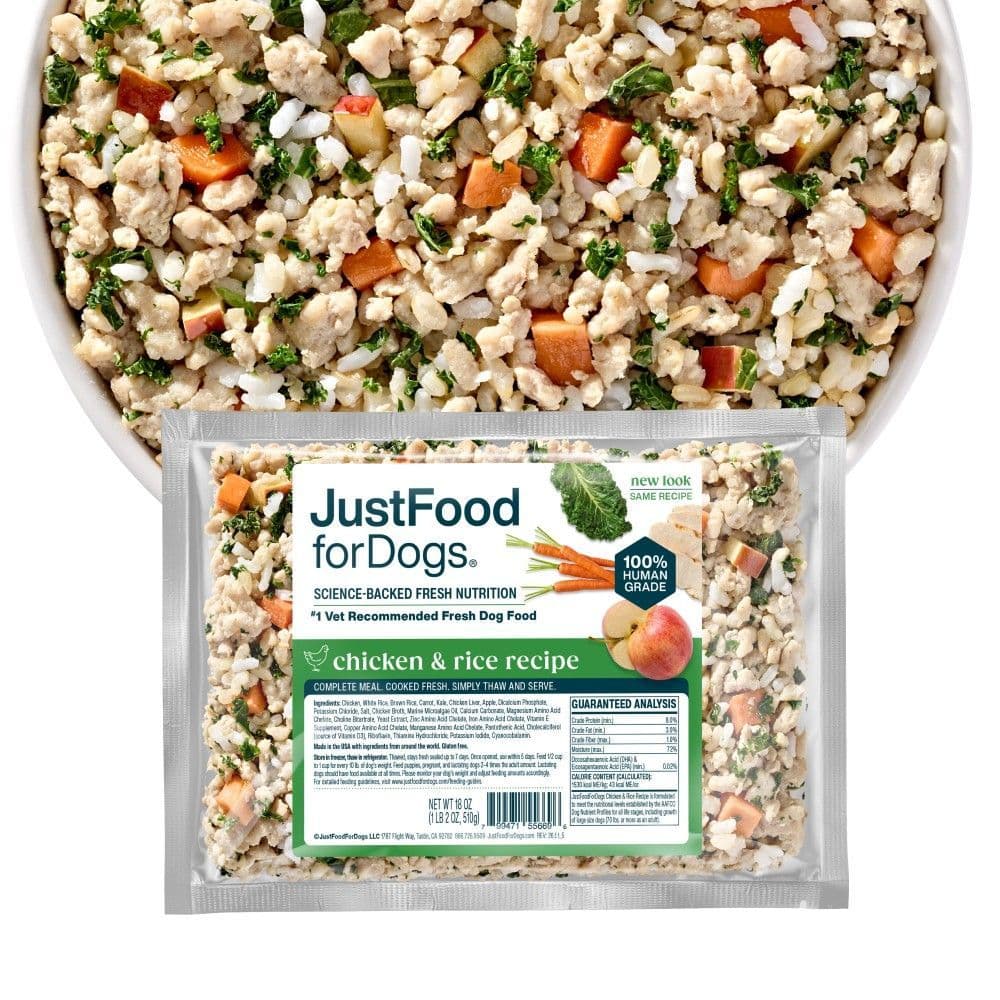
Webvet may earn a commission when you click through to JustFoodForDogs, at no extra cost to you.
- 1Dry matter puts nutrient percentages on a water-excluded basis.
- 2A calculation using label guarantees remains an estimate.
- 3Nutritional adequacy, life stage, and calories still matter when choosing a complete food.
For example, JustFoodForDogs Chicken & Rice provides a real label example for the calculation below. Its protein minimum and moisture maximum are inputs, not a claim that every serving contains those exact percentages.
What is the difference between dry matter and as fed?
As-fed percentages describe food with its water included. Dry-matter percentages describe nutrients relative to the dry portion only.
Imagine 100 grams of a hypothetical food containing exactly 75 grams of water and 10 grams of protein. Its protein is 10% as fed. The dry portion weighs 25 grams, so protein represents 10 ÷ 25 × 100 = 40% of the dry matter.
The food still contains the same 10 grams of protein. Nothing has been added by converting the number. This example uses exact hypothetical composition to explain the concept; real guaranteed-analysis labels usually provide minimums and maximums instead.
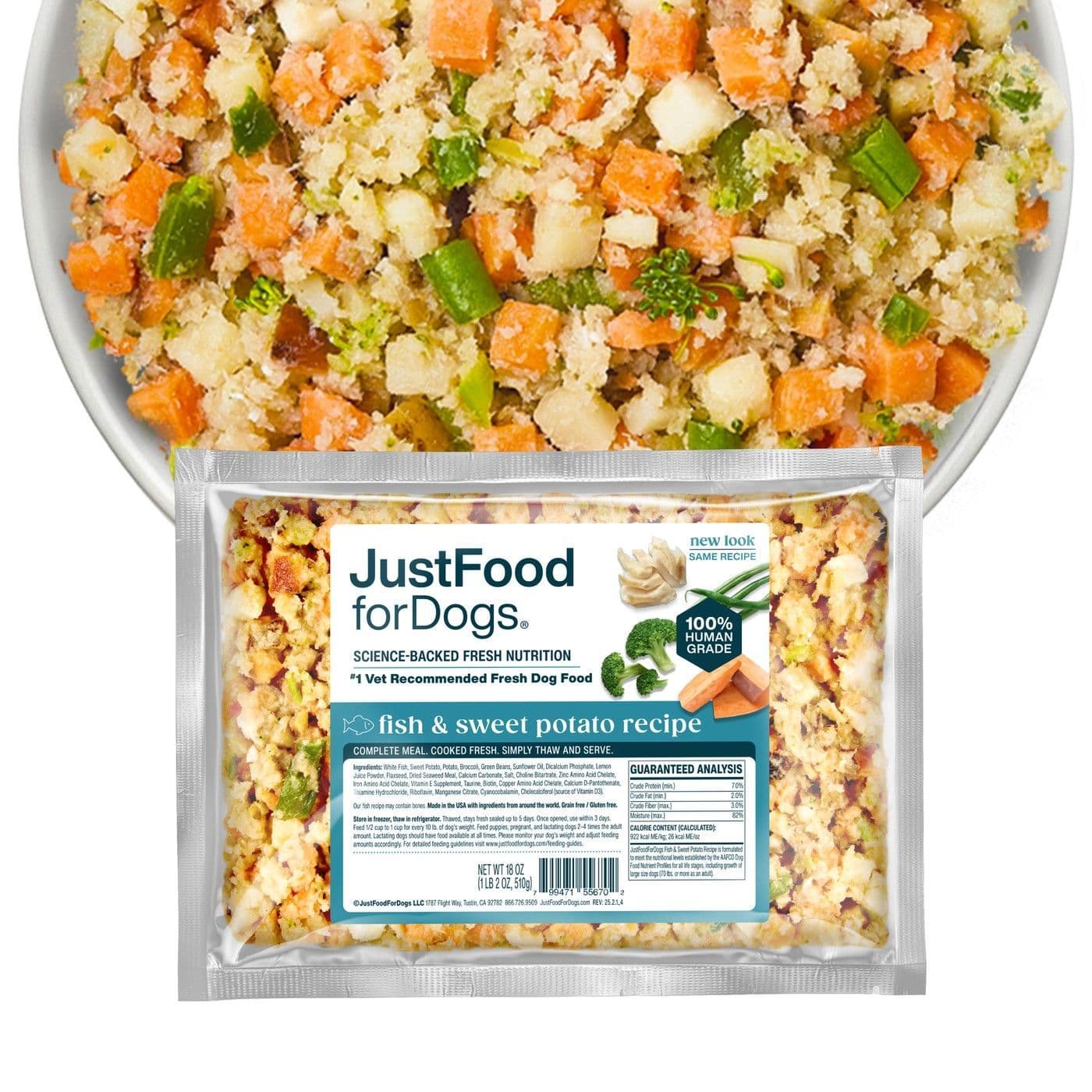
Webvet may earn a commission when you click through to JustFoodForDogs, at no extra cost to you.
How to calculate dry matter basis of dog food?
The dry matter calculation formula has two steps:
- Dry matter percentage = 100 − moisture percentage.
- Nutrient percentage on a dry-matter basis = as-fed nutrient percentage ÷ dry matter percentage × 100.
You can use a basic calculator or spreadsheet. A dry matter basis dog food calculator performs the same arithmetic; its output is only as reliable as the inputs.

Keep each value attached to its label. For example, Fish & Sweet Potato lists a 7% protein minimum and an 82% moisture maximum. Those guarantees must not be relabeled as measured composition simply because a calculator accepts them.
Calculate crude protein using an actual label
The current Chicken & Rice guaranteed analysis lists 8% crude protein minimum and 72% moisture maximum.
The steps are:
- Subtract moisture: 100 − 72 = 28.
- Divide protein by that denominator: 8 ÷ 28 = 0.2857.
- Convert to a percentage: 0.2857 × 100 = approximately 28.6%.
The result is a 28.6% label-based protein estimate on a dry-matter basis. It is not the measured protein content, and it is not a guaranteed dry-matter minimum.
Keep the original guarantees next to the result so that the qualification travels with the number. A copied “28.6% protein” figure without its basis and limitations is easy to misinterpret.
Use a simple worksheet
Record the recipe identity before entering numbers. Similar product names can represent different formulas, and an older label may not describe the food currently being sold. Once you have inspected calculators for the input fields they require, check how their explainers describe the output: converted figures are not automatically the food's true nutrient content. The calculation preserves the limitations of minimum and maximum guarantees. Keeping the original values beside each result makes the fresh/wet/dry worksheet's arithmetic and uncertainty inspectable, so you can reproduce the result and see exactly what it does not establish.
| Worksheet field | What to enter |
|---|---|
| Exact recipe and format | Product name and whether it is fresh, wet, or dry |
| Nutrient value | Percentage and whether it is minimum, maximum, or typical |
| Moisture value | Percentage and whether it is maximum or typical |
| Dry-matter denominator | 100 minus the moisture percentage |
| Calculation | Nutrient percentage divided by denominator, multiplied by 100 |
| Result description | Label-based estimate or typical-analysis calculation, as appropriate |
Use percentage numbers consistently. If moisture is written as 72%, enter 72 in the first formula, not 0.72. Do not combine a percentage in one step with a decimal fraction intended for a different version of the formula.
Tufts' nutrient-conversion guidance explains why comparable reporting bases are needed for useful nutrient comparisons.
Compare fresh, wet, and dry food on the same basis
This dog food dry matter basis chart combines one real label example with two clearly hypothetical labels. The wet and dry examples teach the calculation; they are not identified commercial products or a survey of their categories.
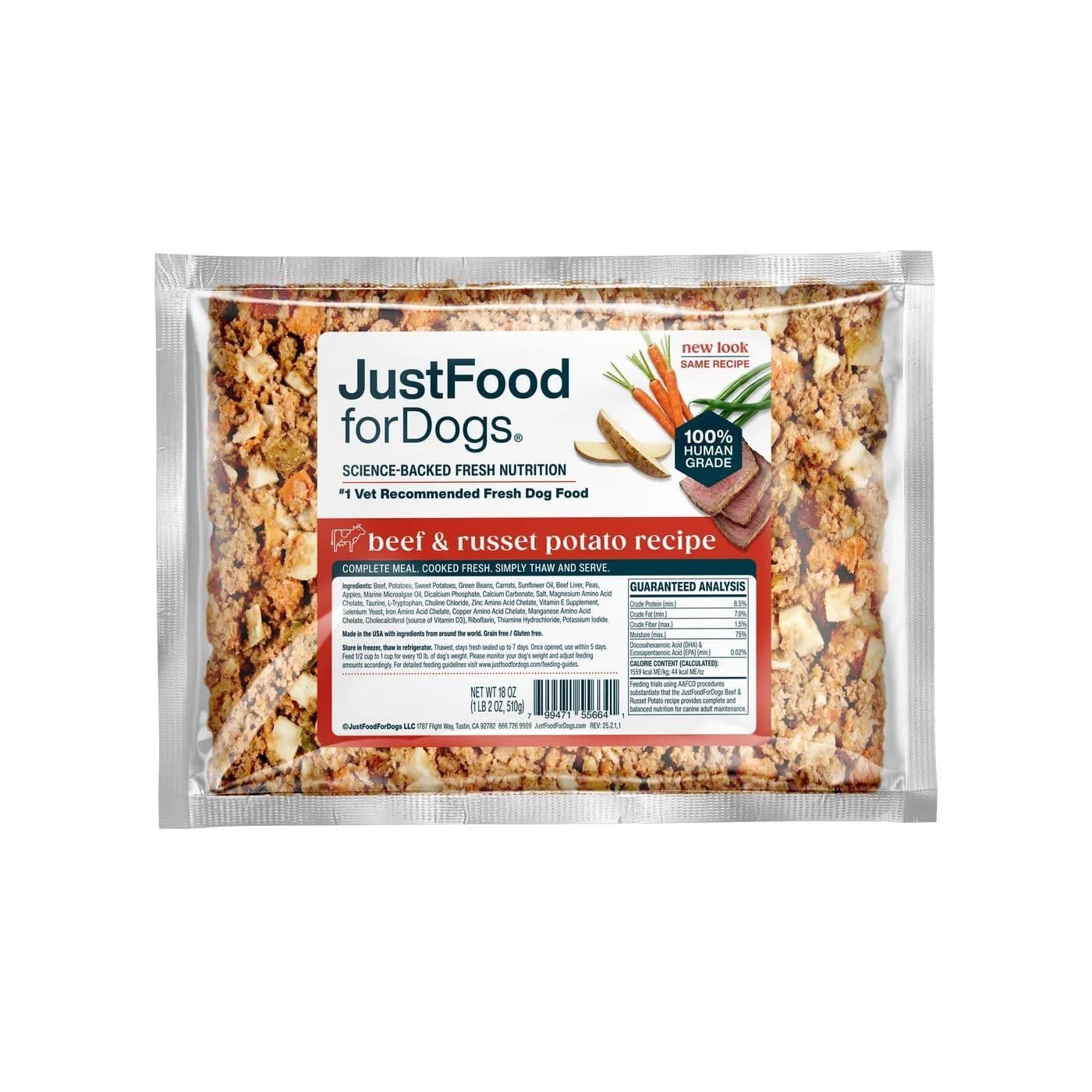
Webvet may earn a commission when you click through to JustFoodForDogs, at no extra cost to you.

| Example | Protein minimum, as fed | Moisture maximum | Denominator | Calculation | Label-based protein estimate |
|---|---|---|---|---|---|
| JFFD Chicken & Rice | 8% | 72% | 28% | 8 ÷ 28 × 100 | 28.6% |
| Hypothetical wet food | 10% | 78% | 22% | 10 ÷ 22 × 100 | 45.5% |
| Hypothetical dry food | 26% | 10% | 90% | 26 ÷ 90 × 100 | 28.9% |
The chart shows why comparing only the as-fed protein percentages can be misleading across formats. It does not show that the hypothetical wet food is the best dog food or that 45.5% is a desirable target for every dog.
The converted figures also do not become comparable measured results. Each starts from minimum and maximum guarantees, and the actual values may differ. Use the chart to understand the method, then request comparable typical nutrient information when the decision requires more precision.
Beef & Russet Potato offers another real label example: its 8.5% protein minimum and 75% moisture maximum produce 8.5 ÷ 25 × 100 = 34%. That result has the same limitations and is not a protein-quality ranking.
Why a guaranteed-analysis conversion is still an estimate
Minimum and maximum guarantees are not actual composition. A protein minimum says that protein meets a stated lower limit. A moisture maximum states an upper limit. Those two boundary values are not necessarily the values present together in a particular serving.
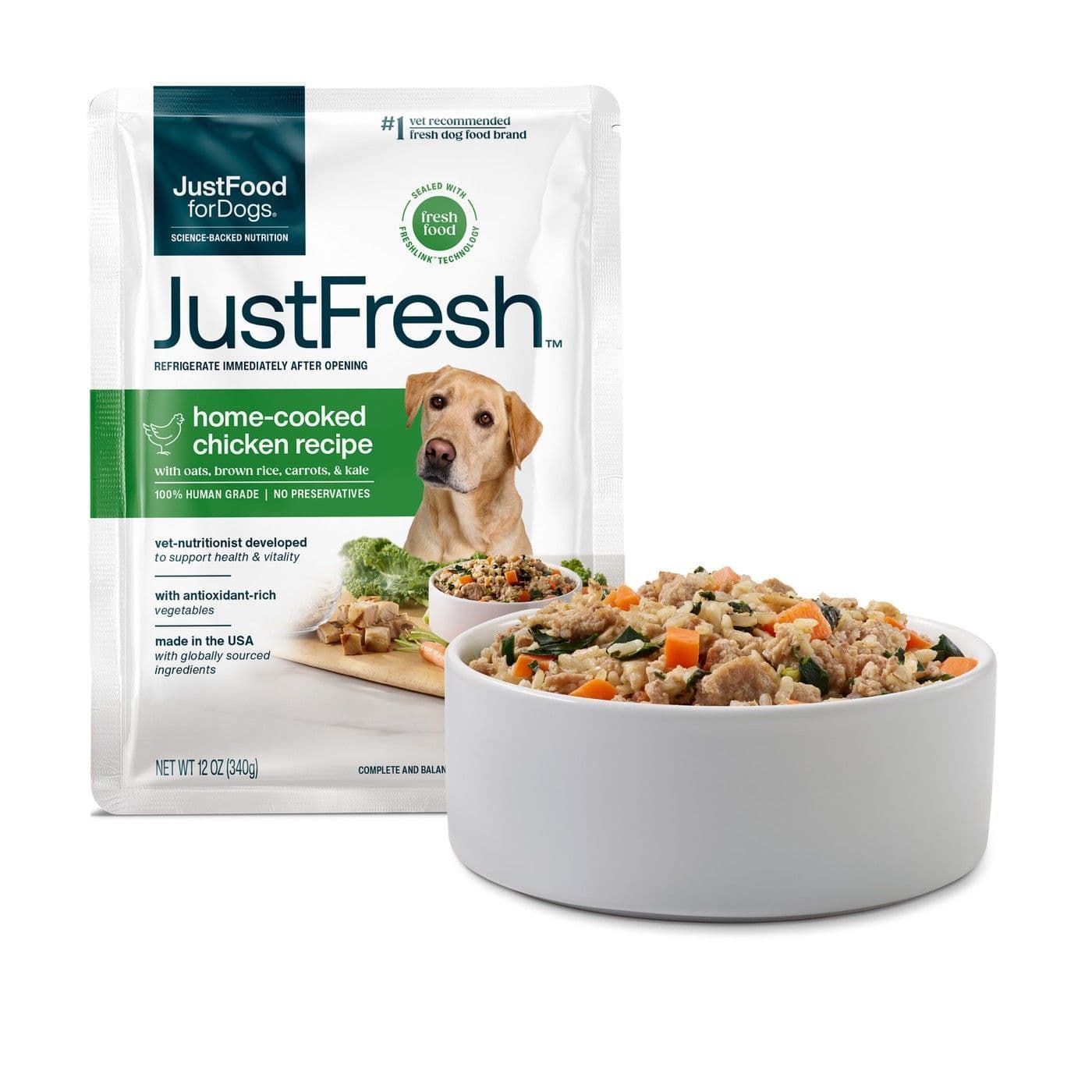
Webvet may earn a commission when you click through to JustFoodForDogs, at no extra cost to you.
That matters mathematically. Consider a hypothetical food whose label lists 8% protein minimum and 72% moisture maximum. If its actual composition were 8% protein and 70% moisture, the actual dry-matter protein percentage would be 8 ÷ 30 × 100 = 26.7%, below the 28.6% result obtained from the label boundaries.
This is why the converted label result should not be described as a guaranteed minimum dry-matter percentage. Tufts' explanation of guaranteed analysis distinguishes label guarantees from actual nutrient amounts.
Ask for compatible typical analysis
- Typical nutrient values for the exact recipe.
- The reporting basis for every value.
- A compatible moisture value.
- Calorie density.
- Whether the figures are averages and how variation is described.
Do not fill a missing field with a number from another recipe. For example, JustFresh Home-Cooked Chicken is a different formula from fresh-frozen Chicken & Rice. One recipe's moisture figure cannot be borrowed to finish the other's calculation.
Dry matter does not replace a calorie comparison
Dry-matter percentages do not tell you how many grams of a nutrient your dog receives at its actual calorie allowance. Two foods can have the same dry-matter percentage while delivering different nutrient amounts per meal because their energy densities and portions differ.
For intake comparisons, manufacturers or veterinary nutrition professionals may use grams of a nutrient per 1,000 kcal. That requires suitable nutrient data and calorie information on compatible bases.

As a purely hypothetical example, food containing exactly 10 grams of protein per 100 grams and 150 calories per 100 grams would supply about 66.7 grams of protein per 1,000 calories. That calculation answers a different question from the dry-matter percentage.
Keep these tasks separate:
- Dry matter: What proportion of the dry solids does a nutrient represent?
- Calorie-based comparison: How much nutrient is supplied for a given energy intake?
- Portion calculation: How many grams of food supply the dog's planned calories?
For the last task, use the recipe's calorie density. WebVet's JustFoodForDogs feeding guide explains the portioning step in more detail.
Use the label to choose an appropriate complete recipe
A dry-matter calculation is one tool, not a complete food-selection method. It does not establish digestibility, ingredient quality, suitability for a medical condition, or nutritional completeness.
Start with the exact nutritional adequacy statement. Chicken & Rice and Fish & Sweet Potato currently include growth in their statements. Beef & Russet Potato and JustFresh Home-Cooked Chicken are adult-maintenance choices. A higher converted protein figure cannot make an adult-only recipe appropriate as a complete puppy diet.
WebVet's guide to what makes dog food complete and balanced explains that broader assessment. If you are comparing preparation methods, fresh versus raw dog food addresses a separate distinction that dry-matter arithmetic does not resolve.
Turn the comparison into a feeding decision
- Does the recipe fit the dog's life stage?
- Is its complete formulation appropriate for the individual dog?
- What calorie allowance is being used?
- What measured portion supplies that allowance?
- Can the household handle and store the food correctly?
Dry matter calculation questions
Frequently Asked Questions
How do I convert dry matter to an as-fed basis?
Multiply the dry-matter nutrient percentage by the dry-matter fraction. For example, 40% protein on a dry-matter basis multiplied by 0.25, representing 25% dry matter, equals 10% protein as fed. Use compatible moisture and nutrient information. Reversing a label-based estimate does not turn it into a measured analysis.
How to calculate carbs in pet food if you have dry matter percentage?
Dry matter alone is insufficient. A common estimate of nitrogen-free extract subtracts protein, fat, crude fiber, and ash from 100 when all values are on a dry-matter basis. This is a calculated fraction, not a direct measurement of total carbohydrate. Missing ash, mixed reporting bases, and minimum or maximum guarantees prevent a reliable exact result. Request compatible typical analysis rather than inventing the missing value.
Why did my dry matter calculation give a result above 100%?
Check whether you mixed decimals and percentages, used the wrong moisture figure, copied values from different recipes, or combined incompatible reporting bases. A component cannot exceed the complete dry matter in a consistent measured analysis. Do not force the answer into a plausible range; correct the inputs or ask the manufacturer for clarification.
Does adding water to kibble change its dry matter protein percentage?
Adding only water changes the as-fed weight and percentage but not the relative protein share of the existing dry solids, assuming none of those solids is lost. Adding broth, meat, or another food is different because it can add nutrients as well as water.
Can I calculate dry matter when moisture is missing?
You need a compatible moisture value to establish the denominator. Ask the manufacturer for the exact recipe's moisture information and its basis. Assuming an average for “wet” or “dry” food creates an illustrative estimate, not a verified calculation for that product.

Editor
The Webvet Editorial Team is the in-house group of pet-care editors and writers behind Webvet, operated by Smart Pet Collective. The team researches, writes, and maintains Webvet's pet health, behavior, and medication content. Every article follows a defined editorial process: research from reputable veterinary and scientific sources, careful drafting, mandatory review of medical content by a credentialed veterinarian, and dated publication. Health and medication articles are medically reviewed by a licensed veterinary professional before they go live and are kept current over time.
Related reading

Can You Freeze Wet Dog Food? Portioning, Thawing, and Food Quality

How Long Can Wet Dog Food Sit Out? Serving and Storage Explained

Can Dogs Eat Ground Beef? Cooking, Portions, and Balanced Meals
