Best Litter Box Enclosures and Litter Furniture: What Vets Say About Enclosed Boxes
A litter box enclosure hides the box and contains scatter, but a badly sized or unventilated one is why some cats stop using it. Here is what vets look for in enclosed boxes, how to size one, and the litter furniture we would buy.

BVMS MRCVS
Medically reviewed by Dr. Pippa Elliott, BVMS MRCVS · Last reviewed

This article contains affiliate links. Webvet may earn a commission when you buy through them, at no extra cost to you.
A litter box enclosure can work well for most cats if it is big enough, easy to step into, open enough for airflow, and easy to scoop every day. The research on covered boxes is reassuring, but a cramped or stuffy cabinet is a real reason some cats stop using the box.
This guide turns veterinary guidance into a practical checklist for any litter box enclosure, whether it is a cabinet, a bench, a side table, a cat tree combo, a double unit for two cats, or a DIY build. Then it compares six pieces of litter furniture sold on Chewy against that checklist.
Three measurements decide most outcomes: interior size relative to your cat, entry height, and ventilation. Get those right and the style you choose is mostly a question of where the box will live.
| Product | Best for | Format | Chewy price at research time | Main tradeoff |
|---|---|---|---|---|
| Frisco Elevated Side Table Litter Box Cover | Most homes, living rooms | Side table cover | $73.89 | Interior size not published; measure your box first |
| PawHut Furniture Style Cabinet Cat Litter Box Enclosure | Owners who want a cabinet look | Cabinet | $84.99 | Cabinet fronts can limit airflow; check the openings |
| Yaheetech Litter Box Furniture Cat House, White, Large | Apartments on a budget | Large cat house | $79.99 | Interior length unconfirmed |
| ZooVilla Kitty Litter Loo Bench Cat Litter Box Enclosure, Black | Entryways and seating spots | Bench | $147.17 | Costs about twice the side table; interior size unconfirmed |
| Yafylly Cat Tree & Litter Box Enclosure | Small spaces | Cat tree over enclosure | $231.49 | No interior dimensions found |
| Cesicia Double Litter Box Cat Litter Box Enclosure, White | Multi-cat homes | Double enclosure | $240.78 | Two boxes side by side may count as one location |
 Sponsored
Have a health question about your cat?
Talk to a licensed vet at Dutch over video or message, including nights and weekends.
Use code Pets60
Plans start at $12/month · covers up to 5 pets
- Licensed vets in most states
- Rx for 150+ conditions
- 4.7 on Trustpilot
Do vets recommend enclosed litter boxes? What matters for the cat
Vets do not reject enclosed boxes outright. The guidance is that a litter box enclosure is acceptable when it gives the cat enough interior size, a low and easy entry, and real ventilation, and when the box inside is scooped daily. Many cats accept them; some do not, and the reasons are predictable.
The Merck Veterinary Manual frames the trade clearly. Owners like covered boxes because they contain mess and odor, but open boxes have more air circulation, and some cats do not like going into enclosed spaces to pee or poop. Merck also notes that some cats like the privacy of a hooded box.
- 1Many cats will use an enclosed box; a 2013 study of 28 cats found no overall preference for covered or uncovered boxes.
- 2Why some cats refuse covered or enclosed boxes: less airflow, feeling cornered, a box that is too small or too high, or a box that is not clean enough.
- 3Interior size relative to the cat matters most: the box should be about 1.5 times the cat's length from nose to base of tail.
- 4Scoop at least once a day, and keep an open box available while a cat gets used to a new enclosure.

Do cats actually use enclosed litter boxes?
Most cats will. In a Journal of Feline Medicine and Surgery study by Grigg and colleagues, 28 cats showed no significant overall difference between covered and uncovered boxes. Eight cats had a preference, split four and four. The authors suggest that when boxes are cleaned at least daily, most cats will not prefer either style.
Why do vets not recommend closed litter boxes?
Three documented concerns drive the caution. Merck notes open boxes have more air circulation. The Illinois Veterinary Teaching Hospital says lids, or boxes in small enclosed spaces such as closets, can contribute to litter box anxiety. It adds that cats should be able to approach a box from several angles so they do not feel cornered.
The Grigg study adds context: avoiding covered boxes is a frequent recommendation for cats that eliminate outside the box, but it had not been tested experimentally before that research. So the advice is a sensible precaution for a cat with problems, not proof that every cat dislikes a covered box.
What litter box aversion looks like
VCA Animal Hospitals defines litter box aversion as elimination that is never or rarely in the box, though the deposits are often very close to it. VCA lists these causes tied to the box itself:
- A box that is too high to get into comfortably
- A box that is too small for the cat
- A box that is simply not clean enough
- The type of litter or substrate inside
Every one of those can be made worse by a poorly chosen enclosure. A cabinet that only fits a small box, a tall step-over threshold, or a door that makes daily scooping a chore all push a cat toward the same aversion.
A cat that pees in the box but poops on the floor right beside it fits that pattern. An enclosure will not repair an aversion that started with pain or a dirty box.
What this means for choosing the best cat litter box setup
The best cat litter box setup is less about open versus covered than about fit. Merck suggests offering several box types, and VCA suggests testing a covered and an open box side by side. If your cat happily uses an open box, add an enclosure carefully rather than forcing a swap.
A few groups need extra care before you hide the box in furniture:
- Senior cats: arthritic cats may need low sides to enter and exit, so a raised threshold or a top opening that requires a jump works against them.
- Kittens: a kitten friendly litter box has sides low enough to climb in and out easily.
- Large or long cats: an extra large cat litter box, or an XL box for a Maine Coon, only works if the enclosure can hold it and still leave room to turn.
- Cats with a history of problems: if a cat has peed or pooped outside the box before, keep an open box available while testing any enclosure.
Owners often want a stylish litter box that doesn't smell, but a lid is not what controls smell. The vet sources stress daily scooping, and none we reviewed evaluates a lid filter. Whether the box inside is a basic tray or a self-cleaning unit, the cat still needs room to dig and paw at the litter.
Product reviews and star ratings on Chewy, Petco, or a single review site show whether owners liked a box, not whether it fits your cat. (Dog litter boxes, such as artificial grass pads, are a separate product not covered here.)
What are some cat litter boxes that look like furniture?
Litter furniture usually takes one of five shapes: a side table or end table cover, a cabinet with doors, a bench, a cat tree or condo with an enclosed base, or a double unit for two boxes. The best one hides the box in your space while meeting the vet size, entry, and airflow rules.
Our picks: the best litter box enclosures and litter furniture
These picks were chosen on format, price, and how well each style can meet the veterinary checklist in the next section. This is an editorial comparison, not a hands-on test. Prices and stock status reflect Chewy listing data gathered on October 13, 2026, and can change.
One limitation applies to every enclosure here: we could not verify manufacturer interior dimensions, entry height, or vent opening size for any of them. Before buying, compare the listing's interior measurements against your cat's body length and the box you plan to use.
Frisco Elevated Side Table Litter Box Cover: best overall
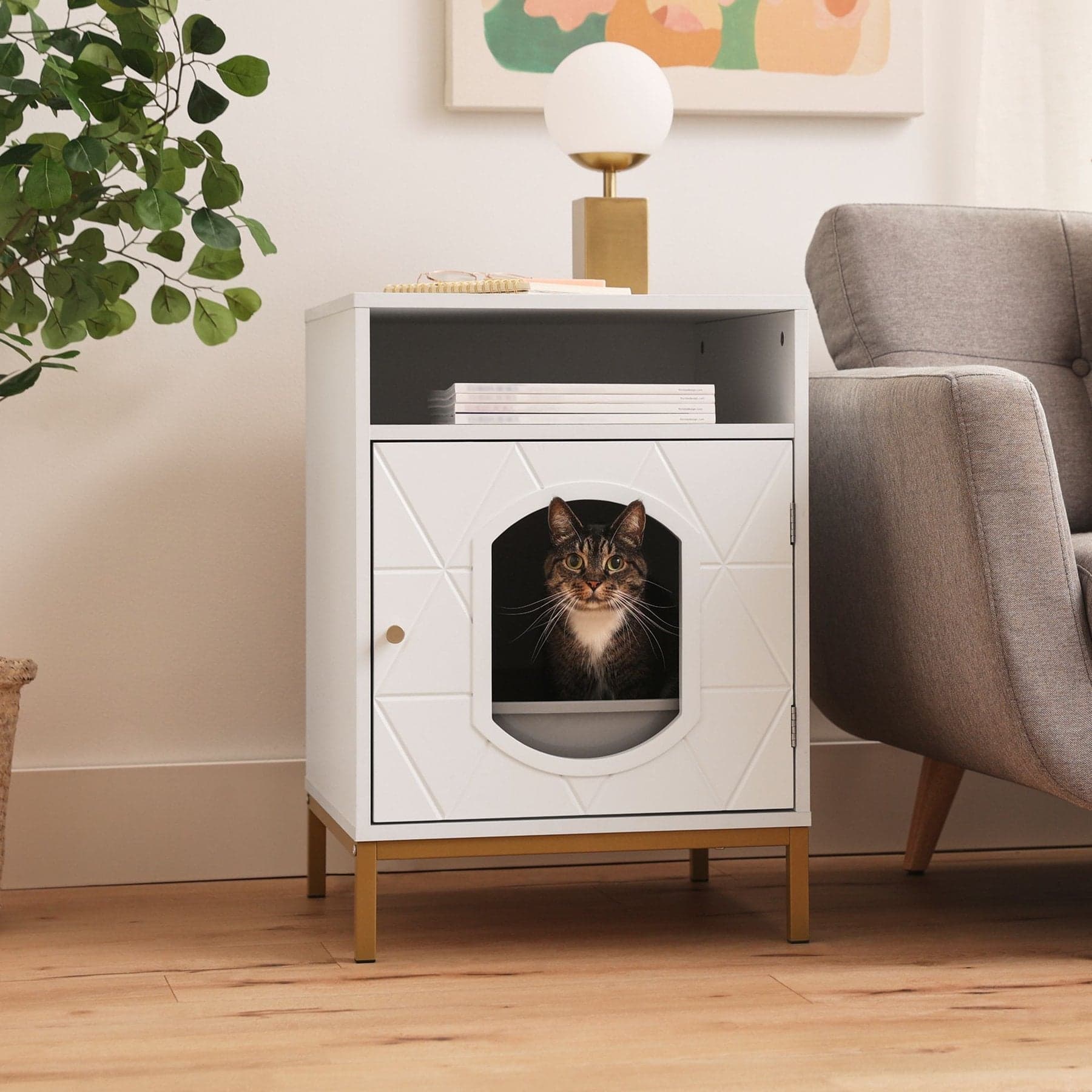
A side-table cover that hides a standard box in a living space, at the lowest listed price in this comparison.
Webvet may earn a commission when you click through to Chewy, at no extra cost to you.
The Frisco Elevated Side Table Litter Box Cover is a side table that sits over the litter box, so the box disappears into living room furniture. It was listed at $73.89 and in stock on Chewy at the time of research, the lowest price in this comparison.
It suits owners who want a hidden litter box in a main living area rather than a basement, which is where Merck says owners often make the mistake of hiding boxes. A side table can sit in a quiet corner of a room the cat already uses.
The tradeoff is uncertainty about the inside. We could not confirm interior length or entry height, so measure your box and check that the cover leaves room for your cat to turn around. If the design raises the box off the floor, make sure a senior cat can still get in easily.
PawHut Furniture Style Cabinet Enclosure: best cabinet with a cleaning door
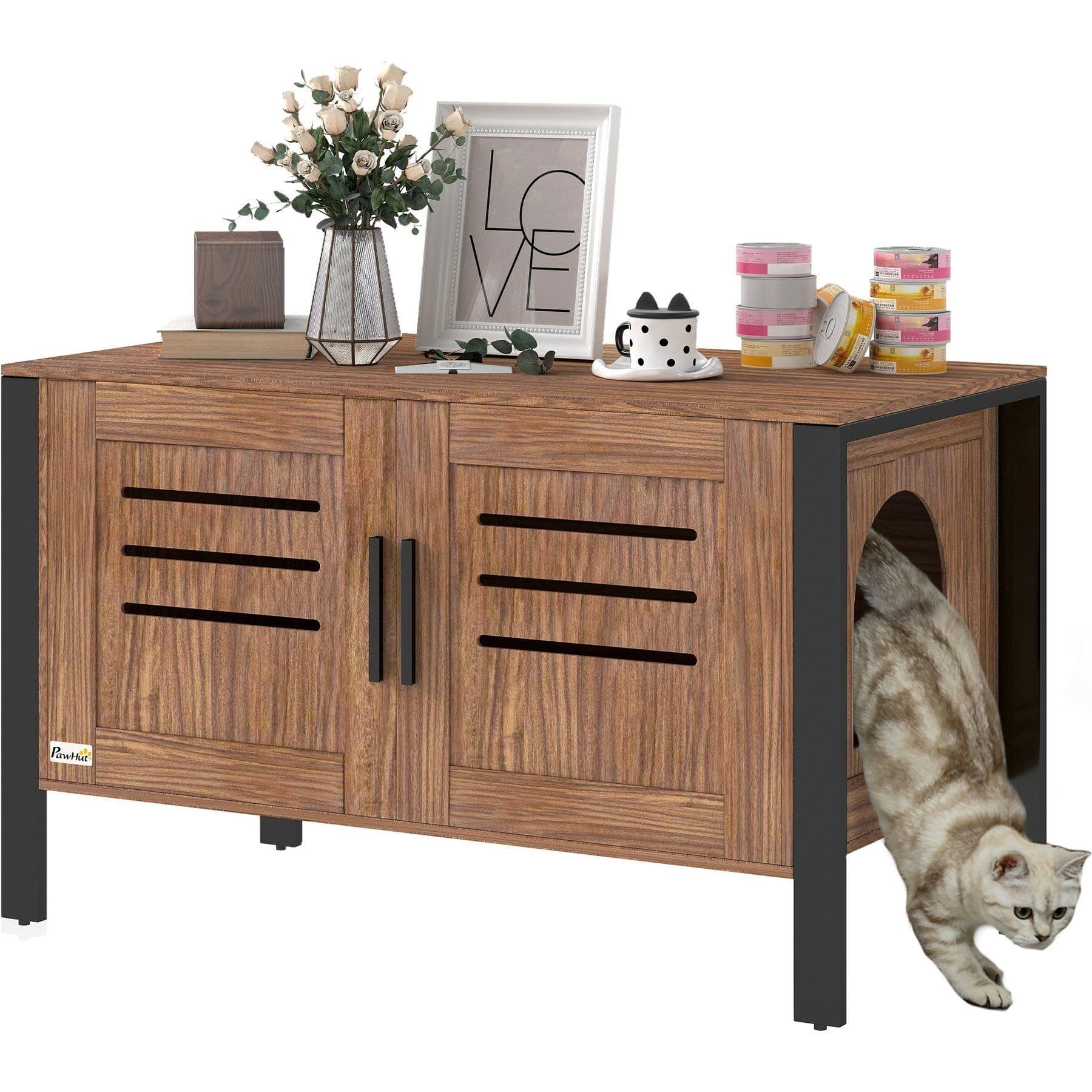
A furniture-style cabinet for owners who want the box behind a cabinet front; measure the interior against your cat first.
Webvet may earn a commission when you click through to Chewy, at no extra cost to you.
The PawHut Furniture Style Cabinet Cat Litter Box Enclosure is built to look like a cabinet, a popular style of litter box enclosure furniture. It was listed at $84.99 and in stock on Chewy at the time of research.
A cabinet suits owners who want the litter box enclosure cabinet look in a bedroom, office, or bathroom. Its value depends on cleaning access: a cabinet door you open fully makes daily scooping and the full wash every 1 to 4 weeks that Illinois recommends far easier.
The tradeoff is airflow and approach. A closed cabinet is the setup Merck and Illinois are most cautious about, so check that it has more than one opening and that your cat is not forced through a tight hole. Confirm interior length on the listing before you buy.
Yaheetech Litter Box Furniture Cat House: best value
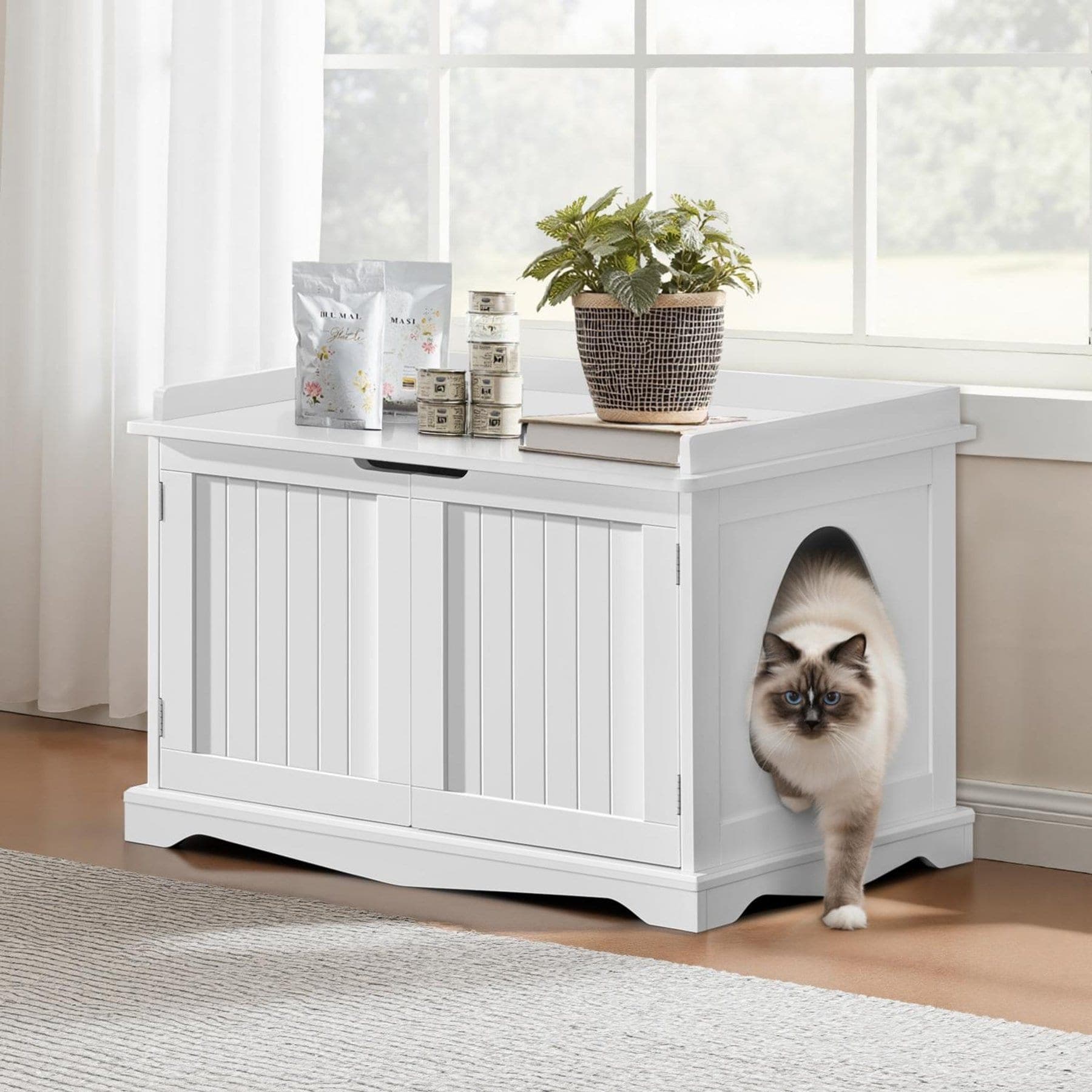
A large white cat-house enclosure at a value price, suited to apartments where the box sits in a living area.
Webvet may earn a commission when you click through to Chewy, at no extra cost to you.
The Yaheetech Litter Box Furniture Cat House, White, Large is a large, white cat house enclosure. It was listed at $79.99 and in stock on Chewy at the time of research, the second-lowest price in this comparison, in a size the listing labels large.
It suits apartment owners who need a cat litter box for small spaces but still want room for a bigger box. White furniture also blends into many apartments more easily than dark wood.
The tradeoff, as with the others, is that the "large" label is not an interior measurement. Check the listed interior length against the 1.5 times body length rule. For a kitten or a senior cat, confirm the entry is low enough to step over, since no published entry height was available.
ZooVilla Kitty Litter Loo Bench: best bench enclosure
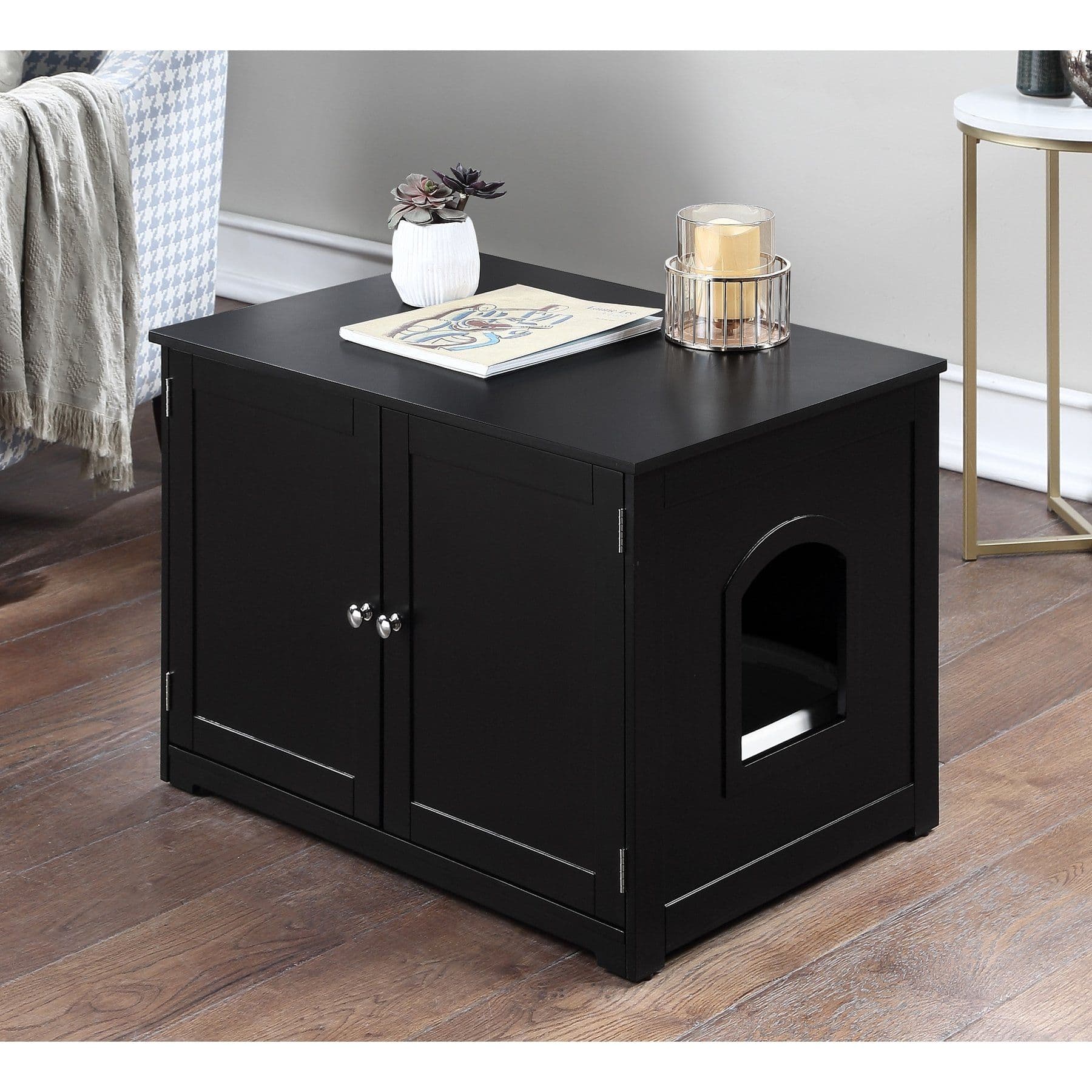
A black bench-style enclosure that doubles as seating; retailer listings put its footprint at about 29.5 x 20.8 inches.
Webvet may earn a commission when you click through to Chewy, at no extra cost to you.
The ZooVilla Kitty Litter Loo Bench Cat Litter Box Enclosure, Black is a bench that hides the box underneath and gives you a seat or a surface on top. It was listed at $147.17 and in stock on Chewy at the time of research.
This is the only pick with published dimensions we could find. Retailer listings for Zoovilla Kitty Litter Loo enclosures put the footprint at about 29.5 x 20.8 inches with MDF construction. That listing does not give interior size or pan fit, and it may not be the identical Chewy item.
A bench suits a hallway, mudroom, or the foot of a bed, and the black finish fits a modern room. The tradeoff is price: it costs nearly twice the side table. Use the overall length as a ceiling: the interior will be shorter, so check it against your cat's size.
Yafylly Cat Tree and Litter Box Enclosure: best for small spaces
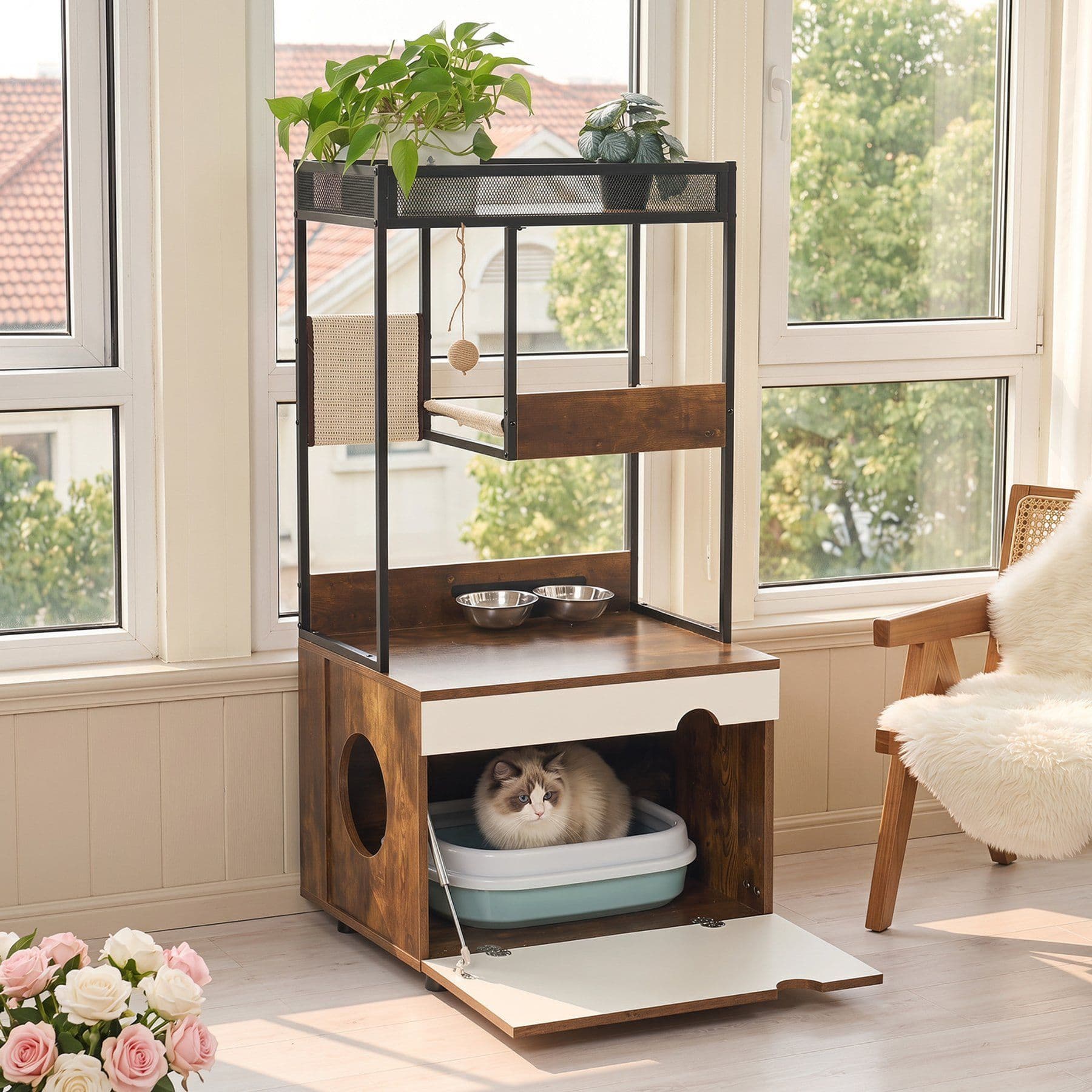
A cat tree stacked over a litter enclosure, so one footprint covers climbing, perching, and the box.
Webvet may earn a commission when you click through to Chewy, at no extra cost to you.
The Yafylly Cat Tree & Litter Box Enclosure combines a cat tree with a hidden litter box in its base. It was listed at $231.49 and in stock on Chewy at the time of research. We found no interior dimensions.
It suits small apartments where floor space is tight, because the climbing structure and the box share one footprint. If your cat also needs scratching surfaces, see our guide to cat trees and scratching posts.
The tradeoff is placement. Merck advises keeping the box in a secluded, low-traffic spot, while a cat tree tends to be a play hub. If another cat uses the perches above, the cat below may feel cornered. Measure the base interior and confirm you can reach every corner to scoop.
Cesicia Double Litter Box Enclosure: best for multiple cats
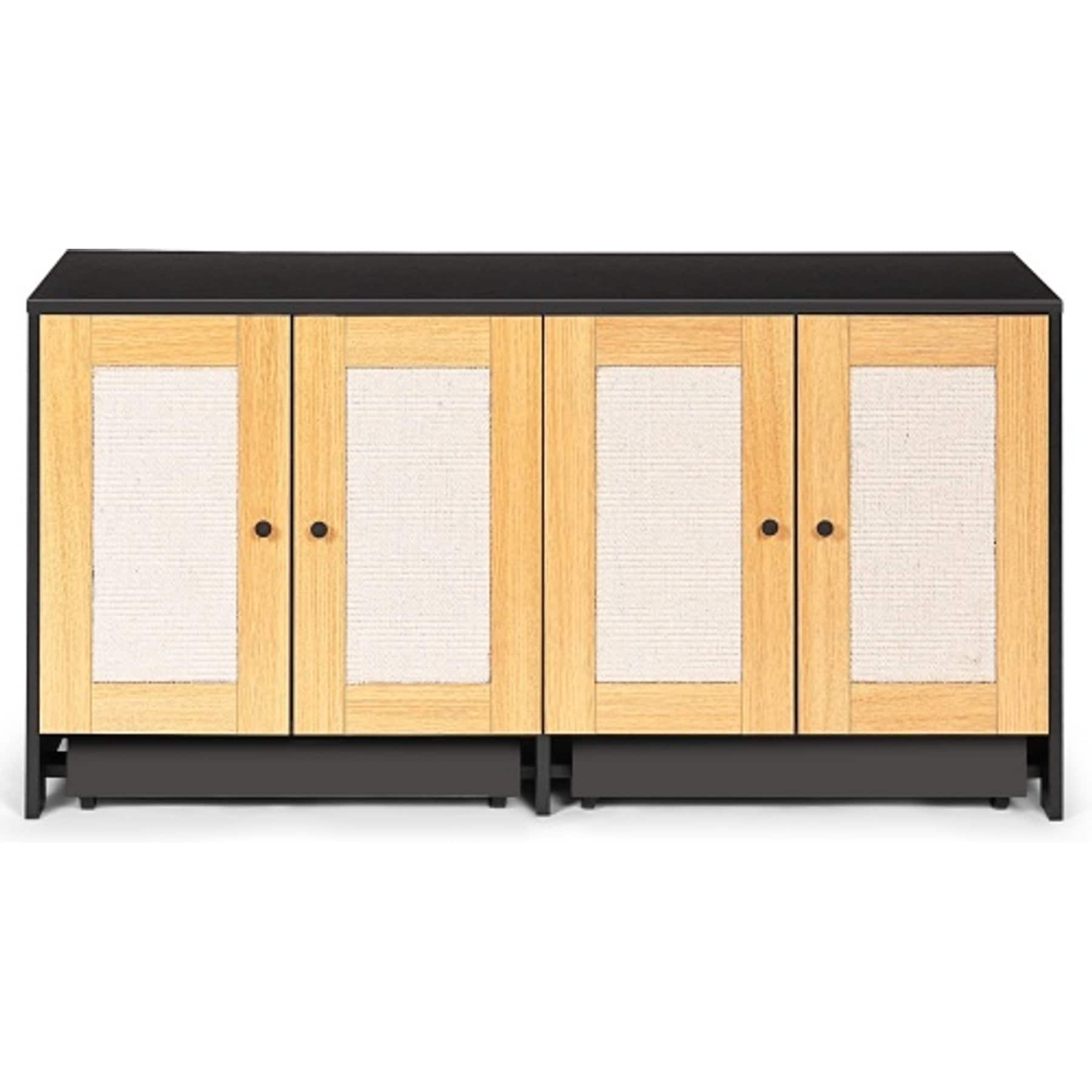
A double enclosure built for two boxes; pair it with at least one more box elsewhere to meet the plus-one rule.
Webvet may earn a commission when you click through to Chewy, at no extra cost to you.
The Cesicia Double Litter Box Cat Litter Box Enclosure, White is a double enclosure designed to hold two litter boxes. It was listed at $240.78 and in stock on Chewy at the time of research. We found no overall or per-compartment dimensions.
It suits multi-cat homes that want two boxes hidden in one piece of furniture. Check each compartment on its own against the 1.5 times body length rule, since two boxes share one footprint.
The tradeoff is location. Illinois warns that cats treat boxes placed close together as one large box, so two boxes in one double enclosure may count as a single location. Pair it with at least one more box elsewhere to meet the one box per cat plus one rule.
SponsoredVet care that's always there
Unlimited video calls and messaging with licensed vets for less than a typical vet visit. One membership covers up to five pets.
Use code Pets60
Plans start at $12/month · covers up to 5 pets
- Licensed vets in most states
- Rx for 150+ conditions
- 4.7 on Trustpilot
How to choose a litter box enclosure: size, entry, ventilation, and cleaning access
Any litter box enclosure, store-bought or homemade, can be judged with the same short checklist. The numbers come from veterinary guidance where it exists, and the gaps are named honestly where it does not.
| Measurement | What to check | Why it matters | Pass or fail |
|---|---|---|---|
| Box length | Box is about 1.5 times the cat's length, nose to base of tail | Illinois and VCA: cats prefer boxes about 1.5 times body length; many commercial boxes are too small | Pass if the box meets 1.5 times; fail if shorter |
| Interior length | Enclosure interior is longer than that box, with room to turn | Merck: cats want room to dig and turn around | Pass if the cat can turn around inside; fail if it must back out |
| Entry height | Threshold low enough to step over | Merck and Cornell: older and arthritic cats need low sides; VCA: kittens need low sides | Pass if your cat steps in without jumping; fail if it hesitates or climbs |
| Ventilation openings | More than one opening, not a single hole into a sealed box | Merck: open boxes have more air circulation; Illinois: cats should not feel cornered | Pass if air and the cat can move through more than one side; fail if sealed |
| Door access | You can reach every corner and lift the box out | Daily scooping and a full wash every 1 to 4 weeks | Pass if you can scoop without unloading the cabinet; fail if you cannot reach the corners |
| Litter depth | Room for at least 3 inches of litter | VCA: at least 3 inches of digging material for kittens | Pass if the box fits under the lid with litter at depth; fail if the lid scrapes |
The table above is a buyer checklist that turns the veterinary objections to closed boxes into measurable size, entry, and ventilation requirements you can test on any enclosure, including one you build yourself.
Interior size relative to your cat
Start with the cat, not the furniture. The Illinois handout says boxes should be 1.5 times the cat's length from nose to base of tail, and that many commercial boxes are too small. VCA gives the same figure, and Merck says larger boxes are better because cats like room to dig and turn around.
Here is how that works in practice:
- Measure your cat from the tip of the nose to the base of the tail.
- Multiply by 1.5 to get the minimum box length. A cat measuring 18 inches needs a box about 27 inches long.
- Check that the enclosure's interior length holds that box with space left over for the cat to turn.
- If the listing only gives outside dimensions, assume the interior is smaller once wall thickness and doors are subtracted.
No primary veterinary source gives a specific interior size for large breeds, so the 1.5 times rule is the standard to use for every cat, large or small.
Entry height for seniors and kittens
Entry height is where many furniture enclosures fall short. Merck says older cats with arthritis may need lower box sides to enter and exit easily, and the Cornell Feline Health Center lists box walls low enough for a senior cat to step over as a basic senior-care change.
For kittens, VCA says the sides must be low enough to get in and out easily. No veterinary source we found gives an entry height in inches, so judge it by watching your cat: a cat that steps in calmly passes, while one that jumps, hesitates, or perches on the edge does not.

Ventilation and the ammonia question
Ventilation is the most common worry about any enclosure, and the honest answer is that the evidence is thin. No primary veterinary source we found measures ammonia inside litter furniture or gives a minimum size for ventilation openings. What Merck does say is that open boxes have more air circulation.
Two related points are documented. Illinois says many cats dislike aromatic or dusty litters, litter deodorizers, and box liners, so masking a stuffy enclosure with scent can backfire. Illinois also says to avoid strong chemicals and ammonia-based products when washing the box.
In practice, that means:
- Choose enclosures with openings on more than one side rather than a single entry hole.
- Leave the cabinet door or back panel open when airflow seems poor.
- Use a soft, unscented clumping litter, which Illinois says most cats prefer; our guide to the best cat litter for odor control covers options.
- Rely on daily scooping, not deodorizers, to manage smell.
Cleaning access and daily scooping
An enclosure that makes scooping hard defeats its purpose. Merck says to scoop every day and clean the whole box at least weekly, more often with more cats. Cornell and VCA both say at least once a day, and Illinois recommends a full wash every 1 to 4 weeks with antibacterial soap and hot water.
Look for a door that opens wide, a box you can slide out without tipping litter, and space nearby for a waste bin, such as the disposal system in our Litter Genie review. If you prefer a stainless steel litter box, confirm it fits inside the enclosure before buying both.
Matching enclosure styles to the checklist
Litter box furniture comes in many styles, from wooden cabinets and wood benches to modern black side tables, white cat houses, and plant litter box designs that look like a planter. Here is how the main styles usually measure up:
- Cabinet enclosures: the most furniture-like option and often the easiest to clean through a front door, but check ventilation and that the cat is not entering a single tight hole.
- Bench enclosures: a long footprint can leave room for a bigger box; check interior length and the step-in height.
- Side table or end table covers: compact and easy to place in a living room; measure carefully, since a smaller footprint means a smaller interior.
- Cat tree with litter box enclosure: a cat tree, cat condo, or cat tower over a hidden box saves floor space; check that climbing traffic above does not crowd the cat below.
- Planter and plant styles: a cat litter box planter or decorative plant top disguises the box; check interior size and airflow as you would for any enclosure.
- Double enclosures: for two boxes, covered in the next section.
Wooden litter box enclosures and wood cabinets look like real furniture; keep a removable box inside so you can lift it out for the full wash. If you want a self-cleaning setup instead, our guide to the best automatic litter boxes covers those separately; check any automatic unit's footprint before planning an enclosure around it.
Litter box enclosures for multiple cats and large cats
Multi-cat homes change the math. Merck says there should be at least one more litter box than the number of cats, plus a box on each floor of a multi-level home. VCA gives the same standard, noting that two cats need at least three boxes, and Cornell agrees.
This one box per cat plus one rule matters more with enclosures, because furniture tends to concentrate boxes in one spot. Illinois warns that cats consider boxes close to each other one large litter box. VCA advises spreading boxes around the home so each cat can use them undisturbed.

How double enclosures fit the plus-one rule
A double litter box enclosure such as the Cesicia Double Litter Box Cat Litter Box Enclosure, White holds two boxes in one piece of furniture. Because Illinois says nearby boxes count as one, treat a double unit as one location. Two cats still need another box in a separate room.
Practical steps for a multi-cat setup:
- Count boxes, then count locations: two boxes in one double cabinet count as one place to go.
- Put at least one box on each floor of the house.
- Keep one box open or uncovered so cats that dislike enclosures always have a choice.
- Scoop more often; Merck says the more cats using a box, the more often it needs cleaning.
Merck adds that the more boxes available, the less likely a cat is to soil outside the box, barring illness or unusual stress.
Stress, multi-cat tension, and feline idiopathic cystitis
Box access is also a health issue. Illinois describes idiopathic cystitis as non-infectious bladder inflammation caused by chronic stress and anxiety. VCA explains that feline idiopathic cystitis is diagnosed only after other causes of abnormal urination are ruled out.
For cats with feline idiopathic cystitis, VCA recommends enough boxes, large boxes with a deep layer of litter, and daily scooping. The Merck Veterinary Manual professional version lists litter box management, stress reduction, and attention to intercat interactions among treatment considerations. An enclosure where one cat can block the only exit works against all three.
Large cats
For large cats, the 1.5 times rule usually means an extra large box, and Illinois notes many commercial boxes are too small. Measure the box you already own and your cat's body length before you buy. Compare interior lengths across styles; only the listed interior measurement settles whether a large box fits.
Where to put a litter box enclosure
Placement can make or break even a well-sized enclosure. Merck says the box should be in a secluded, low-traffic area the cat can easily reach, and that owners often make the mistake of hiding it in the basement or garage. Cornell agrees on quiet, less-trafficked spots and adds that boxes should not be moved often.
Where should a litter box be?
A litter box should be in a quiet, low-traffic spot the cat can reach easily, away from food and water. VCA prefers a separate room from feeding stations where possible. For older cats, Illinois recommends a box on the level of the house where the cat spends most of its time.
Where to put a litter box in a small apartment
Small homes force tradeoffs, and a litter box enclosure is often the answer because it lets the box sit in a living area without looking like one. Good options for where to keep a litter box in an apartment include:
- A quiet corner of the living room, inside a side table or cabinet enclosure
- A bedroom corner away from the bed and the door
- A bathroom, if the door stays propped open and the room is not busy at peak times
- A hallway bench enclosure, if the hallway is not the main route through the home
Avoid the kitchen or anywhere near food and water bowls, and avoid busy rooms the whole household passes through.
Bathroom litter box enclosures
A litter box enclosure for the bathroom keeps the box out of living areas. The main risk is access: a closed door means the cat cannot reach its box. Small enclosed spaces are also what Illinois flags as a possible source of litter box anxiety, so give the cat a clear approach from more than one angle.
Hidden litter box ideas that still work for the cat
There are plenty of ways to hide a litter box, and most hidden litter box ideas succeed or fail on the same points:
- A hidden litter box bench or cabinet in a room the cat already uses works better than a box hidden in a closet.
- A narrow litter box for small spaces is tempting, but it still has to meet the 1.5 times length rule; go longer rather than narrower.
- Hiding the box in a basement or garage is the classic mistake Merck describes.
- Once you choose a spot, leave it there; Cornell and VCA both advise against moving boxes around.
If a cat starts urinating everywhere but the litter box after a move, placement is one of the first things to review. Our guide to cat peeing outside the litter box covers the other causes to rule out.
DIY litter box enclosures: what works and what to avoid
A DIY litter box enclosure can be a good option, especially if store-bought litter furniture is too small for your cat. No primary veterinary source describes a specific build, but the same vet-sourced rules apply to any homemade litter box enclosure: size, low entry, approach from more than one angle, and cleaning access.
The Illinois handout also gives DIY builders a useful start: it names low-sided concrete mixing trays and storage containers as suitable alternatives to commercial litter boxes. That makes a large tote or tray a sound box to build around.

How to make a cat litter box enclosure?
Start with the box, then build the furniture around it. Measure your cat, choose a box about 1.5 times its length, and pick a cabinet or frame with room to turn inside. Cut a low, smooth entry, add a second opening for airflow, and keep a door for daily scooping.
Step by step, a basic build looks like this:
- Measure your cat from nose to base of tail and multiply by 1.5 for the box length.
- Choose the box: a large plastic tote, a storage container, or a low-sided mixing tray.
- Choose the enclosure: an existing cabinet, a bench, or a simple wooden frame with interior length longer than the box.
- Cut the entry low enough for your cat to step over, and sand or cover every cut edge.
- Add a second opening or leave a side open so air moves and the cat can see out.
- Fit a door or removable panel wide enough to scoop daily and pull the box out to wash.
IKEA litter box enclosure hacks
An IKEA litter box enclosure hack usually means converting a cabinet or storage unit by cutting an entry hole in one side. It can look great, but check the same points as any store-bought cabinet:
- Interior length: many standard cabinets are shallower than a large litter box needs.
- Entry height: cut the opening low, not halfway up the side.
- Ventilation: a closed cabinet with one hole is the setup vets are most cautious about, so add a second opening.
- Door access: keep the front door working so you can scoop daily.
Tote and homemade box builds
A DIY litter box enclosure from a tote works because the walls help hold litter in while a cut entry keeps access easy. Illinois advises inspecting any cut-down side for sharp edges, so file or tape the opening first. Leave the lid off or vented rather than sealing the cat inside a closed tub.
What to avoid
Some build plans look tidy but break the vet rules:
- An entry hole cut high up the side, which forces seniors and kittens to jump
- A sealed box with a single opening and no other airflow
- A double litter box enclosure DIY build that places two boxes touching, which cats may treat as one box
- Scented panels, air fresheners, or deodorizers inside the enclosure
- Any build you cannot open fully to scoop and wash
If you are building because a cat will not use its current box, fix the underlying cause first. Learning how to make a cat use a litter box again usually starts with size, cleanliness, and placement, not furniture.
Getting your cat to use a new enclosure
Most cats adjust to a well-designed enclosure, but sudden change is a risk. Merck warns that abrupt changes to litter type or box location can cause a cat to soil outside the box, and that soiling outside the box can signal illness or behavior problems and needs veterinary attention.
No veterinary source we found gives a day-by-day schedule for introducing litter furniture. The supported approach is to offer the enclosure as a choice rather than a replacement, as the Grigg study suggests with its "cafeteria" of box styles.
A gentle introduction looks like this:
- Keep the old open box in its usual place and add the enclosure nearby.
- Use the same litter in both; Merck advises not changing litter type once a cat accepts one.
- Track which box gets used in a simple journal. VCA suggests each test run for one to two weeks to show a clear preference.
- Retire the old box only after the cat uses the enclosure consistently.
- If the cat starts going somewhere else, Illinois suggests placing a box at that new spot to get the cat using a box again.
Watch for warning signs. If your cat strains in the box, call your vet at once, since Merck says straining can be a life-threatening emergency, especially in male cats. If a cat starts leaving stool outside the box, see why is my cat pooping outside the litter box for the medical and behavior causes.
Litter box enclosure questions
Frequently Asked Questions
What size litter box enclosure do I need?
Size the enclosure to the box, and the box to your cat. Vets recommend a box about 1.5 times your cat's length from nose to base of tail, and the enclosure interior must hold that box with space for your cat to turn around. Outside dimensions overstate the usable interior.
Do litter box enclosures make odor worse?
No veterinary source we found shows that enclosures make odor worse or better. Merck notes that owners use covered boxes to contain odor, while open boxes have better air circulation. The practical answer is good ventilation plus discipline: scoop daily, wash the box every 1 to 4 weeks, and skip deodorizers, which many cats dislike.
Can two cats share one litter box enclosure?
Two cats can use the same enclosure, but it should not be their only option. Vets recommend one box per cat plus one, so two cats need at least three boxes. A double enclosure holds two, but Illinois notes cats treat nearby boxes as one, so add a box in another room.
Will a litter box enclosure stop litter tracking?
No veterinary source we found addresses litter tracking, so treat any improvement as a convenience. Owners often add a litter mat at the exit or choose an enclosure with an entry tunnel; our best cat litter mat guide covers options. Do not switch to a litter your cat dislikes just to cut tracking.
Can a senior or arthritic cat use a litter box enclosure?
Yes, if the enclosure has a low entry. Merck says arthritic cats may need lower sides to get in and out, and Cornell advises walls low enough for a senior cat to step over. Watch your cat step inside: if it hesitates or jumps, choose a lower design on the floor the cat uses most.

Editor
The Webvet Editorial Team is the in-house group of pet-care editors and writers behind Webvet, operated by Smart Pet Collective. The team researches, writes, and maintains Webvet's pet health, behavior, and medication content. Every article follows a defined editorial process: research from reputable veterinary and scientific sources, careful drafting, mandatory review of medical content by a credentialed veterinarian, and dated publication. Health and medication articles are medically reviewed by a licensed veterinary professional before they go live and are kept current over time.
Veterinarian · BVMS MRCVS
Dr. Pippa Elliott, BVMS, MRCVS, is a veterinarian with nearly 30 years of experience in companion animal practice. Dr. Elliott earned her Bachelor of Veterinary Medicine and Surgery from the University of Glasgow. She was also designated a Member of the Royal College of Veterinary Surgeons. Married with 2 grown-up kids, Dr. Elliott has a naughty Puggle named Poggle, 3 cats and a bearded dragon.
Related reading

World's Best Cat Litter Review: Clumping, Tracking, Flushing, and Which Cats It Suits

Litter Genie Review: Does It Really Work, What Refills Cost, and the Best Alternatives

Best Stainless Steel Litter Boxes: Vet-Reviewed Picks and Why They Beat Plastic
