Dog Urine Killing Grass: Why It Happens and How to Fix It
Dog urine kills grass because it delivers a concentrated dose of nitrogen from urea, which burns the lawn in round brown spots. Here is why it happens, how to fix the spots, how to prevent new ones, and which grasses hold up best.

BVMS MRCVS
Medically reviewed by Dr. Pippa Elliott, BVMS MRCVS · Last reviewed

This article contains affiliate links. Webvet may earn a commission when you buy through them, at no extra cost to you.
Dog urine killing grass is a nitrogen burn: urine delivers a concentrated dose of nitrogen to one small patch of lawn, and the grass burns as it would under spilled fertilizer. The process is normal for your dog, and prompt watering limits the damage while reseeding repairs it.
These dead spots, sometimes called urine scald, are common wherever dogs urinate, VCA Animal Hospitals says. Female dogs often get the blame, but VCA traces the difference to behavior, not sex.
- 1Dog urine kills grass by delivering concentrated nitrogen from urea, much as spilled fertilizer burns a lawn.
- 2Dog urine spots look like a dead brown center with a dark green ring.
- 3Watering a dog urine spot with about three times as much water as urine, within 8 hours, can produce a fertilizer effect instead of a burn.
- 4Dog rocks and urine-changing supplements are not proven to stop lawn spots.
- 5A change in your dog's drinking or urination, or urine that suddenly stops burning the lawn, is a reason to see a vet.
 Sponsored
Have a health question about your dog?
Talk to a licensed vet at Dutch over video or message, including nights and weekends.
Use code Pets60
Plans start at $12/month · covers up to 5 pets
- Licensed vets in most states
- Rx for 150+ conditions
- 4.7 on Trustpilot
Why Does Dog Urine Kill Grass?
Dog urine kills grass because it delivers concentrated nitrogen from urea to one small patch of lawn. VCA says the nitrogen comes from protein the body breaks down, and Penn State Extension names urea, which is rich in nitrogen, as a major component of dog urine.
Concentration matters more than volume. Colorado State University Extension says damage occurs when a high concentration of nitrogen compounds and salts lands in a small area, and University of Missouri IPM reports that as little as one fluid ounce of concentrated urine burned even tall fescue.
Because concentration drives the burn, dilution helps. VCA says getting your dog to drink more water dilutes the urine and its nitrogen, making a burn less likely, and suggests offering multiple water sources. A HANAMYA Automatic Dog & Cat Water Fountain beside the usual bowl is one way to add a second source.
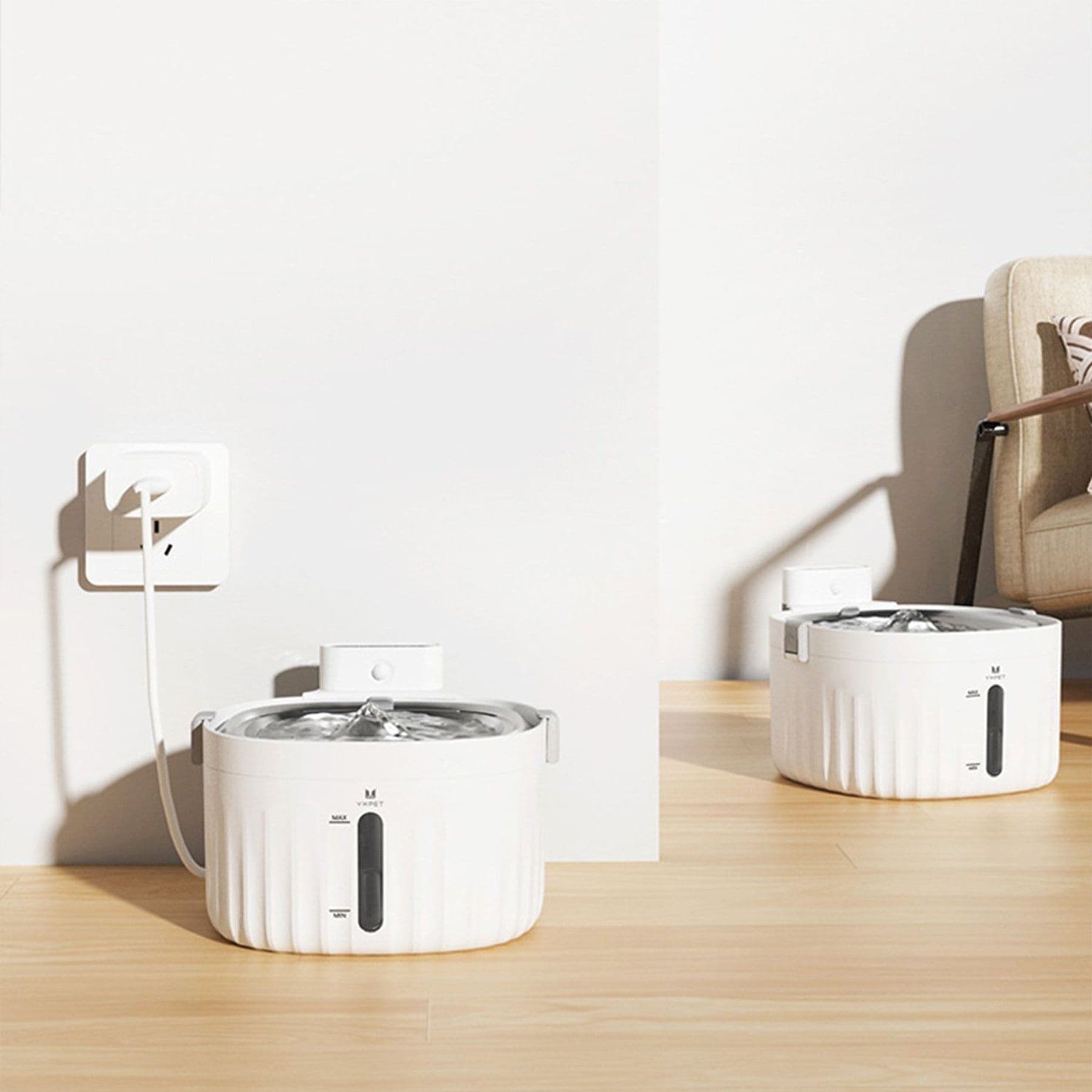
HANAMYA Automatic Dog and Cat Water Fountain is an automatic water fountain for dogs and cats.
Webvet may earn a commission when you click through to Chewy, at no extra cost to you.
The dose also explains the green grass where dogs pee: VCA says a ring of lush, green grass may form around the burn because the grass at the edge gets just enough nitrogen to feed it.
Researchers disagree on which part of dog urine does the most damage:
- Nitrogen from urea. VCA, Penn State, and Colorado State name nitrogen as the cause.
- Salts. Colorado State and NC State say salts add to the injury.
- Lactic acid. NC State Extension calls it the main culprit, citing a 2018 Crop Science study in which lactic acid caused 40 to 87 percent injury, versus 5 to 12 percent for a lab urea-and-salt solution.
Purdue University Extension and Illinois Extension, writing with a Purdue veterinary clinician, say the exact mechanism is not completely understood.
What Dog Urine Spots on Grass Look Like
Dog urine spots on grass look like a dead brown center with a dark green ring. Purdue Extension describes a central crater of brown turf 3 to 6 inches across inside a dark green ring 6 to 12 inches across, though dead patches do not always appear.

Damage ranges from mild to severe. NC State Extension says mild damage shows up as taller, dark-green spots, while the worst cases are dead, straw-colored spots with dark green edges. As it burns, dog pee leaves grass straw-colored, the yellowed look many owners notice.
To confirm that urine caused a spot, check for these signs:
- An ammonia smell from dead grass sealed in a plastic bag, a test from Washington State University Extension
- No cottony fungal growth on the patch, which Kansas State University says separates urine damage from turf disease
- Dying blades that are not water-soaked or matted down, another K-State marker
To get rid of yellow grass from dog urine, water it. Colorado State Extension says heavier watering dilutes salts so living grass can recover; dead patches need reseeding. For repeat spots, give your dog a set potty spot off the lawn, such as a Four Paws Wee-Wee Dog Grass Patch Tray.
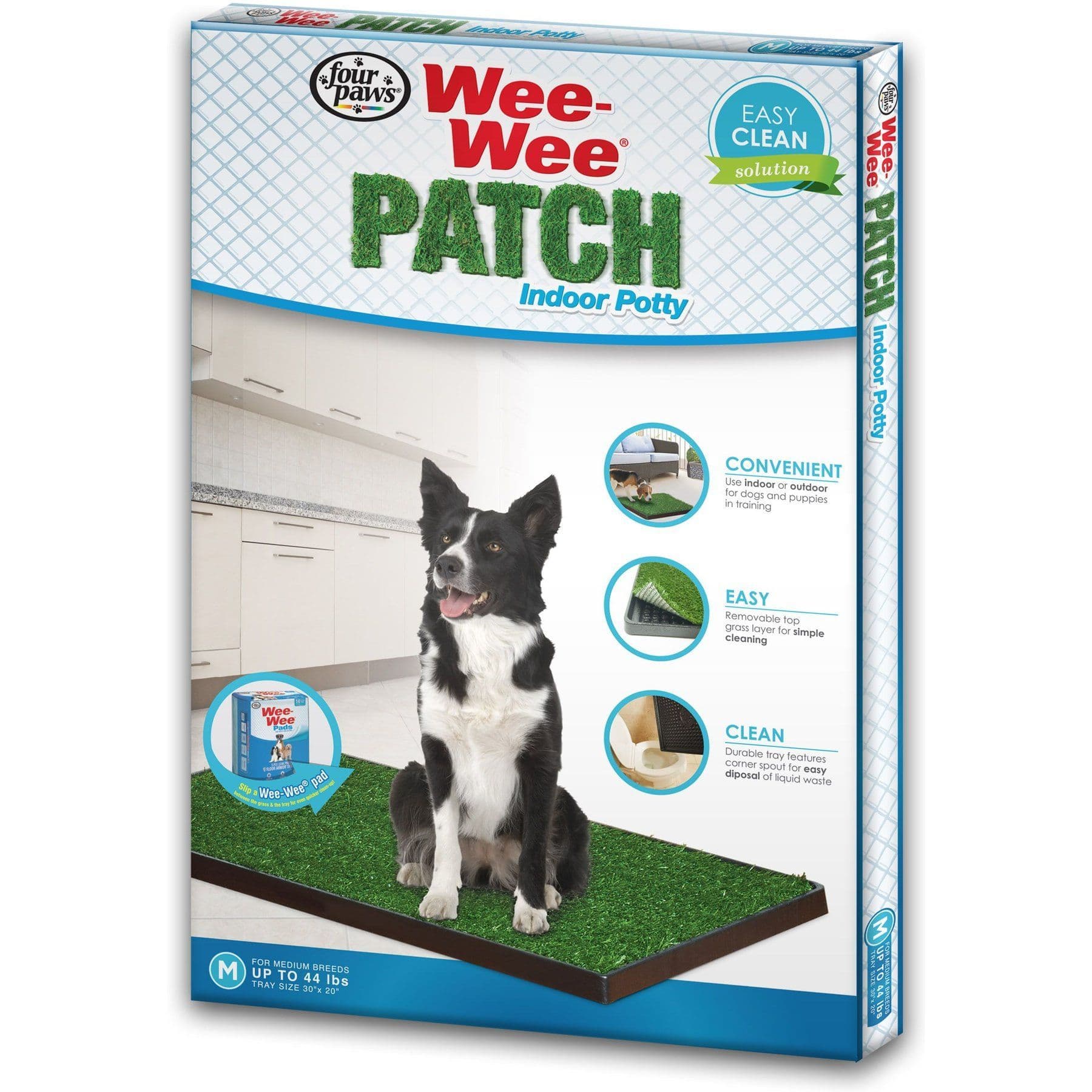
Four Paws Wee-Wee Dog Grass Patch Tray is a dog potty tray with a grass-style surface.
Webvet may earn a commission when you click through to Chewy, at no extra cost to you.
If your dog also eats grass, see why does my dog eat grass.
How long does it take for dog pee to burn grass?
In hot, dry weather, it can take a day or less. Purdue Extension says the most heavily dosed turf turns gray-green and wilted, then straw brown, and can die in 24 hours or less in those conditions. WSU Extension adds that a darker green ring may form within a few days.
Do Female Dogs Kill Grass More Than Males?
Female dogs leave more spots because of how they urinate, not because of their sex. VCA Animal Hospitals says female dogs are reported to burn grass more often because they are more likely to squat and urinate in one place.
The fix for a female dog is the same as for any dog: water the spot right after she goes, or train her to a set potty area.
Is it just female dog urine that burns grass?
No. Colorado State University Extension says most dogs that squat are female, but some males squat too, especially in their own yard. K-State adds that young dogs of both sexes squat, and male leg-lifting does not become common until about 1 year of age.
Male dog urine kills grass too when it lands on open lawn, but NC State Extension says males tend to urinate on vertical structures, such as trees, shrubs, and posts, away from the middle of the lawn. Leg-lifting is explained in urine marking behavior in dogs.
Purdue Extension says urine pH and hormone theories have not been thoroughly tested or proven, and points to voiding behavior as the more likely factor. In a small 2024 study of 10 healthy dogs, urine pH did not change significantly after spaying or neutering. Veterinary references do not report a male-female difference in urine nitrogen.
 Sponsored
Vet care that's always there
Unlimited video calls and messaging with licensed vets for less than a typical vet visit. One membership covers up to five pets.
Use code Pets60
Plans start at $12/month · covers up to 5 pets
- Licensed vets in most states
- Rx for 150+ conditions
- 4.7 on Trustpilot
How to Fix Dog Urine Spots on the Lawn
To fix dog urine spots on the lawn, soak the spot, rake out dead grass, and reseed. VCA says removing dead grass and reseeding helps the lawn grow back, and Colorado State Extension says extra watering makes reseeding more effective by diluting soil salts.
These steps repair grass damaged by dog urine:
- Soak the spot heavily with a hose for a few days, as Colorado State's PlantTalk advises.
- Rake out the dead grass and loosen the soil, as Penn State Extension recommends.
- Reseed, preferably with the same grass variety as the rest of your lawn.
- Water lightly until the seed germinates.

For dog-friendly grass seed, Penn State suggests matching your existing lawn, while Colorado State Extension says perennial ryegrass is more effective than bluegrass for spot seeding a Kentucky bluegrass lawn.
UC IPM lists typical germination times of 5 to 10 days for perennial ryegrass, 7 to 12 for tall fescue, and 14 to 30 for Kentucky bluegrass. Purdue Extension, writing for Indiana lawns, calls fall the best time to seed.
This dog urine lawn damage table is a fix-it table matching what the spot looks like, from a fresh gray-green, wilted spot to a dead circle with a green ring, to the cause and the repair.
| What you see | Why it happens | How to fix it |
|---|---|---|
| Fresh wet spot, or gray-green and wilted grass | Concentrated nitrogen and salts on one small area | Water it heavily right away |
| Taller, darker green spots, nothing dead | Diluted nitrogen acting like fertilizer | No repair needed |
| Yellow or straw-colored patch with some live blades | Salts and nitrogen burning grass that is still alive | Water more often to dilute salts so the grass can recover |
| Dead brown center with a dark green ring | Too much nitrogen in the middle, just enough at the edge | Soak for a few days, rake out dead grass, loosen the soil, and reseed |
| Dead patch still bare after weeks | The grass is dead, and some grasses do not recover on their own | Flush with water, then reseed or resod with a more urine-tolerant grass |
Will grass grow back after dog urine?
It can. NC State Extension says unrepaired urine spots can linger for weeks to months, and that some grasses recover from severe urine injury on their own while others need reestablishment. Warm-season grasses such as Bermuda grass and zoysia grass can recover in as little as a couple of weeks when actively growing.
What to put on burnt grass from dog pee?
Water. Colorado State Extension says the only "product" that can neutralize urine's negative effects is water, and that gypsum and baking soda are salts that may compound the problem. Once the grass is dead, reseed it.
University of Missouri IPM says any drainage benefit from gypsum has proven very temporary. For indoor accidents, see how to get dog pee out of carpet.
How to Stop Dog Urine From Killing Grass
To stop dog urine from killing grass, water the spot right after your dog pees, train your dog to a designated potty area, and encourage more drinking water. The Merck Veterinary Manual says multiple water sources encourage drinking, so consider a second bowl such as the Frisco Elevated Stainless Steel Dog & Cat Bowl.
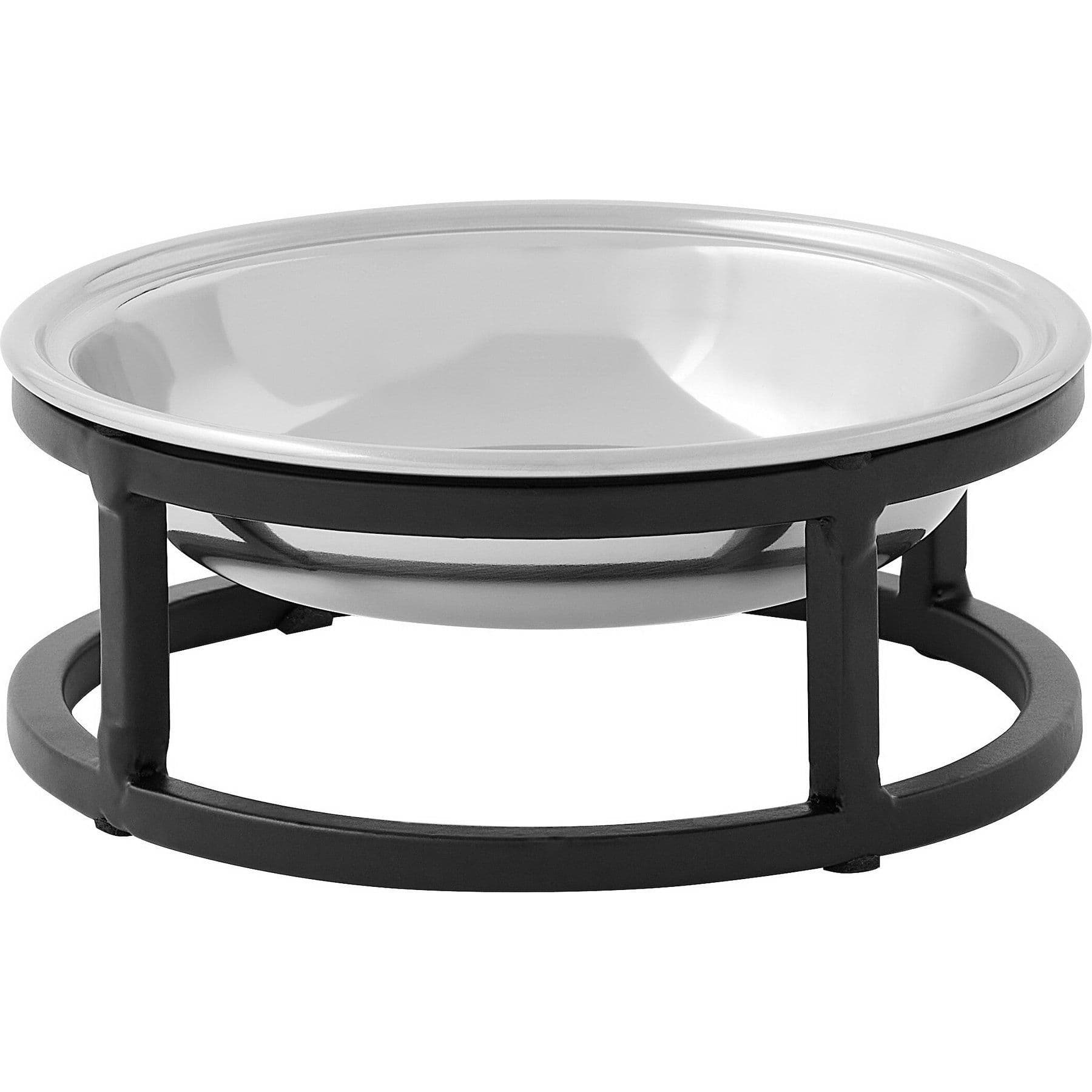
Frisco Elevated Stainless Steel Dog and Cat Bowl is a raised stainless steel bowl for dogs and cats.
Webvet may earn a commission when you click through to Chewy, at no extra cost to you.
VCA calls watering immediately after your dog urinates the most reliable way to prevent the burn. Offering canned food, or adding water to dry food, also raises fluid intake, VCA says.

Merck also says fresh water should always be available, and that canned food is 60 percent to over 87 percent water, versus 3 to 11 percent for dry. In a 2003 study, adding water to dry food diluted urine in one breed but not the other.
How do you stop dog urine from killing grass?
Dilute it fast. University of Missouri IPM reports that pouring about three times as much water as urine on the spot within about 8 hours can produce a fertilizer effect instead of a burn, while burns developed when dilution waited more than 12 hours.
For a lasting fix, Colorado State Extension calls training your dog to a non-turf area, such as mulch or gravel, the only sure solution. VCA also suggests a less noticeable part of the yard or a different surface, such as concrete.
Keeping your dog from peeing on the grass takes patience. Missouri IPM advises staying consistent for at least 2 to 3 weeks to make the new spot a routine, and says several months may be necessary in some cases.
Do Dog Rocks and Water Additives Work?
No. Neither dog rocks nor urine-changing supplements are proven to stop dog urine from killing grass.
Dog Rocks are rocks sold to drop into a dog's water bowl, and the maker says they cause no change to the pH of a dog's urine or drinking water.
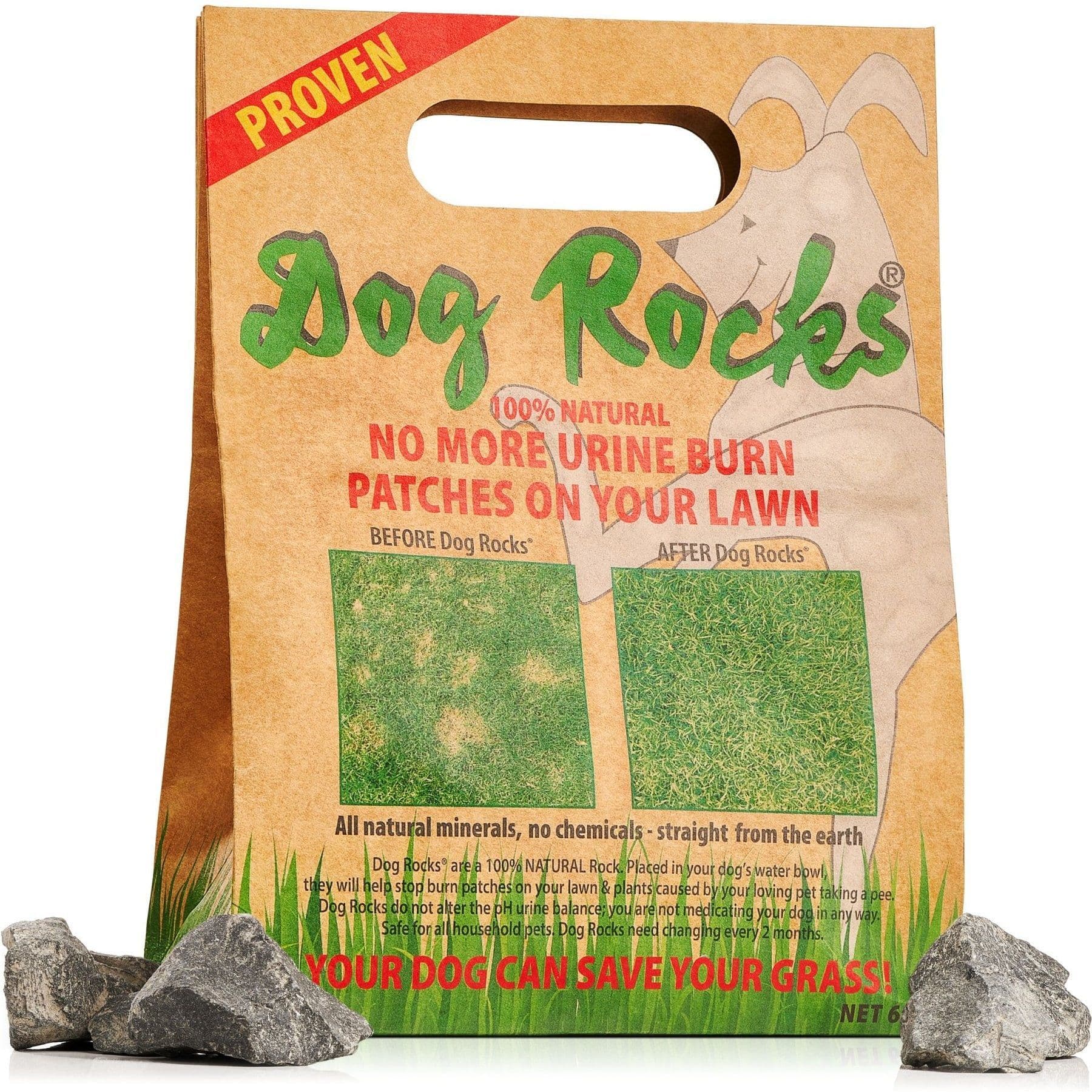
Dog Rocks Grass and Lawn Saver are rocks sold to place in a dog's water bowl.
Webvet may earn a commission when you click through to Chewy, at no extra cost to you.
Accounts of what the rocks are meant to do differ. Penn State Extension lists dog rocks among products promoted to alter urine pH, while McGill University's Office for Science and Society discusses the claim that they remove nitrates from drinking water.
The Dog Rocks website cites no study for its claims. McGill says there are no studies showing that drinking-water nitrates contribute significantly to urine nitrogen, or that the rocks remove nitrates, and concludes there is no theoretical reason Dog Rocks should work and no practical evidence that they do.
The evidence on urine-changing supplements is no better than for dog rocks. Colorado State Extension says no dietary supplement has been scientifically proven to reduce how often or how badly dogs spot a lawn. Marketed supplements and kitchen remedies fare no better:
- NC State Extension says dietary supplements marketed to reduce urine damage, including Methio-Form, ascorbic acid, fruit juices, baking soda, and potassium citrate, have no scientific merit and may harm your dog's health.
- Penn State Extension says tomato juice and cider vinegar are promoted to change urine pH, but nitrogen, not pH, harms the lawn, so it advises against changing your dog's diet over brown patches.
- Colorado State Extension says there are medically sound reasons to change urine pH, but preventing lawn spots is not one of them.
Changing urine pH can hurt your dog. VCA warns that trying to alter it with medications or treatments can lead to crystals and stones in the urine, and the Merck Veterinary Manual notes that struvite crystals form in alkaline urine while cystine crystals form in acidic urine. Ask your vet before trying any supplement.
What do you put in a dog's water to stop it from killing grass?
Nothing except more of it. NC State Extension says filtering impurities from a dog's drinking water will have little, if any, benefit, and McGill found no evidence that Dog Rocks work. Plain water in larger amounts is what dilutes urine nitrogen, VCA says.
Some home remedies, such as adding salt to food, can make a dog drink more, but Colorado State Extension says to consult your veterinarian first, because extra salt can cause problems for older dogs and for dogs with heart or kidney conditions.
Grass Types That Resist Dog Urine
The grass types that tolerate urine better are tall fescue and perennial ryegrass, and Kentucky bluegrass is among the least tolerant. University of Missouri IPM found tall fescue and perennial ryegrass the most resistant of four grasses tested, with diluted urine routinely acting like fertilizer on them.
Lactic acid screens, used as a stand-in for urine, rank cool-season grasses in nearly the same order. NC State Extension and North Dakota State University research summarized in Golf Course Management both list tolerance from most to least:
- Tall fescue
- Creeping red fescue
- Perennial ryegrass
- Kentucky bluegrass
- Creeping bentgrass, ranked last in the North Dakota State research only
Part of the difference is growth habit. VCA says some grass varieties are less susceptible to scalding because they grow faster and have deeper root systems.
Sources disagree on Bermuda grass. North Dakota State found Bermuda grass and zoysia grass more tolerant of lactic acid than cool-season grasses. University of Missouri IPM found Bermuda grass very sensitive, with burns lasting more than 30 days after even 4 fluid ounces of dilute urine.
If you are weighing a warm-season grass for a dog-friendly lawn, NC State Extension flags two limits:
- Bermuda grass and zoysia grass both go dormant in the cold season, so they tolerate much less wear in winter.
- Bermuda grass is not shade tolerant, so yards with lots of trees generally do not suit it.
Cultivar matters too. In the North Dakota State lactic acid screen, the more tolerant cultivars included Arid 3, Ruby, Green Label, Jaguar 3, Aries, and Justice tall fescue; Accent II and Fairway perennial ryegrass; and Super Glade and Nu Destiny Kentucky bluegrass.
These rankings leave out St. Augustine grass, so there is no comparison for it. The toughest grass for dogs in your yard is a urine-tolerant species that also grows well in your climate and shade.
When Lawn Spots Point to a Health Problem
Lawn spots alone are normal, so ask a vet when you notice changes in drinking or urination. University of Missouri IPM adds a lawn clue: if your dog's urine stops burning the lawn and you changed nothing, have your vet examine your dog with a urinalysis to rule out a medical cause.
VCA Animal Hospitals lists these among the causes of increased thirst and urination in dogs:
- Kidney disorders, such as kidney failure or kidney infection
- Pyometra, a uterine infection in intact females
- High calcium levels in the blood
- Some types of cancer
- Liver disease
- Certain drugs or electrolyte imbalances
- Rarely, a behavioral problem called psychogenic thirst
For scale, a 2025 review in Frontiers in Veterinary Science defines excessive drinking in dogs as more than 100 mL of water per kg of body weight in 24 hours. Any clear rise over your dog's usual intake is worth raising with your vet; see dog drinking and peeing a lot for the next steps.
Urine output is harder to judge at home. The same review sets excessive urination at more than 50 mL per kg a day, while the Merck Veterinary Manual lists a dog range of 20 to 100 mL per kg a day, so references differ and the measurement is best left to your vet.
A urinary tract infection can also change how your dog pees. VCA says dogs with UTIs generally try to urinate often whenever they go outside, may strain, cry, or whine while urinating, and sometimes pass visible blood. Read more about UTI in dogs and a dog peeing blood.
Dog Urine and Grass FAQs
Frequently Asked Questions
Does ketchup stop dog urine from killing grass?
No. Veterinary references do not recommend ketchup for lawn spots, and McGill University's Office for Science and Society says the related idea of giving dogs tomato juice does not work and is scientifically unfounded. Tomato juice is promoted to change urine pH, but Penn State Extension says nitrogen, not pH, is what harms the lawn.
Ketchup also adds ingredients a dog does not need. Heinz lists salt and onion powder in its tomato ketchup, and the ASPCA says onion and related plants can damage red blood cells and cause anemia, depending on the amount eaten. Ask your vet before adding any food to change your dog's urine.
What is the normal pH of dog urine?
A 2020 review in Veterinary World gives a normal urine pH range of 6 to 7.5 for dogs and cats, and the Merck Veterinary Manual says dog urine is typically acidic but varies with diet, medications, and disease. Penn State Extension describes dog urine as alkaline, typically above 7.0, so references differ.
For your lawn, the exact number matters little. VCA says there is no relationship between urine pH and nitrogen content, and that dog urine ranges from acidic to neutral to basic depending on when and what the dog eats.
Is it bad if my dog's pee kills grass?
Not for your dog. VCA says getting rid of excess nitrogen through urine is perfectly normal for your dog, even though it is not great for your grass. What deserves attention is a change in your dog's drinking or urination habits, which is a reason to see your vet.
How do you keep grass healthy with dogs?
Pick a grass that grows well in your area, then water, fertilize, mow on schedule, and check often for wear, NC State Extension advises.
Mow as high as practical. K-State suggests 2.5 to 3 inches for most lawn grasses, and Purdue Extension gives 2 to 3 inches.

Editor
The Webvet Editorial Team is the in-house group of pet-care editors and writers behind Webvet, operated by Smart Pet Collective. The team researches, writes, and maintains Webvet's pet health, behavior, and medication content. Every article follows a defined editorial process: research from reputable veterinary and scientific sources, careful drafting, mandatory review of medical content by a credentialed veterinarian, and dated publication. Health and medication articles are medically reviewed by a licensed veterinary professional before they go live and are kept current over time.
Veterinarian · BVMS MRCVS
Dr. Pippa Elliott, BVMS, MRCVS, is a veterinarian with nearly 30 years of experience in companion animal practice. Dr. Elliott earned her Bachelor of Veterinary Medicine and Surgery from the University of Glasgow. She was also designated a Member of the Royal College of Veterinary Surgeons. Married with 2 grown-up kids, Dr. Elliott has a naughty Puggle named Poggle, 3 cats and a bearded dragon.


