Do Dogs Sweat? How Dogs Actually Cool Down
Dogs sweat mainly through their paw pads, while panting does most of the cooling. Learn what damp fur means and when overheating is a veterinary emergency.

BVMS MRCVS
Medically reviewed by Dr. Pippa Elliott, BVMS MRCVS · Last reviewed

This article contains affiliate links. Webvet may earn a commission when you buy through them, at no extra cost to you.
Do dogs sweat? Yes, but not across most of their skin the way people do. Their main sweat glands are in the paw pads, and that small amount of moisture contributes little to whole-body cooling. Dogs primarily release heat by panting and by moving warm blood toward the skin. Heavy panting, confusion, weakness, collapse, or seizures can signal heatstroke and require immediate veterinary care.
Damp paw prints can be normal, but sweating is not a dog's main cooling system. Watch the whole dog, not just the paws. Rapid or distressed breathing, poor coordination, vomiting, collapse, or altered awareness in the heat is an emergency, not a hydration problem to manage with water alone.

 Sponsored
Have a health question about your dog?
Talk to a licensed vet at Dutch over video or message, including nights and weekends.
Use code Pets60
Plans start at $12/month · covers up to 5 pets
- Licensed vets in most states
- Rx for 150+ conditions
- 4.7 on Trustpilot
Do dogs sweat?
Yes. Dogs have eccrine, also called atrichial, sweat glands in their paw pads. These glands can release moisture, especially when a dog is warm or stressed. Their output may appear as damp footprints. The Merck Veterinary Manual overview of the integumentary system explains that these glands are confined to the footpads in dogs and have only a minor role in temperature regulation.
Dogs do not have the same broad distribution of heat-releasing sweat glands that people use. Moisture from four sets of paw pads is not enough to cool a large, fur-covered body. That is why a hot dog pants instead of becoming visibly sweaty from head to toe.
For everyday hydration, a high-capacity water fountain can keep water readily available.
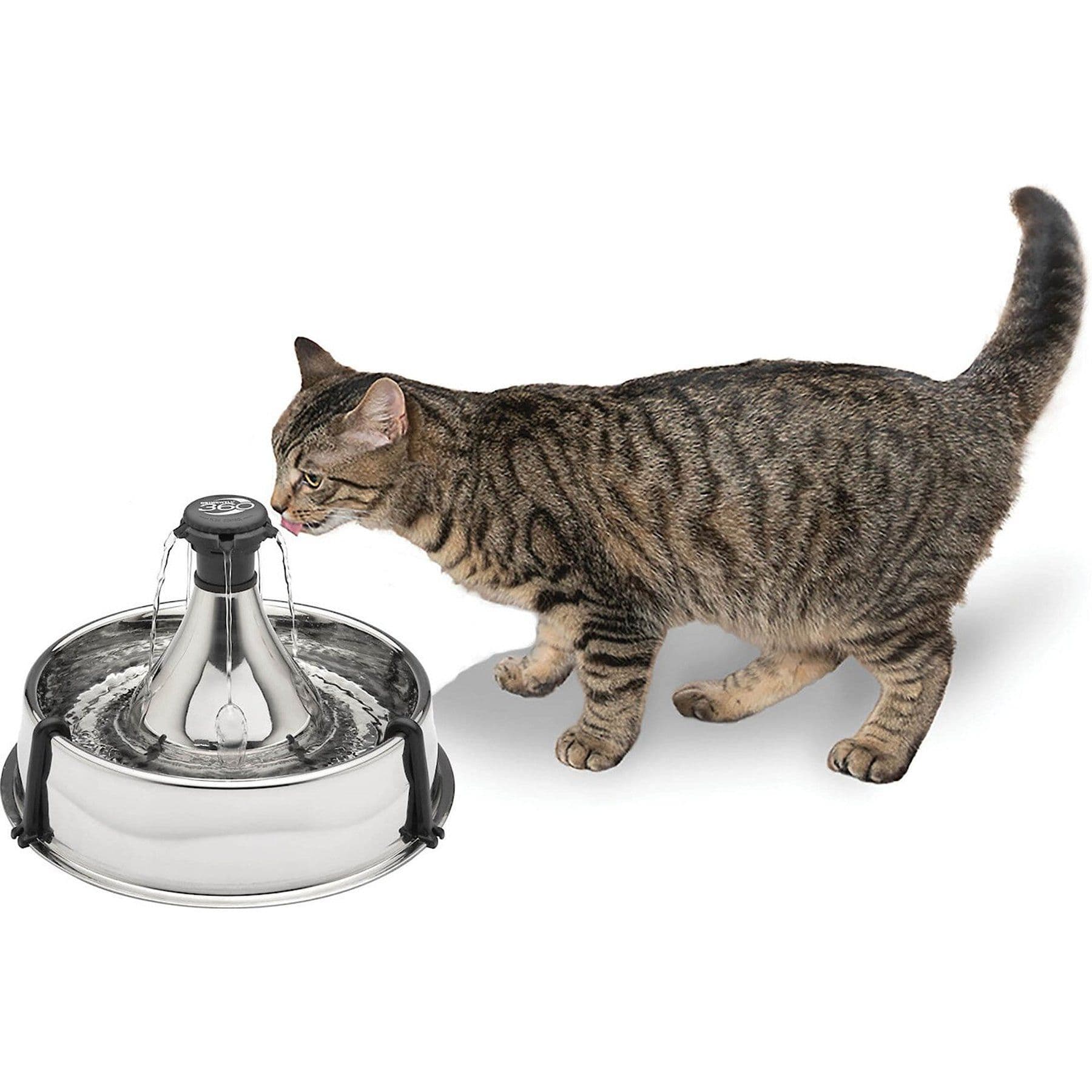
Webvet may earn a commission when you click through to Chewy, at no extra cost to you.
The basic answer to "can dogs sweat" is therefore yes, but the useful answer is more specific: dog sweat glands are mostly in the paws, while panting handles most evaporative cooling. Dogs do not sweat like humans across most of their skin. That distinction matters most when a dog is overheating.
Why sweating through paws has a small effect
Evaporation removes heat when liquid changes to vapor. Paw-pad moisture can evaporate, but the surface area is too small for whole-body cooling. Pads may also be touching hot pavement or another surface with little airflow. The effect cannot match whole-body sweating in humans, so visible paw moisture should never reassure an owner whose dog has heatstroke signs.
A classic study of sweat gland development in canine footpads indexed by PubMed supports the anatomic presence of these glands. Anatomy alone does not mean sweating is an effective defense against dangerous heat.
Where do dogs sweat?

Dogs sweat mainly from the paw pads. You might notice faint wet footprints on a smooth veterinary exam table, floor, or mat. Moist paws can appear during heat, stress, or anxiety, but paw moisture does not tell you by itself whether a dog is safely regulating temperature.
Dogs also have apocrine glands associated with hair follicles. In everyday language these are sometimes called sweat glands, but their secretions are more important for scent communication than cooling. They do not create a useful whole-body sweat response.
Do dogs sweat from their nose?
A wet nose is not evidence that a dog is sweating through the nose. Nasal moisture comes from secretions and licking. Nose wetness varies with activity, sleep, environment, and health. A dry nose also does not prove dehydration or heatstroke on its own.
A stainless-steel fountain or a quiet dog-and-cat fountain can provide additional routine water stations.
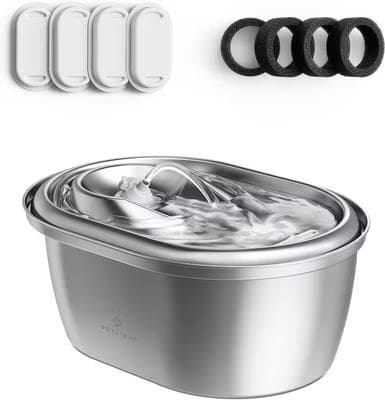
304 food-grade stainless steel pet water fountain, 101 oz. The circulating, filtered water encourages cats to drink more, which supports urinary tract and kidney health.
Webvet may earn a commission when you click through to Chewy, at no extra cost to you.
Do dogs sweat from their armpits, belly, or back?
Not as a normal whole-body cooling mechanism. Damp hair in the armpits, on the belly, back, ears, or torso is more likely to come from water, saliva, urine, skin discharge, or environmental contact. Odor, redness, itching, hair loss, greasy skin, or repeated licking deserves a veterinary skin assessment.
How dogs cool down

Panting is the main evaporative cooling mechanism in dogs. Dogs do not sweat through their tongue; instead, air moves rapidly over moist surfaces in the mouth and respiratory tract. As water evaporates, it carries heat away. Humans rely heavily on sweating while dogs pant for most evaporative cooling. Blood flow toward the skin can also increase, allowing heat to move from the body core toward the surrounding air when conditions permit. This widening of surface blood vessels is called vasodilation. This is how dogs sweat and stay cool: paw-pad moisture plays a small role, while panting and vasodilation carry most of the work.
| Cooling route | What it does | Important limit |
|---|---|---|
| Panting | Moves air over moist respiratory surfaces for evaporative cooling | Becomes less effective in high humidity and can fail during severe overheating or breathing distress |
| Paw-pad sweating | Produces a small amount of moisture on the feet | Surface area is too limited to cool the whole body effectively |
| Blood flow toward skin | Moves internal heat closer to the body surface | Hot surroundings, thick coat, poor airflow, and illness can limit heat loss |
| Rest, shade, and cooler air | Reduces heat gain and improves heat transfer | Prevention helps, but it is not treatment for established heatstroke |
Why dogs pant
Panting can be normal after exercise, during excitement, or in warm conditions. The rate and effort should fall as the dog rests in a comfortable environment. Normal panting is usually coordinated, with the dog alert and able to move normally.
Panting can also reflect pain, anxiety, heart or lung disease, fever, medication effects, endocrine disease, or nausea. Context matters. Unexplained nighttime panting has its own differential; see dog panting at night if that is the main pattern.
Coat and body shape affect risk, not sweating location
A coat can insulate against outside heat as well as trap body heat, depending on conditions. Shaving is not a universal solution and may expose skin to sun. Flat-faced dogs, dogs with airway disease, older dogs, very young dogs, dogs with obesity, and dogs with heart or lung disease may struggle to release heat through panting.
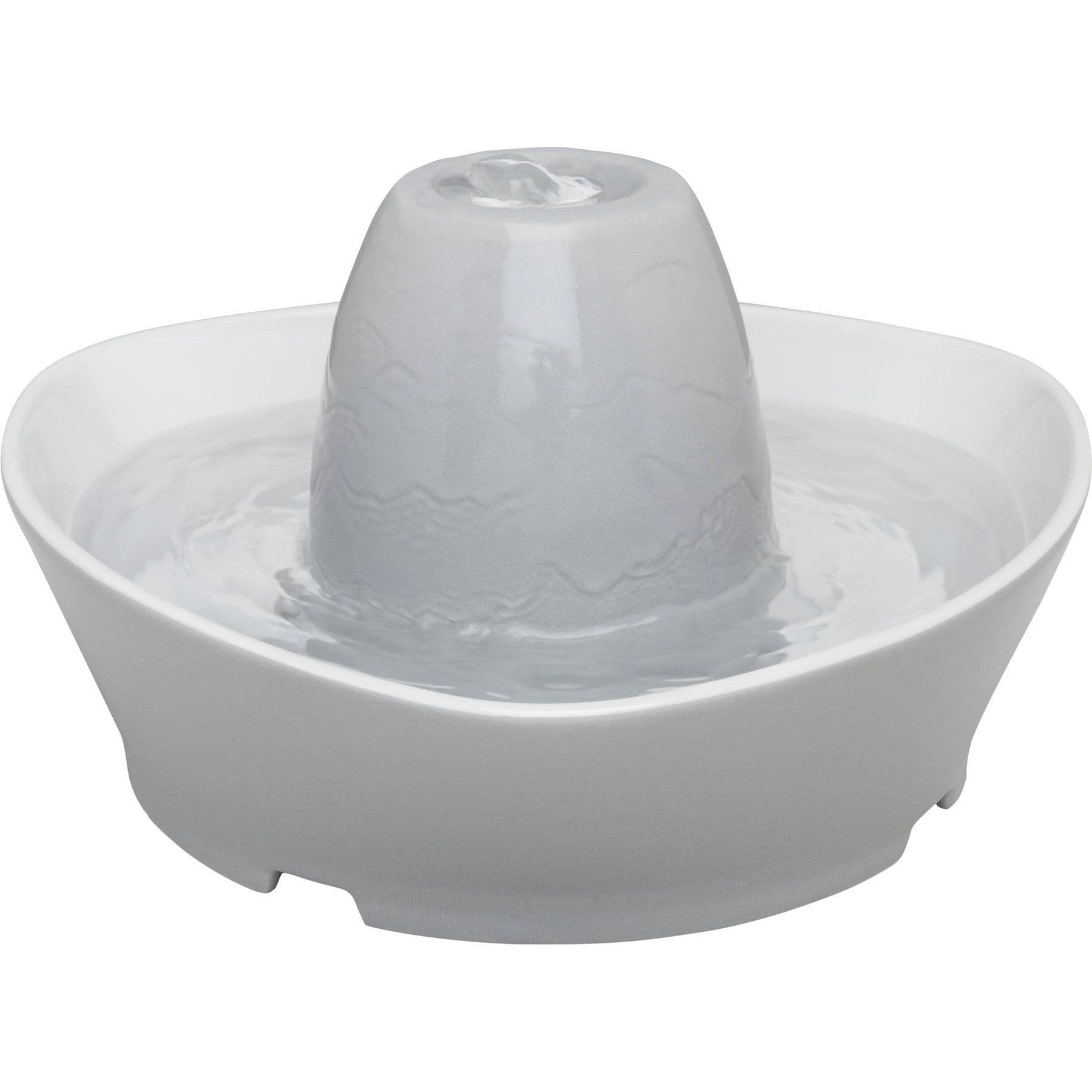
Webvet may earn a commission when you click through to Chewy, at no extra cost to you.
Fitness, acclimation, humidity, shade, airflow, and access to rest also matter. A healthy athletic dog can still develop heatstroke during intense activity, even when the weather does not seem extreme.
 Sponsored
Vet care that's always there
Unlimited video calls and messaging with licensed vets for less than a typical vet visit. One membership covers up to five pets.
Use code Pets60
Plans start at $12/month · covers up to 5 pets
- Licensed vets in most states
- Rx for 150+ conditions
- 4.7 on Trustpilot
Why is my dog wet if dogs barely sweat?

Damp fur is not usually canine sweat. Check the location, smell, color, and what the dog was doing. When dogs smell sweaty or become wet when nervous, inspect the source rather than assuming whole-body sweat. A wet chest after drinking may be water. Damp forelegs may be saliva from licking. Moist skin under a collar or in a fold may reflect trapped water, irritation, yeast, bacteria, or inflammation.
Saliva and licking
Dogs lick itchy or painful areas. Repeated licking can soak the coat and create a cycle of irritation. Fleas, allergies, skin infection, a wound, joint pain, or anxiety may contribute. Do not assume the dog is sweating through the fur if one area stays wet.
Water and environmental contact
Rain, swimming, wet grass, condensation, a leaking water bowl, or lying on a damp surface can explain a wet coat. Dry the dog gently and inspect the skin. Persistent odor, redness, discharge, pain, or hair loss needs veterinary advice.
Anxiety-related paw moisture
Some dogs leave damp paw prints at the clinic, during storms, or in another stressful setting. That can reflect sweat from the footpads. It does not diagnose an anxiety disorder. Look for the larger body-language pattern and the circumstances. WebVet's dog body language guide can help interpret posture and arousal without relying on one sign.
Routine hydration and heat prevention
Routine hydration supports daily heat prevention. Keep fresh water available during ordinary activity, offer regular rest in shade or cooled indoor air, and adjust exercise for humidity, health, coat, and airway shape. A stainless-steel fountain may help some dogs drink routinely at home, while a collapsible travel bowl can make water easier to offer on ordinary outings. Neither product replaces shade, rest, activity adjustment, or supervision.

Collapsible silicone travel bowl with a carabiner that clips to a leash or bag, so your dog always has fresh water on walks, hikes, and car trips.
Webvet may earn a commission when you click through to Chewy, at no extra cost to you.
Never leave a dog in a parked vehicle. Check pavement temperature, provide breaks, and carry a separate water source away from home. Once a dog shows heatstroke signs, prevention advice and hydration products are no longer enough.
When panting or overheating is an emergency

Heatstroke occurs when the body can no longer keep temperature within a safe range. It can damage the brain, kidneys, liver, gastrointestinal tract, muscles, and clotting system. A dog does not need to stop panting or feel dry before heatstroke becomes severe.
The Cornell University College of Veterinary Medicine heat-safety guidance lists heavy panting, drooling, weakness, vomiting, confusion, collapse, and seizures among concerning signs. Any combination of marked heat exposure and neurologic, breathing, gastrointestinal, or mobility changes should be treated seriously.
The Merck Veterinary Manual heat-safety guidance likewise treats heatstroke as an emergency and supports gradual cooling while veterinary care is arranged. The shared point is practical: cooling first aid begins immediately, but it does not replace transport, examination, and treatment for possible organ injury.
Emergency warning signs
- Rapid, forceful, or distressed panting that does not improve with rest
- Thick drool, repeated vomiting, or diarrhea
- Bright red, very pale, gray, or blue gums
- Weakness, stumbling, collapse, confusion, or inability to respond normally
- Seizures or loss of consciousness
- A very high measured temperature when it can be taken safely without delaying care
Suspected heatstroke requires immediate veterinary care while gradual cooling begins. Cooling first aid and transport happen together because a dog that improves outwardly can still have organ, brain, muscle, or clotting injury. This veterinary boundary is essential: apparent improvement after cooling does not make home observation safe or replace examination for internal damage.
Safer first aid while veterinary care is arranged
The American Veterinary Medical Association pet first-aid guidance recommends immediate veterinary care, room-temperature wet towels, and airflow. The goal is gradual heat removal, not making the dog cold as fast as possible.
While veterinary transport is arranged:
- apply room-temperature water to the body
- increase airflow with a fan or air conditioning when available
- avoid ice baths and very cold water, which can interfere with heat release
- stop active cooling when veterinary professionals direct so the dog does not become too cold
Use room-temperature water and airflow, avoid ice baths and very cold water, and remember that water-only treatment cannot diagnose or reverse organ injury. These measures remove heat gradually while transport is underway, but they do not substitute for veterinary examination. Avoid forcing fluid into a weak or confused dog, and follow the emergency clinic's cooling instructions.
Offer small amounts of water only if the dog is alert, able to swallow, and interested. Hydration products stay outside emergency instructions. Water alone does not reverse organ injury, shock, breathing compromise, or clotting problems.
The full emergency protocol belongs to dog heatstroke signs and what to do. Use that live owner for detailed response and follow-up rather than delaying travel to reread general cooling physiology.
What to monitor after a heat event
A dog who seems improved after cooling may still have internal injury. Follow the veterinarian's recommendation for examination, blood work, urine testing, monitoring, and rechecks. Delayed problems can involve the kidneys, liver, gastrointestinal tract, brain, muscles, or clotting system.
Write down the approximate exposure time, activity, weather, first sign noticed, cooling steps, and any measured temperature. Tell the veterinary team about vomiting, diarrhea, abnormal urine, bruising, weakness, confusion, or changes in appetite and thirst. Do not give over-the-counter pain relievers unless a veterinarian specifically directs it, because common human medicines can be toxic and may complicate organ injury.
Future activity should resume only as the veterinarian advises. Review the circumstances that led to overheating, including humidity, intensity, shade, rest, body condition, airway health, and medications. Prevention planning is valuable after recovery, but it does not change the need for immediate care during a new suspected heatstroke event.
Do cats sweat?
Cats have their own sweating and cooling physiology. Questions about whether cats sweat, or whether cats and dogs sweat in the same way, need a feline-specific answer. This article is intentionally dog-only because the cat question already has a live owner. See whether cats sweat for feline paw glands, grooming, panting, and heat-safety context rather than applying dog anatomy to a cat.
Frequently Asked Questions

Frequently Asked Questions
How can you tell if a dog is sweating?
You can sometimes tell that a dog is sweating by noticing slightly damp paw pads or faint wet footprints on a smooth surface. That moisture can occur with heat or stress, but it is not a reliable measure of body temperature or safety. Assess panting effort, alertness, coordination, gum color, and the full situation. Heavy panting, weakness, confusion, vomiting, collapse, or seizures needs immediate veterinary care.
Do dogs sweat through their fur?
No. Dogs do not normally release cooling sweat across the skin under their fur. Their eccrine sweat glands are concentrated in the paw pads. Damp fur is more likely to be water, saliva, urine, skin discharge, or environmental moisture. Persistent wetness, odor, redness, itching, or hair loss warrants a veterinary examination.
Do dogs sweat when nervous?
Yes, dogs can sweat when nervous, but that moisture comes mainly from the paw pads. A stressed dog may leave damp footprints on a smooth floor or exam table. Nervous paw-pad moisture alone does not diagnose anxiety or show whether the dog is overheating. Consider the setting, recovery, and complete body-language pattern, then discuss frequent or severe distress with a veterinarian.
Why does my dog smell sweaty?
If your dog has a sweaty smell, the odor usually comes from skin oils, microbes, ears, saliva, paws, or a damp coat rather than whole-body sweat. Dry and inspect the coat, skin folds, feet, and ears without applying scented products that can hide the source. Persistent odor with itching, redness, discharge, greasy skin, pain, or hair loss requires veterinary assessment.

Editor
The Webvet Editorial Team is the in-house group of pet-care editors and writers behind Webvet, operated by Smart Pet Collective. The team researches, writes, and maintains Webvet's pet health, behavior, and medication content. Every article follows a defined editorial process: research from reputable veterinary and scientific sources, careful drafting, mandatory review of medical content by a credentialed veterinarian, and dated publication. Health and medication articles are medically reviewed by a licensed veterinary professional before they go live and are kept current over time.
Veterinarian · BVMS MRCVS
Dr. Pippa Elliott, BVMS, MRCVS, is a veterinarian with nearly 30 years of experience in companion animal practice. Dr. Elliott earned her Bachelor of Veterinary Medicine and Surgery from the University of Glasgow. She was also designated a Member of the Royal College of Veterinary Surgeons. Married with 2 grown-up kids, Dr. Elliott has a naughty Puggle named Poggle, 3 cats and a bearded dragon.
Related reading

Mastitis in Dogs: Symptoms, Causes, Treatment, and Home Care

Cat Pregnancy Week by Week: Signs, Timeline, and What to Expect

Cat in Heat: Signs, How Long It Lasts, and How Often It Happens
