Cat Sounds and Their Meanings: A Practical Decoder
Learn to interpret everyday cat sounds alongside posture and context, with practical responses to meows, purrs, chirps, yowls and warning sounds and clear reasons to seek veterinary help.

This article contains affiliate links. Webvet may earn a commission when you buy through them, at no extra cost to you.
Cat sounds can tell you that your cat wants contact, needs space or has noticed something interesting. They cannot reliably translate a complete sentence or diagnose a health problem. The most useful interpretation combines the sound with posture, the situation and what is normal for that individual cat.
A brief chirp while approaching a familiar person is a different event from a new, drawn-out cry beside the litter box. Start with that context before deciding whether to offer play, step away or call your veterinarian.
Cat sounds: start with the whole cat
- 1Read sound plus body language, not sound alone.
- 2A sudden voice change, repeated distressed vocalization or change in breathing needs veterinary attention.
- 3Give a cat space when a hiss or growl accompanies tension. Do not punish the warning.
The main everyday vocalizations include meows, purrs, chirps or trills, chatter, yowls, growls and hisses. People use these names inconsistently, and a cat may blend one sound into another. You do not need to identify the technical category perfectly to respond helpfully.
Instead, look for three pieces of information:
- What happened immediately before the sound? A meal being prepared, a visitor entering or another cat approaching changes its likely significance.
- What is the rest of the cat doing? Loose movement, an easy approach and the option to leave differ from crouching, freezing, flattened ears or a lashing tail.
- Is this familiar or new? A long-established greeting deserves a different response from a voice change that began this morning.
A covered bed such as the Best Friends by Sheri Meow Hut is one option if the cat already chooses it and can leave freely.
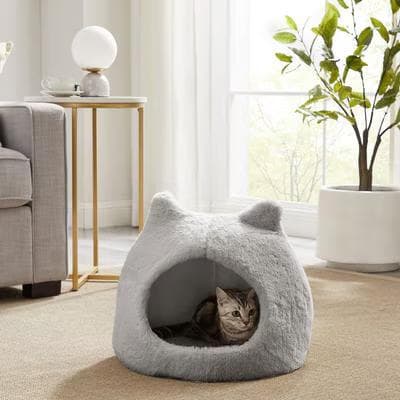
Covered bed for a cat that prefers a sheltered resting spot.
Webvet may earn a commission when you click through to Chewy, at no extra cost to you.
| Sound | What you may hear or see | Useful context | First response |
|---|---|---|---|
| Short meow | Brief voiced call, sometimes repeated | Cat approaches a familiar person or resource | Check what the cat is asking for and whether a routine need is met |
| Purr | Low rhythmic rumble | Resting contact, feeding or another situation | Read comfort from the whole cat; purring alone does not prove wellbeing |
| Chirp or trill | Short rolling or rising voiced sound | Greeting, following or interest | Offer a calm interaction if the cat approaches voluntarily |
| Chatter | Rapid jaw movement with clipped sounds | Watching prey through a window | Keep access secure and watch for frustration |
| Yowl or long cry | Longer, sustained voiced call | Conflict, reproductive behavior, distress or a changed routine | Check surrounding signs and investigate new or persistent episodes |
| Hiss or growl | Breathy forceful hiss or lower sustained growl | Unwanted approach, handling or conflict | Stop the interaction and provide distance |
Use this decoder as a starting point rather than a list of fixed translations. A cat approaching the food cupboard can still have an unrelated health problem; a cat hiding after a visitor may also be physically uncomfortable. Several explanations can be true at once.
For a household with more than one cat, note which animal vocalized and who was nearby. From another room, a sound alone may make an interaction seem playful when one cat is actually trying to escape. Watch access to doors, litter trays and resting places as carefully as the vocal exchange.
Meows, purrs, chirps and chatter

Meows often direct your attention somewhere
Many cats meow around familiar people and everyday routines. The ASPCA’s guide to meowing and yowling describes several possible motivations, including greeting, requests and situations in which something is wrong. That range is why the surrounding activity matters more than a supposed dictionary of pitch.
Check the obvious need before trying to change the sound: fresh water, access to a clean litter tray, a missed meal or a closed door to an ordinary resting place. Once those needs and medical concerns have been addressed, predictable routines can reduce repeated negotiations over attention or food.
If the issue is the amount of vocalizing rather than identifying the sound, use our guide to why a cat meows so much. That guide explains what to check and how to respond. This decoder does not replace that assessment with a rule such as “a high meow always means happiness.”
A purr needs the same context check
People commonly hear purring during relaxed contact, but a purr is not a guarantee that a cat is comfortable or healthy. Look at whether the cat chooses to stay, moves normally, eats normally and responds to touch without tension. Do not use a purr to dismiss a limp, hiding, reduced appetite or another change.
Our guide to why cats purr explores that sound in more detail. If a normally quiet cat begins purring while hunched and withdrawn, the change in behavior matters more than the sound’s pleasant association for people.
Chirps and trills can accompany social contact
A short rolling or rising sound may occur as a cat approaches, follows a familiar person or invites movement toward something. Some people describe it as a “hmm” or a questioning noise. That spelling describes what a human hears, not a literal question the cat has asked.
Offer a choice: pause, speak softly and see whether the cat approaches. You can also offer an appropriate play session if the cat seems interested. Avoid reaching for a cat that makes a friendly-sounding noise while simultaneously leaning away or trying to leave.
A short interactive session with the Frisco Bird with Feathers Teaser Wand can provide a different activity, but store string and feather toys safely when play ends.
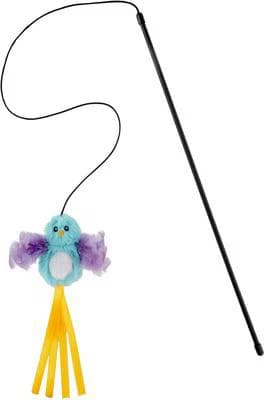
Feather wand for short, supervised interactive play sessions.
Webvet may earn a commission when you click through to Chewy, at no extra cost to you.
Chatter often appears during intense watching
Chatter is commonly noticed when a cat watches birds or other moving animals. The jaw may move rapidly while the cat remains focused on the view. The sound by itself does not establish whether the experience is enjoyable or frustrating.
Keep the window secure and offer a way to disengage. If the cat repeatedly strikes the glass, cannot settle or redirects tension toward a housemate, change the viewing setup rather than prolonging it because the sound seems entertaining.
Offer an alternative to prolonged watching
See cat chirping and related sounds for the dedicated explanation. Sound-effect recordings and “cat translator” apps are not substitutes for observing your own cat’s response.
Yowls, hisses and growls
A yowl is generally longer and more sustained than an ordinary short meow. You may hear it during interactions with another cat, reproductive behavior or a situation involving distress. A cat walking through the house calling repeatedly needs context and, when this is new or persistent, a health assessment.
Do not assume loneliness simply because the sound resembles crying. Check changes in appetite, drinking, toileting, movement, sleep and tolerance of touch. Our cat yowling guide separates these observations from behavior changes you can make at home.
Hissing and growling usually tell you to stop or increase distance. The immediate useful response is straightforward:
- Stop touching, approaching or reaching toward the cat.
- Let the cat move to an available retreat.
- Keep children and other animals from following.
- Avoid staring, shouting or trying to prove that you are “in charge.”
A familiar cat can hiss during an unwelcome interaction and still seek your company later. This is information about the current situation, not a verdict on your relationship. Punishing it can make the situation more threatening while removing a warning you needed to hear.
The dedicated guide to why cats hiss and growl covers introductions, handling and household conflict. If the change appears when a particular area is touched, stop checking it repeatedly and describe the pattern to your veterinarian.
Nighttime calling has its own investigation
The time of day does not create a new meaning for a yowl or meow. Look at the same health and context questions, then consider routine, access and what happens before the calling starts. For the established nighttime plan, follow how to keep your cat quiet while you sleep.
Do not repeatedly play recordings of distressed cats to test a reaction. Provoking the sound can upset your cat or other animals and makes the observation less useful.
Make interaction easier to read
Offer several ways to meet normal needs without having to escalate the volume. Accessible water, clean litter trays, quiet resting spots and predictable play are useful foundations.
A food puzzle such as the Catit Play Treat Puzzle can make a familiar meal more engaging when the cat can operate it comfortably; start easy instead of turning every meal into a difficult task.

Food-puzzle toy for adding a manageable activity to a familiar meal.
Webvet may earn a commission when you click through to Chewy, at no extra cost to you.
Allow social choices too. Offer a hand or sit nearby, then wait. If the cat approaches, keep contact brief and notice whether they ask for more. If they turn away, let that end the interaction. Respecting small signals makes loud warnings less necessary.
When the sound is a health concern
A cough, wheeze, gag or change in breathing can be mistaken for a vocalization. If the sound occurs with breathing effort, open-mouth breathing, collapse or obvious distress, seek urgent veterinary advice rather than using a sound chart to identify it.
Arrange a veterinary assessment for a new or persistent voice change, repeated unexplained calling or a sound accompanied by changes in appetite, drinking, toileting, activity or mobility. A recording can help the clinic understand what you mean, but do not delay urgent care to obtain a better video.

When it is safe to observe, record these details:
- The start time, duration and how often the sound repeats.
- Whether the cat was awake, asleep, eating, moving or using the litter tray.
- Any nearby animal, person, noise or handling event.
- What happened afterward, including recovery to usual behavior.
Keep recordings brief and natural. Do not squeeze the cat, force exercise or recreate a confrontation to reproduce a sound. The best evidence is an ordinary episode accompanied by a clear description of what changed.
Keep a sound record that someone else can understand
Describe pitch, length and repetition in ordinary words. “Three short calls when I opened the cupboard” is more useful than “angry talking.” Add whether the mouth was open, whether the cat approached or withdrew and what happened afterward. You do not need technical acoustic vocabulary.
If the sound is intermittent, keep the phone nearby during normal routines rather than chasing the cat with it. A recording made from across the room may show the full context better than a close-up.
Share the full context
Keep the original clip, including the beginning and recovery. Describe what you can hear before applying a label: “a low continuous sound” and “three separate high calls” let another caregiver compare episodes more reliably than “angry talking.”
| Example note | Useful distinction | What to do next |
|---|---|---|
| Three short calls; walks to cupboard; loose body | A familiar resource-related sequence | Check the ordinary meal routine; do not invent a meaning for the number three |
| Rolling sound; approaches, then turns away when a hand reaches | Approach followed by withdrawal | Stop reaching; a greeting does not require physical contact |
| Breathy hiss; visitor stands in the only doorway | A warning with an obstructed retreat | Have the visitor move away and leave the exit open |
These are examples of how to write observations, not diagnoses or reports from tested cats. If two people use different sound names, compare their descriptions of the same recording. The situation and the next action should still agree.
Give the cat more than one comfortable place to pause
A stable cat tree such as the Yaheetech 63-inch Cat Tree, or an accessible resting shelf, can offer a different viewpoint and a break from household traffic. Choose a height and route that suit the cat’s mobility. A tall perch is not helpful if another animal can block the only way down.
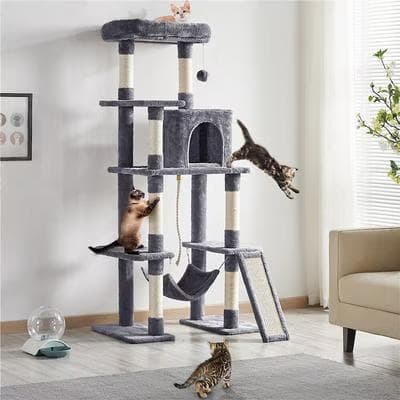
Multi-level resting and climbing space; check stability and easy routes down.
Webvet may earn a commission when you click through to Chewy, at no extra cost to you.
A covered bed can provide a quieter option at floor level, but leave its entrance clear and do not pull the cat out to initiate contact.
Congested breathing is different from a vocalization
A cat that sounds congested while breathing needs a different assessment from a cat choosing to meow. The absence of nasal discharge, or otherwise normal activity, does not identify the cause. Note whether the noise occurs with each breath or only during a vocalization.
Cornell’s guidance on breathing difficulty treats respiratory distress as urgent. If breathing looks difficult, seek immediate veterinary care rather than replaying sounds or waiting for discharge to appear.
Breed and sex do not supply a translation
A Maine Coon’s familiar chirp still needs the same context check as another cat’s sound. Male and female cats may vocalize around reproductive activity, but the sound alone does not establish that a cat is in heat. Investigate an unfamiliar cry instead of treating breed or sex as the explanation.
Learn your own cat’s patterns
Your most useful comparison is your cat on an ordinary day. A naturally talkative cat may have a broad range of familiar sounds; a quiet cat’s new repeated cry may stand out immediately. Neither personality excuses a change in health or daily function.
For a week of nonurgent observation, make a simple note after notable episodes: situation, sound, posture, your response and outcome. This helps distinguish a predictable request from a pattern that is spreading to new settings. It also prevents everyone in the household from describing the same event differently.
An example: the same sound, two different responses
Imagine a cat who gives a brief trill when you enter the kitchen, walks toward a familiar toy and remains loose and engaged. A voluntary play session may be an appropriate response. Now imagine the same short sound while the cat backs away from a visitor’s hand.
The more useful action is to stop reaching and let the cat leave.
Apply the same context check to enrichment
Neither example creates a new translation rule. It shows why the action should follow the whole situation. If the cat’s normal pattern changes, record that change rather than assuming yesterday’s explanation still applies.
The same principle helps with enrichment. A cat may vocalize while watching birds and then walk away comfortably. Another may become increasingly tense and remain fixed at the window. Give both cats a choice to disengage, and change the setup when the activity repeatedly produces frustration.

Questions owners ask
Frequently Asked Questions
What are the sounds of a cat?
Common categories include meows, purrs, chirps or trills, chatter, yowls, growls and hisses. Individuals vary, and sounds can blend. Use posture and context to decide how to respond rather than assuming one sound has one fixed translation.
What are different cat noises called?
People usually call a brief voiced call a meow, a rolling vibration a purr, a short rising call a chirp or trill, and a long sustained call a yowl. These everyday labels are descriptive, not diagnostic categories.
Why do cats say "hmm"?
A sound that resembles “hmm” may be a short trill or other brief vocalization. Watch whether it occurs during a greeting, following behavior or another familiar activity. There is no reliable word-for-word translation.
How do I say "I love you" in cat?
Use predictable care and comfortable, voluntary interaction. Offer play, provide resources and stop touching when your cat moves away. Copying a particular noise does not reliably communicate a human sentence to a cat.
Do cats like it if you kiss them?
Preferences differ. Some tolerate close facial contact; others find it intrusive. Do not bring your face close to a tense cat. Let the cat approach and use the forms of contact they already choose comfortably.
Why should you not stare a cat in the eyes?
Sustained close staring can add pressure during a tense interaction. Soften your gaze, turn slightly aside and give the cat a route away. Body language and freedom to leave matter more than maintaining eye contact.
What does 3 meows mean?
Three meows do not have a fixed translation. Count and pitch are observations to combine with the situation. Check whether the cat is approaching a resource, greeting someone or showing a new behavior change; do not assign a phrase from the number alone.
For example, three familiar calls beside the food cupboard may be a learned meal request. The same count during a tense encounter does not carry that meaning. Check the immediate need and the rest of the cat before responding.
What does a low pitched meow mean?
A lower pitch does not identify one emotion or diagnosis. Compare it with that cat’s usual voice and observe posture, movement and the event preceding it. A new persistent voice change deserves veterinary advice, particularly when eating, breathing or normal activity also changes.
First distinguish a meow from a growl. Cats Protection’s behavior guidance describes low-pitched growling as an intimidating signal. If the low sound comes with tension or an attempt to move away, stop approaching and give the cat space.
What noises do unhappy cats make?
A tense cat may hiss, growl or yowl, but distress can also be quiet. Look for withdrawal, freezing, attempts to escape and changes in normal routines. Give space when the cat signals discomfort instead of waiting for a particular warning sound.
What sounds do cats respond to?
An individual cat may orient to familiar household sounds, a caregiver’s voice or a learned meal cue. A response does not establish enjoyment. Keep volume comfortable and allow the cat to leave; do not use startling noises or distressed-cat recordings to test attention.
How do cats say I love you?
Cats do not use a sound that literally translates that sentence. A cat choosing to approach and remain comfortably nearby offers more useful information about the interaction than an imagined verbal message. Respect its choice to end contact as well as its choice to begin it.
Slow blinking is one studied example of positive cat-human communication. University of Sussex research supports that interpretation, not a literal translation of love. Let the cat choose whether to engage rather than leaning close or demanding a response.
What is the highest form of affection from a cat?
There is no universal ranking. A cat’s preferred contact depends on the individual and the moment. Notice comfortable voluntary interaction and avoid demanding a particular sound, cuddle or handling response as proof of affection.
For your cat, quietly resting nearby may be a more comfortable choice than being picked up. A voluntary approach, relaxed pause and easy departure give you a practical guide to respectful contact. They should not become a scorecard comparing cats or relationships.

Editor
The Webvet Editorial Team is the in-house group of pet-care editors and writers behind Webvet, operated by Smart Pet Collective. The team researches, writes, and maintains Webvet's pet health, behavior, and medication content. Every article follows a defined editorial process: research from reputable veterinary and scientific sources, careful drafting, mandatory review of medical content by a credentialed veterinarian, and dated publication. Health and medication articles are medically reviewed by a licensed veterinary professional before they go live and are kept current over time.


