How Much Does Get Real Dog Food Cost? Price per Day by Dog Size
Get Real dog food cost depends on your dog's size and whether you feed it as a full meal or topper. See packs-per-day math from the published kcal per pack, then check current pricing in the Chewy cart.

BVMS MRCVS
Medically reviewed by Dr. Pippa Elliott, BVMS MRCVS · Last reviewed

This article contains affiliate links. Webvet may earn a commission when you buy through them, at no extra cost to you.
Get Real dog food cost comes down to a few numbers you can work out before you ever open a cart: how many calories your dog needs, how many calories are in each pack, and whether you serve the food as a full meal or as a topper. A small dog eating Get Real as a topper uses a fraction of a pack a day, while a large dog on a full fresh diet can use more than one large pack a day.
Get Real is Chewy's fresh dog food line, sold only at Chewy in select markets. Chewy's Get Real pages list no prices and current pricing is shown in the Chewy cart, so this guide does not quote a dollar figure. Instead, it shows the packs-per-day math by dog size so you can predict how much food you will order, then check the current price for that exact plan.

 Sponsored
Have a health question about your dog?
Talk to a licensed vet at Dutch over video or message, including nights and weekends.
Use code Pets60
Plans start at $12/month · covers up to 5 pets
- Licensed vets in most states
- Rx for 150+ conditions
- 4.7 on Trustpilot
What sets the cost of Get Real dog food
- 1Dog size is the biggest driver, because a larger dog needs more calories and therefore more packs per day.
- 2Full meal vs topper use changes the bill the most for any one dog, since a topper replaces only part of the daily calories.
- 3Pack size and recipe matter less, because the three recipes are close in calories per ounce.
- 4Current pricing is shown in the Chewy cart for the plan you build, so use the pack count here to estimate, then confirm there.
The simplest starting point for a new household is a small trial before choosing a recipe. Chewy offers a Sampler Pack as a risk-free trial so you can see which recipe your dog prefers before you subscribe.
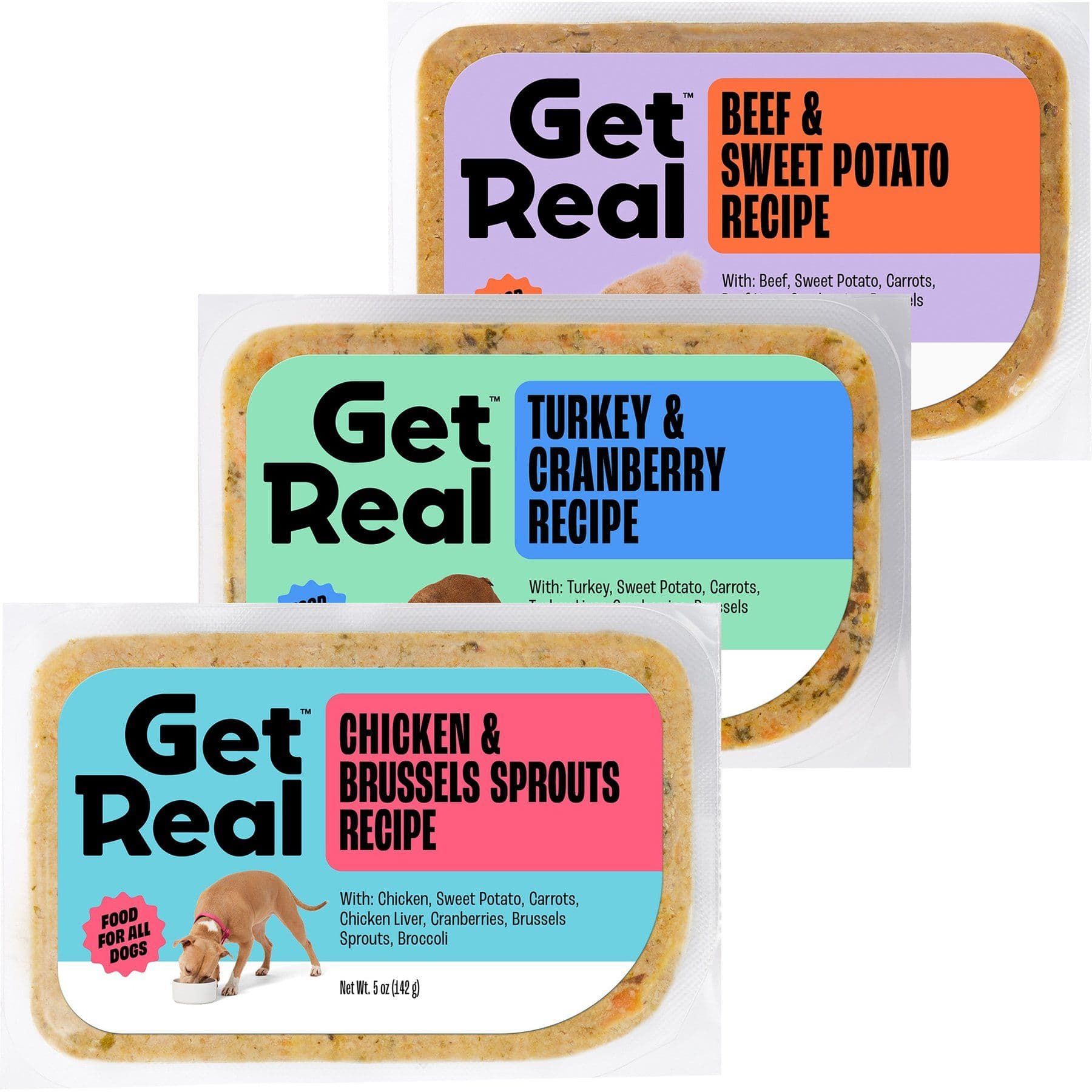
Try more than one Get Real recipe before you commit, then build a subscription around the one your dog eats best.
Webvet may earn a commission when you click through to Chewy, at no extra cost to you.
Every fresh food plan is priced by the amount of food it ships, and the amount of food is set by calories. That makes the dog food cost of a fresh diet more predictable than it first looks. Four factors decide the Get Real dog food cost for your household:
- Your dog's daily calorie need. This rises with body weight, but not in a straight line, so a 60 lb dog eats far less than six times what a 10 lb dog eats.
- Full meal or topper. Feeding Get Real as the whole diet means every calorie comes from the packs. Using it as a topper on kibble means only a share does.
- Recipe. Chicken & Brussels Sprouts is the lowest in calories per pack and Turkey & Cranberry the highest, so the same dog needs slightly more of the chicken recipe.
- Delivery plan. A subscription sets how often packs arrive, and you can change, pause, skip, or cancel it anytime.
Get Real itself is a short-list recipe food: each of the three recipes has 10 ingredients or less plus vitamins and minerals, uses human-grade ingredients, and is gently cooked then frozen. Each is formulated to meet AAFCO nutrient profiles for all life stages, including growth for large dogs (70 lb or more as adults).
Pack sizes and calories: the numbers behind every order

Get Real comes in three pack sizes. The 5 oz mixer pack is designed for mixing into another food, not as a full meal. The 12 oz pack and the 24 oz pack are the full meal sizes. Chewy publishes the calories per pack for every recipe, and those kcal per pack figures are the backbone of any cost estimate.
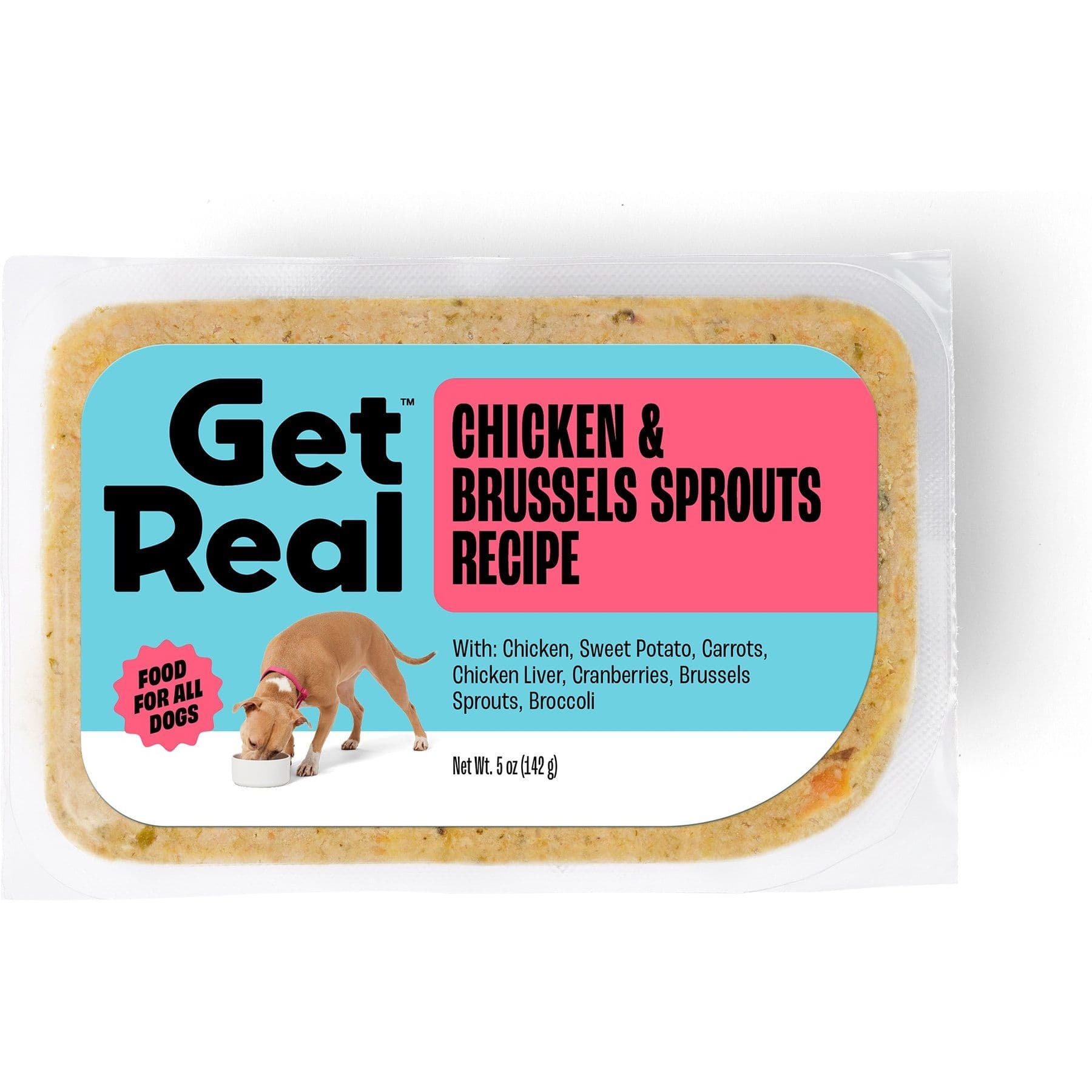
The lowest-calorie Get Real recipe per pack, which gives a dog a fuller bowl for the same daily calories.
Webvet may earn a commission when you click through to Chewy, at no extra cost to you.
| Get Real recipe | kcal per ounce (12 oz pack divided by 12) | 5 oz mixer pack (calories per pack) | 12 oz pack (kcal per pack) | 24 oz pack (kcal per pack) |
|---|---|---|---|---|
| Chicken & Brussels Sprouts | about 35.7 | 179 | 428 | 856 |
| Beef & Sweet Potato | about 37.6 | 188 | 451 | 902 |
| Turkey & Cranberry | about 39.5 | 198 | 474 | 948 |
Reading the table, the calories per pack by recipe differ by roughly 10 percent from lowest to highest. A dog eating the Get Real Turkey & Cranberry Recipe needs about 10 percent fewer packs than the same dog eating chicken, all else equal. That is a real but modest difference, so pick the recipe your dog does best on first and let the pack count follow.
The Get Real Chicken & Brussels Sprouts Recipe has the fewest calories per pack of the three, at 428 kcal per 12 oz pack, so the same daily calories mean slightly more food in the bowl than with beef or turkey.
The pack size you choose mostly affects convenience. A 24 oz pack holds exactly twice the calories of a 12 oz pack, so compare the cost of the calories per pack in the cart rather than assuming one size is the better buy. Larger dogs usually go through a 24 oz pack quickly, while a small dog may be better served by 12 oz packs so each one is used up well inside the 3 to 5 day window after thawing.
 Sponsored
Vet care that's always there
Unlimited video calls and messaging with licensed vets for less than a typical vet visit. One membership covers up to five pets.
Use code Pets60
Plans start at $12/month · covers up to 5 pets
- Licensed vets in most states
- Rx for 150+ conditions
- 4.7 on Trustpilot
Full meal vs topper: how the math changes by dog size

To turn calories into packs per day, you need a daily calorie estimate. A common starting point is the resting energy requirement (RER), which the Merck Veterinary Manual describes as 70 times body weight in kilograms raised to the 0.75 power. A typical neutered adult pet needs about 1.6 times RER. The examples below use that multiplier for a 10 lb small dog (about 350 kcal a day), a 30 lb medium dog (about 790 kcal a day), and a 60 lb large dog (about 1,340 kcal a day). Your own dog may need more or less, and the WebVet guide on how much to feed a dog explains how age and activity shift the number.
Here is the packs-per-day math by dog size, using the Beef & Sweet Potato calories. As a full meal, divide daily calories by the kcal per pack. As a topper, multiply daily calories by the topper share first. This topper share math keeps total calories steady: whatever share Get Real provides, the kibble is cut by the same calories.
| Example dog | Daily calories | Full meal: packs per day | 25 percent topper share: packs per day |
|---|---|---|---|
| Small, 10 lb | about 350 kcal | about 0.8 of a 12 oz pack | about half of a 5 oz mixer pack |
| Medium, 30 lb | about 790 kcal | about 0.9 of a 24 oz pack | about one 5 oz mixer pack |
| Large, 60 lb | about 1,340 kcal | about 1.5 of a 24 oz pack | about 0.75 of a 12 oz pack |
The pattern is clear. Moving from full meal to a 25 percent topper share cuts the fresh food needed by three quarters, and that is the single biggest lever on cost for any given dog. Going from a small to a large dog roughly quadruples the packs needed, even though the dog weighs six times as much.
To get the price per day by dog size, divide your dog's daily calories (times the topper share, if you use one) by the kcal per pack, then multiply by the plan's price per pack. For a medium dog, the Get Real Beef & Sweet Potato Recipe in 24 oz packs works out to a little under one pack a day as a full meal.
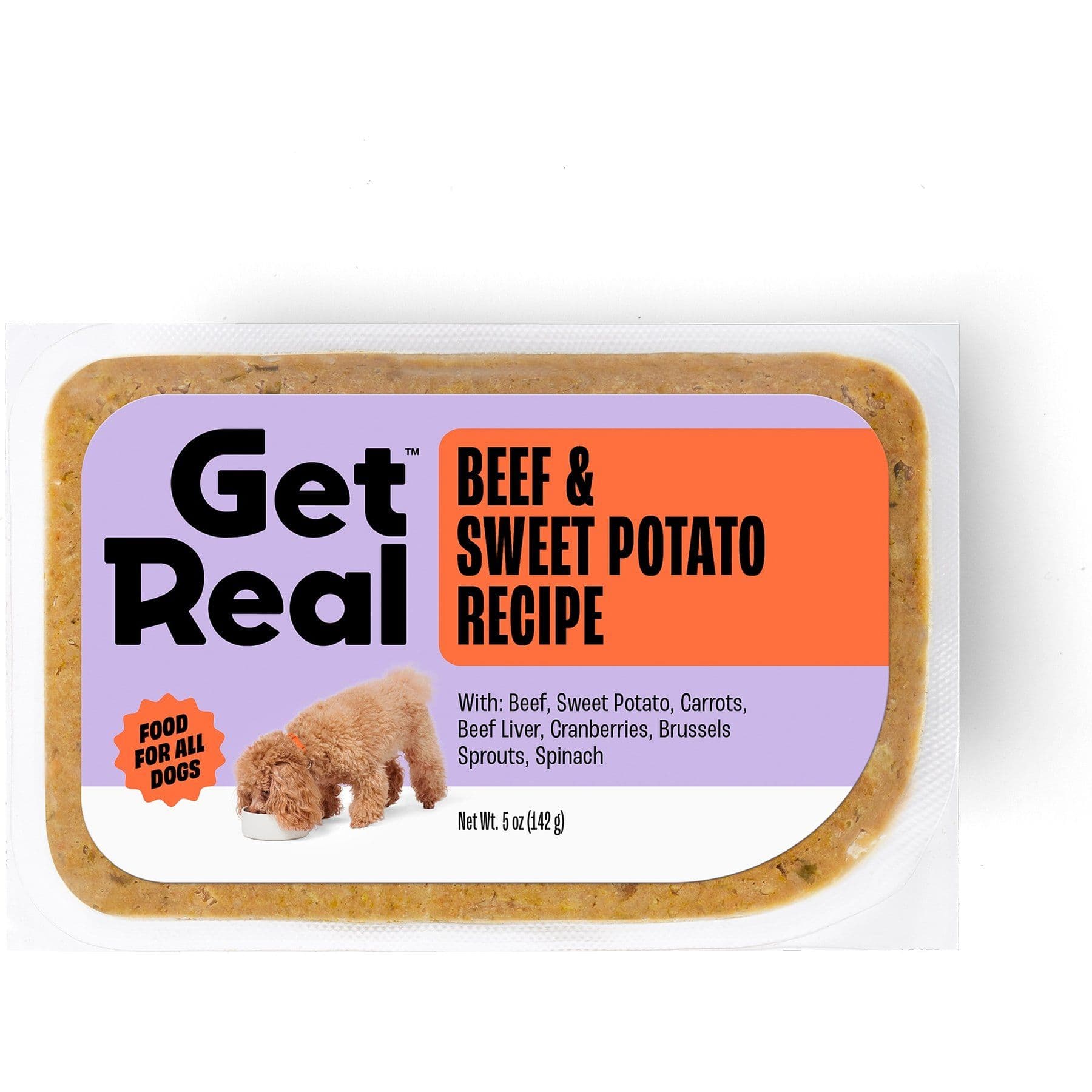
A complete and balanced fresh recipe that works as the whole bowl, with 902 kcal in each 24 oz pack for easy full meal math.
Webvet may earn a commission when you click through to Chewy, at no extra cost to you.
- Small dog, 10 lb, about 350 kcal: 350 divided by 451 is about 0.8 of a 12 oz pack a day as a full meal; a 25 percent topper is about 88 kcal, roughly half a 5 oz mixer pack.
- Medium dog, 30 lb, about 790 kcal: 790 divided by 902 is about 0.9 of a 24 oz pack a day as a full meal; as a topper, about one 5 oz mixer pack.
- Large dog, 60 lb, about 1,340 kcal: about 1.5 of the 24 oz packs a day as a full meal; as a topper, about 335 kcal, or three quarters of a 12 oz pack.
Small dogs and topper plans need the fewest packs per day, and a large dog on a full meal needs the most.
Fresh dog food toppers are the lower-volume option: they add moisture and aroma without replacing kibble entirely. The best dog food toppers for cost control are complete and balanced, because a high quality topper of that kind can take a larger share of a bowl of dry food without diluting the nutrients in the base diet. Get Real can be used as a topper, a kibble mixer, or a full meal, so the share is your choice, while a topper that is not complete and balanced should stay closer to 10 percent of calories. The WebVet guide on how much topper to add walks through choosing that share.
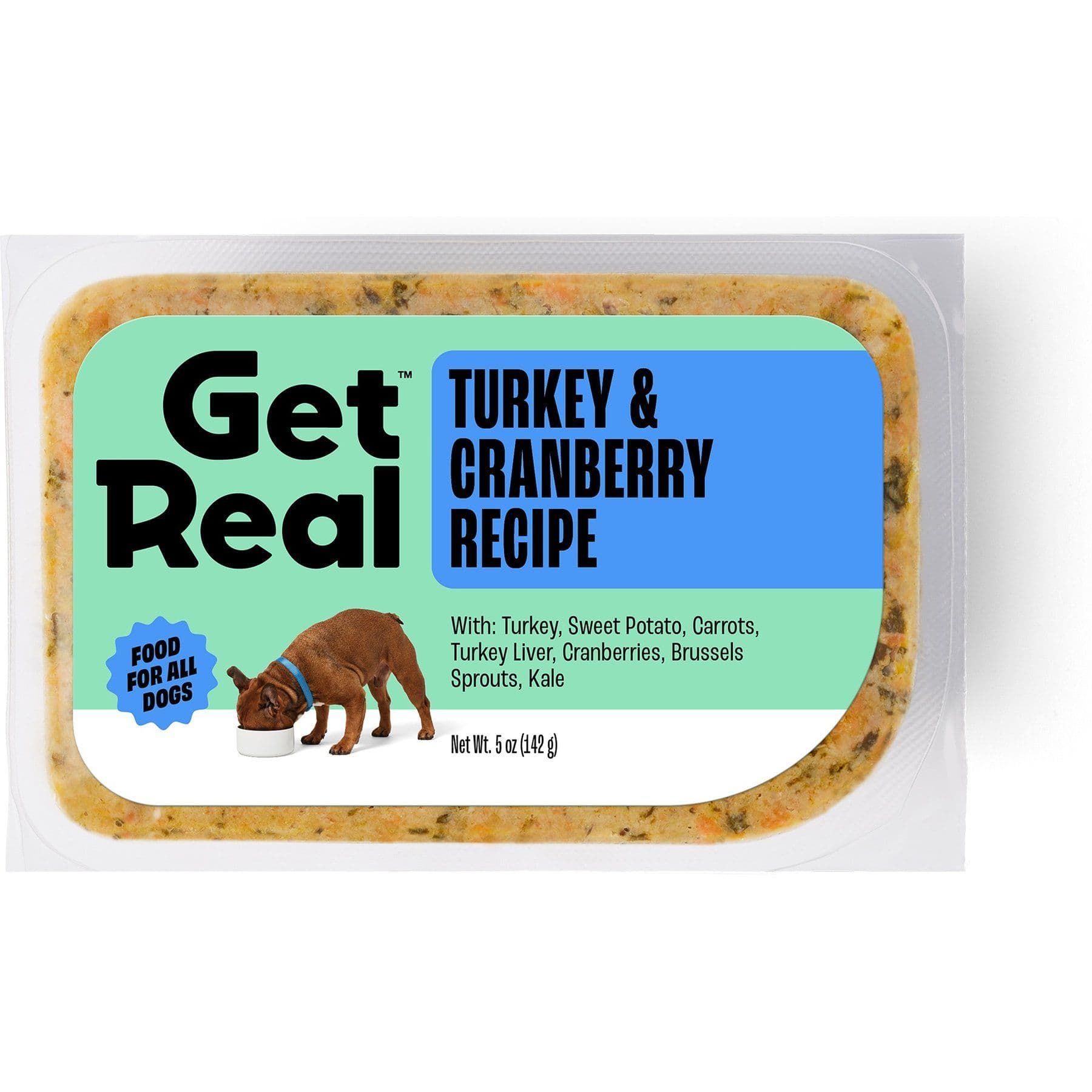
The most calorie-dense Get Real recipe per pack, so a smaller spoonful covers the same topper share of daily calories.
Webvet may earn a commission when you click through to Chewy, at no extra cost to you.
The key rule is to reduce kibble by the topper's calories. If a 30 lb dog gets one 5 oz Beef & Sweet Potato mixer pack (188 kcal) a day, the kibble should drop by about 188 kcal, which is roughly half a cup of a 380 kcal per cup kibble. Skip that step and the topper adds calories, which over time adds weight rather than saving money.
Budgeting by the month with a subscription

Once you know packs per day, the dog food cost per month is a simple multiplication: packs per day times 30. Using the examples above with the beef recipe, the plans work out to:
- Small dog, full meal: about 23 of the 12 oz packs a month.
- Medium dog, full meal: about 26 of the 24 oz packs a month.
- Large dog, full meal: about 44 of the 24 oz packs a month.
- Medium dog, 25 percent topper: about 30 of the 5 oz mixer packs a month.
Multiply that pack count by the per-pack price shown for your plan and you have your dog food monthly cost. Because current pricing is shown in the Chewy cart rather than on a published price list, building the plan there with your dog's details is the only way to see an exact figure.
Get Real ships on a subscription, and the controls are useful for budgeting. With a subscription you can:
- Change the recipes or the delivery frequency as your dog's needs shift.
- Pause deliveries when your freezer is full or your dog is boarding.
- Skip a single delivery so you never pay for food you will not use.
- Cancel anytime if fresh food is not the right fit.
For full meal plans, Chewy ships the second order an extra week later to allow time for the transition.
Packs arrive frozen, and they should go straight into the freezer. Freezer space is a practical limit on how many packs one delivery can hold, so many owners pick a delivery frequency that matches what fits.
Plan for the switch when you budget the first month. Moving from old food to fresh food over 7 to 10 days, or 10 to 14 days for sensitive dogs, means the first deliveries cover a mix of foods. The WebVet guide to transitioning dog food lays out a day-by-day schedule, and the Get Real feeding guide shows how to set portions for each recipe.
Getting the most value from fresh food
Who has the most affordable fresh dog food? For your household, it is the plan that delivers the calories your dog needs with the fewest packs and no waste. Fresh food cost is driven by your dog's daily calories, the calories in each pack, the share of the bowl the fresh food replaces, and how much thawed food goes uneaten, so topper plans and small dogs cost least per day. Compare any fresh food by the cost of the calories your dog actually needs, not by the price of one pack.
Weighing quality against price, the best value is a complete food your dog eats without waste. A few habits stretch the value of a fresh plan:
- Match the share to the budget. A topper plan gives many of the benefits of fresh food for a fraction of the packs.
- Pick the right pack size. Use 12 oz packs for small dogs so each thawed pack is finished within 3 to 5 days.
- Thaw only what you need. Thaw in the fridge for 12 to 24 hours (35 to 48 hours for 24 oz packs), and discard food left at room temperature over 2 hours.
- Keep the dog lean. Weigh your dog every few weeks; an overweight dog costs more to feed.
- Use the subscription controls. Pause or skip rather than letting packs pile up.
Flexibility also protects value. Each Get Real recipe can be fed as a full meal or as a topper and is formulated to meet AAFCO all life stages profiles, so a household can start with a topper plan and move to full meals later on the same recipes.
Where to see current Get Real pricing
You build a Get Real plan on the Get Real page at Chewy by choosing the recipes, full meal or topper use, and delivery frequency, and the current plan price is shown before you check out. To compare a full meal plan with a topper plan, price each one and use the packs-per-day estimate in this guide as a check on the order size.
Get Real is available only at Chewy and only in select markets, so confirm it ships to your area before you plan a budget around it.
Get Real cost questions
Frequently Asked Questions
Is Get Real good for dogs?
Get Real is formulated to meet AAFCO all life stages nutrient profiles, with 10 ingredients or less plus vitamins and minerals in each of three recipes and human-grade ingredients. It is gently cooked then frozen, and it can be fed as a full meal or a topper. Whether it suits your dog depends on your dog's health, so ask your veterinarian about any special diet needs.
How much does Get Real cost per month?
Work out packs per day from your dog's calories and the kcal per pack, then multiply by 30 to get packs per month. A medium dog on a full meal of the beef recipe uses about 26 of the 24 oz packs a month. Multiply that by the per-pack price shown in the Chewy cart for your plan.
Is it cheaper to use Get Real as a topper?
Yes. At a 25 percent topper share, your dog needs about a quarter of the calories from Get Real, so you buy fewer packs than on a full meal plan. Remember to cut kibble by the same calories so the daily total stays steady.
Does my dog's size change what Get Real costs?
Yes. Calories per day rise with body weight, so larger dogs need more packs. The increase is not proportional, though: a 60 lb dog needs roughly four times the calories of a 10 lb dog, not six.
Can I pause or skip a Get Real subscription?
Yes. You can pause the subscription, skip a delivery, change recipes or frequency, or cancel anytime. Skipping is a simple way to avoid paying for food when your freezer is already stocked.
Can I try Get Real before subscribing?
Yes. Chewy offers a Sampler Pack as a risk-free trial, so you can test recipes with your dog first and subscribe later. If you do subscribe, subscription flexibility lets you change, pause, skip, or cancel anytime; check the Chewy cart for what the current Sampler Pack trial includes.

Editor
The Webvet Editorial Team is the in-house group of pet-care editors and writers behind Webvet, operated by Smart Pet Collective. The team researches, writes, and maintains Webvet's pet health, behavior, and medication content. Every article follows a defined editorial process: research from reputable veterinary and scientific sources, careful drafting, mandatory review of medical content by a credentialed veterinarian, and dated publication. Health and medication articles are medically reviewed by a licensed veterinary professional before they go live and are kept current over time.
Veterinarian · BVMS MRCVS
Dr. Pippa Elliott, BVMS, MRCVS, is a veterinarian with nearly 30 years of experience in companion animal practice. Dr. Elliott earned her Bachelor of Veterinary Medicine and Surgery from the University of Glasgow. She was also designated a Member of the Royal College of Veterinary Surgeons. Married with 2 grown-up kids, Dr. Elliott has a naughty Puggle named Poggle, 3 cats and a bearded dragon.
Related reading

Easily Digestible Dog Food: What Makes a Meal Gentle on Your Dog's Gut

Fresh Dog Food for Underweight Dogs: Safe Weight Gain, Step by Step

How to Tell if a Dog Food Is Right for Your Dog: 8 Signs Vets Check
