SpotOn vs Fi vs Tractive: GPS Fence or GPS Tracker, and Which Dogs Need Which
SpotOn, Fi, and Tractive compared: one is a GPS fence that trains and contains the dog, the other two find the dog after it leaves. Which one fits your property, your dog, and your budget over two years.

BVMS MRCVS
Medically reviewed by Dr. Pippa Elliott, BVMS MRCVS · Last reviewed

This article contains affiliate links. Webvet may earn a commission when you buy through them, at no extra cost to you.
SpotOn vs Fi looks like a brand choice, but the two do different jobs. The SpotOn GPS Fence is a collar that trains a dog to stay inside a boundary you set from your phone. Fi and Tractive are trackers that alert you when your dog leaves a zone and show you where it went.
That split drives the money question, too. The prices each maker listed when we checked in October 2026:
- SpotOn: $999 for the Nova collar, with no plan needed for the fence.
- Fi: $189 for a first year, with the membership included.
- Tractive: $79 for the DOG 6, plus a separate subscription.
WebVet did not obtain the products and ran no hands-on test; verdicts rest on maker specifications, Chewy listings, and veterinary guidance. No manufacturer or retailer paid for or reviewed this article.
WebVet may earn a commission on Chewy links; that relationship did not influence the verdict. SpotOn is a WebVet partner, and WebVet may also earn a commission on SpotOn links; its product is described from its published specifications on the same terms as the others.
GPS fence vs GPS tracker: two different jobs
A GPS fence and a GPS tracker can look alike, but they do opposite work. SpotOn is a GPS fence: it trains and contains, cueing the dog with a warning tone near the boundary. Fi and Tractive are trackers: they locate the dog and alert you when it crosses a line you drew.

SpotOn says its system uses GPS to contain a dog with no buried wire, and that its virtual fences do not need a cellular connection, while its tracking does. Fi describes its collar from the other side: it alerts you and never corrects the dog.
- 1The difference between a GPS fence and a GPS tracker is the job: a fence keeps a dog inside a boundary, a tracker helps you find a dog that got out.
- 2What SpotOn, Fi, and Tractive each do: SpotOn contains with a warning tone and an optional static correction, while Fi and Tractive alert you rather than correct the dog.
- 3SpotOn needs a property of at least one-third acre, and its fences keep working without a cell signal.
- 4At October 2026 listed prices, two years of SpotOn starts at $999 and two years of the Tractive DOG 6 at $223, while Fi costs $189 for year one plus a renewal Fi does not publish.
The two jobs, in plain terms:
- Keep the dog in (GPS fence): the collar responds as the dog nears the edge, so the dog learns where home ends. SpotOn works this way.
- Find the dog (GPS tracker): the collar sends a geofence alert to your phone when the dog leaves a safe zone, then shows where it is. Fi and Tractive work this way.
- Both: SpotOn can also track, but only with cellular coverage and an optional plan.
So the right choice depends on whether your dog needs to be kept in or found. A dog on unfenced acreage needs containment first. For ranked picks across many brands, see our guide to the best dog GPS trackers.

Custom GPS boundaries for suitable properties of at least one-third acre. No subscription required for core fencing.
- Custom boundaries with no buried wires
- No subscription required for core fencing
- Optional tracking and escape-alert plan
Core fencing works without a subscription; tracking is optional.
Webvet may earn a commission when you click through to SpotOn, at no extra cost to you.
Does geofencing work for dogs?
Yes as an alarm; a barrier is a different product. Tractive says its virtual fence sends an instant alert to your phone when your dog crosses a safe-zone boundary or enters a no-go zone. It notifies you rather than stopping the dog, and the tracker must be switched on with an active internet connection.
Tractive also notes that a physical fence does not tell you when a pet escapes. A GPS fence such as SpotOn goes further by cueing the dog directly, so the dog can be trained to stay inside.
What are the key differences between SpotOn Fence and Halo fence?
SpotOn's own comparison page draws these lines, so read them as one maker's claims about a rival:
- Correction: SpotOn lists vibration plus an optional static correction capped at 10 seconds, and lists the Halo 5 as vibration plus optional continuous static.
- Subscription: SpotOn says its core containment works without a subscription, while Halo requires a membership.
- Battery: SpotOn rates the Nova at 33+ hours; Fi's comparison page lists the Halo Collar 5 at up to 48 hours.
- Cost: SpotOn says that despite its higher upfront price, Halo is more expensive after two years.
Both pages come from Halo's competitors, so check Halo's own terms.
SpotOn GPS Fence: what it does, how the training works, and who it is for
The SpotOn GPS Fence is a containment collar with no buried wire: you set the boundary from your phone, and the collar uses GPS to hold the dog inside it. SpotOn says you can create unlimited fences, from one-third acre up to more than 100,000 acres.
SpotOn's own pages, including its SpotOn vs Halo comparison, describe how the training works:
- A warning tone starts about 10 feet inside the fence line.
- A second warning comes at about 5 feet before the line.
- At the boundary, the correction options are vibration and an optional static correction, which SpotOn caps at 10 seconds.
- The feedback stops when the dog turns back, so turning around is what ends the cue.
- Without a paid plan, you can still create GPS fences and train your dog to stay in.
What is the battery life of the SpotOn Nova Edition?
SpotOn rates the Nova Edition at 33+ hours with tracking, up from 25+ hours for the earlier Omni, on SpotOn's Nova Edition page. Expect to charge it about daily, far more often than a tracker: Fi rates its Series 3+ at up to 3 months and Tractive its DOG 6 at up to 2 weeks.
The same page lists the Nova's accuracy at under 5 feet (about 6 feet for the Omni) and its satellite access at 151 satellites, up from 128. These are maker figures, not independent measurements.
Who the SpotOn collar suits, based on those specifications:
- Good fit: a property of at least one-third acre, a dog that needs to stay in, and no physical fence.
- Poor fit: yards under one-third acre, which fall below the Nova's stated minimum.
- Poor fit: owners choosing mainly on price, since SpotOn listed the Nova at $999 in October 2026 against Fi's $189 first year.
Fi Series 3+: what it does and who it is for
Fi Series 3+ is a GPS tracker and health monitor, not a fence. Fi says the collar alerts you and never corrects the dog.
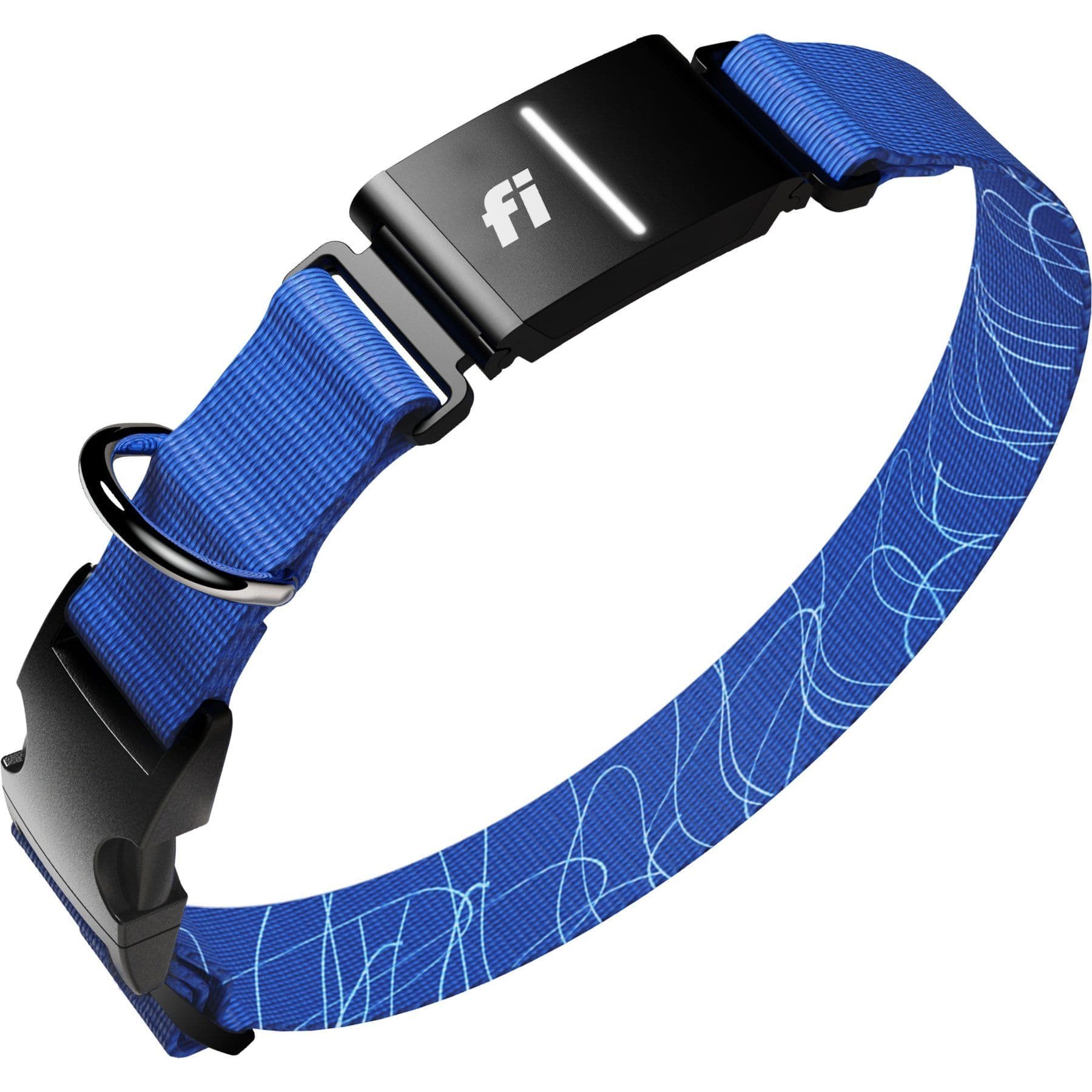
A GPS tracker with escape alerts and a battery rated up to 3 months that alerts you and never corrects the dog.
Webvet may earn a commission when you click through to Chewy, at no extra cost to you.
What it does, per Fi's own pages and the Chewy listing:
- Geofences: unlimited geofences with 24/7 escape alerts, covering North America and much of Europe, 35 countries and territories in all.
- Tracking: the Chewy listing describes always-on precision GPS tracking and escape alerts, paired with activity, sleep, and behavior tracking.
- Build: the Chewy listing describes the collar as waterproof, charged on a wireless charging base.
- Battery: up to 3 months on the Series 3+, a maker claim repeated on Fi's homepage.
- Correction: none. Fi says there is no static shock on any Fi device.
- Price: Fi's comparison page puts the first year at $189 with the device and a one-year membership included, and Chewy listed the Fi Series 3+ Smart Dog Collar, Blue, Large at $189 in October 2026.
The Chewy listing says a twelve-month membership comes with the collar. The Fi Series 3+ page says the membership covers the app, an extended warranty for defects and malfunctions, multiple dogs per account, and unlimited household users.
The open question is year two. Fi's own pages do not state the renewal price after the first year, and other sellers quote different figures. Ask for the renewal price before you buy, because it decides the two-year cost.
Is a Fi collar worth it?
It is worth it if your problem is finding the dog, not keeping it in. Fi carries the longest rated battery of the three, up to 3 months, escape alerts from unlimited geofences, and no correction of any kind. It is not a substitute for a fence: Fi alerts you, not the dog.
The value case also hangs on that renewal price. The $189 Fi listed for year one when we checked sits far below the $999 SpotOn listed for the Nova, but Tractive's tracker, listed at $79, plus a plan may undercut Fi over two years, depending on what Fi charges to renew.
Fi suits these owners best:
- Owners whose dog already lives behind a sound fence and who want to know the moment it gets out.
- Owners who would rather charge a collar every few months than every day or two.
- Households that want no static shock anywhere in the setup.
Where Fi falls short:
- It does not contain. Fi alerts you after the dog has already left the geofence.
- Fi lists coverage for North America and much of Europe, a narrower map than Tractive's 175-plus countries.
Tractive dog tracker: what it does and who it is for
The Tractive GPS tracker locates a dog in real time and alerts the owner when the dog crosses a virtual boundary; it does not correct the dog. Tractive builds a SIM card into the tracker, like the one in your phone, and it uses mobile networks to send you the dog's location.
Coverage reaches more than 175 countries where 2G or LTE (CatM1) cellular coverage is available from one of Tractive's 500+ partner networks, according to the Tractive dog tracker page. The Chewy listing says the tracker updates a dog's location every two to three seconds.
Tractive's virtual fences come in two kinds:
- Safe Zones, such as a garden, which alert you when the dog leaves.
- No-Go Zones, such as pools, busy roads, or restricted gardens, which alert you when the dog enters.
Tractive's published specifications for the dog tracker line:
- Price: Tractive lists the DOG 6 at $79, and Chewy listed the Tractive Smart Dog GPS Tracker with Vital Signs Monitoring, Dog Collar Attachment, Black at $79 in October 2026.
- Size: the DOG 6 is for dogs above 8.8 lbs; the Chewy listing says nine pounds and up.
- Battery: Tractive rates the standard DOG 6 at up to 2 weeks and XL models at up to 6 weeks with Power Saving Zones. The Chewy listing for the Vital Signs tracker says up to 10 days per charge, extended through Power Saving Zones.
- Build: IP68 waterproof, at 1.4 oz for the DOG 6, 2.5 oz for the XL, and 3.5 oz for the XL Adventure.
- Plan: the subscription is separate from the tracker, can be cancelled any time, and every plan carries a 30-day money-back guarantee. The Chewy listing says plans start at $5 a month.
The subscription is the catch. When we checked in October 2026, Tractive's US plans page showed two sets of prices without labeling which is Basic and which is Premium, so recheck the plan you are buying at checkout.
The US plan prices Tractive listed when we checked in October 2026:
- One-year plan: $9 a month, billed $108 a year; the second price set lists $10 a month, billed $120.
- Two-year plan: $6 a month, billed $144; the second price set lists $7 a month, billed $168.
- Five-year plan: $5 a month, billed $300.
Where Tractive falls short:
- Tracking needs a paid subscription on top of the tracker price.
- Virtual fence alerts need the tracker switched on with an active internet connection.
- It does not contain the dog, so it cannot stand in for a fence.
- The DOG 6 is sized for dogs above 8.8 lbs.
Tractive suits owners who want the lowest entry price of the three, dogs that travel abroad, and alerts with no correction. For more on the hardware and app, read our Tractive dog GPS tracker review.
Side by side: containment, tracking, battery, subscription, and two-year cost

Battery figures below are each maker's own rating, and every cost uses the prices listed when we checked in October 2026.
| Compare | SpotOn GPS Fence (Nova) | Fi Series 3+ | Tractive DOG 6 |
|---|---|---|---|
| Job | Keeps the dog in (GPS fence) | Finds the dog (tracker) | Finds the dog (tracker) |
| Containment | Warning tone about 10 feet inside the line, vibration, and optional static correction capped at 10 seconds | None; escape alerts go to the owner and the dog is never corrected | None; virtual fence alerts go to the owner's phone |
| Tracking | Location viewing with an optional plan and cellular service | Always-on GPS tracking with unlimited geofences | Live GPS through a built-in SIM on 2G or LTE (CatM1) in 175+ countries |
| Battery (maker rating) | 33+ hours with tracking | Up to 3 months | Up to 2 weeks; up to 6 weeks for XL models |
| Subscription | Optional; fences work without one. Tracking plans listed at $8.49 a month billed $101.88 a year, $179.76 for two years, or $9.95 monthly | First year included in $189; Fi does not publish the renewal price | Required for tracking and sold separately; two-year plans listed at $144 or $168 |
| Minimum property | One-third acre (Nova) | Not applicable; it does not contain | Not applicable; it does not contain |
| Two-year cost | $999 for containment alone; $1,178.76 with the two-year tracking plan | $189 plus an unpublished year-two renewal | $223 to $247 ($79 tracker plus a $144 or $168 two-year plan) |
Of the three, only the SpotOn GPS Fence does containment. Its collar cues the dog with a tone, then vibration and an optional static correction at the boundary. Fi and Tractive alert the owner instead, and Fi says no Fi device has static shock, so neither will stop a dog set on leaving.
Tracking depends on cellular service for SpotOn and Tractive. SpotOn says its tracking requires a cellular connection because GPS does not send two-way messages, and Tractive's built-in SIM runs on mobile networks. Fi lists its coverage as North America and much of Europe.
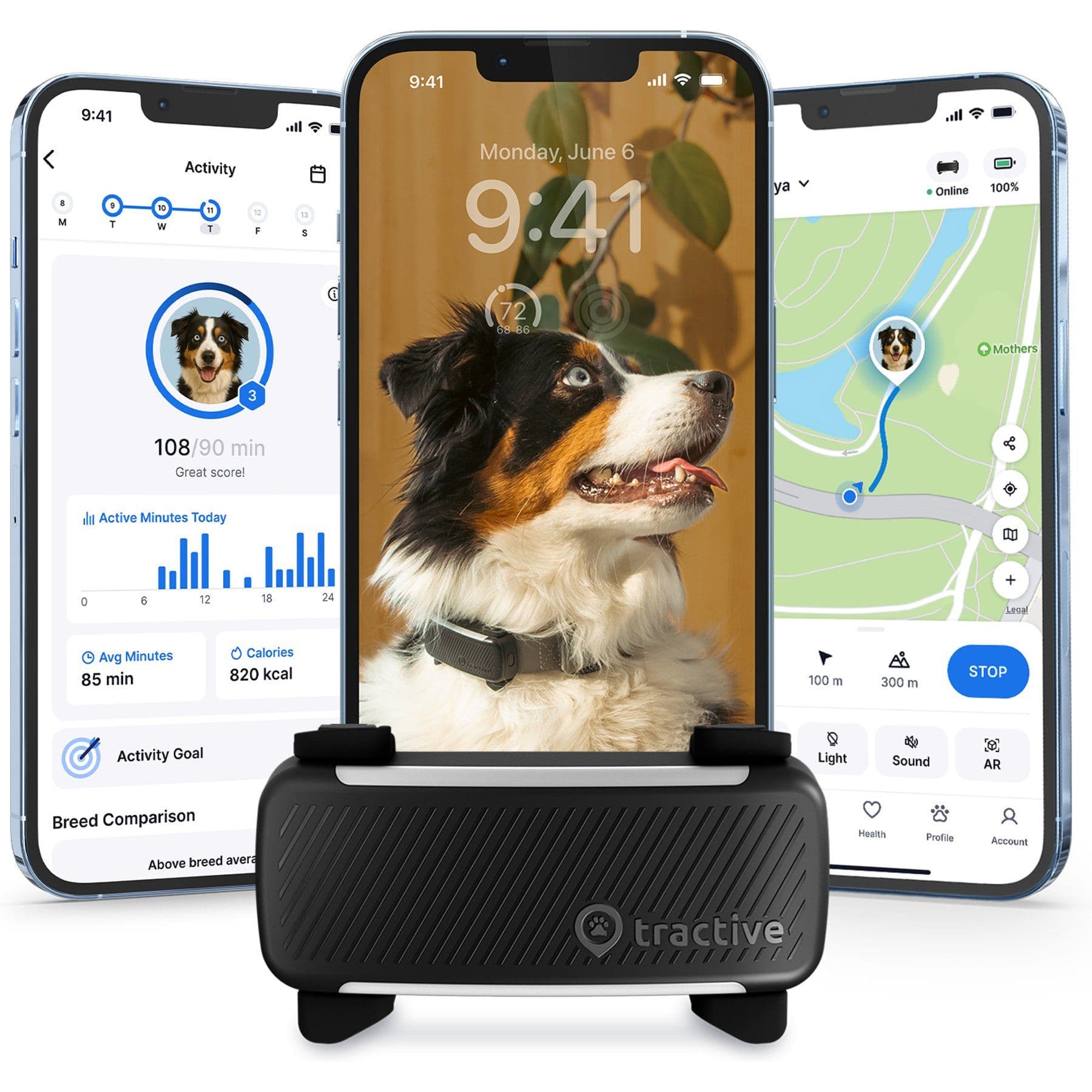
Live GPS tracking with virtual fence alerts for dogs nine pounds and up; the subscription is sold separately.
Webvet may earn a commission when you click through to Chewy, at no extra cost to you.
What each subscription buys:
- SpotOn: tracking only. Fences and training work without a plan.
- Fi: the app, the extended warranty, multiple dogs, and unlimited household users, with year one included in the $189 bundle.
- Tractive: the tracking service itself, billed separately and cancellable any time. Tractive Care, which covers loss, damage, and theft replacement, was listed at an extra $2 a month on a one-year plan, $1.50 on a two-year plan, or $1 on a five-year plan.
Why is SpotOn so expensive?
SpotOn's own answer is that you pay up front instead of every month. When we checked in October 2026, its SpotOn vs Satellai page listed the Nova at $999 with the subscription optional, and its homepage showed financing from $44 a month. SpotOn argues the price is offset because core containment needs no subscription.
Financing spreads the payments but does not lower the two-year total. SpotOn also claims Halo is more expensive after two years; that is SpotOn's comparison, not an independent audit. Against trackers, two years of SpotOn as a fence alone costs more than four times the Tractive DOG 6's two-year total with a plan.
Two-year totals at the prices listed in October 2026, subscription included:
- SpotOn, fence only: $999, since containment needs no plan.
- SpotOn with tracking: $1,178.76 on the two-year plan ($999 plus $179.76); paying $9.95 monthly instead brings it to $1,237.80.
- Tractive: $223 to $247 for the Tractive Smart Dog GPS Tracker with Vital Signs Monitoring, Dog Collar Attachment, Black, listed at $79 on Chewy, plus a $144 or $168 two-year plan; adding Tractive Care at $1.50 a month makes it $259 to $283.
- Fi: $189 for year one, plus a renewal price Fi's own pages do not state.
Those totals leave out loss and repair. Tractive sells loss, damage, and theft replacement separately as Tractive Care, and Fi's membership includes an extended warranty for defects and malfunctions. Check SpotOn's warranty terms before you buy, since its $999 collar would be the costliest of the three to replace.
For a big dog, the XL tracker lowers the entry price further. Chewy listed the Tractive Collar Attachment Smart Dog GPS Tracker with Virtual Fence, X-Large, Brown at $53.40 in October 2026, which puts two years with a $144 plan at $197.40.
The XL listing says it uses LTE and 2G, monitors heart rate, respiratory rate, and barking patterns, and runs up to six weeks per charge.
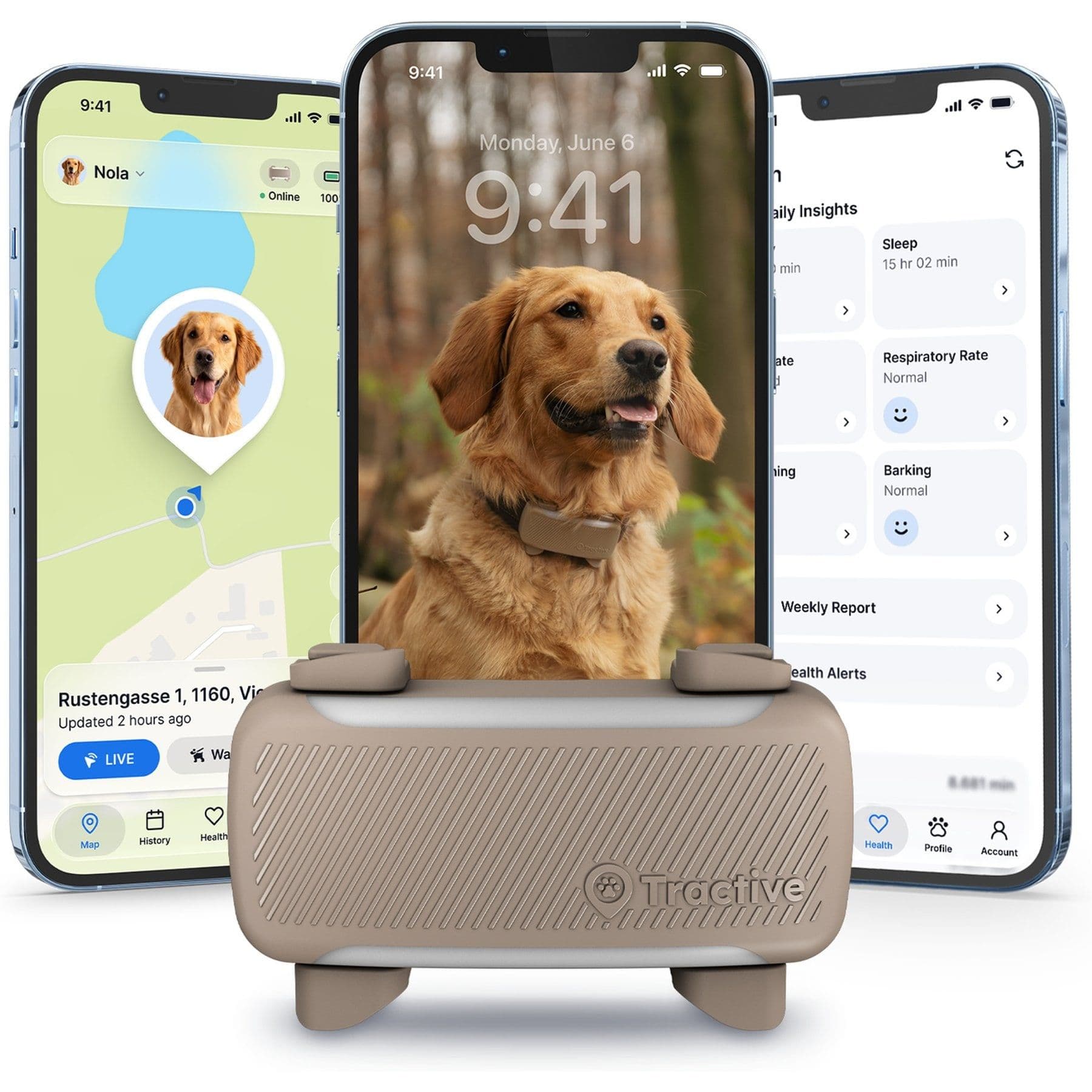
An XL Tractive tracker for active dogs, with live GPS updates every two to three seconds over LTE and 2G.
Webvet may earn a commission when you click through to Chewy, at no extra cost to you.
Which dogs and properties need a fence, a tracker, or both
Start with the property and the dog, not the brand. The question is whether your dog needs to be kept in, found, or both, and whether your land is big enough for a GPS fence at all.

SpotOn sets the minimum property at one-third acre for the Nova and half an acre for the earlier Omni. Below that, a GPS fence is outside its stated range, and the realistic setup is a physical fence plus a tracker.
Answer these four questions before you compare brands:
- Does the dog need to be kept in, found, or both?
- Is the property at least one-third acre?
- Is there reliable cellular coverage where the dog goes?
- Will you accept static correction, or rule it out entirely?
Then match your situation to a setup:
- Small yard under one-third acre: a physical fence, plus Fi or Tractive for an escape alert. Tractive's DOG 6 is sized for dogs above 8.8 lbs, so for dogs under that weight see our picks for the best GPS trackers for small dogs.
- Acreage with no fence, and the dog must stay home: the SpotOn GPS Fence, whose fences run without cell service. Add its optional plan if you also want tracking.
- Several areas to fence: SpotOn, which allows unlimited fences from one-third acre to more than 100,000 acres.
- Fenced yard, occasional escape artist: a tracker with geofence alerts. The Fi Series 3+ Smart Dog Collar, Blue, Large suits owners who want rare charging, and the Tractive Smart Dog GPS Tracker with Vital Signs Monitoring, Dog Collar Attachment, Black suits a lower entry price.
- Owner who forgets to charge: a tracker rather than a fence collar. Fi is rated up to 3 months and Tractive's XL models up to 6 weeks, against SpotOn's 33+ hours.
- Large, active dog on a budget: the Tractive Collar Attachment Smart Dog GPS Tracker with Virtual Fence, X-Large, Brown, which its Chewy listing describes as designed for active dogs.
- Multi-dog household: Fi's membership covers multiple dogs per account and unlimited household users.
- Travel abroad: Tractive, which works in more than 175 countries with partner cellular coverage. Fi covers North America and much of Europe.
- A fence and tracker in one, bought from a retailer: the Invisible Fence GPS Flex Wireless Dog Fence & GPS Tracker, listed at $544.90 on Chewy in October 2026. Its listing describes app settings with 100 stimulation levels of correction, plus training videos, so it is a correction-based fence. Confirm battery life and plan terms with the seller before weighing it against SpotOn.
If you cannot yet answer the first question, start with a tracker. It adds an escape alert to whatever containment you already have and never corrects the dog. Move to a GPS fence only when the property clears one-third acre and a physical fence is not practical.
Some dogs need both jobs covered. On acreage, SpotOn with its optional tracking plan handles both from one collar, as long as cellular coverage reaches where the dog roams. On a smaller lot, a physical fence plus Fi or Tractive splits the same two jobs across two tools.
Two example properties show how those rules play out:
- Two acres, no fence, patchy cell signal: SpotOn's fence fits, because it needs no cellular connection. Its tracking, like Tractive's, relies on cell service, so treat location updates there as a bonus rather than a safety net.
- A quarter-acre lot with a solid fence: this falls below SpotOn's one-third acre minimum, so keep the fence and add Fi or Tractive for an escape alert.
Strengths and drawbacks at a glance:
- Strength: SpotOn contains a dog without buried wire, and its fences run without cellular service.
- Strength: Fi Series 3+ is rated up to 3 months of battery and never corrects the dog.
- Strength: Tractive has the lowest entry price of the three, listed at $79 for the DOG 6 in October 2026, with up to 2 weeks of rated battery.
- Drawback: SpotOn listed the Nova at $999 in October 2026; it needs at least one-third acre, and its correction can include static, which AVSAB advises against.
- Drawback: Fi alerts you only after the dog leaves; it does not keep the dog in.
- Drawback: Tractive needs a paid subscription, and its plans page shows more than one price set.
None of these devices replaces ID. The AVMA says microchips aren't a substitute for proper external identification, and notes a study of about 7,700 strays in which microchipped dogs were returned to owners at more than double the overall rate. If your dog is not chipped yet, see our guide to dog microchip cost.
Our verdict, from the makers' specifications, the Chewy listings, and veterinary guidance:
- SpotOn GPS Fence: the only one of the three that contains a dog, with no buried wire and fences that run without cell service. It earns its $999 October 2026 listed price on one-third acre or more where a physical fence is not practical, and on no smaller property.
- Fi Series 3+ Smart Dog Collar, Blue, Large: the low-maintenance tracker, with the longest rated battery and no correction. The unpublished renewal price is its main drawback.
- Tractive Smart Dog GPS Tracker with Vital Signs Monitoring, Dog Collar Attachment, Black: the lowest entry price for live tracking and alerts, with plan tiers you should recheck at checkout.
Before you buy, recheck:
- Fi's renewal price for year two, which Fi's own pages do not state.
- Which Tractive price set applies to your plan, since its plans page shows two.
- SpotOn's accuracy, battery, and cost comparisons, which come from SpotOn's own pages.
- The Invisible Fence GPS Flex's battery life and plan terms, with the seller.
- Every price, since each figure here is an October 2026 listing.
Safety: static correction, training, and when a physical fence is still the answer
SpotOn's static correction is optional, and SpotOn says it is capped at 10 seconds, but it is still an aversive cue. The warning tone comes first, about 10 feet inside the line, so a dog that turns back at the tone does not reach the correction.
The American Veterinary Society of Animal Behavior (AVSAB) recommends that only reward-based methods be used for all dog training. Its 2025 board statement lists electronic collars among aversive methods that should not be used under any circumstances.
The British Veterinary Association says even low-level electric shock produces stress, pain, and fear responses in dogs and cats, and asks that only visible or audible containment systems be sold. That is UK policy, and US veterinary bodies may take a different line.

If you use a GPS fence, keep the training reward-based:
- Treat the warning tone as the boundary cue. SpotOn starts it about 10 feet inside the line and repeats it at 5 feet.
- Reward the dog for turning back at the tone; on SpotOn, the cue stops as soon as the dog turns away.
- Leave static correction switched off. It is optional on SpotOn, and Fi and Tractive have no correction to switch on.
- Watch for fear responses, which the BVA links to electric shock, and pause the training if your dog seems anxious. Our guide on why a dog is shaking, scared, or anxious explains what to look for.
If you are comparing GPS fences, check how each one limits its correction. SpotOn says its static correction is capped at 10 seconds and lists the Halo 5's static as continuous, though that description of Halo comes from SpotOn's own comparison page.
Trackers sidestep the correction question entirely. Fi says no Fi device has static shock, and Tractive's virtual fences alert the owner rather than stopping the dog, so neither delivers a correction. Their tradeoff is plain: they find a dog, but they do not keep one in.
A physical fence is still the answer when:
- The property is under one-third acre, below SpotOn's stated minimum for the Nova.
- You want containment with no aversive cue at all.
- The dog has reacted with fear to collar cues.
- You need a barrier, not an alert. Fi and Tractive notify you after the dog leaves, which does not stop it.
- A hazard sits close to the yard. A Tractive No-Go Zone alert for a pool or busy road arrives once the dog has already entered it.
- Cellular coverage is weak, since tracker alerts need a connection to reach you.
- Nobody will keep a collar charged. A GPS fence works only while its battery lasts.
- You are not ready to train. A GPS fence depends on the dog learning its warning tone, while a physical fence holds the dog without training.
A tracker on top of a physical fence closes the gap Tractive points to, since a fence alone will not tell you the dog got out. If you are also weighing a wired system, read our guide to the invisible fence for dogs before you buy.
Before any of these collars goes on for daily wear:
- Check the fit and collar type with our guide on how to choose the right dog collar.
- Ask the maker whether the strap or attachment has a breakaway release.
- Set a charging routine that matches the battery: about daily for SpotOn's 33+ hours, every couple of weeks for Tractive's DOG 6, and up to every 3 months for Fi.
SpotOn, Fi, and Tractive questions
Frequently Asked Questions
Does SpotOn work without Wi-Fi or cell service?
For the fence itself, yes. SpotOn says its virtual fences do not require a cellular connection. The collar works from GPS satellite signals, and SpotOn says the Nova can access 151 satellites, up from 128 on the Omni, so the fence and its warning cues keep running when the phone signal drops.
Tracking is the exception. Seeing your dog's location in the app requires a cellular connection, which SpotOn explains by noting that GPS does not send two-way messages, and it requires an optional plan. A property with weak coverage can still use SpotOn as a fence, just not reliably as a tracker.
Can a GPS fence collar also track my dog?
SpotOn can, with two conditions: an optional paid plan and cellular coverage where the dog is. Without a plan, SpotOn says you can create GPS fences and train your dog to stay in; location tracking is what the plan adds, listed at $8.49 a month on a one-year plan when we checked in October 2026.
The Invisible Fence GPS Flex is also sold as a fence and GPS tracker in one; its Chewy listing describes correction set from 100 stimulation levels. The reverse does not hold: a tracker's geofence tells you the dog left, but it does not keep the dog in.
Is Fi a tracker or a fence?
Fi is a tracker. Fi says the Series 3+ and the Fi Mini alert you, not the dog: a geofence you draw sends an escape alert to your phone when the dog leaves it. Nothing on the collar cues the dog to turn back, and Fi says it never corrects the dog.
That makes a Fi geofence a fast warning, not a barrier. Fi lists unlimited geofences with alerts around the clock across North America and much of Europe. Pair it with a physical fence if your dog must stay in.
Which costs more over two years, SpotOn, Fi, or Tractive?
SpotOn, by a wide margin. At the prices listed in October 2026, SpotOn comes to $999 over two years for the fence alone, or $1,178.76 with its two-year tracking subscription. Tractive comes to $223 to $247 with a two-year subscription, and Fi starts at $189 for the first year.
Fi is the hard one to total, because Fi's own pages do not state its renewal price after year one. Ask before you buy, and recheck Tractive's plan tiers at checkout, since its plans page shows two price sets.
Can I use a GPS fence and a tracker together?
Yes, and the jobs do not overlap: the fence keeps the dog in, and the tracker finds it if it gets out. You may not need two devices, though. SpotOn's optional plan adds tracking to the fence collar, which covers both jobs from one collar.
If you add a separate tracker such as Tractive, which runs on its own built-in SIM, ask SpotOn whether its collar can carry a second device before you clip one on.
The more common pairing is a physical fence plus a tracker. A Tractive Safe Zone drawn around a fenced yard, for example, alerts you when the dog leaves it, which the fence alone cannot do.

Editor
The Webvet Editorial Team is the in-house group of pet-care editors and writers behind Webvet, operated by Smart Pet Collective. The team researches, writes, and maintains Webvet's pet health, behavior, and medication content. Every article follows a defined editorial process: research from reputable veterinary and scientific sources, careful drafting, mandatory review of medical content by a credentialed veterinarian, and dated publication. Health and medication articles are medically reviewed by a licensed veterinary professional before they go live and are kept current over time.
Veterinarian · BVMS MRCVS
Dr. Pippa Elliott, BVMS, MRCVS, is a veterinarian with nearly 30 years of experience in companion animal practice. Dr. Elliott earned her Bachelor of Veterinary Medicine and Surgery from the University of Glasgow. She was also designated a Member of the Royal College of Veterinary Surgeons. Married with 2 grown-up kids, Dr. Elliott has a naughty Puggle named Poggle, 3 cats and a bearded dragon.
Related reading

Best GPS Tracker for Small Dogs and Puppies: Light Enough to Wear All Day

Tractive Cat Mini Review: Is the Smallest Cat Tracker Worth the Subscription?

Tractive Dog GPS Tracker Review: Accuracy, Battery, Subscription, and Who It Suits
