How Many Kittens in a Litter? Average Size and What Affects It
Most cats have a litter within a typical range, and studies disagree on whether first litters are smaller. What counts as normal, what affects litter size, how a vet can count kittens before birth, and how to care for a new litter.

BVMS MRCVS
Medically reviewed by Dr. Pippa Elliott, BVMS MRCVS · Last reviewed

This article contains affiliate links. Webvet may earn a commission when you buy through them, at no extra cost to you.
How many kittens in a litter is normal? About four. A review in the Journal of Feline Medicine and Surgery puts the mean at 4.0 kittens across 7,075 litters, ranging from one to nine. Studies disagree on whether first litters run smaller, and litter size tends to fall once a queen reaches 7 years or older.
Breed and health shift the count as well, and a vet can estimate how many kittens a cat is carrying late in pregnancy with an X-ray. That expected number matters most on delivery day, when it helps you judge whether the queen has finished or still needs help.

 Sponsored
Have a health question about your cat?
Talk to a licensed vet at Dutch over video or message, including nights and weekends.
Use code Pets60
Plans start at $12/month · covers up to 5 pets
- Licensed vets in most states
- Rx for 150+ conditions
- 4.7 on Trustpilot
How many kittens in a litter: the typical range and what counts as normal
- 1The typical litter range is one to nine kittens, with an average of about four.
- 2First-litter differences are modest: some studies find first litters smaller, others find no difference.
- 3Burmese and Siamese cats average larger litters, while Persians and Birmans average smaller ones.
- 4A vet can count the kittens on an X-ray taken more than 55 days after breeding.
- 5Spaying prevents future litters completely.
On average, a cat has about four kittens in one litter, and the studies agree closely. Root Kustritz's review in Theriogenology gives 4.0 kittens per litter as the average, and Susan Little's veterinary text The Cat: Clinical Medicine and Management gives an average of 3.7 to 4.6 kittens, depending on the population.
A normal litter can still be much smaller or larger than that. In a UK survey of 1,056 pedigree litters, Sparkes and colleagues recorded litters of 1 to 13 kittens, with a mean of 4.6. A single kitten sits inside the normal range those studies describe, and so does a litter of six or seven.
Much bigger litters are rare. The largest count Root Kustritz cites is 18 kittens, found in one queen during spay surgery. A maximum like that is an outlier, and Sparkes's survey found the risk of a stillborn kitten rose as litter size went up.

Whatever the final count, the queen needs a warm, quiet nest. Little's text notes most queens start nesting about a week before delivery, and the birth spot should sit at 27–32°C (80–90°F).
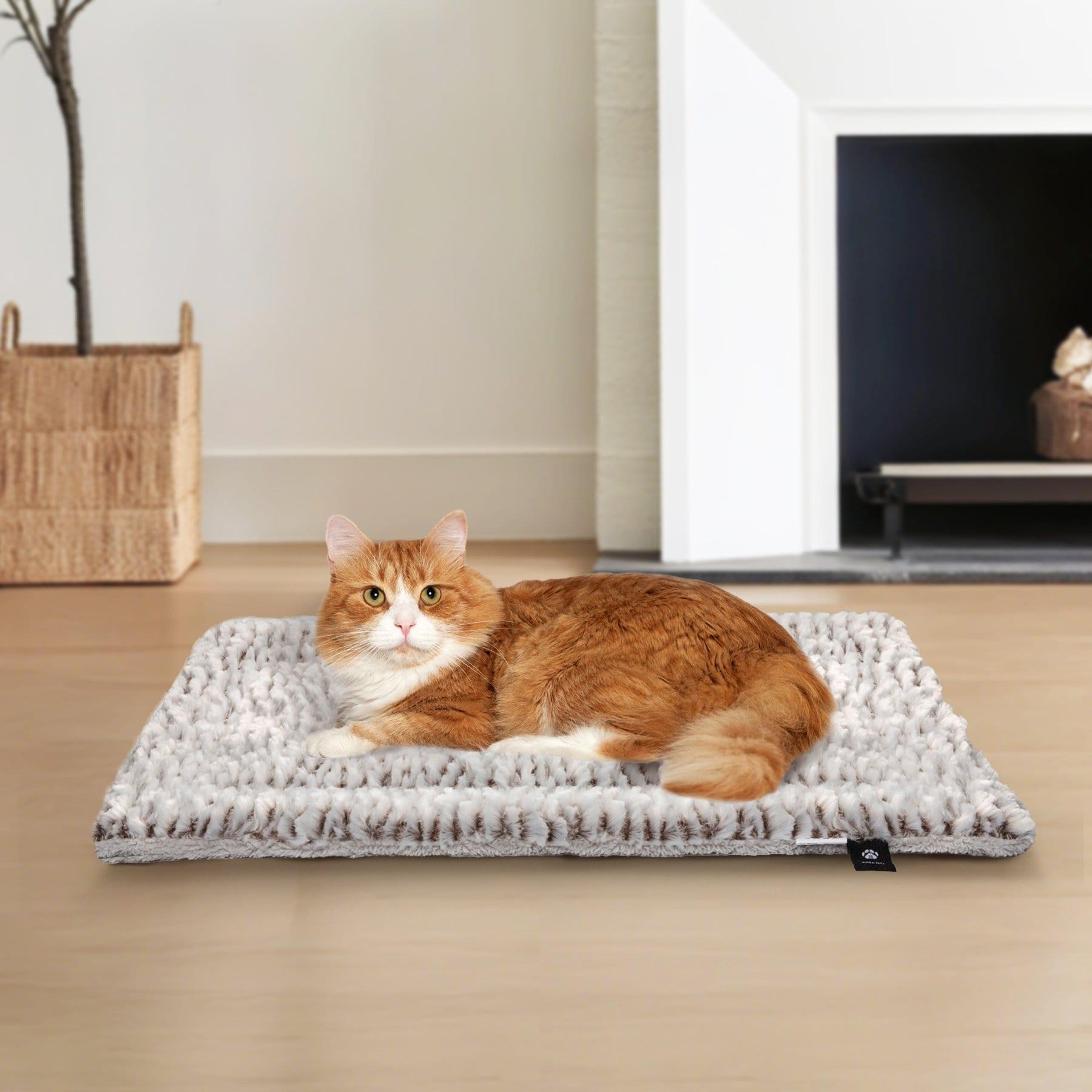
A non-electric self-warming pad that can line one side of the nest box a queen uses in the week before birth.
Webvet may earn a commission when you click through to Chewy, at no extra cost to you.
Line the box with washable towels or a liner such as the Drymate Dog & Cat Whelping Box Mat, Washable Puppy Training Pee Pad, Large: 48 x 50-in, which can be laundered between uses.
First litters versus later litters: how a cat's age and history change the count
A cat's first litter usually falls in the same range as any other litter. An early Brisbane study, summarized by Sparkes and colleagues, found first litters tended to be smaller. Sparkes's own larger survey found no significant effect of previous litters, or the queen's age, on litter size.
Later litters are not reliably bigger either. The evidence on litter order is mixed, and breed mattered more in the UK data.
Age has clearer effects at the extremes:
- Under 1 year old: Little notes these queens may not show mature maternal behavior, and Veronesi and Fusi report significantly higher kitten mortality in their litters.
- About 18 months to 8 years: Little describes this as the most fertile stretch of a queen's life.
- 7 years and older: litter size has been shown to decrease from about 7 years, and Little's text notes that queens over 8 have smaller litters, more spontaneous abortions, and more kittens with congenital defects.

History matters beyond the number. The Merck Veterinary Manual notes that strangers or unfamiliar surroundings can disrupt delivery and mothering, especially for a cat delivering her first litter.
First heat usually comes at 5 to 9 months but ranges from 3.5 to 18 months, as covered in how old can a cat get pregnant.
What affects litter size: breed, age, health, and nutrition
Breed has the strongest measured effect on litter size. Age matters mainly at the extremes, and good health and nutrition support a normal pregnancy.
Nutrition supports a healthy pregnancy rather than raising the count. Root Kustritz lists severe malnutrition and taurine deficiency as dietary causes of poor reproductive performance, and says queens should gain 12–38% of their pre-pregnancy weight by parturition, the medical term for giving birth. The Journal of Feline Medicine and Surgery adds that obesity is linked to difficult births and stillbirths.
Little's text says diets designed for growth or for reproduction and lactation suit the pregnant queen. A kitten formula such as Hill's Science Diet Kitten Healthy Development Cat Food, 3.5-lb, listed at $22.99 on Chewy when checked in November 2026, is one example of a growth diet your vet may suggest.

A kitten growth formula a vet may suggest for a pregnant or nursing queen and, later, for weaning kittens.
Webvet may earn a commission when you click through to Chewy, at no extra cost to you.
One factor owners often assume matters does not: Root Kustritz reports that the number of matings is not correlated with litter size. Mean litter sizes from the UK pedigree survey by Sparkes and colleagues:
- Burmese: 5.7 kittens
- Siamese: 4.9 kittens
- Maine Coon: 4.6 kittens (from 27 queens, a small sample)
- Persian: 3.8 kittens
- Birman: 3.6 kittens
Siamese queens in that survey averaged close to five kittens and Maine Coons a little fewer, with wide variation between litters. Ragdoll and Sphynx litters do not have a published breed average in these large surveys, so the overall average of about four is the fairest guide for those breeds.
Coat pattern is a separate matter. The Merck Veterinary Manual explains that the calico pattern needs two X chromosomes, so almost all calico cats are female. A calico queen's breed, age and health, not her coat, shape her litter size.
Health and genetics matter too. Ström Holst's 2022 review notes that inbreeding has been associated with small litter size in cats. Kittens in one litter can also have different fathers: Root Kustritz describes superfecundation, offspring from more than one tom in a single litter, as common in cats.
SponsoredVet care that's always there
Unlimited video calls and messaging with licensed vets for less than a typical vet visit. One membership covers up to five pets.
Use code Pets60
Plans start at $12/month · covers up to 5 pets
- Licensed vets in most states
- Rx for 150+ conditions
- 4.7 on Trustpilot
How a vet can tell how many kittens your cat is carrying
Owners cannot count the kittens reliably at home, but a vet can. The Merck Veterinary Manual says pregnancy can be detected by day 21 to 30 by abdominal palpation or ultrasound, and X-rays more than 55 days after breeding help determine the number.
Each method answers a different question:
- Abdominal palpation: possible from about day 15, easiest on days 21–25, and difficult after day 35, according to the 2022 review by Ström Holst. It confirms pregnancy but is not a counting tool late on.
- Ultrasound: more common for confirming pregnancy and shows whether the kittens are alive, but Little's text notes it may not be as good as a radiograph for counting.
- Radiograph (X-ray): detects pregnancy once the kittens' bones mineralize, typically by day 36 to 45, and lets the vet count kittens by counting skulls.

Pregnancy lasts about 60 to 65 days by Merck's figure, and Ström Holst's review gives a mean of about 65 days within a range of 57 to 72 days, so the counting X-ray falls in the final week or so; how long are cats pregnant covers the full timeline, and cat pregnancy week by week walks through each stage.
Whether this is her first litter or a later one, expect a count in the usual range, about four on average, and only a late X-ray gives a real number. Past litters are not a dependable predictor, since the UK survey found previous litters had no significant effect on size. If you are unsure she is expecting, start with how to tell if a cat is pregnant.
Treat the X-ray number as a pre-birth count to check against on delivery day. Merck notes that after birth, a vet uses a physical exam and sometimes X-rays to confirm every kitten has been delivered. A few preparations before the due date make that count useful:
- Write the pre-birth count down and keep it by the nest box.
- Set up the nest in a quiet room; Little's text advises keeping the queen away from all other cats for the last 2 weeks of pregnancy.
- Have a kitchen scale that reads in single grams, which Veronesi and Fusi call the gold standard for monitoring kittens.
- Keep your vet's number and the nearest emergency clinic's number somewhere easy to find.
A large count also changes the preparation. Sparkes's data showed kitten birth weight fell as litter size rose, and Veronesi and Fusi name competition from siblings as one reason a kitten may not take in enough milk. Their review advises supplemental feeding when a kitten's weight gain falls below expectations, with close watching for illness.
That is a step your vet guides, but having a small bottle set such as the PetAg Small Animal Nursing Kit, 2-oz bottle ready before a big litter arrives saves a late scramble.

A small bottle and nipple set sized for newborn kittens, for supplemental feeds when a slow-gaining kitten needs them.
Webvet may earn a commission when you click through to Chewy, at no extra cost to you.
In a big litter, two early checks matter most:
- First milk within hours: Veronesi and Fusi note that kittens absorb protective antibodies from first milk only until about 12 to 16 hours after birth, so every kitten needs a turn at a teat early.
- Birth weight: they give a normal newborn weight of about 100 g, within a range of 75 to 120 g. A low birth weight kitten needs close watching to make sure it takes in enough first milk, with warmth and feeding support when needed.
Bottle feeding is a backup, not a substitute. Formula-fed kittens gain more slowly than kittens fed their mother's milk, so nursing stays the plan. For a true orphan, the same review rates a foster queen as best but rarely available.
Kitten milk replacer is for a kitten the mother cannot feed, used as the vet directs. If your vet advises longer supplemental feeding, PetAg KMR Kitten Milk Replacer Powder for Kittens, 12-oz can is a powdered formula made for kittens from newborn to 6 weeks old. PetAg also sells KMR as a liquid.

Liquid kitten milk replacer for a kitten its mother cannot feed, used only as your vet directs.
Webvet may earn a commission when you click through to Chewy, at no extra cost to you.
How many litters a cat can have in a year, and why spaying matters
An unspayed queen averages 2 to 2.5 litters a year, with a range of 1 to 3, according to Little's text, at about four kittens a litter. A review of feral cat control estimates that free-roaming cats produce a litter of 1 to 6 kittens 1.6 times per year.
The cycle restarts quickly. Cats cycle every 14 to 21 days in season, and Little notes most queens return to heat about 4 weeks after weaning, some while still nursing. Cat in heat and cats mating cover the signs.
Those litters add up over a lifetime. Little's text estimates that a queen with a breeding life of about 10 years, left to breed freely, can bear up to 100 kittens in her lifetime. Spaying is how that stops:
- The Merck Veterinary Manual states that pregnancy can be completely prevented or ended by spaying.
- The Cornell Feline Health Center advises spaying before the first heat, and notes that spaying at three to six months virtually eliminates later mammary cancer risk and rules out pyometra.
- Cornell also notes a female cat can become pregnant as early as four months, and in one survey almost 90% of owners said their cat had one or two litters before being spayed.
Costs vary by clinic and region; cat spay neuter cost lays out what to expect. Your vet can advise on timing for your cat.
What month do cats usually give birth?
Kittens can arrive in any month, but spring is the busiest season. Little's text notes slightly more pedigree litters are born in spring, and an Italian study by Romagnoli and colleagues found 67% of heat cycles fell between January and June.
A Colorado State University veterinarian warns that a female born this year may deliver her first litter as early as February.
When a pregnant or nursing cat needs a vet: labor trouble, retained kittens, and weak newborns
Call the vet when labor stalls, a kitten is stuck, or fewer kittens arrive than the pre-birth count. This during-labor checklist helps you tell when the queen has finished and when a missing kitten means a vet call.
| What to check | What is reassuring | When to call the vet |
|---|---|---|
| Kittens born versus the pre-birth count | The number matches the X-ray count and contractions have stopped | Fewer kittens than the pre-birth count, or not all kittens delivered within 36 hours |
| Time between kittens | Median gap of about 30 minutes; 95% arrive within 100 minutes of the last | More than 3 hours between kittens |
| Strong straining | A kitten follows within the hour | Strong contractions for more than 60 minutes with no kitten |
| Kitten or membranes at the vulva | Delivered within 15 minutes | Visible for more than 15 minutes with no progress |
| The queen after birth | Curled around the kittens, nursing, eating within a day | Fever, foul or heavy bloody discharge, lethargy or poor appetite past 24 hours, tremors, straining after all kittens and placentas |
| Each kitten | Warm, nursing, gaining weight after the first 24 hours | Constant crying, restlessness, failure to gain, or weight loss after the first 24 hours |
The pre-birth count is the most useful number you have on delivery day. Little's text warns that in a long delivery, the queen may nurse the kittens already born, so she can look finished when she is not.
Sources give slightly different time limits. The Merck Veterinary Manual describes stage I labor lasting 12 to 24 hours, with kittens usually less than 1 to 2 hours apart, and flags trouble at more than 1 to 4 hours between kittens; Little's text sets the line at more than 3 hours.
Ström Holst describes dystocia, a difficult birth, as an emergency that threatens both mother and kittens. After a stalled labor, Merck notes that a vet uses an exam and sometimes X-rays to find any retained kitten.

Kitten survival depends heavily on the birth and the first week. Veronesi and Fusi list sudden death, death soon after birth, and fading kitten syndrome among the patterns of early loss. In one study of 136 kittens from 35 queens with difficult births, only 66% survived despite veterinary help.
Is it painful for female cats to give birth?
Labor involves strong contractions, but a normal birth is usually quiet. Little's text notes the queen bears down during delivery, yet crying out is uncommon. A queen crying and biting at her vulva is on Little's list of signs that need veterinary help, and dystocia is defined as a painful, slow, or difficult delivery.
What is the survival rate for kittens after birth?
Most kittens born in a home or cattery survive. In the UK pedigree survey, 7.2% were stillborn and mean mortality from birth to 8 weeks was 9.1%, mostly in the first week. Romagnoli's catteries averaged 14% loss before weaning.
Kittens in the wild fare far worse. The feral cat review cites one survey in which 75% of kittens died or disappeared within 6 months of birth, with trauma a common cause.
Caring for a new litter: warmth, feeding, and weighing kittens
Warmth comes first. Veronesi and Fusi recommend a kitten box at 32–34°C for the first week, easing to 24–27°C by 3 weeks. Any heat source should be covered by a towel and kept to one side of the box, and heating pads need caution because their temperature can be hard to control.
A non-electric option such as the Mora Pets Self-Heating Reversible Cat Pad, Grey, Small, listed at $18.56 on Chewy when checked in November 2026, works by reflecting the cats' own body heat.
For the queen's resting spot, a washable bolster bed such as the Mora Pets Cozy Waffle Nesting Machine Washable Bolster Cat Bed, Blue, Medium gives a den-like space with raised edges.

Weighing is the clearest daily check on a litter. Sources differ slightly on how often:
- Merck Veterinary Manual: weigh kittens as soon as they are dry, then twice daily for the first week; newborns should gain 10% of their body weight each day.
- Veronesi and Fusi: weigh daily until 2 weeks, then twice a week until weaned; expect a gain of 50 to 100 g per week.
- Both: a kitten losing weight after the first 24 hours needs prompt attention.
Feeding stays with the queen for the first weeks. By about 4 weeks, Little's text notes, she spends less time with the kittens and often stands when they try to nurse, the natural start of weaning kittens. A kitten age chart tracks each kitten's milestones week by week.
Do mother cats actually love their kittens?
Mother cats show strong, consistent care, though science measures behavior rather than feelings. After birth, the queen curls around her litter to warm and protect them, and she licks each newborn to stimulate breathing and dry it. Little's text adds that a queen that mothers poorly the first time may raise later litters well.
Does a father cat know his kittens?
Toms do not take part in raising kittens. A 2016 study in BMC Evolutionary Biology describes the domestic cat as a species without paternal care, and found that female cats, but not males, adjusted their response to distressed kitten calls.
In free-living groups, the Merck Veterinary Manual notes that related females may rear kittens together.
How long after a cat gives birth can you touch the kittens?
You can handle newborns briefly from the first day for weighing and health checks, as long as the queen stays calm. Little's text advises monitoring a queen in labor while interfering as little as possible. Longer, gentle handling suits the socialization window that the AAHA/AAFP guidelines place from about 2–3 weeks.
How many kittens in a litter questions
Frequently Asked Questions
How many kittens does a cat have the first time?
A first litter usually lands in the normal range of one to nine kittens, sometimes toward the smaller end, although studies disagree on whether first litters are truly smaller. Young queens under a year old may not yet show mature mothering, so a young first-time mother deserves quiet, close watching.
Can kittens in the same litter have different fathers?
Yes. A queen can be mated by more than one tom during a single heat, so kittens born together can have different fathers. Little's text reports multiple-paternity litters more than 70% of the time in crowded urban free-roaming cats, compared with less than 22% in sparse rural areas.
How many kittens can a cat have in a year?
An unspayed cat averages 2 to 2.5 litters a year and can have up to 3. Because she can return to heat soon after weaning, or even while nursing, a spay is the dependable way to prevent more litters.
What is the largest litter of kittens?
The largest litter on record in the veterinary literature Root Kustritz reviews is 18 kittens, found in one queen during spay surgery. Counts like that are rare: the biggest litter in the UK pedigree survey of 1,056 litters was 13 kittens.
How can I tell how many kittens my cat will have?
Ask your vet about an x-ray more than 55 days after breeding, when the kittens' skulls are visible enough to count. Feeling the belly at home is not reliable, and ultrasound confirms pregnancy earlier but is less precise for counting.
Veterinarian · BVMS MRCVS
Dr. Pippa Elliott, BVMS, MRCVS, is a veterinarian with nearly 30 years of experience in companion animal practice. Dr. Elliott earned her Bachelor of Veterinary Medicine and Surgery from the University of Glasgow. She was also designated a Member of the Royal College of Veterinary Surgeons. Married with 2 grown-up kids, Dr. Elliott has a naughty Puggle named Poggle, 3 cats and a bearded dragon.
Related reading

How Old Can a Cat Get Pregnant? Earliest Age and Why It Matters

Can a Dog Be Spayed While in Heat? Risks, Timing, and Cost

Can a Dog Get Pregnant When Not in Heat? How the Fertile Window Works
