FIP in Cats: Symptoms, Diagnosis, and Current Treatment Options
Learn how veterinarians assess suspected FIP, what US compounded treatment access means, and which questions to ask about monitoring, costs, prognosis, and other cats.

BVMS MRCVS
Medically reviewed by Dr. Pippa Elliott, BVMS MRCVS · Last reviewed

This article contains affiliate links. Webvet may earn a commission when you buy through them, at no extra cost to you.
FIP in cats is a serious disease associated with feline coronavirus, but a positive coronavirus test does not by itself establish FIP. Diagnosis brings together the cat’s history, examination, laboratory findings, and sometimes fluid or tissue testing. Veterinarian-directed antiviral treatment has changed the outlook, making prompt assessment and a clear treatment-access discussion important.
 Sponsored
Have a health question about your cat?
Talk to a licensed vet at Dutch over video or message, including nights and weekends.
Use code Pets30
Plans start at $11/month · covers up to 5 pets
- Licensed vets in most states
- Rx for 150+ conditions
- 4.7 on Trustpilot
Feline coronavirus and what FIP means
Feline infectious peritonitis, usually shortened to FIP, develops in some cats infected with feline coronavirus. The common intestinal form of that virus often causes no obvious illness or only mild, temporary digestive signs. In a minority of infected cats, changes in the virus and the cat’s inflammatory response lead to disease affecting tissues beyond the intestine. Exposure and FIP are therefore different findings.
The Cornell Feline Health Center’s FIP overview explains this distinction. A cat can have coronavirus antibodies without having FIP. Conversely, a veterinarian may have substantial concern about FIP based on several clinical findings even when no single test provides a simple yes-or-no answer.
- 1Feline coronavirus exposure is not the same as a confirmed FIP diagnosis.
- 2Persistent illness needs veterinary assessment; breathing difficulty, collapse, seizures, or severe weakness need urgent help.
- 3Ask about the diagnostic evidence, veterinarian-prescribed treatment source, monitoring, and the full estimate.
Young cats and cats from crowded environments are among those for whom a veterinarian may consider FIP, but age, breed, or housing history cannot make the diagnosis. An older cat can also need investigation. A useful history includes where the cat previously lived, when symptoms began, changes in appetite or weight, and any previous test results. Share what you know without trying to identify one event or person responsible.
Is FIP genetic or hereditary?
FIP is an infectious disease with several influences on susceptibility, rather than a diagnosis established by a cat’s family tree. The AAFP/EveryCat diagnostic guidelines describe an interplay between viral characteristics, the cat’s genetic characteristics and age, concurrent disease, and other stressors. A related cat’s illness is useful history, but it does not show that your cat inherited an inevitable outcome. Give the veterinarian the family and housing history without using breed or parentage as a substitute for examination and testing.
For a planned evaluation or recheck, prepare a secure carrier that fits the cat comfortably. The Frisco Travel Safety Medium carrier is one transport option to compare with your cat’s size and the clinic’s handling advice. A carrier makes the journey more manageable; it does not provide medical monitoring. Call ahead for instructions if the cat has difficulty breathing or cannot settle comfortably.

Compare this Medium carrier with your cat’s size and your clinic’s handling instructions for planned visits.
Webvet may earn a commission when you click through to Chewy, at no extra cost to you.
Early signs and wet, dry, eye, or neurologic involvement
Early warning signs can include reduced appetite, weight loss, low energy, and fever. Those first signs are nonspecific: many diseases can produce the same pattern. A cat who remains playful or eats some food is not automatically free of serious illness. Record changes from that cat’s usual behavior and arrange an examination rather than trying to diagnose FIP from an isolated symptom.
A cat exposed to coronavirus can go weeks, months, or even years before showing symptoms of FIP, according to Cornell. That does not mean a symptom-free cat has been confirmed to have hidden FIP throughout that interval. It means exposure history cannot supply a dependable countdown. Bring earlier records to the appointment and describe when the current changes actually began.

Photograph: Phaeton68 (2013), Wikimedia Commons, CC BY-SA 3.0.
This documented historical case illustrates abdominal enlargement, not a way to diagnose your own cat. Pictures of cats with FIP cannot show all the disease’s forms or establish the cause of a similar-looking belly. The photograph predates the current antiviral-treatment discussion; an old case’s outcome does not predict what treatment can achieve for a cat assessed today.
For routine observation while arranging or following care, note how much food is offered and how much is eaten. The OurPets Durapet Small bowl is a washable feeding option, but its listed 0.75-cup capacity is not a recommended meal amount. Use the diet and feeding plan your veterinary team provides, and report poor intake rather than expecting a new bowl to solve it.
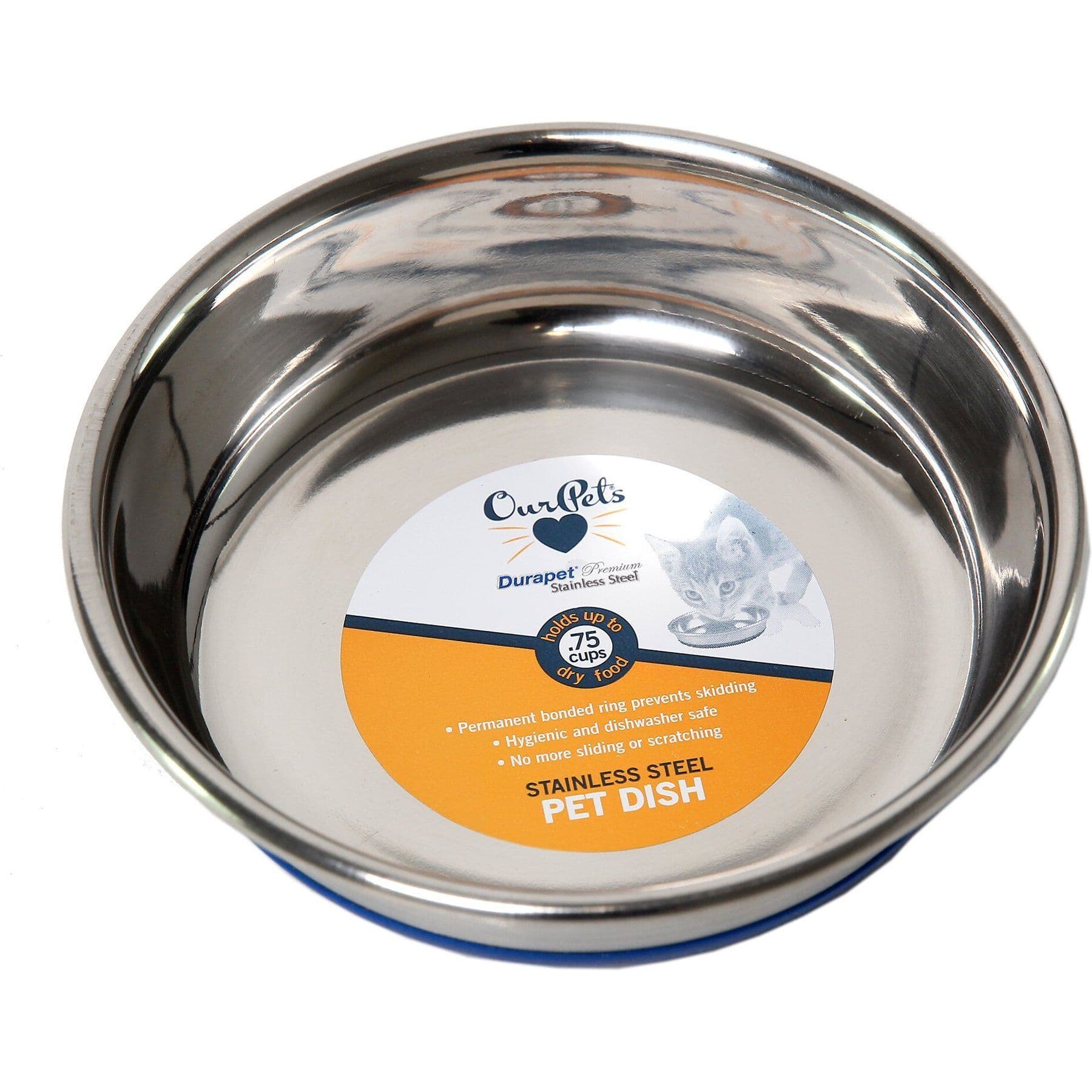
A washable 0.75-cup bowl for offering the veterinarian-recommended food and observing intake. Capacity is not a meal recommendation.
Webvet may earn a commission when you click through to Chewy, at no extra cost to you.
| FIP progression has no fixed timetable | What an owner may know or notice | Practical next step |
|---|---|---|
| Coronavirus exposure | There may be no obvious illness | Interpret exposure tests with the veterinarian; they do not confirm FIP |
| First signs | Appetite, weight, activity, or temperature changes | Arrange assessment and describe the pattern |
| Organ involvement | Fluid accumulation, eye changes, or neurologic abnormalities may occur | The veterinarian chooses relevant examination and testing |
| Deterioration | Breathing difficulty, collapse, seizures, or marked weakness | Seek urgent assessment instead of waiting for a predicted stage |
| Treatment follow-up | Response and remaining abnormalities differ between cats | Follow the individual monitoring plan and report changes |
Wet and dry FIP describe patterns, not separate home diagnoses
Effusive, or wet, FIP involves fluid accumulating in a body cavity, such as the abdomen or chest. Non-effusive, or dry, FIP can involve inflammation in organs without that obvious fluid accumulation. These categories can overlap or change during illness. A cat does not need a swollen abdomen for the veterinarian to consider FIP.
Feline infectious peritonitis can involve a cat’s eye or nervous system, with or without effusion. Merck’s owner guide describes eye changes and central nervous system signs. New eye abnormalities, impaired vision, unsteady movement, or seizures need veterinary assessment. Our guide to cat eye infections explains why an eye problem has several possible causes.
What does a FIP belly look like?
Fluid in the abdomen can produce a rounded or pot-bellied appearance. That appearance is not specific to FIP, and a photograph cannot establish whether enlargement is fluid or something else. Do not repeatedly press or manipulate the belly to test it. Tell the clinic when the enlargement appeared, whether it is changing, and whether breathing, appetite, or movement has also changed.
What are the final stages of FIP in cats?
There is no reliable owner-facing countdown from a particular symptom to a final stage. Untreated clinical FIP is usually progressive and life-threatening, but the affected organs and speed of deterioration vary. Severe breathing trouble, collapse, seizures, inability to function normally, or uncontrolled discomfort call for urgent veterinary help. Do not wait for a cat to match a photograph or checklist of terminal signs.
Why diagnosis combines several findings
The veterinarian begins with the whole case: age and history, examination findings, the pattern of illness, and appropriate laboratory results. Fever, weight loss, abdominal fluid, or neurologic changes can increase concern, but none establishes FIP alone. Our cat fever guide explains why temperature and behavior changes need clinical context.
Depending on the findings, the workup may include blood tests, evaluation of fluid, imaging to investigate affected areas, or selected tissue tests. Ask what each proposed test can answer and what it cannot. Testing a sample for viral genetic material, for example, is a different question from interpreting coronavirus antibodies, and the sample and clinical circumstances matter.
Does FIP show up in bloodwork?
Bloodwork can contribute important evidence, but an abnormal panel or a positive coronavirus antibody result is not automatically a positive FIP diagnosis. Cornell notes that antibody testing cannot reliably distinguish ordinary coronavirus exposure from the FIP-associated process. The clinician interprets results alongside examination findings and may recommend testing a different sample when that is more informative.
What is the gold standard for diagnosing FIP in cats?
Merck’s veterinary reference describes definitive diagnosis through examination of affected tissue and detection of coronavirus antigen in the associated cells, commonly using immunohistochemistry. Obtaining invasive samples may be unsuitable for a very sick cat, so clinicians may use less invasive samples and the overall evidence. Ask which approach is appropriate, what its limitations are, and how the result would change care. A “gold standard” label does not make a procedure necessary or safe for every patient.

Can FIP in cats be misdiagnosed?
Yes. Its signs overlap with other diseases, while available tests can produce misleading results if interpreted without context. A presumptive diagnosis means the clinician has weighed the available evidence; it does not mean the owner should treat a symptom match as certainty. Ask which alternatives remain plausible, what finding would strengthen or weaken the diagnosis, and when reassessment or a specialist opinion would be useful.
Wet FIP can also be misdiagnosed if abdominal or chest fluid is assumed to confirm it. The presence of effusion is a finding to investigate, not a final identification of its cause. Ask whether analysis of that fluid would help distinguish FIP from other possibilities in this cat.
Keep copies of laboratory reports and the written assessment. When seeking another opinion, send the actual results rather than only a verbal summary that “the coronavirus test was positive.” Include what sample was tested and which medications have already been given. That information helps the next clinician understand the original reasoning without unnecessarily repeating the workup.
SponsoredVet care that's always there
Unlimited video calls and messaging with licensed vets for less than a typical vet visit. One membership covers up to five pets.
Use code Pets30
Plans start at $11/month · covers up to 5 pets
- Licensed vets in most states
- Rx for 150+ conditions
- 4.7 on Trustpilot
Current US treatment access and GS-441524
A major update in the treatment of feline infectious peritonitis is access to veterinarian-prescribed GS-441524, an antiviral used for FIP. Cornell’s treatment announcement describes access to a compounded oral formulation in the United States through a veterinary prescription. This is a reason to discuss treatment promptly with your clinician, not a reason to buy an unverified product or work out a dose from an online group.
For other prescribed tablets, an Ezy Dose weekly organizer may help only when the pharmacist approves repackaging and the owner can preserve clear identification and directions. It is not a recommendation to transfer a compounded antiviral out of its labeled container. Keep every medication’s name, instructions, and pharmacy contact details available to all caregivers.

An organizer for separately prescribed tablets only when the pharmacist approves repackaging. Keep compounded antivirals in their labeled container unless advised otherwise.
Webvet may earn a commission when you click through to Chewy, at no extra cost to you.
Is GS-441524 approved in the US?
The FDA enforcement discretion described here concerns compounding; compounded availability is not FDA approval. In its May 10, 2024 statement, the FDA explains that it does not intend to enforce new-animal-drug approval requirements for GS-441524 products compounded for a veterinarian’s specific cat patient when the conditions in Guidance for Industry #256 are met. The agency also states that drugs compounded from bulk substances remain unapproved drugs.
That distinction matters when a seller uses “approved,” “legal,” or similar shorthand. Ask the prescribing veterinarian and dispensing pharmacy about the exact product and applicable access conditions. An academic announcement about a treatment option does not convert a compounded product into an FDA-approved medicine, and a social-media claim does not establish its concentration, purity, or suitability.
| Discussion topic | Question for the veterinary team | What to record |
|---|---|---|
| Diagnostic evidence | Which findings support FIP, and which alternatives remain? | Test results and the working diagnosis |
| Compounded access | Which prescribed formulation and pharmacy will supply it? | Exact product, concentration, contact details, and written directions |
| Monitoring plan | What observations, examinations, and tests are needed? | Recheck dates and the clinic’s contact instructions |
| Full estimate | What is included beyond the antiviral itself? | Diagnostics, medication, monitoring, supportive care, and possible changes |
| Response or problems | What should prompt a call or urgent visit? | Specific changes to report and out-of-hours contact information |
What are the treatment options for FIP in cats?
The plan may combine veterinarian-directed antiviral treatment with supportive care tailored to the affected organs and the cat’s condition. Cornell describes measures such as fluid therapy, drainage of problematic accumulated fluid, or transfusion when an individual patient needs them; these are clinical decisions, not home procedures. Eye or neurologic involvement also affects the clinician’s plan. Do not copy another cat’s prescription, change formulations independently, or assume that similar-looking products are interchangeable.
If medication administration is difficult, contact the team before doses are missed or improvised. Ask for a demonstration using the actual prescribed formulation and for instructions about storage, handling, and what to do after a missed or vomited dose. Do not crush, divide, or move medicine into another container unless the dispensing professional confirms that it is appropriate.
What can treatment at home involve?
Some prescribed care may take place at home when the veterinarian considers the cat stable enough and the caregiver can follow the plan. Home care is not a substitute antiviral remedy. Before leaving the clinic, confirm who will give each medicine, where it will be stored, and how the team wants observations reported. Ask the clinic to demonstrate any unfamiliar task and check your understanding. A written log of administration and symptoms is more useful than trying to remember several days of changes at a recheck.
A comfortable resting area can make prescribed care easier. Keep the cat’s essentials accessible and choose bedding the cat can use without an awkward jump. The FurHaven NAP Gray Jumbo bed is one floor-level resting option; check its dimensions and cover-care instructions against your room and the cat’s needs. Bedding supports comfort but does not change the antiviral prescription or establish recovery.

A floor-level resting option. Check the Jumbo bed’s dimensions and care instructions against your cat’s needs.
Webvet may earn a commission when you click through to Chewy, at no extra cost to you.
Treatment monitoring, costs, and prognosis
Monitoring is part of treatment rather than an optional extra after buying medication. The veterinarian may need repeated examinations or tests and updates about appetite, activity, weight, comfort, and any eye or neurologic changes. Ask which observations to record at home, how often the clinic wants an update, and what should trigger an earlier call. Follow that individual plan instead of a fixed internet schedule.
How much does FIP treatment with GS-441524 cost?
There is no single reliable US course total that applies to every cat. Request an actual quote for the prescribed formulation and amount, then ask what is separate. A medication-only price is not the same as the cost of diagnosis, treatment, and follow-up. The plan can also change as the clinician reassesses the cat, so ask how additional costs would be discussed before they are incurred.
- Diagnostic workup: examinations, laboratory testing, imaging, and any fluid or tissue evaluation.
- Medication: the exact pharmacy product and prescribed supply, plus dispensing or delivery charges if applicable.
- Monitoring: planned rechecks and tests, and circumstances that could require extra visits.
- Supportive care: any clinic-based treatment or additional medicines the individual cat needs.
If the estimate is difficult to afford, tell the clinic early. Ask which care is urgent, which costs are predictable, and whether there are verified assistance or payment options for your circumstances. Do not assume that a “free FIP treatment” advertisement is a genuine program or that an unregulated seller provides the same medication. No specific free treatment entitlement or national average price is established here.
Can cats be cured of FIP?
Antiviral treatment has made successful outcomes possible, and a diagnosis no longer carries the same outlook as it did before these therapies. Cornell describes GS-441524 as an effective option supported by clinical research. That does not guarantee cure for an individual cat, establish one recovery percentage for every presentation, or justify stopping treatment as soon as appetite improves.

Life expectancy depends on the case, whether effective treatment is available, the organs involved, and the response to care. Untreated clinical FIP is generally progressive and often fatal; treated cats should not be assigned that historical prognosis automatically. Ask what improvement the clinician expects, how they will assess it, and what would lead them to change the plan. A survivor’s online story can offer encouragement without predicting your cat’s course.
Does an FIP diagnosis mean I should put my cat down?
The diagnosis alone does not make euthanasia inevitable. If the cat is suffering or treatment is not achieving an acceptable quality of life, discuss comfort and humane options with the veterinarian. An owner should not be left trying to manage severe distress without help. The decision should reflect the cat’s current condition, realistic care options, and the treating team’s assessment.
Other cats, indoor exposure, and owner concerns
Household questions become clearer when common feline coronavirus is separated from FIP itself. Coronavirus exposure can occur before the current illness is recognized, and only some exposed cats develop FIP. A positive antibody result in a healthy housemate does not establish that the housemate has FIP or will inevitably become ill.
How did my indoor cat get FIP?
An indoor or inside-only cat can get FIP after previous feline coronavirus exposure. A cat may have encountered the virus earlier in life or through contact with other cats and contaminated material. Cornell explains that FIP can develop well after the initial exposure. You may never identify exactly when it happened, and an indoor cat’s infection does not establish a recent breach in household care.
Is FIP contagious to other cats?
Common feline coronavirus spreads between cats, including through fecal contamination, while the FIP-associated process usually develops within an infected individual. Cornell notes that transmission of the FIP-associated form is still a subject of research. Avoid treating the statement “FIP is not contagious” as permission to ignore routine hygiene or to make decisions about a multi-cat household without advice.
Cornell reported in April 2026 that researchers identified concerning type-2 coronavirus features in archived US samples. The report discusses the potential for transmission and severe disease, while noting that a Cyprus-scale outbreak had not occurred in the US at that time. This makes absolute claims that FIP-associated viruses can never spread inappropriate. It does not establish that every affected household has that variant or that a national outbreak is occurring.
Whether a cat with FIP can be around other cats depends on the household assessment. Ask the veterinarian whether temporary separation or testing is useful for your particular cats. Clean litter boxes, keep them away from food and water, and reduce crowding and stressful competition where possible. There is no universal number of days after which every household question is resolved. The plan depends on the cats, their health, and the clinician’s interpretation of the situation.
What about people and dogs in the household?
Feline coronavirus is not considered a human FIP infection risk; Cornell states that these feline coronaviruses are not known to pass from infected cats to people. A dog does not receive a feline FIP diagnosis simply because it lives with an affected cat. Report illness in any household animal to its veterinarian rather than transferring a cat’s diagnosis or prescription to another species.
Is it my fault that my cat got FIP?
It is not your fault simply because your cat got FIP; the diagnosis is not evidence that you caused the illness. Coronavirus exposure is common, and the disease develops through factors an owner cannot fully control. Good care still matters, but a tidy home, indoor lifestyle, or attentive owner cannot guarantee prevention. Focus the conversation on what the cat needs now and what practical changes the veterinary team recommends.
Why are so many cats getting FIP?
Seeing more cases discussed online does not by itself show that disease incidence is rising nationally. Awareness, testing, treatment access, and the communities you follow can affect how often you encounter the topic. If several cats connected to one household, shelter, or cattery are ill, tell the veterinarian about that specific pattern so it can be investigated. Do not infer an outbreak or a genetic cause from unrelated online reports.
FIP questions
Frequently Asked Questions
What can be mistaken for FIP?
Depending on the findings, alternatives can include lymphoma, bacterial inflammation in the abdomen or chest, congestive heart failure, and toxoplasmosis. The Feline Veterinary Medical Association’s diagnostic brief lists these among possible differentials. They do not all resemble FIP in the same way. Ask which diagnostic evidence supports FIP and which other causes remain plausible for your cat; a symptom list cannot distinguish them reliably.
Do cats eat when they have FIP?
Some cats continue eating, especially when illness is less obvious, while others have substantially reduced food intake. Eating does not rule FIP out, and refusal to eat should prompt veterinary assessment rather than repeated food changes alone. Record intake and follow the team’s advice; do not force-feed or add supplements without guidance.
Can a fully vaccinated cat get FIP?
Yes. Routine vaccines do not guarantee protection from FIP or prove that a cat has never encountered feline coronavirus. Cornell describes the available FIP vaccine as having uncertain effectiveness and notes that it is not routinely recommended by the feline vaccine advisory panel it cites. Discuss appropriate vaccination and infection precautions with your veterinarian rather than treating a vaccination record as an FIP rule-out test.
Veterinarian · BVMS MRCVS
Dr. Pippa Elliott, BVMS, MRCVS, is a veterinarian with nearly 30 years of experience in companion animal practice. Dr. Elliott earned her Bachelor of Veterinary Medicine and Surgery from the University of Glasgow. She was also designated a Member of the Royal College of Veterinary Surgeons. Married with 2 grown-up kids, Dr. Elliott has a naughty Puggle named Poggle, 3 cats and a bearded dragon.
Related reading

Feline Calicivirus: Symptoms, Treatment, and Managing Multiple Cats

Panleukopenia in Cats: Symptoms, Treatment, and Household Precautions

Leptospirosis in Dogs: Symptoms, Testing, Treatment, and Prevention
