Cat UTI Home Remedies: What's Safe (and Vet Truth)
A vet-reviewed look at cat UTI home remedies: which at-home steps are safe supportive care, which are risky, and the urinary blockage warning signs that mean you must call the vet right now.

BVMS MRCVS
Medically reviewed by Dr. Pippa Elliott, BVMS MRCVS · Last reviewed

This article contains affiliate links. Webvet may earn a commission when you buy through them, at no extra cost to you.
Cat UTI home remedies can offer supportive comfort and encourage healing, but they cannot cure a true urinary tract infection on their own. A genuine bacterial UTI in cats needs vet-prescribed antibiotics.
Many cats with UTI-like signs actually have feline lower urinary tract disease (FLUTD) or a life-threatening urethral blockage. Safe at-home care means boosting hydration, reducing stress, and keeping the litter box clean while you get your cat to a veterinarian.
This guide explains what actually helps at home, what to skip, and, most importantly, the warning signs that turn a urinary problem into an emergency. Read the emergency section first if your cat is straining and producing little or no urine.
- 1Home remedies support recovery but do not replace veterinary diagnosis and antibiotics for a true bacterial UTI.
- 2A male cat straining to urinate and passing little or nothing is a medical emergency that can be fatal within hours.
- 3The most evidence-backed at-home step is increasing water intake, mainly by feeding wet food.
- 4Cranberry, apple cider vinegar, baking soda, and D-mannose are not proven cures and some are unsafe for cats.
- 5Most feline lower urinary signs are stress-linked (FIC), so reducing stress and cleaning the litter box genuinely helps.
- 6Any blood in the urine, straining, or a cat not urinating for over 24 hours needs a vet, not a home remedy.
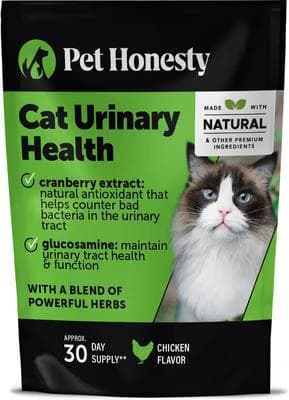
Webvet may earn a commission when you click through to Chewy, at no extra cost to you.
Can you actually treat a cat UTI at home? (read this first)
No, you cannot reliably cure a cat UTI at home. If your cat has a confirmed bacterial urinary tract infection, it requires antibiotics that only a veterinarian can prescribe after testing the urine.
Home remedies for a cat UTI are supportive care at best. Skipping the vet risks letting a treatable problem become a dangerous one.
There is an important twist. According to the Merck Veterinary Manual, true bacterial UTIs are actually uncommon in young, healthy cats. Most cats showing urinary signs (straining, frequent trips, blood, peeing outside the box) have feline lower urinary tract disease (FLUTD), often driven by stress rather than bacteria.
That matters because antibiotics do nothing for a stress-driven bladder, and only a vet can tell the difference with a urinalysis.
Can a cat recover from a UTI without antibiotics?
Sometimes the underlying problem resolves on its own, but a true bacterial infection usually will not clear without antibiotics, and delaying treatment can allow it to spread to the kidneys. Stress-related cystitis (FIC) episodes may ease within a week with supportive care.
You cannot know which condition your cat has without a vet exam, so home remedies for a cat UTI without antibiotics should never be a substitute for that diagnosis.
If you suspect a UTI, the safest first move is to review the full list of cat UTI symptoms so you can describe them accurately to your vet, then book an appointment.
 Sponsored
Have a health question about your cat?
Talk to a licensed vet at Dutch over video or message, including nights and weekends.
Use code Pets30
Plans start at $11/month · covers up to 5 pets
- Licensed vets in most states
- Rx for 150+ conditions
- 4.7 on Trustpilot
When a cat UTI is an emergency: blockage warning signs
A urethral blockage is the true emergency behind many cat urinary cases, and it can kill a cat within a day. If your cat is straining and unable to pass urine, treat it as a life-threatening crisis and go to a vet immediately. Home remedies are useless and dangerous when the urethra is obstructed.

What is the silent killer in cats?
When people talk about the silent killer in cats in the urinary context, they usually mean a urethral obstruction (a blocked cat). Urine cannot escape the bladder, toxins build up in the blood, potassium rises, and the heart and kidneys can fail.
The Merck Veterinary Manual notes that obstruction is far more likely in male cats because their urethra is longer and narrower. It can look deceptively like ordinary litter box straining until the cat crashes.
Male cat UTI symptoms and why males are higher risk
Male cats show the same signs as females (straining, blood, frequent tiny puddles, licking the genitals) but they are far more likely to fully obstruct. There are no safe home remedies for a male cat UTI when a blockage is possible.
A male cat that has not urinated and is straining needs emergency care, not cranberry supplements. When in doubt, assume the worst and get seen.
How long can a cat live with an untreated UTI?
It depends entirely on the cause. A mild bacterial infection may simmer for days to weeks while causing pain and risking kidney spread. A full urethral blockage is different: toxins and potassium build up fast, and an obstructed cat can die within roughly one to three days, often sooner in a fully blocked male.
Because you cannot tell at home which one your cat has, untreated is never a safe plan.
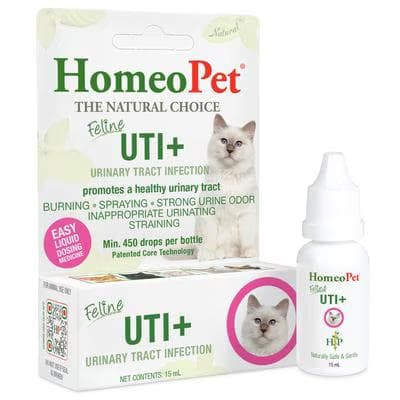
Webvet may earn a commission when you click through to Chewy, at no extra cost to you.
How fast do you need to act on straining?
Treat repeated straining with little or no urine as a same-hour emergency, not a same-day errand. A cat who is comfortable, eating, and passing normal amounts of urine can usually wait for a next-day appointment while you offer supportive care. A cat who is straining unproductively, crying, vomiting, or hiding cannot wait.
When you are unsure which situation you are in, call an emergency clinic and describe exactly what you see so a professional can triage it with you.
- 1Producing normal urine and acting normal: supportive care at home is reasonable while you book a prompt vet visit.
- 2Straining with little or no urine, crying, vomiting, or lethargy: emergency, go now, especially for a male cat.
- 3When in doubt, phone an emergency clinic and describe the signs rather than waiting to see if it passes.
SponsoredVet care that's always there
Unlimited video calls and messaging with licensed vets for less than a typical vet visit. One membership covers up to five pets.
Use code Pets30
Plans start at $11/month · covers up to 5 pets
- Licensed vets in most states
- Rx for 150+ conditions
- 4.7 on Trustpilot
Cat UTI home remedies: supportive care while you wait for the vet
If your cat is still urinating normally and you have a vet visit lined up, supportive home care can keep her more comfortable in the meantime. These at-home steps for a cat UTI are about comfort and hydration, not cure. None of them replace the appointment.
- Offer fresh water constantly and add a second or third water station around the home.
- Switch to or add wet food to increase moisture intake (the single most useful step).
- Scoop the litter box more often and keep it in a quiet, low-traffic spot.
- Reduce household stress: keep routines steady, add hiding spots, and minimize conflict with other pets.
- Watch the litter box closely so you can tell the vet exactly how much and how often your cat is urinating.
Hydration and diet: the most evidence-backed step
Increasing water intake is the most evidence-backed home remedy for a cat with a UTI or FLUTD. More dilute urine flushes the bladder, reduces irritation, and lowers the risk of crystals and blockage. Because cats have a naturally low thirst drive, the easiest way to add water is through their food.

Practical ways to boost hydration:
- Feed canned or pouch wet food, which is roughly 70 to 80 percent water, instead of (or alongside) dry kibble.
- Stir a splash of warm water or unsalted, onion-free broth into meals.
- Try a pet water fountain, since many cats prefer moving water.
- Use wide, shallow bowls to avoid whisker fatigue, and keep water away from the food and litter box.
For cats with recurring urinary trouble, a vet may recommend a therapeutic urinary diet. To understand what you are aiming for, it helps to know what healthy cat urine should look like so you can spot changes early.
Stress reduction and litter box hygiene (the FLUTD/FIC link)
Stress is a leading trigger of feline urinary signs. The most common form of FLUTD is feline idiopathic cystitis (FIC), a stress-linked bladder inflammation, so calming your cat's environment is genuine supportive care, not just a nicety. This is why so many cases flare after a move, a new pet, or a change in routine.
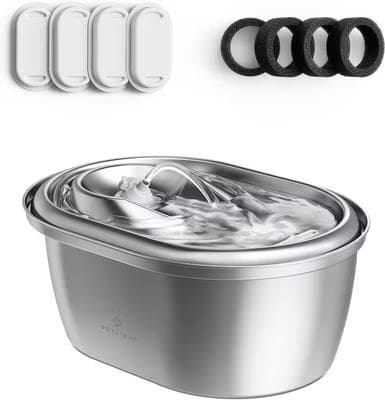
304 food-grade stainless steel pet water fountain, 101 oz. The circulating, filtered water encourages cats to drink more, which supports urinary tract and kidney health.
Webvet may earn a commission when you click through to Chewy, at no extra cost to you.
What triggers a UTI in cats?
True bacterial UTIs are more likely in older cats, cats with kidney disease or diabetes, and females (whose shorter urethra lets bacteria travel more easily). FLUTD-type signs, by contrast, are triggered by stress, obesity, dehydration, an all-dry diet, and dirty or competitive litter box setups.
Female cat UTI symptoms and home concerns often overlap with FIC, so the same supportive care applies while you await a diagnosis.
Litter box best practices that reduce stress and irritation:
- Provide one box per cat plus one extra, in separate quiet locations.
- Scoop at least once or twice daily and use unscented, soft-textured litter.
- Keep boxes away from noisy appliances and high-traffic paths.
- Consider a synthetic feline pheromone diffuser and predictable daily play and feeding times.
If your cat has started avoiding the box, that is a classic urinary red flag. Our guide on a cat peeing outside the litter box walks through the medical and behavioral causes in more depth.
Cranberry, apple cider vinegar, and D-mannose: what the evidence says
Popular supplement remedies like cranberry, apple cider vinegar, baking soda, and D-mannose are not proven to cure cat UTIs, and several are unsafe. Most were studied in humans or dogs, not cats, and giving the wrong one can worsen a urinary problem. Never dose these without asking your vet first.
| Home Remedy | What the Evidence Says |
|---|---|
| Cranberry | May slightly discourage bacteria from sticking to the bladder wall, but it is not a cure and acidifies urine, which can be harmful if your cat has struvite versus oxalate crystals. Vet guidance required. |
| Apple cider vinegar | Not recommended. It is acidic, unpalatable, can upset the stomach, and can dangerously shift urine pH. No good evidence it treats feline UTIs. |
| Baking soda | Avoid. It alkalizes urine and is high in sodium; giving it based on a guess can make crystal problems worse and is unsafe without lab-confirmed pH. |
| D-mannose | Limited, mostly human evidence for E. coli infections. Not validated in cats and does nothing for stress-driven FIC or blockage. Discuss with your vet. |
| Herbal blends (parsley, marshmallow root, uva ursi) | Not proven in cats and some are risky. Uva ursi can be toxic to cats, and diuretic herbs can mask worsening signs while a blockage builds. Do not use without veterinary direction. |
| Vitamin C | Sometimes suggested to acidify urine, but cats make their own vitamin C and extra can be counterproductive or upset the stomach. It does not treat an infection. Skip it unless a vet advises otherwise. |
| Extra water / wet food | The one broadly safe, vet-supported step. Dilutes urine, reduces bladder irritation, and supports the whole urinary tract. |
The core problem with urine-acidifying remedies is that they only make sense once a vet knows your cat's urine pH and crystal type.
It is well established in veterinary medicine that pushing urine pH in the wrong direction can encourage a different type of crystal to form. An acidifying diet aimed at struvite, for instance, can raise the risk of calcium oxalate.
VCA Animal Hospitals notes that specific therapeutic diets can support lower urinary tract health, but matching the right diet to the problem requires lab work first. Guessing at home can do real harm.

Crystal litter that changes color alongside some urinary changes, as a prompt to call your vet.
Webvet may earn a commission when you click through to Chewy, at no extra cost to you.
How vets diagnose and treat a cat UTI (brief, then link out)
A vet diagnoses a cat UTI with a physical exam and a urinalysis, sometimes adding a urine culture, bloodwork, or imaging. Treatment depends on the cause: a confirmed bacterial infection gets targeted antibiotics.
FLUTD or crystals are managed with diet, hydration, pain relief, and stress control. A blockage requires emergency catheterization to relieve the obstruction.
There is no reliable best over-the-counter cat UTI medicine. OTC urinary supplements may support bladder health but cannot cure an infection, and antibiotics are prescription-only for good reason: the wrong drug or dose fuels resistance and delays real treatment.
We cover the veterinary workup in detail in our guide to how vets diagnose urinary problems in cats, and the full options in our cat UTI treatment overview.
How long does it take for a cat's UTI to clear?
With appropriate antibiotics, a straightforward bacterial UTI often improves within a few days, though the vet may prescribe a full course of one to two weeks or longer. Stress-related FIC flares usually settle within about a week once hydration and stress are managed.
If signs persist despite treatment, your vet may culture the urine to adjust the plan.
Preventing future UTIs and protecting urinary health
Preventing recurrence comes down to the same pillars as supportive care: keep your cat well hydrated, feed a moisture-rich diet, minimize stress, and maintain immaculate litter boxes. Cats that have had one urinary episode are prone to repeats, so consistency matters more than any single supplement.
We go deep on long-term strategy in our vet's guide to preventative care for feline urinary health, and multi-cat homes have extra considerations covered in how to monitor urinary health in multi-cat households. If you have noticed pink or red urine, read blood in cat urine before assuming it is a simple infection.
When you can't afford a vet: lower-cost options
If cost is the barrier, do not simply skip care, because an untreated blockage costs a cat its life. There are lower-cost paths that still get your cat evaluated, which is the step that matters most.
- Call local nonprofit and shelter clinics, humane societies, and veterinary teaching hospitals, which often offer reduced-cost care.
- Ask your vet about payment plans, or apply for medical credit or charitable pet-care funds.
- Be upfront about your budget; many clinics can prioritize a diagnostic urinalysis first and phase the rest.
- For a suspected blockage in a male cat, go to an emergency clinic regardless of cost, since it is genuinely life-or-death.
Male cat UTI treatment cost varies widely by region and severity (unblocking a cat is far more expensive than treating a simple infection), which is exactly why early evaluation and prevention save money in the long run. The AVMA's pet owner resources can help you locate assistance in your area.
Frequently Asked Questions
What to do if your cat has a UTI but you can't afford a vet?
Do not skip care entirely, because an untreated urinary blockage can be fatal. Contact low-cost or nonprofit clinics, shelters, and veterinary teaching hospitals, and ask about payment plans, medical credit, or charitable funds.
Be honest about your budget so the clinic can prioritize a urinalysis first. If a male cat is straining and not producing urine, treat it as an emergency and get seen regardless of cost.
Can a cat recover from a UTI without antibiotics?
A true bacterial UTI usually will not clear without antibiotics and can spread to the kidneys if ignored. Stress-related bladder inflammation (FIC) may ease within a week with hydration and stress reduction, but you cannot tell which condition your cat has without a vet exam. Never rely on home remedies in place of a diagnosis.
What triggers UTI in cats?
True bacterial UTIs are more common in older cats, females, and cats with diabetes or kidney disease. More often, cats show urinary signs from FLUTD, which is triggered by stress, dehydration, an all-dry diet, obesity, and dirty or competitive litter boxes. Increasing water intake and lowering stress address the most common triggers.
How long does it take for a cat's UTI to clear?
With the right antibiotics, a simple bacterial UTI often improves within a few days, though vets typically prescribe a full course of one to two weeks or more. Stress-related flares usually settle within about a week once hydration and stress are managed. See your vet if signs persist despite treatment.
Can you cure a cat's UTI at home?
No. Home care can support comfort and hydration, but a bacterial UTI needs vet-prescribed antibiotics, and many urinary cases are actually FLUTD or a blockage that home remedies cannot fix.
The safest approach is a vet diagnosis plus supportive care (more water, wet food, less stress, a clean litter box) while you wait for the appointment.
What is the silent killer in cats?
In the urinary context, the silent killer usually refers to a urethral blockage. Urine cannot leave the bladder, toxins and potassium build up, and the kidneys and heart can fail within a day or two.
It often looks like ordinary litter box straining until the cat suddenly collapses, which is why any straining with little urine output is an emergency.
How long can a cat live with untreated UTI?
It depends on the cause. A mild bacterial infection can linger for days to weeks while causing pain and risking kidney involvement. A full urethral blockage is different and can be fatal within roughly one to three days, sometimes faster in a fully blocked male cat.
Because you cannot tell which one your cat has at home, leaving urinary signs untreated is never safe.
Is apple cider vinegar or cranberry safe for a cat with a UTI?
Neither is a reliable cure, and apple cider vinegar is not recommended. It is acidic, unpalatable, can upset the stomach, and can shift urine pH in a harmful direction.
Cranberry may slightly reduce how well bacteria stick to the bladder wall, but it also acidifies urine, which can worsen certain crystal types. Because the right approach depends on your cat's urine pH and crystal type, only offer either one if your veterinarian specifically recommends it.
What is the fastest home remedy to relieve a cat UTI?
There is no home remedy that quickly relieves a cat UTI, and looking for one can waste time your cat may not have. The safest fast action is a vet visit for a urinalysis, because a true infection needs prescription antibiotics and a blockage needs emergency care.
While you arrange that, the most useful home step is increasing water intake, mainly by feeding wet food, along with a calm, clean litter box setup.
This article is for general educational purposes and does not replace professional veterinary care. If your cat is showing urinary signs, contact your veterinarian promptly, and seek emergency care immediately for any cat that is straining and unable to urinate.

Editor
The Webvet Editorial Team is the in-house group of pet-care editors and writers behind Webvet, operated by Smart Pet Collective. The team researches, writes, and maintains Webvet's pet health, behavior, and medication content. Every article follows a defined editorial process: research from reputable veterinary and scientific sources, careful drafting, mandatory review of medical content by a credentialed veterinarian, and dated publication. Health and medication articles are medically reviewed by a licensed veterinary professional before they go live and are kept current over time.
Veterinarian · BVMS MRCVS
Dr. Pippa Elliott, BVMS, MRCVS, is a veterinarian with nearly 30 years of experience in companion animal practice. Dr. Elliott earned her Bachelor of Veterinary Medicine and Surgery from the University of Glasgow. She was also designated a Member of the Royal College of Veterinary Surgeons. Married with 2 grown-up kids, Dr. Elliott has a naughty Puggle named Poggle, 3 cats and a bearded dragon.
Related reading

Salivary Mucocele in Dogs: Symptoms, Surgery, and Recovery

Diabetes in Cats: Symptoms, Treatment, and Remission

Diabetes in Dogs: Early Signs, Diagnosis, and Daily Management
