Best Dental Powder for Dogs: Four Options Compared
Compare ProDen PlaqueOff, Original ProBright, RADIUS OralPro+ and Finn Plaque Patrol by dental evidence, exact ingredients and weight-based daily cost, with guidance on safe use and dental care.

BVMS MRCVS
Medically reviewed by Dr. Pippa Elliott, BVMS MRCVS · Last reviewed

This article contains affiliate links. Webvet may earn a commission when you buy through them, at no extra cost to you.
The best dental powder for dogs should have evidence for the job you want it to do, a formula your dog can safely use and a daily cost you can sustain. Among these four options, ProDen PlaqueOff Powder has the clearest independently assessed plaque-and-tartar evidence through Veterinary Oral Health Council acceptance. The other powders differ in ingredients and serving size, but that does not establish that they work equally well.
This comparison uses manufacturer labels and dated prices, not hands-on testing. Powder belongs in a home-care plan alongside brushing and veterinary dental assessment. It cannot determine whether a painful tooth needs treatment or replace professional cleaning when disease is already present.
Best dental powders for dogs: how to choose
Start with the mouth, not the jar. Plaque is a soft bacterial film; tartar is mineralized buildup. A product that helps reduce future accumulation is different from a treatment for established periodontal disease. Persistent bad breath, bleeding gums or trouble eating deserve a veterinary examination before adding another supplement.
The Veterinary Oral Health Council's accepted-products list identifies products with submitted data meeting its standards for plaque or tartar control. “VOHC accepted” is the useful term. A quality seal for supplement manufacturing, a customer star rating or a manufacturer's ingredient explanation measures something different.
- 1ProDen PlaqueOff Powder has VOHC acceptance for plaque and tartar among these four selections.
- 2Compare the exact formula and weight-based serving, not the price of the jar alone.
- 3Seaweed-containing powders need particular care in dogs with thyroid disease or restricted diets.
- 4Pain, bleeding, loose teeth and persistent bad breath call for dental assessment, not a stronger powder.
Choose by the product's dental evidence first, then check dietary restrictions and administration. A multi-ingredient dental-and-gut powder may fit an owner's preferences, but a digestive claim is not proof of cleaner teeth. Likewise, green color, “natural” wording and the number of probiotic organisms do not show how much plaque a finished product prevents.
A dental or multivitamin powder is not automatically equivalent to these oral-care products. Check its actual purpose and ingredients, including added iron or other nutrients, rather than assuming a broader supplement supplies the same plaque-control evidence. Ask your veterinarian whether those extra nutrients belong in your dog’s diet.
Four dental powders compared
The daily-cost examples below use a 40-pound adult dog, each manufacturer's matched serving and October 2, 2026 prices. They exclude shipping, tax and discounts. This same-dog comparison matters because the smallest tub is not necessarily the cheapest ongoing option, and one scoop does not weigh the same across brands.
| Product | Best fit | Format and main ingredients | Evidence and daily cost | Main limitation |
|---|---|---|---|---|
| ProDen PlaqueOff Powder, 60 g | Owners prioritizing VOHC-accepted plaque and tartar support | Seaweed powder; Ascophyllum nodosum | VOHC accepted; two 0.33 g scoops, about $0.27/day | Natural iodine requires thyroid-suitability review |
| Original PetLab Co. ProBright Medium, 60 g | Dogs 25–75 pounds whose veterinarian agrees with this combination | Powder with probiotics, brown algae and sodium hexametaphosphate | No matching product trial established here; one 2 g scoop, about $1.43/day | Original is different from Advanced; do not transfer its studies |
| RADIUS OralPro+, 100 g | Owners seeking this enzyme/probiotic blend after ingredient review | Powder with kelp, porcine plasma, yeast, enzymes and probiotics | No product-specific clinical evidence established here; two 3.3 g scoops, about $1.32/day | Multi-ingredient formula; not for puppies under six months |
| Finn Plaque Patrol, 170 g | Dogs suited to a flavored kelp-and-postbiotic food topper | Powder with kelp, EpiCor, goat milk and bee propolis | No product-specific clinical evidence established here; two 5.5 g teaspoons, about $2.26/day | Higher serving mass and cost; contains dairy |
ProDen PlaqueOff Powder: the clearest evidence-based starting point
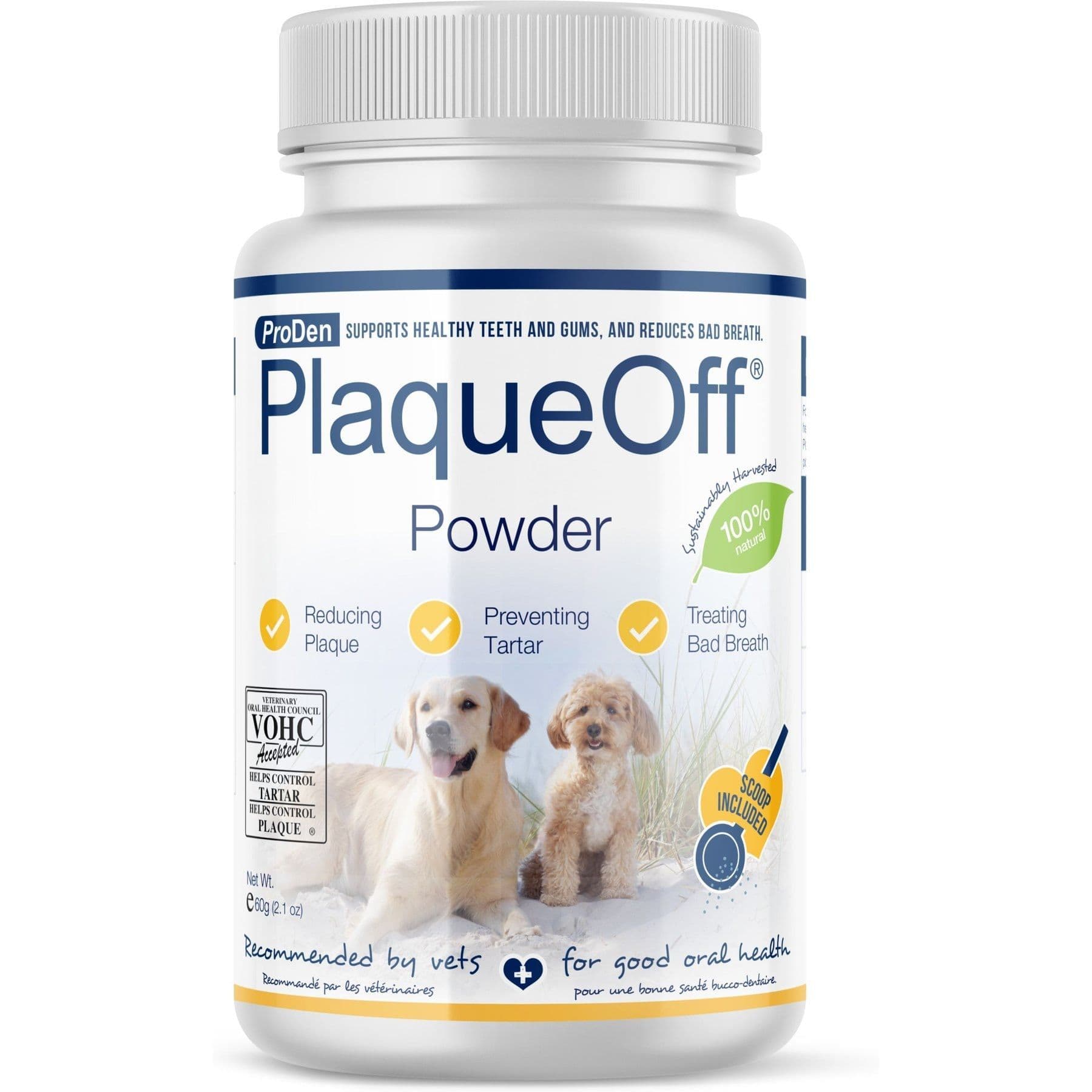
A 60-gram PlaqueOff powder with VOHC acceptance for plaque and tartar. Check iodine and thyroid suitability before adding it to food.
Webvet may earn a commission when you click through to Chewy, at no extra cost to you.
ProDen PlaqueOff Powder uses the seaweed Ascophyllum nodosum and appears on the VOHC list for both plaque and tartar. That makes it the strongest evidence-led starting point among these four for a suitable dog. Acceptance does not mean it will remove every deposit, cure gum disease or eliminate brushing.
The selected bottle contains 60 grams. Swedencare's current US directions specify one scoop below 22.1 pounds, two at 22.1–55.1 pounds and three above 55.1 pounds, once daily. The manufacturer identifies the scoop as 330 mg. At $24.99, those amounts cost roughly $0.14, $0.27 and $0.41 per day respectively.
The practical tradeoff is the seaweed's iodine. Ask your veterinarian before use in a dog with thyroid disease, thyroid medication or an iodine-restricted diet. Match the instructions on the package you receive: packaging and weight-band wording can change. Add the measured amount to food your dog will finish, rather than assuming that a partly eaten meal delivers a full serving.
Original PetLab Co. ProBright Medium: a specific multi-ingredient option
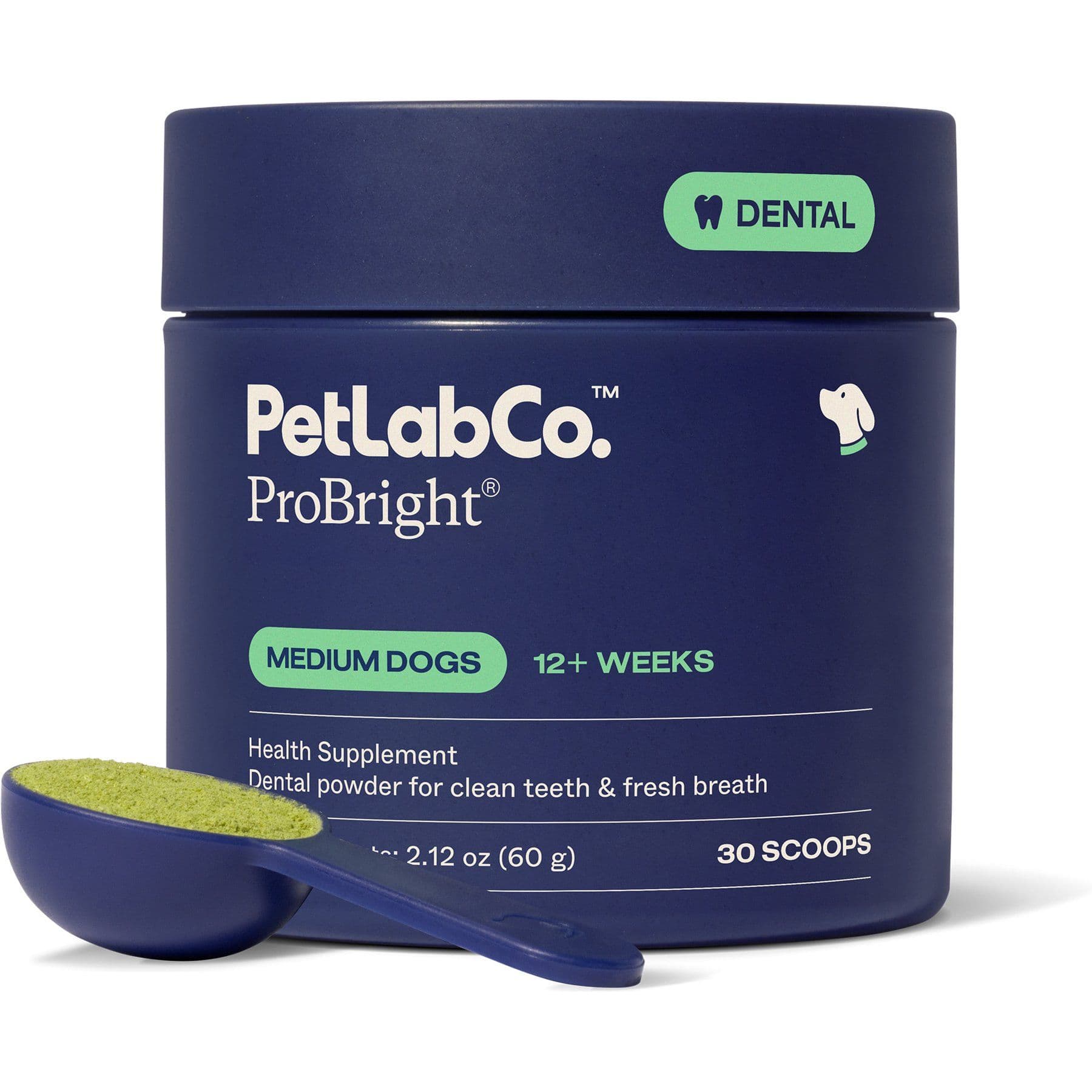
Original ProBright Medium contains 30 daily 2-gram scoops for dogs 25–75 pounds. Compare this exact formula rather than borrowing Advanced product claims.
Webvet may earn a commission when you click through to Chewy, at no extra cost to you.
The selected Original ProBright for medium dogs is the 60-gram, 30-scoop product for dogs weighing 25–75 pounds. It is not ProBright Advanced. Its manufacturer label calls for one 2-gram scoop daily at mealtime, not in drinking water. The captured $42.95 price works out to approximately $1.43 a day.
That scoop includes 750 million CFU of proprietary probiotics, 850 mg brown algae and 100 mg sodium hexametaphosphate, along with rosemary, decaffeinated green tea and perilla. Inactive ingredients include calcium bentonite, brewer's yeast, spinach and yeast palatant. This list is useful for assessing dietary fit, but ingredient quantities do not substitute for a trial measuring the finished product's dental effect.
The manufacturer specifies dogs 12 weeks and older and cautions about chronic diarrhea, pregnancy and hyperthyroid disease, with veterinary examination advised. Check those conditions before ordering. A medium-dog tub is not a license to use the same scoop for a smaller or larger dog; choose the correctly labeled variant.
RADIUS OralPro+: an enzyme and probiotic blend
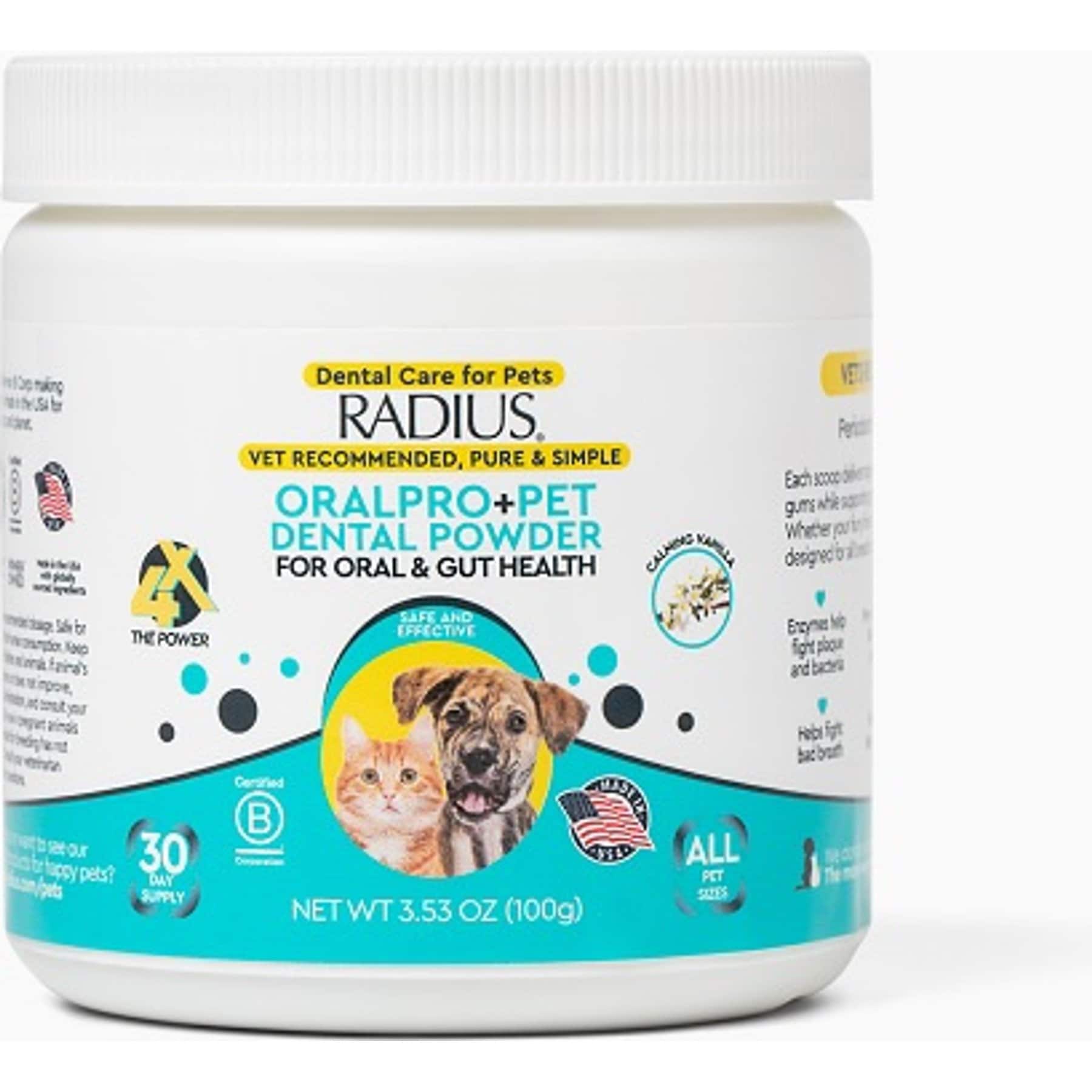
RADIUS OralPro+ combines kelp, enzymes and probiotics in a 100-gram jar. Check the full ingredient panel and your dog’s weight-based scoop count.
Webvet may earn a commission when you click through to Chewy, at no extra cost to you.
RADIUS OralPro+ combines several ingredient types in a 100-gram jar, also labeled 3.53 ounces. The manufacturer's ingredient panel lists 1,000 mg kelp, 875 mg porcine plasma and 830 mg brewer's yeast per 3.3-gram scoop. Smaller amounts include sodium hexametaphosphate, fructooligosaccharides, an enzyme blend and a probiotic blend labeled 200 million CFU.
The enzyme blend includes ingredients such as lysozyme, amylase and papain. This is a description of the formula, not proof that it breaks down established tartar in a dog's mouth. No matching product-specific clinical trial or VOHC acceptance was established in the evidence reviewed for this comparison.
Directions specify one scoop under 25 pounds, two at 25–50 pounds and three above 50 pounds daily. At $19.99 per jar, that is about $0.66, $1.32 or $1.98 per day. The roughly 30-day supply applies to the one-scoop amount; a 40-pound dog uses it in about 15 days. The product is not for puppies under six months. Its porcine ingredient also matters for dogs whose veterinary diet plan restricts animal proteins.
Finn Plaque Patrol: kelp with a postbiotic food topper
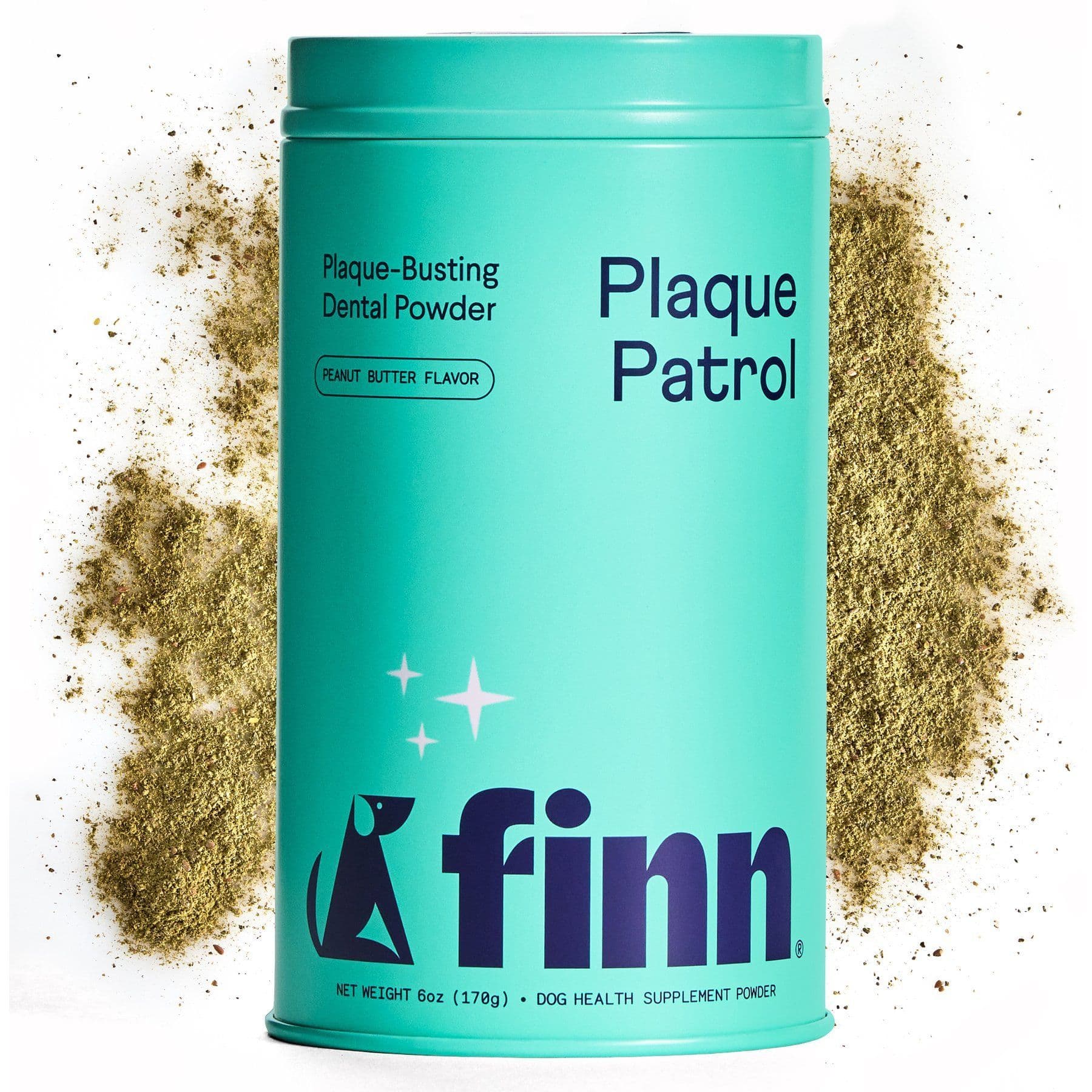
Finn’s 170-gram dental topper combines kelp and EpiCor with goat milk and bee propolis. Compare the teaspoon-based daily cost and dietary fit.
Webvet may earn a commission when you click through to Chewy, at no extra cost to you.
Finn Plaque Patrol is a 170-gram, 6-ounce powder containing kelp and EpiCor, a postbiotic ingredient. A 5.5-gram teaspoon supplies 495 mg kelp and 65 mg EpiCor. The manufacturer's full formula also includes goat milk, bee propolis, flaxseed, alfalfa, parsley, fennel seed and peanut butter flavor.
EpiCor should not be described as a named live-probiotic formula. Nor does the presence of parsley or fennel establish treatment of dental disease. This may be a convenient topper for a dog that accepts the flavor, but we did not test acceptance, breath changes or plaque reduction, and no matching product trial or VOHC acceptance was established here.
Finn's directions are one teaspoon at 1–25 pounds, two at 26–50 pounds, three at 51–75 pounds and four above 75 pounds. At $35, that is approximately $1.13, $2.26, $3.40 and $4.53 daily. Dairy and bee propolis should be considered when reviewing sensitivities. A larger tin can still cost more per day when the serving is larger.
How dental powders work and where evidence differs
These powders are eaten with food; they do not physically brush every tooth surface. Different formulations propose different mechanisms, including seaweed ingredients, compounds intended to affect mineral accumulation and probiotic or enzyme blends. A convincing mechanism is a reason to investigate a product, not a measurement of clinical benefit.

Keep three kinds of evidence separate:
- Product-specific plaque or tartar studies assess an outcome for a defined formulation and use pattern.
- Ingredient research may explain a possibility without testing the jar on your shelf.
- Owner reviews can describe convenience or acceptance, but cannot reliably separate product effects from brushing, diet changes or recent cleaning.
VOHC acceptance offers a useful way to identify products with reviewed plaque or tartar data. Absence from the list does not prove a powder cannot help, but it limits how confidently we can rank its dental effects. A product that makes food smell different or changes breath is not automatically preventing disease under the gumline.
Does Petlab dental powder really work?
The answer must distinguish Original ProBright from Advanced products. This comparison did not establish a clinical trial matching the selected Original medium-dog formula, so it cannot promise a measured plaque reduction for that tub. Evidence or marketing for Advanced should not be transferred to Original. Its ingredients may offer a rationale for use, but discuss the exact label and dental goal with your veterinarian before treating that rationale as proven benefit.
Do dental water additives for dogs really work?
Some specific water additives have VOHC acceptance, while others rely on ingredient or manufacturer claims. Their effectiveness also depends on correct dilution and normal drinking, so they are not interchangeable with food powders. Never withhold plain water to force consumption of an additive. Our guide to dog dental water additives explains that separate choice and how to compare the exact products.
What is the highest rated dental powder for dogs?
There is no reliable universal ranking across retailers because star ratings change, review counts differ and customers may be rating delivery or flavor rather than dental outcomes. For an evidence-led choice among these four, ProDen PlaqueOff's VOHC acceptance is more relevant than a changing star average. It still needs to fit the individual dog's health and diet; “highest rated” does not make a thyroid caution disappear.
 $65 · no membership
Have a health question about your dog?
A licensed vet can assess your dog over video and prescribe online when it's appropriate.
 Talk to a vet
- Licensed vets
- All 50 states
- same-day Rx

Webvet may earn a commission if you book.
Compare ingredients, directions and daily cost
Use daily cost, not price per scoop, to compare products. The calculation is jar price multiplied by grams used per day, divided by net grams in the jar. A 40-pound dog's RADIUS serving is 6.6 grams, so $19.99 × 6.6 ÷ 100 is approximately $1.32. Finn uses 11 grams for that weight, giving $35 × 11 ÷ 170, or about $2.26.
Before starting a food powder:
- Check the dog's current weight and the exact version of the product.
- Use that product's scoop, or its stated teaspoon measure, rather than swapping measuring tools between brands.
- Read the complete ingredient panel against allergies, prescription diets and other supplements.
- Mix with a portion the dog reliably finishes and follow the package's introduction instructions.
- Record the start date and maintain the dental routine so changes can be assessed sensibly.
Do not double a missed serving or layer several dental powders together in an attempt to get faster results. Multiple kelp-containing products can duplicate ingredients, and adding a powder, chew and water additive simultaneously makes it harder to identify the cause of an upset stomach. If you need a different format, compare vet-recommended dental chews on their own merits rather than treating all dental products as equivalent.
The listed costs are estimates from package mass and label directions, not guaranteed days of use. Spillage, measuring accuracy and changing prices affect the total. Supply length also has to fit the product's storage and expiry instructions; stretching a jar by under-serving it makes the price calculation look better without following the label.
Take the jar or a clear label photograph to a dental appointment. Ask what change the veterinarian will look for at reassessment and whether the existing brushing schedule should stay the same. This gives you a way to evaluate the purchase beyond fresher breath. If the dog dislikes the food after powder is added, protect normal eating and ask about a different home-care format rather than disguising increasing amounts in more treats.

When a powder is the wrong next step
A powder is the wrong next step when the dog has a painful mouth, loose or broken teeth, facial swelling, bleeding or difficulty eating. These signs need veterinary attention. Even a dog that still eats may have dental disease, so willingness to take dinner is not a dependable all-clear.

For ongoing care, focus on a routine the dog tolerates. Introduce a soft toothbrush gently, use a dog-appropriate toothpaste and avoid forcing the mouth open. The WebVet dental-health guide covers home care and professional treatment in more detail. Dental cleaning under anesthesia allows veterinary assessment and treatment below the gumline; a powder cannot perform that work.
Homemade dental powders and baking powder are not equivalent to tested dog products. Do not brush with baking powder, use human toothpaste or mix a kitchen recipe to reproduce a commercial label. A familiar ingredient or green-colored powder says little about safe amounts or dental benefit. For alternatives such as NutriPaw, Other Half, This Dog's Life or In Clover, apply the same exact-product evidence check; this four-product comparison does not establish their formulas or rank their effectiveness.
Dental powder questions
Frequently Asked Questions
Do vets recommend dog dental powder?
Veterinarians may recommend a specific dental powder as an addition to a dog's home-care plan, especially when its evidence and ingredient profile fit that dog. That is different from recommending every powder. Ask which outcome the product supports, whether it has VOHC acceptance and how it fits around brushing and checkups. A recommendation should also consider thyroid disease, restricted diets and existing supplements.
Which is the best plaque remover powder for dogs?
Of the four compared here, ProDen PlaqueOff is the clearest evidence-based starting point for a suitable dog because it has VOHC acceptance for plaque and tartar. “Remover” can be misleading if it suggests that powder strips off all hardened deposits. Existing heavy tartar or gum disease needs a veterinary examination and potentially professional cleaning, even when an accepted home-care product is used daily.
Does tooth powder actually work for dogs?
Some dog dental powders have product-specific evidence for reducing plaque or tartar accumulation, but the result cannot be generalized to every powder. Evaluate the exact formulation and intended outcome. Consistent labeled use matters, and breath alone is not a reliable measure of dental health. If the mouth is already painful or heavily affected, a powder is an adjunct after veterinary assessment, not the treatment that resolves the underlying disease.
What dissolves plaque on dog's teeth?
Plaque is a soft film that daily brushing helps disrupt; it should not be confused with hardened tartar. Certain home-care products can help reduce accumulation, but pouring or rubbing a household chemical on teeth is unsafe and unnecessary. Use dog-appropriate dental products and ask the veterinarian about established deposits. No powder in this comparison is a substitute for the cleaning and assessment required when tartar and periodontal disease are present.
Can I scrape the tartar off my dog's teeth myself?
Do not use a dental scaler or sharp household tool to scrape your dog's teeth. Movement can injure the mouth, and visible scraping does not assess or clean below the gumline where disease may persist. It can also make future handling harder if it hurts. Arrange a dental examination, then build a gentle home-care routine appropriate to the findings rather than attempting a cosmetic cleanup at home.
What is the best dental additive for dogs?
The best additive is an evidence-supported product your dog can safely and consistently use, whether that is a powder or a water additive. Check the exact VOHC listing and the intended plaque or tartar claim, then review ingredients and cost. A dog that refuses treated water needs a different approach, because maintaining drinking is more important than delivering an optional dental supplement through the bowl.
What do vets recommend for dog teeth cleaning?
Veterinary dental care combines examination, appropriate professional treatment and daily home care, usually including brushing when the mouth is comfortable. The schedule for professional cleaning depends on the individual dog's findings rather than a powder's advertising promise. Ask the veterinarian to demonstrate safe brushing and identify signs needing an earlier visit. A food topper may support the routine, but it does not inspect tooth roots or treat a damaged tooth.
What kills bacteria in a dog's mouth?
The goal is to control plaque and dental disease, not sterilize a dog's mouth. Brushing disrupts bacterial film, and a veterinarian may prescribe a specific oral product when indicated. Do not use household disinfectants, peroxide mixtures or human mouthwash in the mouth. Products intended for people can contain unsuitable ingredients, and suppressing an odor without examining a painful or diseased mouth can delay the treatment the dog needs.
$65 · no membershipHave a health question about your dog?
A licensed vet can assess your dog over video and prescribe online when it's appropriate.
Talk to a vet- Licensed vets
- All 50 states
- same-day Rx
Webvet may earn a commission if you book.
Veterinarian · BVMS MRCVS
Dr. Pippa Elliott, BVMS, MRCVS, is a veterinarian with nearly 30 years of experience in companion animal practice. Dr. Elliott earned her Bachelor of Veterinary Medicine and Surgery from the University of Glasgow. She was also designated a Member of the Royal College of Veterinary Surgeons. Married with 2 grown-up kids, Dr. Elliott has a naughty Puggle named Poggle, 3 cats and a bearded dragon.


