How Cats See the World: Color, Dark, and Motion
Cats see a less colorful, less sharply detailed world than people, but they excel at detecting motion and navigating dim light. Explore feline color, night vision, distance, and the limits of what science can recreate.

BVMS MRCVS
Medically reviewed by Dr. Pippa Elliott, BVMS MRCVS · Last reviewed

This article contains affiliate links. Webvet may earn a commission when you buy through them, at no extra cost to you.
How cats see the world differs from how people see it. Cats probably experience fewer color differences and less fine detail than humans, but they are highly sensitive to movement and make far better use of dim light. Their visual system favors the needs of a small predator active around dawn and dusk.
No photograph, filter, or illustration can literally reproduce a cat's subjective experience. Science can measure anatomy, behavior, light sensitivity, color discrimination, and visual acuity. It cannot place a human viewer inside a cat's mind.

 Sponsored
Have a health question about your cat?
Talk to a licensed vet at Dutch over video or message, including nights and weekends.
Use code Pets60
Plans start at $12/month · covers up to 5 pets
- Licensed vets in most states
- Rx for 150+ conditions
- 4.7 on Trustpilot
How cats see the world
Cat vision involves fewer color differences and less fine detail than typical human vision, with stronger motion detection and dim-light performance. Cats still need some light to see and recognize people using vision together with smell, sound, and context.
The useful comparison is not that cat vision is better or worse than human vision. Each system emphasizes different information. Human eyes excel at fine detail and broad color discrimination in daylight. Feline eyes collect light efficiently, detect movement quickly, and survey a wide area while the cat hunts, climbs, or navigates close to the ground.
What do cats see? Cat eyesight prioritizes available light, motion, contrast, and a broad field more than the fine stationary detail typical human vision resolves. Do cats have good eyesight? It depends on the task: cats outperform people in dim light and motion detection but resolve less fine distant detail. Understanding feline vision requires several dimensions rather than one literal point-of-view image.

| Common claim | Evidence confidence | What the evidence supports | Practical meaning |
|---|---|---|---|
| Cats see only black and white | Not supported | Behavioral research supports feline color discrimination | Color exists for cats, but the range and saturation differ from ours |
| Cats see perfectly in total darkness | False | Rods and the tapetum improve use of available light, but they do not create light | A cat still needs some light to navigate visually |
| Everything is blurry to cats | Misleading | Fine detail and distant acuity are lower than in typical human vision | Motion and contrast may matter more than small stationary detail |
| Cats can see ultraviolet light | Supported with limits | Experimental evidence suggests sensitivity into wavelengths humans do not see | We cannot know exactly how ultraviolet information appears subjectively |
| Cats see infrared heat like a thermal camera | Not supported | Cats can feel warmth, but that is not evidence of retinal heat imaging | Do not treat heat sensing as infrared vision |
| A phone filter shows the exact cat point of view | Unknowable and overstated | Filters can illustrate selected differences only | Use simulations as teaching aids, never proof of experience |
This confidence-labeled myth table separates supported findings, cautious inference, and unknown subjective experience. It shows the evidence confidence for each common claim and what the evidence supports before translating the finding into practical meaning. That confidence-to-practical bridge helps an owner use strong evidence for lighting and play decisions, while treating a literal recreation of feline experience as an illustration rather than proof.
A supervised motion-based cat toy can make movement more important than color during play.
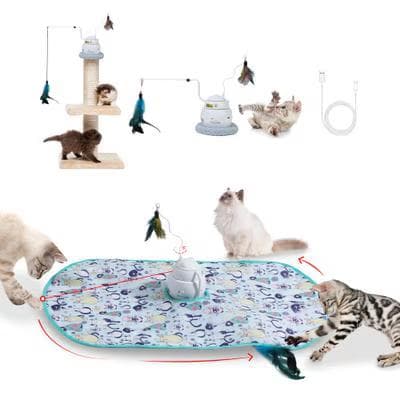
Webvet may earn a commission when you click through to Chewy, at no extra cost to you.
What does cat vision look like?
Based on visual physiology and behavioral tests, the world probably looks less saturated and less sharply detailed to a cat than it does to a person with typical vision. Blue and yellow ranges are more distinguishable. Red and green differences are likely muted. Distant fine patterns blur sooner, while a moving edge can remain highly meaningful.
What does a cat's vision look like in practical terms? Imagine fewer strong color contrasts, softer distant detail, and unusually important movement, while remembering that this is only a model. Feline distance vision is less sharp than typical human vision while motion detection is strong. Lighting and distance can change the balance from moment to moment.
That description is an evidence-based model, not a literal screenshot. A cat's attention, prior experience, eye health, lighting, distance, and movement all change what information becomes useful at a given moment.
How the eye uses light
The retina at the back of the eye contains photoreceptors. Rod photoreceptors are very sensitive to low levels of light and movement. Cone photoreceptors support color discrimination and sharper daylight detail. Cats have a visual system weighted more toward rods than humans do, which helps explain the dim-light and motion advantage.
The Merck Veterinary Manual overview of the feline eye also describes the tapetum lucidum, a reflective layer behind the retina. The anatomical term is tapetum lucidum. It reflects light back through the retina and contributes to eyeshine when available light strikes a cat's eyes at night. The layer improves the opportunity to use existing light, but it does not create light or guarantee a sharp image.
This confidence table prevents two common errors: turning an anatomical advantage into a superpower, and treating an uncertainty as though nothing is known.
What colors can cats see?
Cats are not limited to black, white, and gray. They have cone photoreceptors and can discriminate color, although their color vision is less varied than typical human trichromatic vision. Cats are generally described as having dichromatic color vision.

VCA Animal Hospitals summarizes the likely feline palette as strongest for blues, grays, and yellows, with reds and greens appearing less distinct. Experimental work indexed in PubMed on feline color vision also supports the conclusion that cats can discriminate colors rather than seeing an entirely monochrome world.
Blue and yellow stand out more clearly
Blue and yellow objects may create more useful color contrast for a cat. That does not mean every blue toy is automatically interesting. Brightness, movement, texture, sound, location, and the cat's learning history may matter more than hue.
An interactive butterfly toy or track toy gives cats visible movement to follow at close range.

Webvet may earn a commission when you click through to Chewy, at no extra cost to you.
Red and green are harder to separate
Red and green may appear less saturated or more similar to neutral tones. A red object can still stand out when it is bright, moving, or placed against a contrasting background. Saying a cat cannot see red at all is more absolute than the evidence supports.
What about purple, pink, and orange?
Mixed colors depend on their components and brightness. Purple may provide a blue signal, while pink and orange may be less distinct from nearby neutral or yellowish tones. Exact color names are human categories, so they should be used as approximations.
A simple home application is to prioritize contrast. A blue or yellow toy against a neutral floor can be easier to locate than a red toy on a brown rug. For food, water, steps, and litter areas, strong light-dark contrast can be more dependable than a particular hue.
Can cats see in the dark?
Cats can see in dim light far better than people, but they cannot see in absolute darkness. Vision requires light. Rod photoreceptors, a relatively light-efficient eye, and the tapetum lucidum help cats make use of small amounts that humans may find inadequate.
Cats have more rod-driven low-light sensitivity but cannot see in absolute darkness. The tapetum lucidum reflects available light back through the retina and contributes to eyeshine, but it does not generate light. This clear distinction between a dim-light advantage and total darkness prevents an anatomical adaptation from becoming a false superpower. In a room with no light at all, feline vision has no light signal to use.

Can cats see in complete darkness?
No. In a space with zero light, there is nothing for the retina to detect and nothing for the tapetum to reflect. The reflective layer improves a second chance to capture available photons. It is not a lamp inside the eye.
This distinction resolves the question can cats see in 100% darkness. They cannot. A hallway illuminated by moonlight, a night-light, or light leaking under a door is dim, not completely dark. A cat can also navigate with memory, whisker input, hearing, smell, and touch, which may make its performance look visual even when very little can be seen.
Why cat eyes shine at night
Eyeshine occurs when incoming light reaches the tapetum and reflects back out. Color varies with angle, lighting, and the eye. Eyeshine is normal in many situations, but a new cloudy appearance, persistent redness, discharge, unequal pupils, or one eye reflecting differently should be discussed with a veterinarian.
How much better is feline night vision?
Sources often provide a single ratio, but real performance varies with contrast, wavelength, task, age, and eye health. It is more accurate to say cats need much less light than humans for many visual tasks. That advantage does not guarantee perfect focus, depth judgment, or recognition at every distance.

Webvet may earn a commission when you click through to Chewy, at no extra cost to you.
Provide a small, safe light source when an older cat, visually impaired cat, or cat in an unfamiliar room must find stairs, food, water, or a litter box. Consistent furniture placement and high-contrast edges can reduce uncertainty.
SponsoredVet care that's always there
Unlimited video calls and messaging with licensed vets for less than a typical vet visit. One membership covers up to five pets.
Use code Pets60
Plans start at $12/month · covers up to 5 pets
- Licensed vets in most states
- Rx for 150+ conditions
- 4.7 on Trustpilot
How sharp is a cat's vision?
Feline visual acuity is lower than typical human acuity. A commonly used comparison describes cats as needing to be around 20 feet from a detail that a person with typical vision might resolve at 100 feet. That type of 20/100 comparison is an approximation drawn from behavioral testing, not an eyeglass prescription for every cat.
Research indexed in PubMed on feline visual acuity supports measuring cats through controlled visual tasks. Results help describe thresholds, but they do not justify a universal image filter. Individual cats also differ because of age, genetics, prior eye disease, and test conditions.
Near focus and whisker range
Cats may not resolve very close objects sharply. Whiskers, smell, and touch provide information near the face, and a cat may reposition its head before biting or pawing. That is one reason a stationary treat directly under the nose can be harder to locate visually than owners expect.
Distance and recognizing people
A cat does not need a crisp facial portrait to know who entered the room. The query how do cats see humans therefore has two answers: visually, people may be less sharply detailed at a distance than they appear to us; behaviorally, cats recognize familiar people through a multisensory cue stack:
- Vision: silhouette, movement, and available facial detail
- Sound and scent: a familiar voice and odor
- Context: gait, routine, location, and learned expectations
Cats recognize people using multiple senses, so vision alone does not explain how a cat identifies an owner. Can cats see humans clearly? The answer changes with distance, light, contrast, motion, and eye health. Voice, scent, and context can still identify an owner when facial detail is limited, so reduced detail does not mean every person appears as an indistinguishable shape.
Field of view and depth
Forward-facing eyes create binocular overlap that supports depth judgments important for pouncing and jumping. Cats also have a broad visual field and useful peripheral awareness. Exact values vary by measurement method, and a wide field does not mean equal sharpness everywhere. Peripheral vision is especially useful for detecting movement.
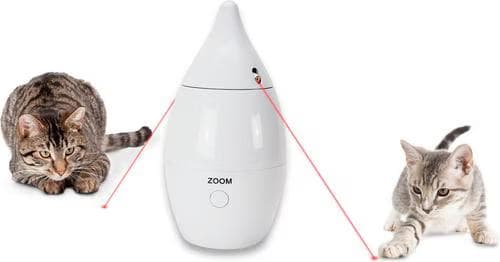
Webvet may earn a commission when you click through to Chewy, at no extra cost to you.
Why motion matters more than fine detail
Cats are tuned to notice change. A small object that darts, pauses, and changes direction may be more compelling than a colorful object that remains still. Rod-rich retinal processing and hunting behavior both make motion a high-value cue.
Screen and laser interest depends on motion, contrast, distance, and the individual cat, and lasers must never target eyes. That practical translation from color and motion research helps owners choose safer toy movement, screen use, and home navigation rather than assuming color alone controls interest. A visible target, stable footing, safe stopping point, and catchable ending matter more than trying to reproduce one ideal feline color palette.
Television and phone screens
Many cats can see movement on modern screens. Whether they respond depends on frame rate, brightness, contrast, content, distance, and the individual. A cat may track an animal on television, ignore it, investigate behind the screen, or lose interest when no smell or physical object follows.
Color is only one part of safe play. Motion, contrast, distance, footing, and the cat's arousal level matter. For another example of how sensory input can affect behavior, read what catnip does to cats.

Screen videos are optional enrichment, not a required exercise program. Prevent tipping, protect cords, provide an easy exit, and stop if the cat becomes frustrated or overaroused. Real-world play that ends with a safe object to catch can provide a clearer completion to the hunting sequence.
Can cats see green lasers?
Cats can detect a bright green laser spot because brightness, contrast, and movement make it visible even if green color discrimination differs from ours. The issue is not simply whether green is in the ideal feline palette.
Never aim any laser at a cat's eyes, another animal, or a person. Keep the dot away from reflective surfaces and dangerous climbing areas. Because a cat cannot physically catch light, finish with an object the cat can capture. If laser play creates frantic searching or frustration, stop using it and choose a physical toy instead.
What cats may see beyond human vision
Some mammals, including cats, appear able to detect ultraviolet wavelengths that humans cannot see. That finding is interesting, but it does not reveal what ultraviolet information looks like to a cat or how often it changes daily decisions.
Claims about ultraviolet sensitivity have experimental support, while infrared heat vision and literal point-of-view recreations do not. Experimental anatomy and behavior can support a cautious statement about wavelengths, but feeling warmth is not infrared heat vision, and a human-made filter cannot reproduce feline subjective experience. This is a confidence boundary, not a claim that nothing is known, and it keeps supported evidence separate from an attractive but untestable image.
Ultraviolet sensitivity
Lens transmission and behavioral evidence support cautious statements about ultraviolet sensitivity. It may make some materials, urine traces, feathers, or flowers differ from their appearance to humans. Specific claims about glowing patterns should be tied to actual evidence rather than invented from a filter.
Infrared and heat
Cats seek warm places and detect temperature through skin and other sensory systems. That is not the same as seeing infrared radiation as a thermal image. Searches asking whether cats can see infrared, heat, or red security-camera illumination often mix separate ideas. A cat may notice a device's visible indicator, sound, movement, or warmth without possessing thermal-camera vision.
The limit of a point-of-view recreation
A cat-vision image can reduce saturation, soften detail, widen a frame, or brighten a dim scene to demonstrate separate findings. It still uses a human display viewed by a human visual system. It cannot reproduce feline attention, retinal processing, ultraviolet sensitivity, motion thresholds, or subjective awareness all at once.
Use recreations to ask better questions, not to claim certainty. A caption should identify which evidence-based feature is being illustrated and which parts remain artistic.
Make the home easier for a cat to see
The most useful vision advice is often about contrast, light, movement, and consistency. A cat does not need a room redesigned in false feline colors. It needs important resources that are easy to locate and safe to approach.
Use these principles:
- Put a light-colored dish on a darker mat, or a dark dish on a lighter mat, so the edge is distinct.
- Add gentle lighting near stairs, litter boxes, water, and sleeping areas for older or visually impaired cats.
- Keep walkways clear and avoid moving major furniture without giving the cat time to relearn the route.
- Choose a high-contrast wand toy or track toy that moves in short, catchable patterns.
- Present a hand or object from a visible angle instead of suddenly touching a resting cat.
- Keep window perches stable and prevent access to unsafe drops.
Color can help, but brightness contrast often has a larger practical effect. A yellow toy on a pale floor may disappear into the background, while the same toy against a dark rug becomes easier to track. Motion can make a low-color object conspicuous, but frantic movement can also overwhelm or frustrate a cat.
Watch the individual's response. A cat that repeatedly misses one side, hesitates only in dim areas, misjudges jumps, or startles when approached may be revealing a functional vision change. Do not assume the cat is stubborn, old, or clumsy. Record when the problem occurs, compare both sides when safe, and arrange a veterinary examination.
For a cat with confirmed vision loss, scent and texture markers can support navigation. Keep them subtle and consistent. A distinct mat under a water bowl or a textured runner leading to a litter area gives information without creating an obstacle. The plan should preserve independence while reducing falls and surprise.
When changes in vision need a veterinarian
Vision can decline gradually or change suddenly. Cats often compensate with memory, hearing, smell, and whiskers, so early changes can be subtle. Watch function rather than waiting for obvious blindness.

The Cornell Feline Health Center describes signs such as cloudiness, unequal pupils, and difficulty navigating as reasons for veterinary attention.
Other signs to schedule promptly include:
- new hesitation at stairs or jumps
- missing toys or food that were previously easy to locate
- startling when approached from one side
- persistent redness, discharge, rubbing, or squinting
- one eye appearing different from the other
- behavior changes that may reflect pain or disorientation
Keep the home layout predictable while waiting for care. Block unsafe heights, add gentle lighting, and approach with sound so the cat is not surprised. Changes in visual response also affect how owners read cat body language, so interpret posture alongside sensory and medical context.
Frequently Asked Questions
How far away can my cat see me?
How far away a cat can see you is not defined by one maximum recognition distance. A cat's fine visual detail is lower than typical human detail, but distance acuity is approximate rather than one fixed cutoff. Cats use multiple senses and can combine movement, outline, voice, scent, gait, and context to recognize a familiar person. Lighting, contrast, eye health, background clutter, and whether the person moves all affect performance. A cat may recognize you before it can resolve fine facial features.
Do cats see humans as other cats?
There is no proof that cats literally see humans as cats. A cat can recognize a familiar person by combining movement, voice, scent, gait, outline, and context even when fine facial detail is less sharp than it is for a person. Social behavior toward humans may resemble behavior used with cats, but that does not reveal the animal's private category for us. Recognition is multisensory, not a simple visual label.
Can cats see phone screens and television?
Many cats can detect motion on modern screens and may track animals, toys, or high-contrast movement on a phone or television. Screen interest varies with motion, contrast, distance, and refresh rate, as well as the individual cat's vision and experience. A cat may notice movement without understanding the scene as a real animal or event. Protect the device from pouncing and provide physical play that has a safe ending.
Can cats see red and green?
Cats can detect color, but red and green are harder for cats to distinguish than they are for most humans. Those colors may look duller or less separated from surrounding shades. Blue and yellow usually provide clearer contrast. Motion, brightness, shape, texture, and scent can matter more than hue during play, so a red toy can still attract a cat when it moves or contrasts strongly with the floor.
Can cats see ultraviolet light?
Research suggests feline lenses can transmit some ultraviolet wavelengths that human lenses block, so cats may detect parts of the near-ultraviolet range. The practical appearance of that information to a cat is not fully known. Ultraviolet sensitivity does not prove cats see spirits, invisible heat, or supernatural activity. Cats do not use infrared vision to see heat, although other senses help them locate warm places.

Editor
The Webvet Editorial Team is the in-house group of pet-care editors and writers behind Webvet, operated by Smart Pet Collective. The team researches, writes, and maintains Webvet's pet health, behavior, and medication content. Every article follows a defined editorial process: research from reputable veterinary and scientific sources, careful drafting, mandatory review of medical content by a credentialed veterinarian, and dated publication. Health and medication articles are medically reviewed by a licensed veterinary professional before they go live and are kept current over time.
Veterinarian · BVMS MRCVS
Dr. Pippa Elliott, BVMS, MRCVS, is a veterinarian with nearly 30 years of experience in companion animal practice. Dr. Elliott earned her Bachelor of Veterinary Medicine and Surgery from the University of Glasgow. She was also designated a Member of the Royal College of Veterinary Surgeons. Married with 2 grown-up kids, Dr. Elliott has a naughty Puggle named Poggle, 3 cats and a bearded dragon.
Related reading

Dog Muscle Spasms and Twitching: Causes, Symptoms, and When to Worry

Anemia in Dogs: Symptoms, Causes, Diagnosis, and Treatment

Seizures in Dogs: Types, Causes, What to Do, and Treatment
