How to Tell If Your Dog Has a Genetic Health Condition: A Guide to DNA Health Screening
Learn what a dog DNA health report can establish, how to interpret clear, carrier, and at-risk results, and which questions to bring to your veterinarian after an Embark screening.

BVMS MRCVS

This article contains affiliate links. Webvet may earn a commission when you buy through them, at no extra cost to you.
Dog DNA health screening looks for tested genetic variants associated with inherited conditions, including findings that may matter before a dog shows symptoms. If you want to understand your dog's inherited risks, a health-inclusive test such as Embark Breed + Health can provide information to discuss with your veterinarian.
A result cannot, by itself, tell you that your dog currently has a disease. The next step depends on the exact condition, the variant found, and your dog's history and examination. This guide explains what clear, carrier, and at-risk findings can mean and how to turn the report into useful questions about your dog's care.

 Sponsored
Have a health question about your pet?
Talk to a licensed vet at Dutch over video or message, including nights and weekends.
Use code Pets60
Plans start at $12/month · covers up to 5 pets
- Licensed vets in most states
- Rx for 150+ conditions
- 4.7 on Trustpilot
What DNA health screening can tell you about your dog
Dog genetic testing reads selected parts of a dog's DNA and compares them with established information about inherited variants. A health report can identify findings worth discussing, while ancestry or physical-trait reports answer different questions.
That distinction matters when comparing dog genetic testing companies, including Embark and Wisdom Panel. A breed result, a coat-color result, and a disease-associated variant may appear in one account, but they do not carry the same medical meaning.
A useful health report helps you identify:
- The condition and genetic variant being assessed.
- The result and its condition-specific interpretation.
- The limits of that interpretation.
- Appropriate questions for your veterinarian.
Dog genetic testing accuracy also has more than one meaning. Correctly identifying a tested variant does not necessarily predict whether an individual dog will become ill. Health decisions require both a dependable test and a sound interpretation of its result.
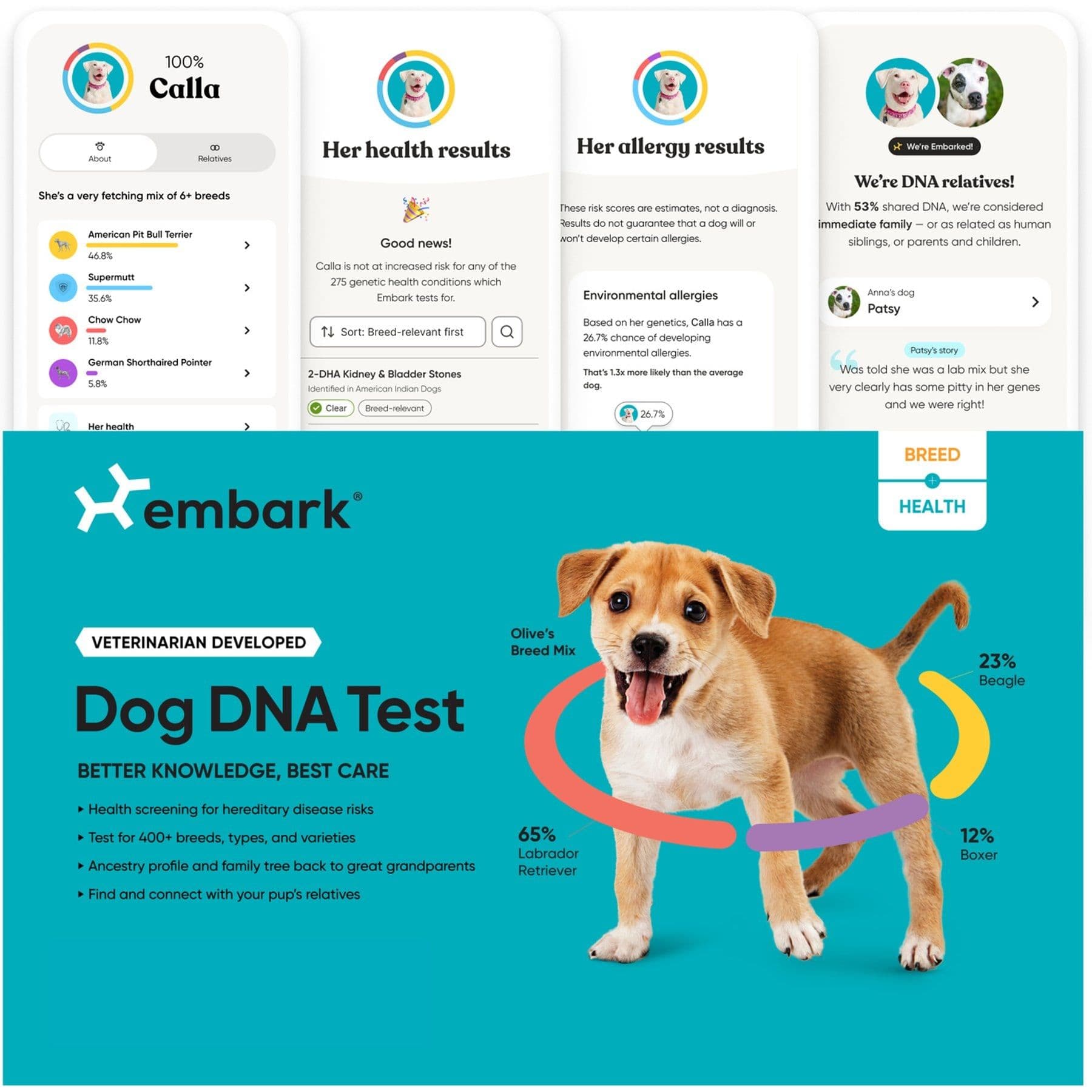
Explore your dog's ancestry and tested inherited health risks with Embark Breed + Health.
Webvet may earn a commission when you click through to Chewy, at no extra cost to you.
When genetic testing can be useful
Genetic health testing can be useful for a dog that appears healthy, particularly when the owner wants to understand inherited risks or has limited family history. A result may give the veterinarian information to consider alongside routine examinations and the dog's changing needs.
Testing can serve several different purposes:
- Companion-dog screening: Exploring inherited findings that may inform future care.
- A specific clinical question: Investigating a concern identified by a veterinarian.
- Breeding decisions: Assessing relevant inherited variants alongside other health examinations.
- Ancestry identification: Learning breed background, which is separate from diagnosing disease.
Dog breeder genetic testing should be selected for the breeds and conditions involved, rather than assuming any broad panel completes a breeding assessment. Similarly, genetic testing to determine dog breed cannot establish whether a dog currently has a medical condition.
If your dog has symptoms, arrange veterinary care. Do not wait for a mail-in kit to explain weakness, pain, a new lump, or another concerning change.
What Embark Breed + Health screens for
Embark Breed + Health combines ancestry information with screening for more than 270 genetic health conditions. Its current product information also lists 55 physical traits. Breed ID focuses on ancestry and relatives; choose the health-inclusive kit when screening is your purpose.

Embark dog genetic testing can bring several kinds of information into one report:
Explore your dog's ancestry and tested inherited health risks with Embark Breed + Health.
Webvet may earn a commission when you click through to Chewy, at no extra cost to you.
- Findings associated with inherited conditions.
- Drug-sensitivity information such as MDR1.
- Results that require a more qualified risk interpretation.
- Ancestry and traits that provide additional context.
The value is not simply the number of results. It is understanding which findings matter for your dog. Embark's product explanation describes health screening as a risk assessment and directs owners to discuss relevant results with their veterinarian.
Understanding clear, carrier, and at-risk results

Read the result together with the condition's explanation. The same number of variant copies can have different implications for different conditions. Condition-specific inheritance is more useful than a blanket rule that one copy is harmless or two copies always cause disease.
A clear result concerns the tested variants only. A carrier result often describes a recessive variant that may be passed to offspring, but the actual report and condition determine its significance. An at-risk result indicates an increased possibility of a relevant condition, not a diagnosis or a guaranteed outcome.
| Result | What it can mean | Useful next action |
|---|---|---|
| Clear | No risk variant detected among the tested variants only | Continue routine care and investigate symptoms on their own merits |
| Carrier | A variant is present; its meaning depends on condition-specific inheritance | Ask whether the finding affects the dog, offspring, or both |
| At risk or increased risk | The result is associated with a greater likelihood of the condition | Discuss confirmation and monitoring in the context of the individual dog |
| Risk estimate | Several factors may contribute to an estimated probability | Ask which factors were used and how the estimate should influence care |
The useful connection is between result meaning and next action. Your veterinarian may recommend recording the finding, considering a targeted test, adjusting a monitoring plan, or making no immediate change. The right response should follow the particular result rather than the emotional impact of the label.
For example, ask whether confirmation and monitoring are appropriate before making a major care decision. A broad screening panel and a targeted diagnostic investigation serve different purposes. Bringing the full report gives your veterinarian more to work with than saying your dog “tested positive.”
Clear is not complete health clearance. A panel cannot exclude every inherited cause of illness, conditions outside its scope, or diseases influenced by many factors. Keep the reassuring information in perspective while continuing to respond to changes in your dog.
 Sponsored
Vet care that's always there
Unlimited video calls and messaging with licensed vets for less than a typical vet visit. One membership covers up to five pets.
Use code Pets60
Plans start at $12/month · covers up to 5 pets
- Licensed vets in most states
- Rx for 150+ conditions
- 4.7 on Trustpilot
Why genetic risk is not a diagnosis
Genes can influence health without determining exactly what will happen. Penetrance describes how consistently a genetic variant is associated with the expected condition. Penetrance and breed context matter because a result's implications may differ across dogs and populations.
The testing method matters too. Direct versus linkage testing describes whether a test examines the variant itself or uses nearby DNA that tends to be inherited with it. Embark's explanation of its methods makes this distinction and explains why health findings need interpretation.
Several examples show how to use the information constructively.
MDR1: information to share before prescribing
MDR1 drug sensitivity is associated with a variant in the ABCB1 gene. A relevant finding can help your veterinarian assess certain medicines and doses. It does not mean every medication is unsafe or that prescribed parasite prevention should be stopped.
The practical step is to have the result recorded in your dog's medical file and mention it when another clinic provides care. Embark's MDR1 guidance specifically advises speaking to the veterinarian before discontinuing or changing a medicine.
Our guide to ivermectin for dogs explains why preventive doses, other treatment uses, formulations, and MDR1 status cannot be reduced to one universal dosing rule. The result should inform the prescription, not replace it.
IVDD: inherited risk is not a forecast
An IVDD-related genetic result can provide information about a risk associated with disc disease. It cannot tell you that a particular disc is damaged, whether symptoms will develop, or how severe an individual dog's problem will become.
Explore your dog's ancestry and tested inherited health risks with Embark Breed + Health.
Webvet may earn a commission when you click through to Chewy, at no extra cost to you.
A veterinarian assesses pain, movement, and neurological function when investigating IVDD in dogs. A DNA result is additional context. New back or neck pain, an unsteady gait, or weakness needs veterinary attention; sudden loss of walking ability is urgent regardless of the genetic report.
POMC and appetite: a clue, not a weight prediction
POMC is involved in appetite regulation. A variant has been associated with increased food motivation in Labrador Retrievers and closely related Flat-Coated Retrievers. That can help explain why a dog seems especially interested in food without predicting its future weight.
Embark's POMC result uses a linkage test rather than directly examining the causal deletion. Its POMC and appetite explanation describes both that limitation and the association with food motivation.
Use the finding to discuss an appropriate feeding plan and follow your dog's body condition. A sudden increase in appetite still deserves investigation, especially alongside weight loss or other changes. An inherited appetite tendency is not an explanation for every new symptom.
MCT: a combined risk assessment
Embark's mast cell tumor risk assessment combines ancestry, genetic variants, and sex. It is not a result for one “cancer mutation,” and it does not detect a tumor currently growing in the dog. A higher estimate and a lower estimate both require the same distinction between future risk and present disease.
Explore your dog's ancestry and tested inherited health risks with Embark Breed + Health.
Webvet may earn a commission when you click through to Chewy, at no extra cost to you.
The company's MCT results explanation describes the assessment. If you notice a lump, arrange an examination rather than using the score to decide whether it matters. Our guide to mast cell tumors in dogs explains why a lump's appearance alone cannot settle its identity.
Hip dysplasia: a panel does not replace joint assessment
Hip dysplasia involves more than a single genetic yes-or-no answer. The Orthopedic Foundation for Animals describes a polygenic condition and uses veterinary radiographs for hip evaluation. A broad consumer DNA panel cannot certify normal hips or replace the veterinary examinations and imaging used to assess joint health.
That distinction is especially important when an owner is considering breeding or investigating stiffness and reduced activity. Share family history and genetic information, but ask which orthopedic assessments are appropriate. A reassuring result elsewhere on a panel does not answer the hip question.
Using the report to plan your next steps
The most useful response to a notable finding is to share the exact report. Include the condition name, result, variant information, and the laboratory's explanation. Your veterinarian can then consider it alongside the dog's age, symptoms, medications, and previous findings.

Before the appointment, make a short list:
- Is this a directly tested variant, a linkage result, or a broader risk estimate?
- What does the finding mean for this dog's breed background and health history?
- Would confirmation change the care plan?
- Is any monitoring recommended, and what would it involve?
- Which changes at home should prompt a call?
- Does the result affect a current or future prescription?
A result does not always call for an immediate intervention. Sometimes its value is having relevant information available before a medication is prescribed or knowing which question to raise during a routine examination. Ask the clinic to distinguish actions needed now from information to retain for later.
Keep the report accessible and make sure other caregivers know about findings that affect care. A medication-related result is particularly useful when an emergency clinic or specialist has not met your dog before. Share the actual document rather than relying on a remembered label.
Meanwhile, continue ordinary preventive care and observation. A genetic panel is one source of information about your dog. Examination findings, body condition, activity, appetite, and changes over time remain important whether the report contains several notable results or none.
Choosing a panel for your dog’s needs
The best dog genetic testing kit is the one that answers your question with an interpretable result. Start by deciding whether you want broad screening for a healthy companion, help with a specific veterinary concern, or information for breeding decisions.
For an owner interested in ancestry and inherited health information together, Embark Breed + Health is a practical option. Prices change through the year, so check the current price on the linked product page. Dog genetic testing cost should be considered alongside the relevant panel coverage and any veterinary follow-up the result may require.
Before buying, check:
- Whether the exact kit includes health screening.
- Whether the condition you care about appears in the current panel.
- How the report explains significant findings.
- What interpretation support is available.
- Whether your veterinarian recommends a targeted test instead.
If you are deciding between dog DNA test companies or asking whether DNA My Dog is a good test, use our comparison of Embark, Wisdom Panel, and DNA My Dog. It also covers current price comparisons, including Wisdom Panel, without treating the cheapest kit as automatically the best health purchase.
If the question is “What breed is my dog?”, a breed-identification test has a different primary job. Our guide to finding out your dog's breed explains visual guesses, ancestry estimates, and unexpected results. Knowing breed background does not by itself establish that a dog has a condition associated with that breed.
Health-inclusive kits can also be gifts for new dog owners, but the recipient should choose whether they want that information and control their own account. Our DNA-kit gift guide explains how to match the kit to the owner's interests and keep activation and sharing in their hands.
Dog DNA health screening questions
Frequently Asked Questions
What is the highest-rated dog DNA test kit?
For health screening, prioritize relevant health variants, clear explanations, and interpretation support over an overall star rating. Embark Breed + Health combines ancestry with an extensive screening panel and information to discuss with your veterinarian. Customer ratings can describe the buying experience, but they do not establish which panel best answers a particular clinical question.
Does a clear result rule out an inherited condition?
No. It applies to the tested variants only, not every possible inherited cause of disease. If your dog develops a concerning change, symptoms still need assessment even when the panel was clear. Give the veterinarian the report so they can see exactly what was evaluated and which questions remain unanswered.
Should I change medication because of a DNA result?
Share the report with the prescribing veterinarian before changing treatment. A drug-sensitivity finding may influence the choice of medicine or dose, but the answer depends on the drug and its use. Do not independently stop prevention, substitute another product, or change an amount based on a general description of the variant.
Can a DNA test tell whether my dog currently has cancer?
An inherited-risk report or MCT risk estimate does not diagnose cancer or detect an existing tumor. New lumps need examination even if the report suggests a lower risk. Your veterinarian may recommend sampling or other tests based on the lump and the dog, rather than using a genetic score as the deciding factor.
Does a POMC result mean my dog will become overweight?
No. An appetite-related predisposition is not a predetermined outcome, and Embark's result is based on linkage testing. Follow your dog's individual body condition and discuss an appropriate feeding plan with your veterinarian. Do not assume that a new change in hunger is genetic, particularly if it occurs with weight loss or other signs.
Does genetic screening replace other health tests before breeding?
No. It supplies condition-specific genetic information, while other health examinations assess different concerns. The appropriate plan depends on the breed, family history, relevant inherited conditions, and applicable screening recommendations. Ask your veterinarian which examinations and records are needed rather than treating a broad clear panel as complete breeding clearance.
Veterinarian · BVMS MRCVS
Dr. Pippa Elliott, BVMS, MRCVS, is a veterinarian with nearly 30 years of experience in companion animal practice. Dr. Elliott earned her Bachelor of Veterinary Medicine and Surgery from the University of Glasgow. She was also designated a Member of the Royal College of Veterinary Surgeons. Married with 2 grown-up kids, Dr. Elliott has a naughty Puggle named Poggle, 3 cats and a bearded dragon.
Related reading

Best Dog DNA Test 2026: How Embark Compares to other Dog DNA Tests

The Best Gift for New Dog Owners: Why a DNA Kit Is the Unexpected One

How to Figure Out What Breed Your Dog Is (and How Accurate DNA Testing Really Is)
