Cosequin vs Dasuquin for Dogs: Ingredients, Evidence and Cost Compared
Compare four exact Cosequin and Dasuquin formulations, their ingredients, weight-based directions and daily costs. Learn what the evidence supports and what to discuss with your veterinarian.

BVMS MRCVS
Medically reviewed by Dr. Pippa Elliott, BVMS MRCVS · Last reviewed

This article contains affiliate links. Webvet may earn a commission when you buy through them, at no extra cost to you.
The useful answer to cosequin vs dasuquin depends on the exact formulation. Both brands contain glucosamine and chondroitin, but the four products compared here differ in additional ingredients, tablet or chew size, weight-based directions and daily cost. Dasuquin's ASU is a real ingredient difference. It is not, by itself, proof that your dog will feel better on Dasuquin.
This is an independent, label-based expert analysis with affiliate links. We did not obtain or test these products. We compared manufacturer formulations with the selected package sizes and October 2, 2026 prices, then considered the limits of the clinical evidence. A dog who is limping or struggling to rise needs an assessment, even if a supplement is already in the food bowl.
Cosequin vs Dasuquin: the differences that matter
Cosequin and Dasuquin are joint supplements made by Nutramax. Neither is an NSAID, and neither should be treated as a replacement for prescribed pain medicine. The exact formulation matters more than a broad description such as “maximum strength,” because two products sharing a brand name can contain different quantities and extra ingredients.
For example, the Cosequin MINI soft chew below is for small dogs. It does not contain the same amounts as the larger Cosequin soft chews sold under similar names. The selected Dasuquin products are small/medium-dog chewable tablets, not soft chews, and both current tablet formulations contain Boswellia and green tea extract in addition to ASU.
- 1Compare the exact formulation and your dog's weight band before comparing price.
- 2ASU distinguishes these Dasuquin tablets, but an extra ingredient does not establish better pain relief.
- 3Initial and maintenance amounts differ; calculate the cost of the stage your dog will actually use.
- 4Keep veterinary pain control and mobility care separate from supplement shopping.
If your veterinarian has recommended a glucosamine/chondroitin product with MSM, Cosequin Maximum Strength Plus MSM tablets are one option with a relatively low per-tablet cost in the selected two-bottle bundle. That buying advantage applies to the package shown, not to every Cosequin size or formula.
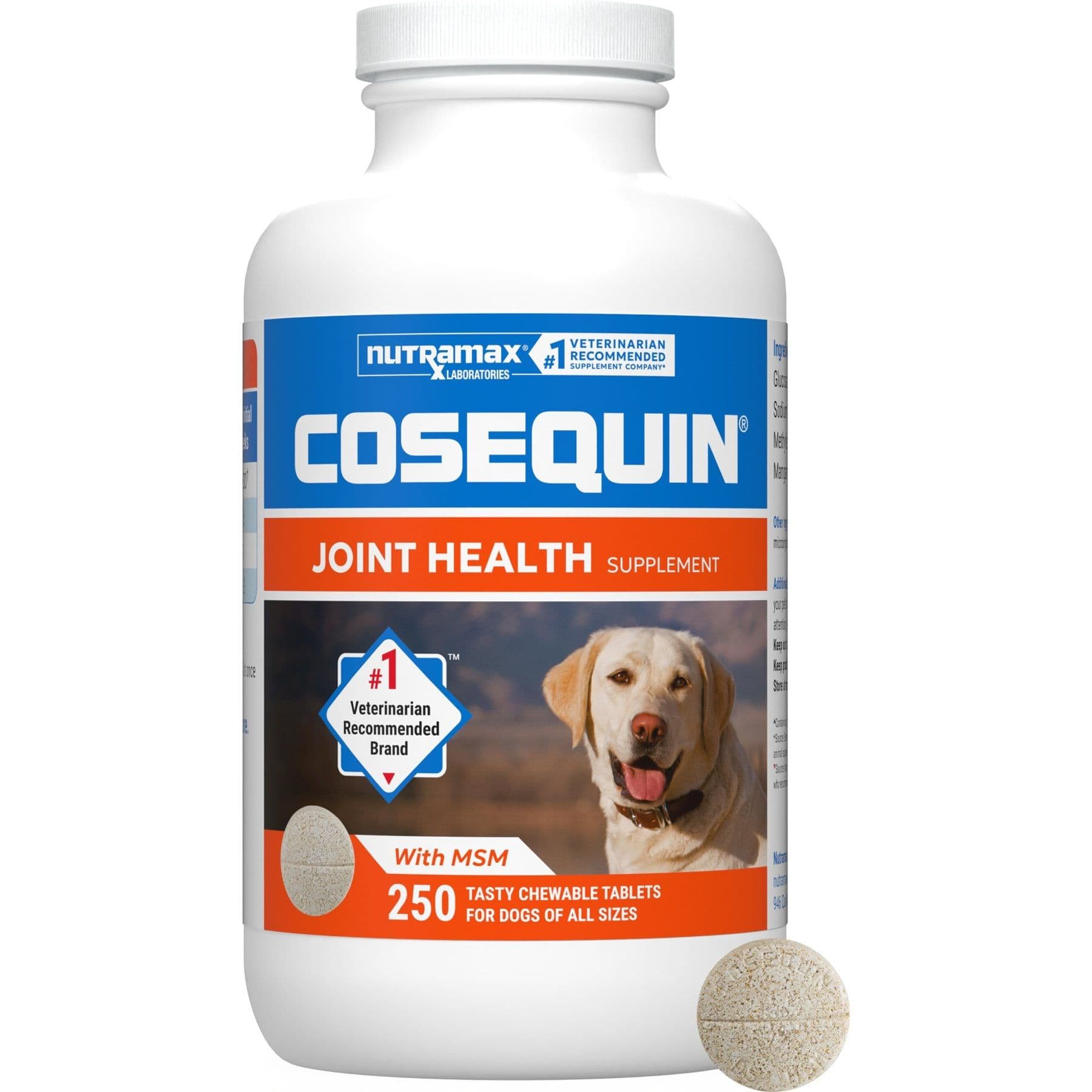
Two 250-tablet bottles of Cosequin Plus MSM. Compare the 500-tablet total and your dog’s labeled maintenance amount before choosing the larger bundle.
Webvet may earn a commission when you click through to Chewy, at no extra cost to you.
 $65 · no membership
Is your dog slowing down or seeming sore?
A licensed vet can examine your dog over video and prescribe treatment online when it's appropriate.
 Talk to a vet
- Licensed vets
- All 50 states
- same-day Rx

Webvet may earn a commission if you book.
Compare daily cost for your dog's weight
Start with a weight you know, then compare the maintenance amount for that dog. A 40-pound dog falls within both the Cosequin tablet 31–60-pound band and the selected Dasuquin tablet 30–59-pound band. That gives a fair same-dog example. The MINI chew example is for a 20-pound dog and should not be compared as though it were a dose for the 40-pound dog.

The arithmetic is package price divided by total units, multiplied by units per day. Thus $119.98 divided by 500 is about $0.24 per Cosequin tablet; $39.99 divided by 84 is about $0.48 per standard Dasuquin tablet. The $44.99 MSM version is about $0.54 per tablet. Taxes, shipping and discounts are excluded, and checkout prices may change.
| Product and selected package | Best fit to discuss | Format and distinguishing ingredients | Maintenance daily cost | Main tradeoff |
|---|---|---|---|---|
| Cosequin Plus MSM, two 250-tablet bottles | A dog whose plan calls for this glucosamine/chondroitin/MSM formula | Chewable tablet; 600 mg glucosamine, 300 mg chondroitin, 250 mg MSM | 40-pound example: one tablet, about $0.24 | $119.98 upfront for 500 total tablets |
| Cosequin MINI Plus MSM & Omega-3, two 45-chew bags | A small dog suited to the MINI label | Small soft chew; 260 mg glucosamine, 130 mg chondroitin, 175 mg MSM, 30 mg omega-3s | 20-pound example: one chew, about $0.33 | Different formula and weight range; 90 total chews |
| Dasuquin Small/Medium, 84 tablets | A veterinarian-selected ASU formula without added MSM | Tablet; glucosamine/chondroitin plus ASU, Boswellia and green tea | 40-pound example: one tablet, about $0.48 | Higher cost than the selected Cosequin tablet bundle |
| Dasuquin with MSM Small/Medium, 84 tablets | A veterinarian-selected ASU formula that also includes MSM | Same listed Dasuquin ingredients plus 400 mg MSM | 40-pound example: one tablet, about $0.54 | More ingredients do not prove a better clinical result |
For a 20-pound dog, Cosequin MINI MSM & Omega-3 soft chews cost about $0.67 daily during the initial two-chew phase and $0.33 at one chew daily for maintenance. A softer format may make administration easier for some dogs, but we have not tested palatability. Make sure the dog actually eats the full portion before considering it a successful substitution.
The label's initial period is four to six weeks; its maintenance column is described as after the initial six weeks. In the 40-pound examples, the initial amounts are two tablets daily, so the corresponding costs are approximately $0.48, $0.95 and $1.07. Do not change the amount early just to match the cheaper maintenance calculation. Your veterinarian may set a different plan after considering your dog's health and response.
Weight-band boundaries deserve attention. A dog weighing exactly 30 pounds uses the Cosequin tablet's 16–30-pound band but the Dasuquin tablet's 30–59-pound band. A calculation using only “medium dog” could therefore compare the wrong amounts. Recheck the label when changing brands, and use a current measured weight rather than a visual estimate. For a fair purchase comparison, write down:
- Total usable tablets or chews in the package, including whether it is a bundle.
- The initial and maintenance amounts for your dog's exact weight.
- The full price you would actually pay, including any subscription condition.
- Whether the supply can be used within its expiry and storage requirements.
The best-price option may change when you compare a smaller trial package with a long-term bundle. That is a purchasing decision, not a reason to switch a dog that is doing well without discussing the change. Keep the old label so your veterinarian can see what changed if tolerance differs.
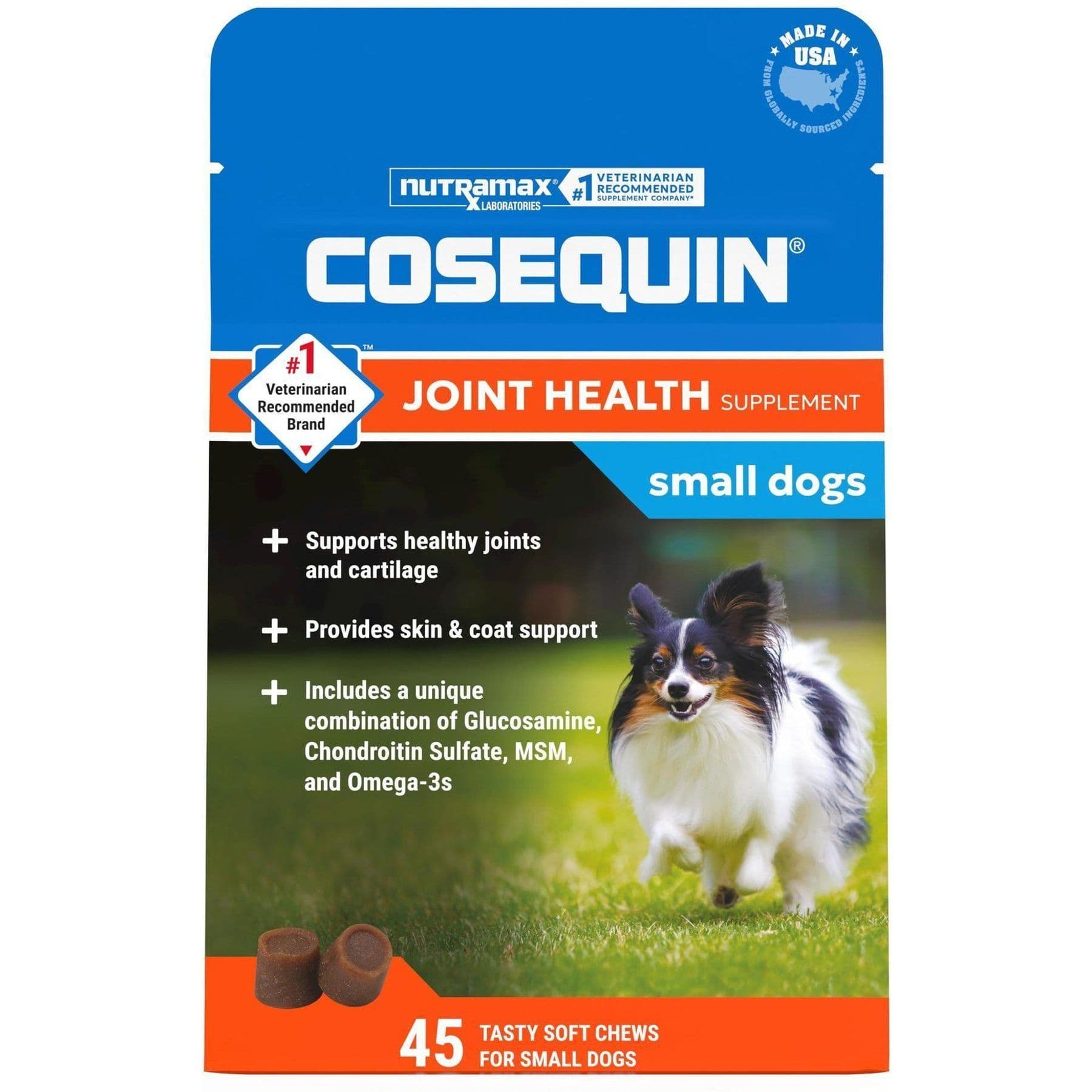
Cosequin MINI soft chews for small dogs, supplied as two 45-count bags. This MSM and omega-3 formula uses its own 5–25-pound directions.
Webvet may earn a commission when you click through to Chewy, at no extra cost to you.
Compare the first purchase with the ongoing expense
The cheapest day and the cheapest first purchase are different questions. The selected Cosequin tablet bundle costs $119.98 upfront, while the selected Dasuquin bottles cost $39.99 or $44.99. A low per-tablet price may make sense for a dog already using the exact formula, but a large bundle may be less appealing when you are still checking whether the dog accepts it.
Do not assume the whole package will be used at the initial amount. A label that changes to maintenance after the initial period requires two calculations if you want to estimate how long the first purchase lasts. Equally, do not describe the entire first bottle as maintenance-only when the dog is beginning treatment. The simple daily figures above deliberately keep those two stages separate.
For ongoing budgeting, compare the supplement with the rest of the care plan. If a more expensive formulation would mean postponing a needed examination or prescribed treatment, explain that constraint to your veterinarian. The useful question is which parts of the plan have the strongest expected benefit for this dog, not which brand occupies the highest price tier.
Compare four dog formulations
The selected packages are Cosequin Maximum Strength Plus MSM chewable tablets, 250 count, bundle of 2; Cosequin MINI small-dog soft chews with MSM and omega-3, 45 count, bundle of 2; Dasuquin small/medium-dog chewable tablets, 84 count; and Dasuquin with MSM small/medium-dog chewable tablets, 84 count.
Cosequin tablets with MSM
The selected Cosequin Maximum Strength Plus MSM package contains two 250-tablet bottles, or 500 tablets total. Each tablet supplies 600 mg glucosamine hydrochloride, 300 mg chondroitin sulfate, 250 mg MSM and 3 mg manganese. The manufacturer's tablet label supports these amounts; they should not be transferred to another Cosequin product.
Its weight chart gives these initial-to-maintenance amounts:
- Up to 15 pounds: half a tablet daily initially, then half every other day.
- 16–30 pounds: one tablet daily initially, then half daily.
- 31–60 pounds: two tablets daily initially, then one daily.
- Over 60 pounds: three tablets daily initially, then one to two daily.
The larger bundle lowers the unit price but also ties up more money in a product your dog may not tolerate or reliably accept. Check expiry dates and storage instructions before buying a long supply. A price comparison is useful only after the formulation fits the care plan.
Cosequin MINI soft chews with omega-3s
The selected MINI package is two 45-count bags, giving 90 chews. Per chew, the small-dog manufacturer label lists 260 mg glucosamine hydrochloride, 130 mg chondroitin sulfate and 175 mg MSM, plus 30 mg total omega-3 fatty acids, including 25 mg combined EPA and DHA.
For dogs weighing 5–10 pounds, the label starts at one chew daily and moves to one every other day for maintenance. At 11–25 pounds, it starts at two daily and moves to one daily. Those are the MINI directions; this chart does not establish an amount below 5 pounds or above 25 pounds. The omega-3 content also does not establish that this chew supplies an individually prescribed osteoarthritis omega-3 dose.
Dasuquin without added MSM
The selected Dasuquin Small/Medium chewable tablets are labeled for dogs under 60 pounds. Each tablet contains 600 mg glucosamine hydrochloride, 250 mg chondroitin sulfate, 45 mg avocado/soybean unsaponifiables, or ASU, 20 mg Boswellia serrata extract and 16 mg green tea extract. This is an 84-tablet bottle.
Those details come from the current Dasuquin tablet formulation. “Dasuquin adds ASU” is an incomplete comparison here: the chondroitin amount differs from the Cosequin tablet, and Boswellia and green tea are present too. A dog already receiving another supplement may therefore be getting overlapping ingredients even if the two product names look different.
Dasuquin with MSM
The selected Dasuquin with MSM Small/Medium tablets add 400 mg methylsulfonylmethane, abbreviated MSM, to the listed standard Dasuquin tablet formula. The manufacturer's MSM tablet page is the appropriate label for this 84-tablet option. MSM is an ingredient, not a synonym for the Dasuquin Advanced line.
For both selected Dasuquin tablets, dogs under 10 pounds receive half a tablet daily in both phases. Dogs at 10–29 pounds receive one initially and half for maintenance; dogs at 30–59 pounds receive two initially and one for maintenance. Two tablets can therefore be a label amount for some dogs, but not a universal instruction. Large-dog tablets, soft chews, Senior, Advanced and Advanced with egg shell membrane require their own labels. Their amounts cannot be reconstructed from this chart.

What changes for a large dog?
Both 84-tablet Dasuquin selections here are the small/medium formulations for dogs under 60 pounds. They are not the selected product for a 60-pound or larger dog. Do not try to manufacture a large-dog serving by multiplying the small/medium tablet count: the ingredient proportions and the labeled chart must be checked on the actual large-dog formulation.
This boundary also affects price comparisons. A Labrador weighing 70 pounds cannot be assigned the $0.48 or $0.54 maintenance examples given for a 40-pound dog. Those figures belong to different labeled products and weight bands. Obtain the large-dog package price and its own directions before deciding whether it is more economical.
The Cosequin tablet label does include an over-60-pound band, but that does not make it equivalent to either small/medium Dasuquin bottle. Similarly, a “90-count Cosequin soft chew” search result may lead to the MINI bundle here, whose chart covers only 5–25 pounds. Check three details together before checkout:
- Full formulation name, including MINI, MSM or any added ingredient wording.
- Dosage form, because a soft chew is not automatically equal to a tablet.
- Labeled weight range, including exactly where the boundary changes.
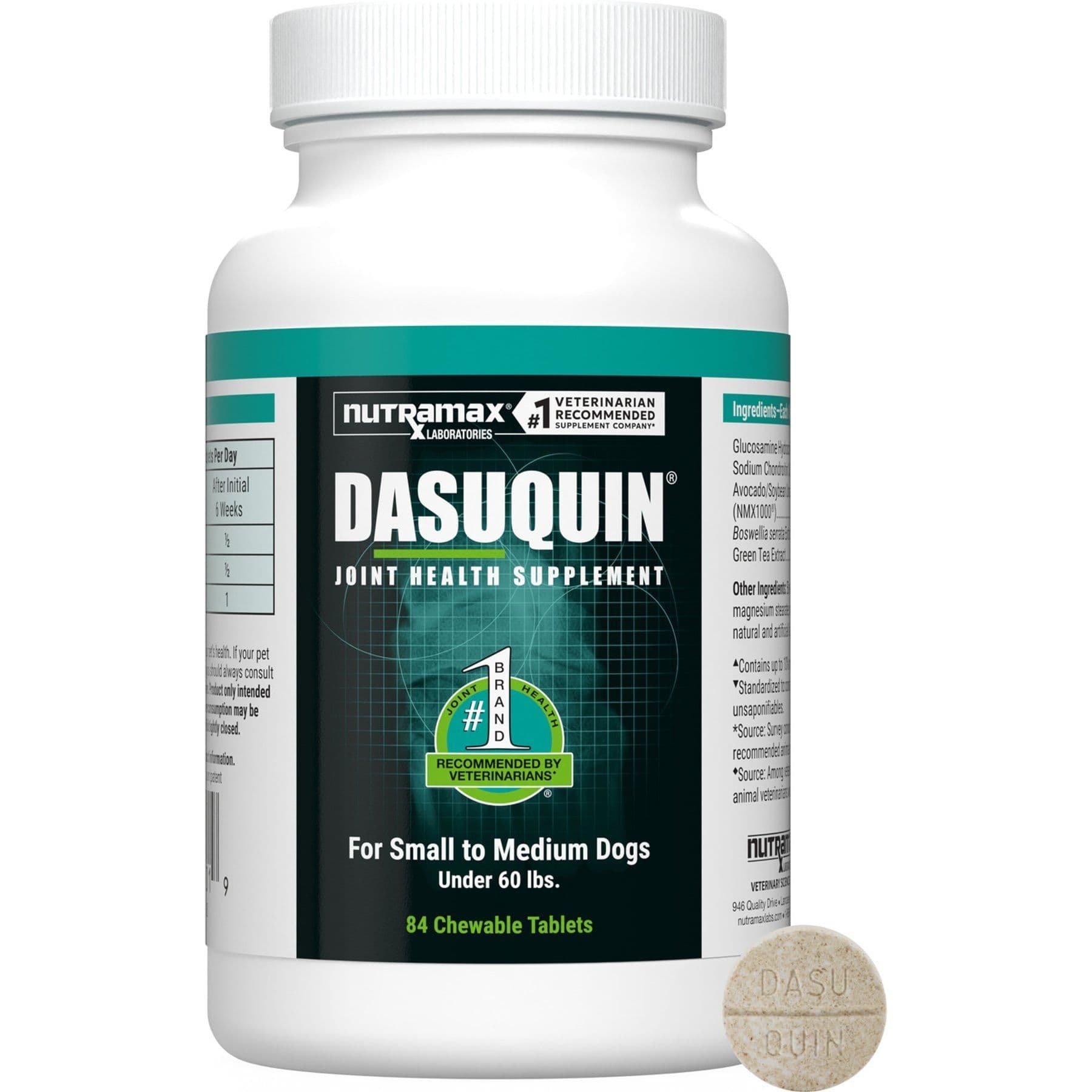
An 84-tablet small/medium-dog Dasuquin option with ASU, Boswellia and green tea, without added MSM. Use the exact under-60-pound label.
Webvet may earn a commission when you click through to Chewy, at no extra cost to you.
Where Dasuquin Advanced and ESM fit
Dasuquin Advanced is a separate product family, not another name for the standard Dasuquin with MSM bottle in this comparison. Nutramax's current product catalog distinguishes standard tablets and soft chews, Senior soft chews, Advanced tablets and soft chews, and Advanced with ESM versions. The catalog identifies the Advanced formulations as veterinarian-exclusive products.
The Advanced chewable tablet page lists additional ingredients including turmeric extract and alpha-lipoic acid, alongside its glucosamine, chondroitin, ASU and other components. The Advanced with ESM soft-chew page identifies egg shell membrane as an ingredient. That does not mean every Advanced form contains ESM, nor that the tablets and soft chews have identical panels.
Use that orientation to ask a more precise question at the clinic: “Which exact Advanced product are you recommending, and what is the reason for its additional ingredients in my dog's plan?” A longer list or veterinary distribution channel does not by itself demonstrate better pain control than one of the four retail formulations here. We have not priced or ranked the Advanced range as a fifth pick.
- If a dog already receives turmeric, an omega-3 supplement or another joint blend, bring those labels too.
- Choosing a combination product might simplify administration, but it could also duplicate ingredients already being given.
- Do not assume added omega-3 amounts replace a separately prescribed amount, or that an ESM label justifies a switch after a particular birthday.
What about Dasuquin Senior?
Dasuquin Senior soft chews are also a separate formula. The manufacturer lists beta-glucans, omega-3s and antioxidants alongside joint-support ingredients, with distinct small/medium and large-dog versions. The difference between standard Dasuquin and Dasuquin Senior includes the format and these added ingredients. The Senior name does not prove superior arthritis relief or mean every older dog should switch; compare the complete label and the reason for changing with your veterinarian.
What the evidence can and cannot tell you
These evidence limitations matter when asking how Dasuquin works or how fast a dog will improve. A label’s initial four-to-six-week schedule is an administration plan, not a guaranteed response time. Agree on a reassessment date and the signs of benefit or worsening with your veterinarian.
Ingredient biology, a manufacturer's joint-support description and an improvement in a clinical trial answer different questions. Glucosamine and chondroitin are commonly included to support cartilage, while ASU and other ingredients are included in different combinations. A plausible mechanism does not establish that a particular finished product reduces a particular dog's pain.

A 2022 systematic review and meta-analysis found no meaningful analgesic effect for the chondroitin-glucosamine products it evaluated in osteoarthritis. That is important context for expectations, but it is not a direct trial of the four current formulations in this comparison. It neither proves one current brand superior nor tests every ingredient combination now sold.
Use three separate questions when weighing a claim:
- Was the research on dogs with the condition your dog actually has?
- Did it study this finished formulation, or only one ingredient in a different setting?
- Did it measure pain and function, or a laboratory marker that may not translate into a noticeable benefit?
For background on the ingredient class, see glucosamine for dogs and cats. If your veterinarian recommends a monitored supplement trial, agree on what success means before starting. Comfortable rising, willingness to walk and ease of getting into position to toilet are more useful observations than “seems younger.” Keep activity conditions similar and record changes in pain medicine so improvement is not automatically credited to the supplement.
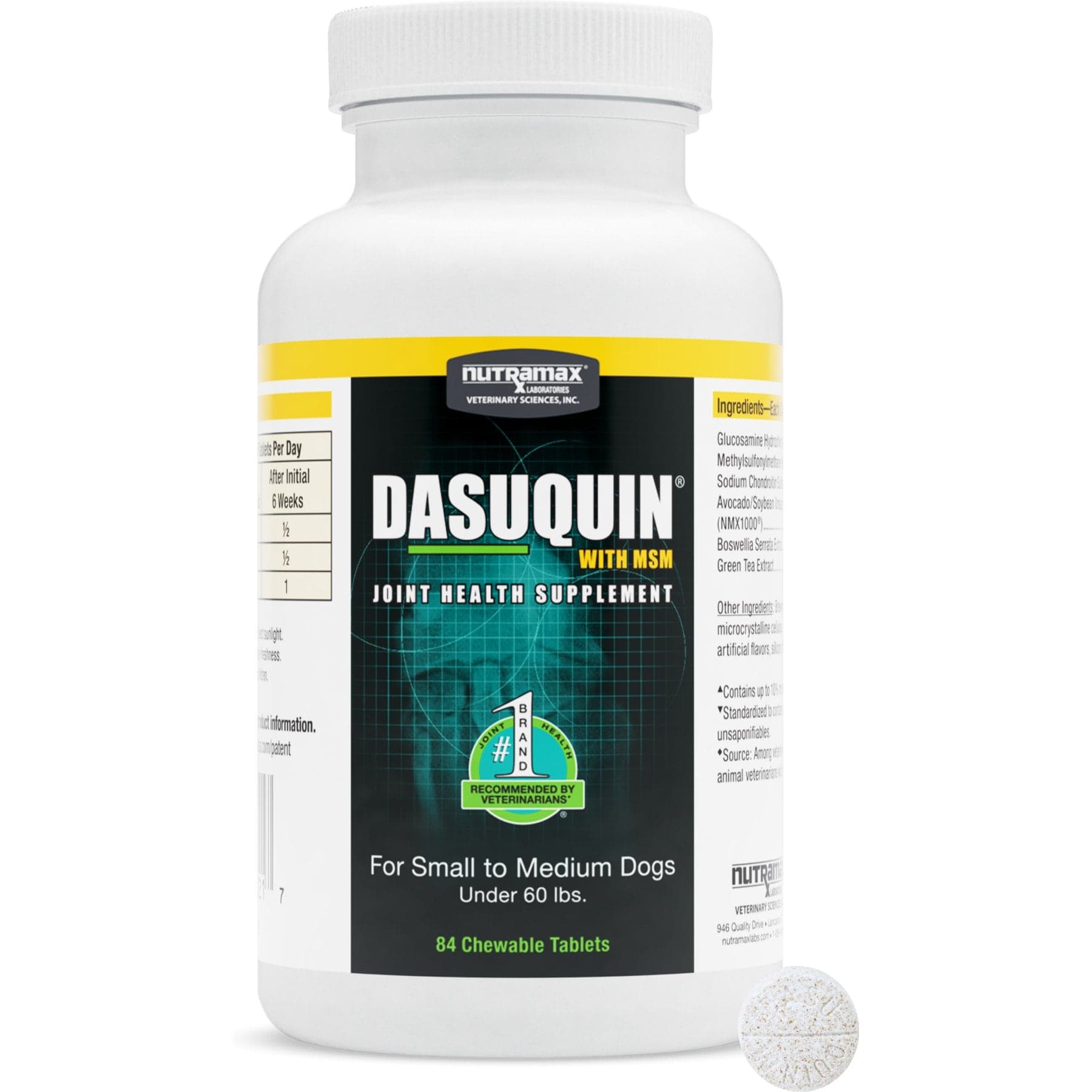
Dasuquin Small/Medium chewable tablets with 400 mg MSM per tablet. Compare the 84-count price and labeled serving with the standard formula.
Webvet may earn a commission when you click through to Chewy, at no extra cost to you.
Evaluate function without turning the trial into a test of endurance
Choose two or three ordinary activities your dog already attempts comfortably enough to observe. Examples include getting up from its usual bed, walking a familiar short route and moving across a nonslip floor. Record what happens naturally. Do not make a sore dog climb stairs or jump into a car to generate a before-and-after comparison.
A simple record can include:
- How much help the dog needs with the selected everyday task.
- Whether it hesitates, stops early or avoids the task altogether.
- The activity and any medicines given that day.
- Appetite, stool changes and whether the supplement was actually consumed.
Short videos under similar conditions may help your veterinarian compare movement over time. Note a change in weather, exercise, flooring or another treatment instead of assuming all improvement belongs to the supplement. Equally, a bad day after unusually strenuous activity should be interpreted in context rather than used alone to declare a product ineffective.
Agree on the reassessment date with the veterinarian. The label's four-to-six-week initial phase is an administration instruction, not proof that every dog improves by a deadline or that worsening pain should be tolerated until then. If the dog becomes less comfortable, contact the practice sooner. If there is no worthwhile benefit at review, discuss whether to continue, stop or change the broader plan.
Age or arthritis severity does not create a proven supplement ladder
It is tempting to assign Cosequin to young dogs, Dasuquin to dogs with arthritis and Advanced to seniors. The current evidence reviewed here does not establish that automatic sequence. A healthy dog's age alone does not demonstrate a need for a joint supplement, and a painful dog's age does not show which extra ingredient will help.
For a dog with diagnosed osteoarthritis, ask how the supplement fits around treatments intended to improve comfort and function. The AAHA pain-management guidelines emphasize individualized, multimodal care and reassessment. A decision to add or change a supplement should preserve that broader plan rather than replace it with a progression through product tiers.
Choosing with your veterinarian
Bring the full label and a list of medicines, foods and supplements to the appointment. Cosequin and Dasuquin can be part of a veterinarian-directed plan that also includes medicines such as carprofen or grapiprant (Galliprant), but the combination should be checked for your dog. Do not assume that being available without a prescription removes the need to review drug interactions or duplicate ingredients.

Vomiting, diarrhea or other stomach upset after starting a supplement deserves attention. Stop the new product and ask your veterinarian how to proceed, particularly if symptoms persist or your dog has another illness. Constipation, a new seizure, abdominal pain, jaundice or worsening mobility should not be written off as a normal adjustment. Temporal association does not by itself prove the supplement caused the problem, but it is still clinically useful information.
There is no reliable basis here to promise that either brand cannot affect a dog with kidney disease, liver disease or elevated liver enzymes, a history of pancreatitis or seizures. Nor do the reviewed sources establish that those disorders are expected effects of normal use. That distinction matters: an unexplained symptom needs investigation, while a search result linking two terms is not a diagnosis.
Choose a format your dog accepts, a label that matches its weight and a budget you can maintain. Add practical help where it makes a difference: mobility aids such as harnesses and ramps can reduce the difficulty of everyday tasks. If getting up or walking remains painful, revisit the treatment plan rather than repeatedly changing supplement brands.
Switching from Cosequin to Dasuquin
A switch should start with the reason for changing. A dog that refuses a tablet presents a different problem from a dog whose mobility is deteriorating, and vomiting after a new product is different again. If the problem is uncontrolled pain, a brand substitution alone may miss what needs treating. If the problem is administration, another suitable format may address it without implying a clinical upgrade.
Give the veterinarian the old label, proposed new label and the amount currently given. Ask for a clear switch plan covering when to stop the old product, when to start the new one and which initial or maintenance directions apply. Do not assume the labels require a universal washout interval, that no interval could ever be needed, or that overlap is automatically safe. Other medicines, adverse effects and the dog's health can change the advice.
Before starting the new bottle, confirm:
- Whether the old supplement stops completely and on which day.
- Whether the new formulation uses an initial phase for this dog.
- Which other supplements remain in the plan.
- What signs should prompt stopping the new product and calling the practice.
Write the change on the household feeding instructions so two caregivers do not continue different products by mistake. Keep the packaging and record the switch date. If symptoms develop, the exact timing and amounts are more useful than saying that the dog “changed joint supplements.” Do not restart a product suspected of causing a significant reaction simply to see whether the reaction happens again.
Combining Cosequin, Dasuquin and other joint supplements
Do not routinely give Cosequin and Dasuquin together. These selected products overlap in glucosamine and chondroitin, and some also overlap in MSM and other ingredients. Giving the full labeled amount of both is not the same as creating an evidence-based combination, and it may make it harder to identify which product caused a problem.
For example, one selected Cosequin MSM tablet plus one selected Dasuquin MSM small/medium tablet contains a combined 1,200 mg glucosamine hydrochloride, 550 mg chondroitin sulfate and 650 mg MSM. That arithmetic illustrates duplication; it is not a recommended daily amount or evidence that the combination is safe for a particular dog. The Dasuquin tablet also brings ingredients that are not in the selected Cosequin tablet.
To avoid accidental duplication:
- Count ingredients from every relevant source, including another joint chew or multicomponent topper.
- Share the full list with your veterinarian rather than reviewing each bottle in isolation. A multivitamin may still contain joint-support ingredients.
- Keep one current household record of what is being given, especially while using up or replacing a bottle.
Do not stop prescribed pain medicine because a supplement has been added or because your dog appears brighter on a good day. If comfort improves, discuss whether a supervised change is appropriate. If the dog is worse, an extra chew from the second bottle is not an appropriate rescue treatment.
Cosequin and Dasuquin questions
Frequently Asked Questions
What is the lawsuit against Cosequin for dogs?
Lytle v. Nutramax is a California class action challenging certain Cosequin marketing claims. The court-authorized notice describes an $11.5 million settlement, says Nutramax denies wrongdoing and explains that the court did not decide either side was right. Final approval and payment status were not verified here. The allegations and settlement notice are separate from scientific evidence about current formulations.
Does Dasuquin help with pain?
Dasuquin is sold for joint support, but it should not be relied on as immediate pain relief. The evidence reviewed here does not establish the selected tablets as a substitute for prescribed analgesia. If a dog is limping, reluctant to rise or waking because it cannot get comfortable, veterinary pain assessment is the next step. A supplement trial should have a planned reassessment rather than delaying that care.
Is there anything better than Cosequin for dogs?
“Better” depends on the problem. A dog with untreated arthritis pain may benefit more from a complete veterinary treatment plan than from switching supplements. A dog refusing tablets may need a different format; a dog with an adverse reaction needs a suitability review. Dasuquin offers different ingredients, but this comparison found no current head-to-head evidence establishing that it is clinically better for every dog.
Is Dasuquin better than Cosequin?
Not demonstrably across all dogs and formulations. The selected Dasuquin tablets contain ASU, Boswellia and green tea, and the MSM version adds MSM. Those differences may inform a veterinarian's choice, but ingredient count is not a validated ranking. The selected Cosequin tablet bundle costs less per maintenance day for a 40-pound dog. That is a price advantage, not evidence of superior symptom control.
What is the best joint supplement for dogs?
There is no single product established here as best for every dog. A useful choice requires a diagnosis, evidence relevant to the desired outcome, a suitable formulation and a realistic budget. Ask your veterinarian what benefit they expect, how they will assess it and when to stop if it is not helping. Popularity, online ratings and a long ingredient list cannot answer those questions on their own.
Do any joint supplements really work for dogs?
Evidence differs by ingredient, formulation and outcome. The cited systematic review found more favorable evidence for omega-3 approaches than for glucosamine-chondroitin analgesia, but that does not validate every omega-3-containing chew or dose. A product may have a plausible joint-support rationale without proven pain relief. Evaluate the actual formulation and trial evidence with your veterinarian, and track function rather than assuming improvement from a marketing description.
What is the best treatment for senior dogs with arthritis?
Senior dogs usually need an individualized plan combining pain control, appropriate activity, weight management where needed and changes that make the home easier to navigate. Other diseases and current medicines affect treatment choices. Supplements may be discussed within that plan, but should not displace treatments needed for comfort. Ask for a follow-up schedule and specific signs that mean the plan needs adjusting rather than waiting for a supplement to rescue worsening pain.
$65 · no membershipIs your dog slowing down or seeming sore?
A licensed vet can examine your dog over video and prescribe treatment online when it's appropriate.
Talk to a vet- Licensed vets
- All 50 states
- same-day Rx
Webvet may earn a commission if you book.
Veterinarian · BVMS MRCVS
Dr. Pippa Elliott, BVMS, MRCVS, is a veterinarian with nearly 30 years of experience in companion animal practice. Dr. Elliott earned her Bachelor of Veterinary Medicine and Surgery from the University of Glasgow. She was also designated a Member of the Royal College of Veterinary Surgeons. Married with 2 grown-up kids, Dr. Elliott has a naughty Puggle named Poggle, 3 cats and a bearded dragon.


