Can Dogs Take Human Probiotics? A Vet's Guide
Human probiotics are not safety-tested for dogs. Learn why a dog-specific probiotic is the safer starting point, how to check an exact formula, and when digestive signs need a vet.
Medically reviewed by Dr. Athena Gaffud, DVM · Last reviewed

This article contains affiliate links. Webvet may earn a commission when you buy through them, at no extra cost to you.
Can dogs take human probiotics? A human probiotic label does not establish safety or benefit for a dog; evidence must match the exact formulation, amount and intended use. Veterinarians generally advise a probiotic formulated specifically for canine use. That does not make the bottle in your medicine cabinet a good automatic choice. The useful questions are which organisms a product contains, what else is in it, and whether that formulation was made for your dog.
A dog-specific product gives owners directions intended for dogs and a clearer way to discuss daily support with their vet. PetLabCo.® offers two different approaches: dedicated Probiotic Chews for gut-focused support and DF-14 Daily Foundation for owners considering broader daily coverage. Choosing between them starts with your dog's needs, not the largest number on the label.
Sponsored content: WebVet maintains editorial control over this article, which is sponsored by PetLabCo.®. WebVet may earn a commission from purchases made through its affiliate links.
Human probiotics are not all harmful, but the exact ingredients, formula and dose matter. Ask your veterinarian before sharing your supplement. A dog-specific product can simplify daily use; it does not replace assessment of persistent digestive signs.
- While they may not be harmful, human products are not safety-tested for use in dogs.
Can dogs take human probiotics safely?
Human branding alone does not establish their safety or efficacy for a dog. It is important to note that human products are not safety-tested for use in dogs, and veterinarians generally advise the use of a probiotic specifically formulated for canine use. The specific formulation and format matters - a plain capsule and a flavored gummy can contain very different added ingredients. Two products that both say “probiotic” may contain different organisms, amounts and combinations. Your dog's age, medications and medical history also affect the decision. Signs such as diarrhea do not, by themselves, show that your dog needs a probiotic.
For that reason, show your veterinarian the full product label rather than asking whether probiotics in general are safe. Include the front of the package, ingredient panel and recommended serving. If the product has a separate sweetener or “other ingredients” list, photograph that too. A familiar brand name does not identify everything inside a particular version.
A practical starting point is to ask:
- What is the goal: routine digestive support or help with a diagnosed problem?
- Has this exact formulation been studied in dogs for that goal?
- Is every added ingredient appropriate for my dog?
- What amount and follow-up plan does my veterinarian recommend?
If routine canine gut support is the goal, PetLabCo.® Probiotic Chews provide a dog-specific option with weight-based label directions. They are intended for dogs 12 weeks and older. Check suitability before adding them, particularly if your dog already receives another digestive supplement. Related reading: Petful’s PetLabCo. Probiotic Chews review.
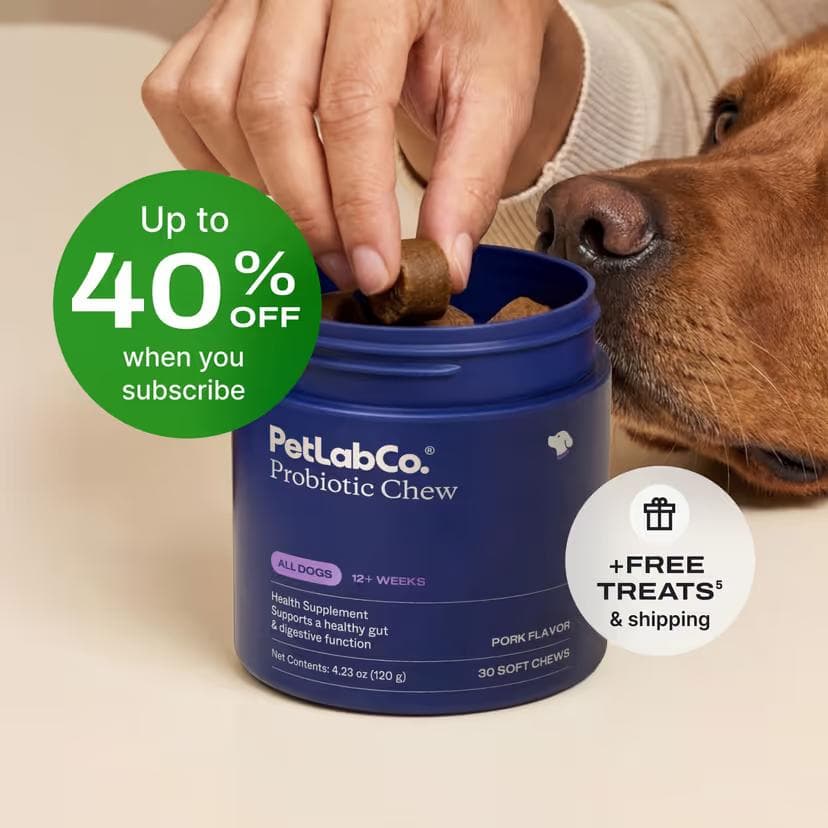
Clinically studied probiotic soft chews that support your dog's gut health while targeting occasional loose stools and seasonal allergies. Pork flavor, 30 chews per tub.
Webvet may earn a commission when you click through to PetLabCo.®, at no extra cost to you.
Why strains and formulas matter
Probiotics are live microorganisms given for a health benefit. The name on the label can include a genus, species and sometimes a strain designation. A strain is a more specific identifier than the species name alone. Research about one strain or combination does not automatically establish the same outcome for every product containing a similarly named organism.
The evidence needs to fit the exact strain, amount and formula, as well as the patient and intended outcome. Studies in healthy adult dogs, for example, do not automatically establish treatment of illness in a puppy. Ask what was measured and in which dogs before interpreting a result as a reason to choose one formula.
This is also why the human-versus-dog distinction needs some care. Dog-specific labeling can make selection and serving instructions easier, but it is not a substitute for relevant evidence. Likewise, an organism also used in human products is not automatically useless in dogs. The match between the organism, formulation, amount and intended use is what matters. While some may not be harmful, human products are not safety-tested for use in dogs. Evidence for one formulation does not establish the benefits of another.
What a study can tell you
For example, a controlled study in healthy dogs assessed a specifically identified Bacillus coagulans strain and particular outcomes. It cannot establish benefits for a different blend whose public label does not identify that same strain. Ask about the evidence behind the exact product under consideration.
Three label terms worth separating
- Probiotics: live microorganisms in the formula.
- Prebiotics: substrates used by microorganisms; these are not themselves live probiotic organisms.
- CFU: colony-forming units, a way of describing viable-organism quantity. A higher count alone does not prove a better match for your dog.
PetLabCo.®'s guide to dogs and human probiotics offers additional brand context. Use that alongside the label and veterinary advice when deciding whether you want a dedicated canine gut product or a broader supplement.
When you compare two labels, note what each one actually identifies. A species name such as Bacillus coagulans is useful information, but it is not the same as a named strain code from a particular study. If the public label does not provide that detail, leave the comparison at the level the evidence supports. You can still compare ingredients, format and serving instructions without claiming that another product's trial proves the same outcome.
 $65 · no membership
Worried about your dog's vomiting or diarrhea?
A licensed vet can examine your dog over video and prescribe treatment online when it's appropriate.
 Talk to a vet
- Licensed vets
- All 50 states
- same-day Rx
Webvet may earn a commission if you book.
Doses, additives, and accidental ingestion
There is no universal human-probiotic dosage chart that can safely convert every adult capsule into a dog serving. The universal efficacy and suitability of human probiotics for dogs has not been clinically tested. Dividing your dose by body weight ignores differences in the organisms, concentration and added ingredients. It may also create an inaccurate serving if the contents do not mix evenly or the product is not intended to be divided.
The label check should cover the organism and strain, amount per serving, added ingredients, storage requirements, and your dog's age and health. Bring the actual package to the conversation. “One capsule” is a format description, not a standardized dose across brands.
Be especially careful with gummies, chewables and flavored powders. Some human products contain xylitol, also called birch sugar, which is toxic to dogs. If your dog may have swallowed a xylitol-containing product, contact a veterinarian or animal poison-control service immediately. The AKC's xylitol guidance explains why possible exposure needs prompt professional advice.
If your dog ate a bottle of probiotics or swallowed an unknown amount, note the product, likely amount and time. Keep the packaging. Even when xylitol is absent, a professional may need to assess the other ingredients, how much was eaten and the dog's condition. Follow professional instructions instead of giving another supplement in an attempt to “balance out” the first one.
Choosing dog-specific daily support
The best probiotic for a dog is the one that fits the intended use, full formula and individual animal. A dedicated gut chew and a multifunctional powder can both contain probiotic organisms while serving different daily routines. There is no need to treat them as competing versions of the same formula or assume both should be given together.
| Decision | Probiotic Chews | DF-14 Daily Foundation |
|---|---|---|
| Main fit | Dedicated, gut-focused daily support | Broader whole-body daily support with a probiotic component |
| Format | Standard 4 g soft chew | Powder mixed with food |
| Probiotic label | B. coagulans, B. clausii and B. subtilis blend; 3 billion CFU per chew | Different blend with B. subtilis, B. animalis subsp. lactis and S. boulardii; amounts vary by serving |
| Serving approach | Daily chew count follows weight tiers | Size-specific tub and scoop directions |
| Decision to discuss | Whether a dedicated gut-support product fits | Whether the broader ingredient combination fits the whole diet and supplement routine |
The Probiotic Chews also list FOS and GOS prebiotics, each at 100 mg per chew, plus a 75 mg postbiotic yeast blend. This clearly labeled combination gives owners a practical gut-focused option to discuss with their veterinarian. Its strengths are the defined formula, canine directions and convenient daily format.
Clinically studied probiotic soft chews that support your dog's gut health while targeting occasional loose stools and seasonal allergies. Pork flavor, 30 chews per tub.
Webvet may earn a commission when you click through to PetLabCo.®, at no extra cost to you.

For owners who want probiotic support as one part of a broader daily routine, DF-14 Daily Foundation combines its probiotic blend with other ingredients intended for multiple areas of everyday support. Its organism blend and serving amounts differ from the soft chews. Comparing the two solely by CFU would overlook their different purposes.
DF-14 also adds a broader ingredient list to review, including animal-derived ingredients. Tell your vet about food sensitivities and other supplements. The decision may be a gut-focused chew, the broader powder, another vet-directed plan or no additional supplement. A clear purpose makes that discussion more useful than automatically stacking products. Related reading: Vetstreet’s PetLabCo. product guide.
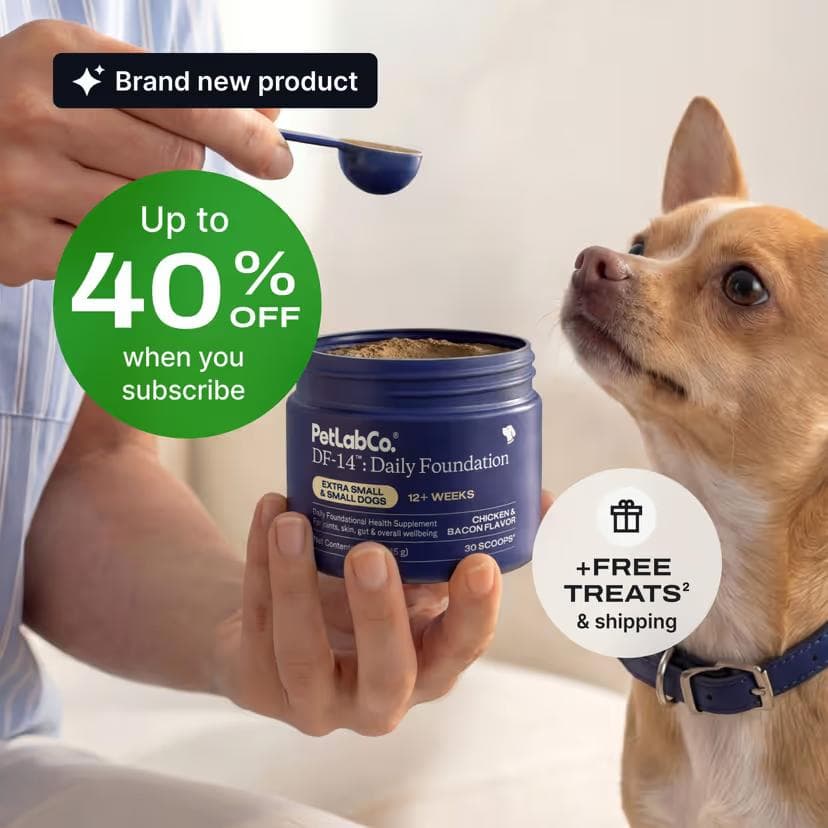
One daily scoop of whole-body support. DF-14 covers gut health, joints, skin, immune function, and more in a single multifunctional powder for dogs.
Webvet may earn a commission when you click through to PetLabCo.®, at no extra cost to you.
What about yogurt, pumpkin, and homemade probiotics?
Foods and supplements are not automatically interchangeable. Some plain fermented foods contain live cultures, but the organisms and amounts may not match a studied canine supplement. A food can also add calories, fat, lactose or ingredients your dog does not tolerate. “Natural” does not resolve those practical questions.
Do not try to make a homemade probiotic culture for a sick dog. Home fermentation does not give you a verified organism blend, dose or contamination check. It also creates a new variable when your veterinarian may be trying to identify the reason for digestive changes. A commercial food with live cultures still needs its ingredient list checked before it is offered.
If your goal is simply a steady digestive routine, your vet may first focus on:
- A complete and balanced diet appropriate for the dog.
- Consistent portions and a gradual transition when changing foods.
- Avoiding sudden additions of rich treats or table scraps.
- Investigating recurring signs instead of adding more products.
Pumpkin and other fiber-containing foods belong in a separate discussion about the diet. They do not supply a standardized probiotic formula. For a dog with diarrhea, a homemade or “natural” probiotic remedy cannot replace assessment of the cause. Ask what dietary change, if any, is appropriate before replacing the dog's usual food or prescribed plan.
Building a sensible daily routine
If your veterinarian agrees that a dog-specific supplement fits, use one clearly defined plan. For the PetLabCo.® Probiotic Chews, current label directions are one soft chew daily for dogs under 25 lb, two for dogs 25–75 lb, and three for dogs over 75 lb. Each soft chew weighs 4 g.
Keep the product in its original container so the identity, lot information and directions remain available. Follow its storage instructions and use the scoop or serving method intended for that product. For this soft chew, the label specifies a cool, dry place away from direct sunlight. Heat and careless storage are not ways to improve a live-organism supplement.

Track the reason you started the product and what changes you observe. A simple record of appetite, stool pattern and any simultaneous food changes can make follow-up more informative. Starting several new supplements at once makes it harder to identify what your dog tolerates.
Agree on three practical details with the person who feeds your dog:
- Which exact product is being used, including the formula name.
- Who gives the daily serving so it is not accidentally repeated.
- Which changes in appetite, comfort or stool should prompt a call.
This is especially useful in a household with several dogs. Store the tubs separately from treats, and check each dog's individual plan instead of assuming the same supplement and serving suit everyone.
The Probiotic Chews label recommends veterinary assessment before use. It also advises stopping and consulting a veterinarian if the condition worsens or does not improve. Discuss medications, pregnancy or breeding plans beforehand; a general “daily use” direction is not proof that the formula is appropriate for every dog indefinitely.
Clinically studied probiotic soft chews that support your dog's gut health while targeting occasional loose stools and seasonal allergies. Pork flavor, 30 chews per tub.
Webvet may earn a commission when you click through to PetLabCo.®, at no extra cost to you.
When diarrhea changes the decision
A question about sharing a probiotic becomes a different decision when the dog is unwell. Diarrhea has many possible causes, and a supplement cannot identify which one is present. Do not delay needed care for significant diarrhea while trying a probiotic. Blood, repeated vomiting, pain, weakness, reduced appetite or suspected toxin or foreign-body exposure needs veterinary advice rather than a trial of whatever supplement is available.
For the separate adult-dog question, our guide to probiotics for dogs with diarrhea explains the broader supportive-care context. Young puppies and medically vulnerable dogs need their own assessment. Do not assume advice for a bright adult dog applies to a small puppy losing fluid.
Evidence is also more nuanced than “probiotics stop diarrhea.” Research reviews find variable results across the tested formulations and situations. Your veterinarian can decide whether a specific product belongs alongside the rest of the care plan. The need for diagnosis, hydration or prescribed treatment does not disappear because a supplement is easy to buy.
Frequently Asked Questions
Is pumpkin a probiotic for dogs?
Plain pumpkin supplies fiber; it is not a standardized live probiotic formula. That makes it a different dietary tool, not a substitute for a selected probiotic product. Whether extra fiber makes sense depends on the dog and the reason for the digestive change. Ask your vet before adding daily portions, especially when your dog is already eating a therapeutic diet or has ongoing signs.
Can dogs take human probiotics every day?
That depends on the specific formula and the dog's needs. A human label does not establish an appropriate canine serving or a reason for continuous use. If your veterinarian recommends a particular product, agree on the amount, purpose and timing of reassessment. Continued use should have a clear rationale; do not keep adding capsules simply because a previous bottle caused no obvious problem.
What if my dog ate a human probiotic capsule?
Keep the packaging and contact your veterinarian with the dog's weight, amount swallowed, time of ingestion and complete ingredient list. A single plain capsule and several sweetened gummies are different exposures. If xylitol or another concerning ingredient is possible, seek immediate veterinary or poison-control advice without waiting for signs. Do not induce vomiting or give additional products unless directed.
About PetLabCo.® and this guide
PetLabCo.® offers canine supplements in several formats. Here, its dedicated Probiotic Chews and multifunctional DF-14 illustrate two distinct daily-support decisions. The comparison uses published label information and veterinary sources, with suitability determined for the individual dog.
PetLabCo.® products are not intended to diagnose, treat, cure, or prevent any disease. Consult your veterinarian before starting any new supplement regimen.
$65 · no membershipWorried about your dog's vomiting or diarrhea?
A licensed vet can examine your dog over video and prescribe treatment online when it's appropriate.
Talk to a vet- Licensed vets
- All 50 states
- same-day Rx
Webvet may earn a commission if you book.

Veterinarian · DVM
Athena Gaffud, DVM, is a licensed veterinarian and writer based in the Cagayan Valley of the northern Philippines. She runs the website countryvetmom.com. Dr. Gaffud earned her Doctor of Veterinary Medicine degree from the University of the Philippines Los Baños in 2011, ranking in the top 10 and receiving the Best Undergraduate Thesis Award in Large Animals. With over a decade of experience, she has worked as a researcher, a practitioner for small and large animals, and in veterinary technical sales, marketing, and pet insurance. A published author, Dr. Gaffud promotes responsible pet ownership and combats misinformation on animal care through her platforms, including the DocAthena Facebook Page and DocAthena YouTube channel. She is a writer and editor for various pet-related websites such as Total Vet, Honest Paws, PangoVet, Dogster, Catster, My Best PH, Paw Origins, Bully Max, Not a Bully, Paws and Claws CBD, many others. She was also cited in different pet-related media articles such as The Dog People, USA Today, Newsweek, New York Post, Reader’s Digest, Smithsonian Magazine, Woman’s World, Dog Time, Patch, Kinship, Martha Stewart, and many others. Moreover, she is also a published fiction author on Kindle.


