Best Taurine Supplement for Dogs
Choosing a taurine supplement starts with your dog’s diet and health. Compare standalone and multifunctional options, understand label amounts, and learn when your veterinarian should guide the plan.

This article contains affiliate links. Webvet may earn a commission when you buy through them, at no extra cost to you.
Choosing a taurine supplement for dogs starts with a useful distinction: supporting an everyday nutrition routine is different from correcting a diagnosed deficiency. The right choice depends on your dog’s complete diet, health history, and the amount your veterinarian actually wants you to give.
For owners seeking taurine within broader daily support, PetLabCo.® DF-14 Daily Foundation is our featured multifunctional option. Its size-specific formulas combine taurine with L-carnitine and other ingredients. A dog needing an individually prescribed taurine amount may need a different approach, so the label and the purpose should agree before you buy. Related reading: Petful’s guide to L-carnitine for dogs.
Sponsored content: WebVet maintains editorial control over this article, which is sponsored by PetLabCo.®. WebVet may earn a commission from purchases made through its affiliate links.
Key Takeaways
- 1Taurine has important physiological roles, but a healthy dog does not automatically need an extra supplement.
- 2A veterinarian can review diet history, clinical signs, and appropriate testing when deficiency is a concern.
- 3DF-14 supplies 42.5–315 mg of taurine per labeled serving, depending on dog size. It is a whole-body support formula.
- 4Compare the label amount with the veterinary plan. Do not increase a multifunctional powder to reach an independently chosen taurine dose.
- 5Diet-associated dilated cardiomyopathy, or DCM, is complex. A grain-free label alone cannot diagnose a nutritional problem or establish a solution.
| Product | Form (dog-specific label) | Taurine per serving | Other actives | Age minimum | Serving |
|---|---|---|---|---|---|
| PetLabCo.® DF-14 Daily Foundation (our pick) | Powder, chicken and bacon flavor; dog-specific label: yes | 42.5 mg (extra small), 85 mg (small), 200 mg (medium), 315 mg (large) per size-specific scoop | L-carnitine 10 to 75 mg, probiotic blend, postbiotic yeast, prebiotic FOS, krill omega-3, glucosamine HCl, chondroitin sulfate, astragalus extract, cranberry extract, lactoferrin, sodium hexametaphosphate, vitamins C and E, beta-carotene | Over 12 weeks | One scoop from the correct size tub once daily at mealtime, wet or dry food |
| Dr. Oscar Taurine for Dogs with L-Carnitine | Chewable tablet, chicken flavor; dog-specific label: yes | 500 mg per tablet | L-carnitine 50 mg | Not stated on label | 1 tablet daily up to 25 lb; 2 tablets 26 to 50 lb; 3 tablets 51 to 75 lb; 4 tablets 76 lb and up |
| Herbsmith Taurine Boost | Powder; dog-specific label: yes (dogs and cats) | 212 mg per teaspoon (2.3 g) | L-carnitine 424 mg, EPA 110 mg, DHA 61 mg, coenzyme Q10 24 mg, whole-ground krill on a flaxseed carrier | None stated; label says suitable for puppies and kittens | Dogs under 20 lb: 3/4 tsp twice daily; 21 to 40 lb: 1 1/2 tsp; 41 to 80 lb: 3 tsp; 81 to 120 lb: 4 1/4 tsp; over 120 lb: 5 tsp, each twice daily |
| VetriScience Extra Strength Healthy Heart for Dogs (formerly Vetri Cardio Canine) | Soft chew, chicken flavor; dog-specific label: yes | 250 mg per 5 g soft chew | L-carnitine HCl 250 mg, arginine 150 mg, hawthorn berry extract 100 mg, magnesium 60 mg, DMG 50 mg, berberine HCl 50 mg, coenzyme Q10 30 mg, folic acid 0.9 mg, potassium 0.1 mg | Not stated on label | 1 soft chew per 30 lb of body weight daily; split between AM and PM if giving more than one |
Our ranked picks for taurine supplements
We ranked these four products on the same criteria the rest of this guide uses: a clearly stated taurine amount per actual serving, a dog-specific label with weight-based directions, a transparent list of the other actives your dog receives alongside taurine, and how well the format fits the reason you are buying. PetLabCo.® DF-14 Daily Foundation ranks first because it is the only option here that pairs a labeled taurine amount with L-carnitine and a broader daily support formula in one scoop, which is the use case most owners searching this phrase actually have.
One honest caveat shapes the rest of the list. If your veterinarian has set a specific standalone taurine amount, a multifunctional powder is not the right tool, because raising the scoop count also raises every other ingredient. For that brief, the Dr. Oscar tablet below is the closest fit among the products we verified. The remaining two picks are heart-focused blends where taurine shares the label with L-carnitine and other actives. We did not hands-on test any product; every fact comes from the manufacturer's own product page.
1. PetLabCo.® DF-14 Daily Foundation: best for taurine within daily whole-body support
DF-14 earns the top spot for owners who want taurine as part of an everyday routine rather than as a single-ingredient add-on. Each size-specific scoop lists its taurine amount plainly: 42.5 mg for dogs under 4 lb, 85 mg for 4 to 24.9 lb, 200 mg for 25 to 75 lb, and 315 mg for dogs over 75 lb. L-carnitine scales the same way, from 10 mg to 75 mg, so the two ingredients most often discussed together in canine heart nutrition arrive in one measured serving.
What separates DF-14 from a dedicated taurine product is everything else in the scoop: a probiotic and postbiotic blend, prebiotic FOS, krill omega-3, glucosamine and chondroitin, astragalus extract, cranberry, lactoferrin, and vitamins C and E with beta-carotene. That breadth is the point. It is a chicken-and-bacon flavored powder labeled for dogs over 12 weeks, given once daily on wet or dry food, and it can stand in for several separate general-wellness products with one measured scoop. It is the pick for a healthy dog whose owner wants taurine covered inside a daily foundation, not for correcting a diagnosed deficiency.
2. Dr. Oscar Taurine for Dogs with L-Carnitine: best for a veterinarian-set standalone taurine amount
When a clinician has named a taurine number, the product needs to deliver taurine in predictable, adjustable units without dragging a dozen other actives along. Dr. Oscar Taurine for Dogs with L-Carnitine does that: each chicken-flavored chewable tablet supplies 500 mg of taurine with 50 mg of L-carnitine, and the label steps the count by weight, from one tablet daily for dogs up to 25 lb to four tablets daily at 76 lb and above.
Because the tablet is essentially taurine plus a small amount of carnitine, a veterinarian can match or adjust the count to a prescribed plan more cleanly than with any blend on this list. The label does not state a minimum age, so confirm suitability for a puppy with your clinician. Treat the weight chart as the manufacturer's serving, not as the medical dose; the prescribing veterinarian sets that.
3. Herbsmith Taurine Boost: best powder for households with dogs and cats
Herbsmith Taurine Boost is labeled for dogs and cats of all ages, including puppies and kittens, which makes it the practical choice when one container needs to serve more than one species. A level teaspoon (2.3 g) supplies 212 mg of taurine alongside 424 mg of L-carnitine, 110 mg EPA, 61 mg DHA, and 24 mg coenzyme Q10, delivered on whole-ground krill and flaxseed.
Note the ratio: this is a carnitine-forward heart formula in which taurine is the second active, and the directions call for twice-daily servings that scale from 3/4 teaspoon for dogs under 20 lb to 5 teaspoons for dogs over 120 lb. The label cautions against use in pregnant animals and within 48 hours of surgery, and asks owners to check with a veterinarian for dogs with clotting disorders, anticoagulant treatment, diabetes, or shellfish allergy.
4. VetriScience Extra Strength Healthy Heart for Dogs: best heart-focused soft chew
Formerly sold as Vetri Cardio Canine, VetriScience Extra Strength Healthy Heart for Dogs is the most complete cardiac blend of the group. Each 5 g chicken-flavored soft chew carries 250 mg of taurine and 250 mg of L-carnitine HCl, plus arginine, hawthorn berry extract, magnesium, DMG, berberine, 30 mg coenzyme Q10, folic acid, and potassium. Directions are one soft chew per 30 lb daily, divided between morning and evening if more than one is given.
It fits an owner who specifically wants a heart-support soft chew that a dog will accept as a treat, rather than a powder. As with DF-14, the taurine amount cannot be raised without raising every other active, so it is a support formula rather than a tool for a prescribed standalone taurine amount. The label does not state a minimum age.
What taurine does for dogs
Taurine is an amino sulfonic acid involved in normal cellular functions, including those of the heart and retina. It also participates in bile-acid processes that help the body handle dietary fats. These normal roles explain why taurine matters; they do not mean that extra taurine will improve every dog’s heart, eyesight, or energy.
Dogs can generally make taurine from sulfur-containing amino acids supplied by their diet. This process of taurine synthesis depends on having the necessary dietary building blocks. That makes their nutritional situation different from cats, which have a specific dietary taurine requirement. Whether an individual dog maintains adequate taurine depends on more than the presence of one ingredient on a bag: the overall diet, digestion, metabolism, and patient all matter.
It helps to separate three questions:
- Does the dog need adequate taurine? Yes, normal taurine status matters to health.
- Does every dog need a taurine supplement? No. A complete diet and the dog’s clinical situation should be assessed first.
- Can a supplement replace an appropriate diet or medical care? No. It has to fit the wider plan.
Taurine and L-carnitine are sometimes grouped together because both appear in discussions of canine heart nutrition. Their jobs are different. L-carnitine helps transport long-chain fatty acids into mitochondria for energy production; taurine has its own cellular and physiological functions. One amount cannot be substituted for the other, even when a formula contains both.

That combination can be convenient in a daily multifunctional product. DF-14 Daily Foundation includes both ingredients within a broader formula. Its usefulness as a routine choice should be judged by that actual formulation and your dog’s needs, rather than by assuming that the presence of two familiar ingredients establishes a medical effect.
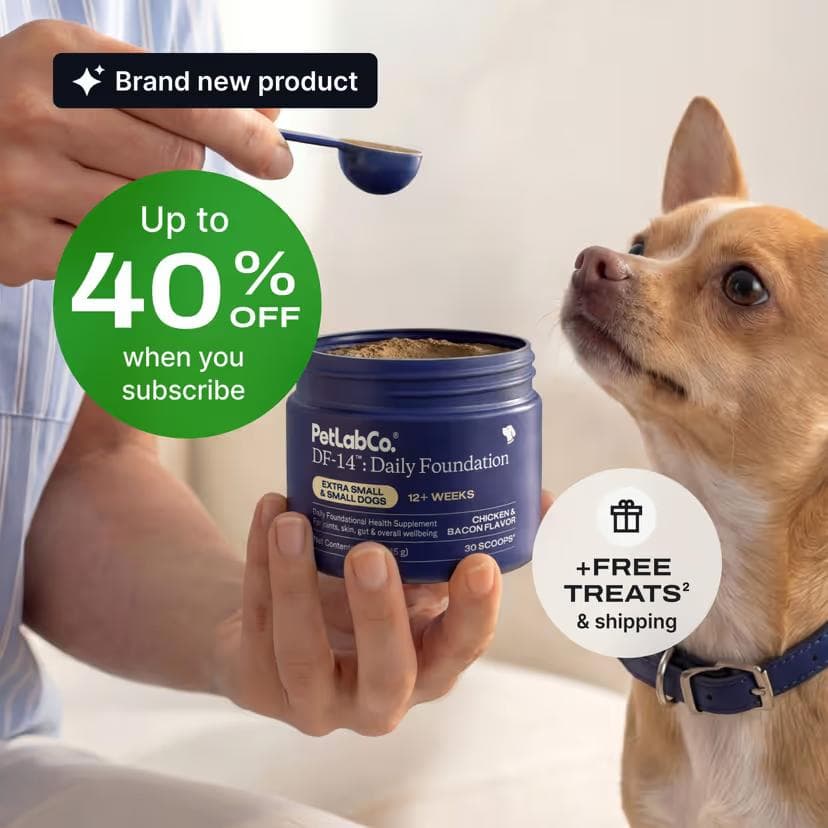
One daily scoop of whole-body support. DF-14 covers gut health, joints, skin, immune function, and more in a single multifunctional powder for dogs.
Webvet may earn a commission when you click through to PetLabCo.®, at no extra cost to you.
When to ask about taurine testing
Ask your veterinarian about taurine assessment when there is a relevant diet concern, a diagnosed heart condition, a family or breed history that warrants investigation, or unexplained changes in your dog’s health. Testing is most useful when the result will help answer a specific clinical question. It is not a requirement to buy a routine supplement, nor something an owner should interpret from an online reference range alone.
Possible heart-related signs include reduced exercise tolerance, unusual weakness, fainting, or altered breathing. These signs are not specific to taurine deficiency. They can occur with other cardiac and noncardiac problems, and some dogs with early disease may not show an obvious change at home. An examination and, when indicated, heart imaging address different questions from a nutrient blood test.
Which breeds deserve a closer discussion?
Golden Retrievers and American Cocker Spaniels appear in published studies of taurine-responsive heart disease. That history can help guide a veterinary conversation, especially when combined with diet and clinical findings. It does not establish that every dog of either breed needs the same supplement, or that another breed cannot develop low taurine.
Other dogs may be predisposed to DCM through mechanisms unrelated to a taurine deficiency. Breed risk and nutrient status therefore need to be considered separately. A normal taurine result does not by itself exclude heart disease, and an owner cannot distinguish genetic from diet-associated disease by looking at the dog’s food label.
What happens during the assessment?
Bring information the veterinary team can actually use:
- The exact food name, formula, and length of time fed, including recent changes.
- Typical amounts of food, treats, toppers, and supplements.
- Photos of every supplement’s ingredient panel and serving directions.
- A record of changes in breathing, activity, appetite, or body weight.
Your vet may discuss plasma or whole-blood taurine testing, depending on the case and laboratory. For example, the UC Davis Amino Acid Laboratory offers canine taurine testing with specimen-specific handling instructions. The clinical team arranges suitable testing and interprets it alongside the dog’s examination and diet history. Sample handling, the specimen type, the laboratory’s reference information, and any supplementation already given affect interpretation. Tell the team about current taurine use before testing, and do not stop prescribed products without instructions.
For a dog with taurine-deficient dilated cardiomyopathy, reviewing the dog food is part of treatment planning alongside supplementation and heart care. There is no universal food substitution that an owner can choose from the test result alone.
Planning the appointment
Costs vary with the examination, laboratory, and whether cardiac testing is also needed. Request an itemized estimate rather than assuming a quoted “taurine test” includes the entire assessment. WebVet’s guide to resting breathing and activity trends explains useful observations to share, without turning home monitoring into a diagnosis.
Diet, grain-free food, and heart health
The relationship between diet and non-hereditary DCM remains more complicated than “grain-free food removes taurine.” Non-hereditary DCM is considered multifactorial: several interacting factors may contribute. FDA describes an investigation involving diet, genetics, underlying medical conditions, and other possible factors. Its current questions and answers on non-hereditary DCM do not establish one ingredient or one dietary label as the explanation for every case.
A 2018 observational study of Golden Retrievers included 24 dogs with both taurine deficiency and DCM. Most had been eating grain-free or legume-rich diets, and most improved after dietary changes together with taurine supplementation. Because those interventions occurred together in affected dogs, the findings should not be recast as evidence that an everyday supplement prevents DCM in healthy dogs.
For owners, the practical implications are specific:
- Keep an accurate diet history rather than relying on a front-of-bag claim.
- Discuss the entire formulation and your dog’s health with the veterinary team.
- Follow any recommended diet change as part of the plan, instead of assuming a supplement cancels out a dietary concern.
The question “What blocks taurine absorption?” also needs more context than a list of forbidden foods. Taurine status may be influenced by amino-acid supply, digestion, metabolism, and losses, alongside individual differences. Current evidence does not support diagnosing a universal “taurine blocker” from a single ingredient in your kitchen. A nutrition assessment can examine the actual diet and identify whether further investigation is warranted.
Why a per-pound dose is not enough
A taurine dosage for a dog with heart disease should come from its treating veterinarian; a number per pound found online is not a complete plan. The diagnosis, formula, other care, and follow-up matter alongside body weight.
This is why the aim is a coherent feeding plan, not an automatic instruction to add more taurine. If your dog has diagnosed congestive heart failure, diet and supplements belong alongside the prescribed treatment and follow-up. They should not displace medication, imaging, or the monitoring your clinician recommends.
Choosing a taurine supplement for dogs
The best taurine supplement for dogs is the one that matches the reason for using it. A standalone product gives a veterinarian more flexibility to specify taurine independently. A multifunctional formula can suit an owner who wants that ingredient within a convenient daily combination. Neither format is automatically superior; they answer different needs.
Start with these selection criteria:
- Purpose: Is the goal a general daily routine or a particular veterinary prescription?
- Amount per actual serving: Check the scoop, chew, or capsule your dog will receive, rather than the amount in the whole container.
- Complete formulation: Include flavorings, other active ingredients, and relevant dietary sensitivities.
- Administration: Choose a format your dog can take consistently and that you can measure correctly.
A powder may be useful for a dog that readily eats a moistened meal. A capsule may fit a clinician’s precise plan, provided the formulation and method of administration are suitable. A product described as “natural” still needs the same label review. The word does not tell you whether the amount, accompanying ingredients, or intended use fits your dog.
For a whole-body support routine, our featured choice is DF-14 Daily Foundation because it combines a clearly listed taurine amount with L-carnitine, astragalus, and ingredients serving other everyday support areas. This recommendation is based on its published composition and convenience for that use case. It is not a ranking from hands-on testing or proof of superiority over all standalone taurine products.
Where to buy and what to verify
If you are deciding where to buy taurine for your dog, use a source that identifies the exact formula, current label, and manufacturer. The product links in this guide lead to PetLabCo.®’s product information; a veterinarian-prescribed standalone product should match the clinician’s exact recommendation.
Keep product reviews in their proper role as well. Owner comments may help you anticipate acceptance, packaging, or ease of serving. They cannot show whether a dog’s blood taurine level is appropriate, whether a heart condition changed, or whether the same product will meet another dog’s prescribed requirements.
One daily scoop of whole-body support. DF-14 covers gut health, joints, skin, immune function, and more in a single multifunctional powder for dogs.
Webvet may earn a commission when you click through to PetLabCo.®, at no extra cost to you.
DF-14 Daily Foundation for broader daily support
DF-14 is a powdered multifunctional supplement, rather than a dedicated high-dose taurine preparation. The current product information lists taurine, L-carnitine, astragalus extract, and other ingredients within a formula positioned for 14 areas of support. For an owner who prefers one daily addition to a meal, that broader scope is its central appeal.
The taurine amount changes with the size-specific formulation and serving. For example, the labeled medium-dog scoop supplies 200 mg of taurine and 45 mg of L-carnitine. Those numbers describe the product. They are not instructions to treat a deficiency, and they should not be multiplied until they resemble a dose found elsewhere online.

Where the formula may fit
Consider the product when your veterinarian agrees that a multifunctional daily supplement is appropriate and its ingredients fit your dog’s diet. It may simplify administration compared with managing several separate general-wellness products. Review what it overlaps with before combining it with another powder or chew, because convenient packaging does not remove the need to count ingredients.
Its current formulation includes animal-derived ingredients, including krill, crawfish-derived glucosamine, bovine chondroitin, and flavoring components. These details matter when a dog has a dietary restriction or is completing an elimination diet. Bring the complete current label to the clinician overseeing that diet rather than deciding from the main ingredient name alone.
The product page provides a chicken-and-bacon flavor and gives an age boundary above 12 weeks. That label boundary does not establish that every growing dog needs supplementation. Puppies still need a complete growth diet and individualized advice if there is a nutritional or cardiac concern.
What the broader formula changes about shopping
Compare DF-14 with the actual job you want a supplement to do:
- For taurine within broader daily support, the combined formula may be a practical fit.
- For a veterinarian-specified standalone taurine amount, ask whether the formulation can meet the plan without changing other ingredient amounts.
- For a sign of illness or a suspected deficiency, establish the cause and plan before choosing a product.
The detailed DF-14 product information is useful for that discussion because it lists the ingredients by size. Recheck the tub you receive if the packaging or formulation changes; an older article, review, or scoop from a previous product should not replace its directions.
One daily scoop of whole-body support. DF-14 covers gut health, joints, skin, immune function, and more in a single multifunctional powder for dogs.
Webvet may earn a commission when you click through to PetLabCo.®, at no extra cost to you.
Taurine dosage: label amount versus a veterinary plan
There is no single taurine dosage that is right for every dog. A veterinary plan for a diagnosed deficiency depends on the patient and clinical goal, while a supplement’s label amount describes the manufacturer’s serving. Keeping those two columns separate prevents a common error: using a multifunctional product as if it were a container of isolated taurine.
At the smallest labeled serving, DF-14 supplies 42.5 mg of taurine; the amount increases with the size-specific formula. The following table shows DF-14’s current labeled daily servings and the taurine they supply. Use the correct tub and its supplied scoop. A “scoop” is not a universal weight across all sizes.
| Dog’s weight | Correct DF-14 serving | Taurine label amount | L-carnitine label amount |
|---|---|---|---|
| Under 4 lb | One little scoop from the Small tub, 0.75 g | 42.5 mg | 10 mg |
| 4–24.9 lb | One big scoop from the Small tub, 1.5 g | 85 mg | 20 mg |
| 25–75 lb | One Medium scoop, 2 g | 200 mg | 45 mg |
| Over 75 lb | One Large scoop, 3 g | 315 mg | 75 mg |
These label amounts are not a veterinary prescription. In particular, do not add extra scoops to achieve a taurine target taken from a study or another product. Each extra scoop also increases the other ingredients, making the resulting combination different from either the labeled routine or an isolated supplement plan.
An example of reading the label correctly
Suppose a 50 lb dog’s owner is considering DF-14 for a daily whole-body support routine. The relevant product row is the Medium formula: one 2 g scoop provides 200 mg of taurine. The next question is whether that whole formula fits the dog’s existing diet and supplements. The table does not authorize the owner to infer a per-pound medical dose or to increase the serving for a heart concern.
If that same dog already has a prescribed taurine product, show both labels to the prescribing veterinarian. The clinician may want a different combination, may prefer a standalone formulation, or may decide additional taurine is unnecessary. The decision depends on the existing plan, not on which package looks more comprehensive.
Discuss administration and reassessment at the same time:
- Whether the product should be given with the usual meal.
- How to handle a missed or partially eaten serving.
- What to do if digestive upset or another new change appears.
- Whether any follow-up examination or blood testing is part of the clinical plan.
DF-14’s label recommends veterinary advice before use and says to stop and consult a veterinarian if the condition worsens or does not improve. It also notes that safe use during pregnancy or breeding has not been established and that absorption of simultaneously administered drugs may be delayed. Ask about timing with your dog’s actual medicines instead of applying an invented spacing rule to every drug.
One daily scoop of whole-body support. DF-14 covers gut health, joints, skin, immune function, and more in a single multifunctional powder for dogs.
Webvet may earn a commission when you click through to PetLabCo.®, at no extra cost to you.
Comparing two labels without confusing the units
A fair comparison starts with the amount supplied by the directions for your dog, rather than the largest number printed on either package. A container may describe an ingredient per capsule, per scoop, per gram, or per daily serving. Write down that basis before deciding whether two numbers mean the same thing. A powder's total weight includes all of its ingredients; it is not the weight of taurine alone.
For example, the Medium DF-14 label describes a 2 g scoop containing 200 mg of taurine. Two grams is 2,000 mg of total powder, so reading that scoop as 2,000 mg of taurine would be a tenfold error. The useful product comparison is the listed 200 mg alongside the rest of the formula and the intended daily use. This is a label-reading example, not a suggested medical dose.
Use three columns in your comparison:
- Serving basis: what physical amount the manufacturer calls one serving.
- Taurine amount: how many milligrams that serving contains.
- Other ingredients and purpose: what else the dog receives and whether the product is intended for broader support.
DF-14's size-specific presentation is helpful here because the published product information gives both the scoop weight and the individual taurine amount. Keep the Small, Medium, and Large directions separate. A bigger tub category does not simply mean using more of the same small-dog powder, and borrowing a scoop from another tub makes the comparison unreliable.
After reviewing the labels, the decision becomes easier to describe: either you are choosing a combined daily formula that fits the dog's routine, or you are matching an individually specified nutrient plan. Bring the actual product name and label to that discussion. That lets the veterinary team assess a concrete option rather than an unspecified “heart supplement.”
Food sources and a practical daily routine
The best sources of taurine for dogs depend on whether you mean everyday food or a prescribed supplement. Animal-derived foods can supply taurine and its building blocks, while a veterinarian selects supplemental sources to fit a specific need. Dogs naturally obtain the building blocks for taurine from dietary protein, and some animal tissues also contain taurine itself. Meat, fish, and other animal-derived ingredients vary in composition. A list of high-taurine foods does not tell you whether the complete diet supplies an appropriate overall nutrient balance or whether a particular dog has normal taurine status.
When someone asks which dog food is highest in taurine, the more useful question is whether the food is complete for the dog’s life stage and appropriate for its health needs. A prominent taurine claim on the front of a package cannot answer every part of that assessment. Ask the manufacturer for relevant formulation information if your veterinarian needs it.
Avoid trying to correct a suspected deficiency by improvising a rotation of high-taurine toppers. Large additions can change calorie intake and dilute the balance of the regular food. A home-prepared diet needs a formulated recipe and its specified supplements; adding taurine alone does not establish that other nutrients are adequate.

A simple mealtime routine
For a dog whose veterinarian approves a daily multifunctional supplement, make administration straightforward:
- Keep the product in its original, resealable container with the correct scoop.
- Follow the weight-specific directions and mix DF-14 into wet food or slightly moistened kibble as labeled.
- Confirm that the dog eats the portion carrying the supplement.
- Keep a simple record of the product, amount, start date, and reason for use.
- Revisit the plan when food, weight, medication, or health changes.
The goal is consistency with a useful plan, not adding products each time an online claim sounds promising. A brief record makes the next veterinary conversation more productive and helps distinguish the intended nutritional role from unrelated changes in your dog’s condition.
Frequently Asked Questions
Can I give a dog a human taurine supplement?
Do not choose one from the ingredient name alone. Human products can differ in concentrations, additional ingredients, sweeteners, and serving forms. Xylitol is a particular safety concern in some flavored or chewable products. A veterinarian should check the full label and proposed amount before use. A dog-specific product also needs review; the species label alone does not establish that it fits a prescribed treatment plan.
Can a dog take taurine and L-carnitine together?
The ingredients have different roles, and they are combined in some products and veterinary plans. That does not make every combination or amount appropriate. Review combined daily amounts from food and all supplements with the clinician, especially if your dog already receives a prescribed product. DF-14 contains both as part of a broader formula, not as an invitation to add separate high-dose preparations automatically.
How long does taurine take to work in a dog?
There is no universal timeline. A dog being managed for a diagnosed deficiency needs follow-up testing and clinical assessment chosen by the veterinary team. An owner using a general-wellness formula may not see an obvious change, especially when the dog was already nutritionally replete. Lack of a visible boost is not a reason to increase the dose or postpone assessment of continuing signs.
Do puppies need a taurine supplement?
Most puppy feeding decisions begin with a complete growth diet appropriate for the individual dog. Extra supplementation should address a specific reason identified with the veterinarian, not simply a belief that more nutrients produce better growth. DF-14’s label age boundary is separate from whether a puppy needs the product. A puppy with weakness, poor growth, or a suspected heart problem needs veterinary assessment.
What is the best taurine supplement for dogs?
For taurine within everyday whole-body support, our pick is PetLabCo.® DF-14 Daily Foundation, which lists 42.5 to 315 mg of taurine per size-specific scoop alongside L-carnitine and a broader daily formula. For a veterinarian-set taurine amount, the Dr. Oscar 500 mg chewable tablet may be a closer fit, but each tablet also supplies 50 mg of L-carnitine, so the veterinarian should account for both ingredients.
Is a multifunctional powder or a standalone taurine product better?
Neither is better in every case. A multifunctional powder like DF-14 suits a healthy dog whose owner wants taurine covered in one daily scoop. A standalone tablet or powder suits a dog whose veterinarian has prescribed a specific taurine amount, since the serving can be matched to that plan. Match the product to the reason you are buying, and bring both labels to your clinician if your dog already takes a prescribed product.
Sources and Product Information
- FDA: Questions and answers on non-hereditary DCM
- Kaplan and colleagues: Taurine deficiency and DCM in Golden Retrievers
- Kittleson and colleagues: The multicenter spaniel trial
PetLabCo.® products are not intended to diagnose, treat, cure, or prevent any disease. Consult your veterinarian before starting a new supplement regimen.

Veterinarian · DVM
Athena Gaffud, DVM, is a licensed veterinarian and writer based in the Cagayan Valley of the northern Philippines. She runs the website countryvetmom.com. Dr. Gaffud earned her Doctor of Veterinary Medicine degree from the University of the Philippines Los Baños in 2011, ranking in the top 10 and receiving the Best Undergraduate Thesis Award in Large Animals. With over a decade of experience, she has worked as a researcher, a practitioner for small and large animals, and in veterinary technical sales, marketing, and pet insurance. A published author, Dr. Gaffud promotes responsible pet ownership and combats misinformation on animal care through her platforms, including the DocAthena Facebook Page and DocAthena YouTube channel. She is a writer and editor for various pet-related websites such as Total Vet, Honest Paws, PangoVet, Dogster, Catster, My Best PH, Paw Origins, Bully Max, Not a Bully, Paws and Claws CBD, many others. She was also cited in different pet-related media articles such as The Dog People, USA Today, Newsweek, New York Post, Reader’s Digest, Smithsonian Magazine, Woman’s World, Dog Time, Patch, Kinship, Martha Stewart, and many others. Moreover, she is also a published fiction author on Kindle.


