Signs of Littermate Syndrome: What to Watch by Age
Compare normal puppy bonding with concerning distress, fear, and conflict. Use an age-aware checklist and know when to ask for behavior support.

This article contains affiliate links. Webvet may earn a commission when you buy through them, at no extra cost to you.
People use signs of littermate syndrome to describe repeated distress apart, difficulty functioning independently, or conflict between dogs raised together. The term is not a diagnosis. Look for a pattern affecting either dog's comfort, safety, or daily activities rather than treating closeness or noisy puppy play as proof of a problem.
This guide helps you describe what you see. It cannot determine the cause from a checklist, a video, or the dogs' age. If either dog is injured, intensely distressed, or unsafe around the other, contact your veterinarian and arrange qualified behavior support.
- 1Observe context, intensity, and recovery instead of counting symptoms.
- 2Normal bonding allows each dog to rest, engage with people, and choose breaks.
- 3Repeated distress, restricted access to essentials, or escalating conflict deserves help.
Signs of littermate syndrome versus normal bonding
Normal bonding versus distress in littermate syndrome
The most useful distinction is flexibility. Puppies can enjoy one another and still learn to spend comfortable moments apart. They can play enthusiastically and still respond to pauses. Concern rises when the same difficulty repeatedly prevents one dog from doing ordinary things.
Early signs of littermate syndrome are not a validated set of warning symptoms. Instead, notice changes in everyday contexts. Compare each dog with their own usual behavior, including what happens when the other dog is present and when suitable individual support is available.
| Context | Flexible behavior | Concerning pattern |
|---|---|---|
| Brief supported separation | Notices the change, then resumes an activity | Escalating distress, frantic following, or inability to settle |
| Individual attention | Can interact with a familiar person | Repeatedly cannot engage without the other dog |
| New experiences | Explores at an individual pace with support | Persistent fear that prevents ordinary participation |
| Shared play | Both pause, disengage, and choose to return | One repeatedly hides, retreats, or cannot get away |
| Food and rest | Both can access separate essentials | One repeatedly blocks or threatens the other |
Observe what happens when they are apart
Notice whether each puppy can remain comfortable when the other changes location during an ordinary routine. A brief look toward the door is different from escalating vocalizing, frantic attempts to follow, or an inability to return to a familiar activity.

Observe rest without competition
Give each dog access to their own comfortable resting place before comparing their behavior. A FurHaven Cuddler bed can serve as one resting station; the linked model is Large. The useful observation is whether the dog chooses to settle comfortably, not whether buying a “calming” bed changes a diagnostic score.
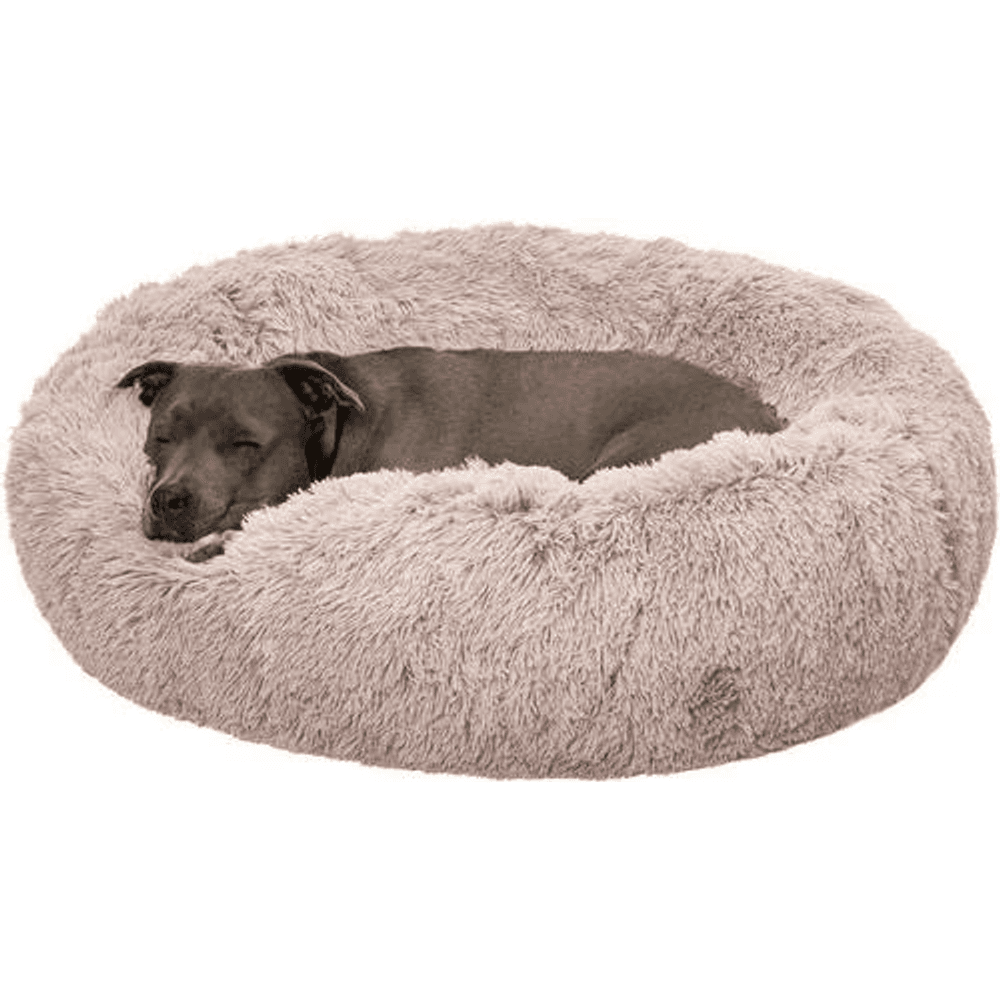
An optional individual resting place for calm, ordinary observation. The linked model is Taupe Large. Its product name does not establish a calming or diagnostic effect.
Webvet may earn a commission when you click through to Chewy, at no extra cost to you.
Do not lengthen a separation to see how severe the reaction becomes. Start with whatever arrangement is comfortable, which may mean separate activities in the same room with a person nearby. If an everyday change causes marked distress, seek help finding a manageable starting point.
- Record what changed, such as the other dog leaving sight.
- Describe what the puppy did, without guessing motives.
- Note whether support helped and how recovery occurred.
Watch each dog's access to people and space
A puppy who usually lets the other approach a person first may simply have a different preference. It becomes more concerning if the puppy repeatedly cannot reach attention, food, water, resting places, or an exit without being followed, blocked, or threatened.
Look beyond the louder dog. The quieter puppy may step away, stop approaching, or spend increasing time avoiding the other. Check that both have uninterrupted access to essentials and comfortable individual time with people. Silence by itself does not show that a dog is comfortable.
Compare normal behavior, context, and recovery time
Two puppies may both startle at a dropped object. One may return to sniffing while the other remains unable to engage. The initial reaction matters, but recovery helps describe how disruptive the experience was for each dog.
Use the same context-and-recovery approach across a few ordinary days. You might discover that a puppy struggles mainly when tired, when a valued item is present, or when the activity is too difficult. That gives a professional more useful information than a total symptom score.
Keep individual observation notes
Write separate notes even if both puppies were involved in the same event. One dog might approach, pause, and return to resting, while the other follows repeatedly and cannot settle. Those are different experiences. Recording only that “the puppies were excited” loses the difference that may guide a useful change.
Compare the same kind of situation across observations. A quiet room with a familiar caregiver offers different support from a busy doorway. Record changes in that support before concluding that the dogs are getting better or worse. Keep the process practical enough that you can describe it clearly at an appointment.
Compare manageable solo outings
A well-fitted Frisco padded harness can support a brief individual outing with one caregiver. The link opens the Small variant, so check the measurements. Observe an easy, familiar situation first; do not drag a frightened dog away from its companion to test independence.

A Black Small harness for a supported individual outing when the fit suits your dog. Introduce it gently; do not use an outing to provoke or test distress.
Webvet may earn a commission when you click through to Chewy, at no extra cost to you.
At what age does littermate syndrome happen?
There is no established age at which littermate syndrome happens, begins, or ends. The label is used for different behaviors, so it does not have a reliable developmental countdown. A puppy's age helps you choose appropriate expectations and support, not predict a diagnosis.
There is no fixed age range when problems must start, show up, or end. Nor is there a standard duration for how long they last. Older dogs and young puppies need different support; neither should be expected simply to grow out of distress or wait for it ever to disappear on its own.
Young puppies are learning how to feel secure in a new household. As dogs grow, their size, interests, and relationships can change. Adult dogs can also show distress apart or conflict. New or sudden behavior changes warrant veterinary assessment instead of being assigned to an assumed puppyhood syndrome.
| Stage | What to observe | Support to arrange |
|---|---|---|
| Early weeks at home | Adjustment, rest, comfort with familiar people | Predictable care and tiny manageable individual experiences |
| Growing puppies | Ability to participate individually and pause shared play | Separate learning opportunities and suitable rest |
| Adolescence | Changes in interaction, access to space, and intensity | Review supervision and seek help for repeated conflict |
| Adult dogs | Persistent patterns or a new change from normal | Individual assessment, including veterinary input when appropriate |
Early weeks at home
Some dependence is understandable when a puppy has just left a familiar environment. Expect to provide human comfort and care. Do not interpret every whine as an early sign that the dogs will never function independently.
The RSPCA's puppy-care guidance emphasizes positive learning, short sessions, and regular rest. Keep experiences small enough for the individual puppy. One successful calm moment offers more useful information than forcing a long test of separation.
Growing puppies and adolescents
As the dogs become more active, a previously easy shared activity may need more supervision. Look for changes in whether both choose to participate. A mismatch in size, energy, or preferred play style can make the same game enjoyable for one and overwhelming for the other.
Adjust the activity rather than expecting the less comfortable dog to tolerate it. Give each a route to rest and support disengagement. If conflict repeats or either dog appears fearful around the other, get advice before practicing more shared sessions.
Age is context, not a diagnostic cutoff
Queries such as “what age does littermate syndrome stop?” assume that a birthday resolves the problem. Behavior does not follow that rule. Improvement depends on the actual concern, appropriate care, learning opportunities, and sometimes professional treatment.
Keep expectations realistic without assuming that difficulties are permanent. A useful goal is better daily functioning: resting comfortably, enjoying individual attention, or moving safely through shared spaces. Ask the professional supporting your dogs how to measure progress for their particular situation.

Keep an observation rewarding
For a puppy who is relaxed and able to eat normally, Zuke’s Mini Naturals Peanut Butter & Oats treats can reward a familiar cue during a short individual session. Eating a treat does not prove an absence of fear. Record the whole response, and make the task easier if the puppy struggles.

Soft, pea-sized training treats made with peanut butter and oats. Small enough to reward often while keeping treats inside the 10% of daily calories vets recommend.
Webvet may earn a commission when you click through to Chewy, at no extra cost to you.
Avoid a symptom score or age countdown
Do not count ordinary puppy behaviors and compare the total with an online threshold. A single serious welfare concern may need attention even if a dog shows none of the other listed signs. Several mild, brief reactions may instead reflect a situation that needs easier expectations and support.
The significance comes from the dog's experience and daily functioning. If one puppy repeatedly cannot rest or move away from the other, that matters regardless of age. If both recover readily and participate comfortably with suitable support, continue observing without turning every interaction into a test.
Arrange comfortable individual space
A MidWest exercise pen can define a supervised area during an ordinary individual activity when both dogs are already comfortable with it. The linked model is 36 inches high. Check size, panel spacing, and escape behavior, and introduce the arrangement gradually with suitable support.

Webvet may earn a commission when you click through to Chewy, at no extra cost to you.
Aggression and fighting: when play stops being mutual
When people describe littermate syndrome aggression or fighting, the label does not explain why the conflict occurred. Start by asking whether both dogs could leave, what was happening before the interaction, and whether either dog was frightened or hurt.
Growling, movement, and noise need context. A single sound cannot establish whether dogs are playing or in conflict. More concerning patterns include repeated pursuit of a dog trying to escape, blocking access to essentials, freezing around valued items, or interactions that leave one dog hiding.
Make room for a voluntary pause
During safe, supervised play, offer a calm break using responses the dogs already know. Watch what each chooses afterward. If one rests or moves away, respect that choice. Do not repeatedly bring the dogs back together because one still wants to play.
- Both dogs should have space to disengage.
- Remove pressure to share valued food or objects.
- Keep rest areas available so a tired puppy is not continually approached.
- Arrange help if one dog repeatedly cannot relax around the other.
Handle serious conflict as a safety issue
Do not let repeated fights continue on the assumption that siblings need to settle a hierarchy. Avoid reaching between fighting dogs or grabbing near their mouths. Prevent further contact using a safe arrangement and obtain professional guidance appropriate to the situation.
The RSPCA's advice on dogs living with companions emphasizes space to get away and professional advice for fear or aggression. Shared housing works best when both dogs have meaningful choices and suitable care.
Why the label cannot diagnose your dogs
Some descriptions present littermate syndrome as one condition caused by an unusually strong bond. That can hide important differences. Distress when a companion leaves, fear of new experiences, and conflict around resources are not interchangeable problems.
Our littermate syndrome guide explains the evidence, causal uncertainty, and breed questions. There is no dependable breed ranking or prevalence estimate that tells you what is happening in your particular pair.
Questions about how often littermate syndrome happens, whether it always occurs, or whether puppies from different litters can struggle belong to that wider evidence discussion. A golden retriever pair, unrelated puppies, or dogs of different ages cannot be assessed from their family relationship alone. “Littermates syndrome” is another spelling of the same informal label.
Choose accurate descriptions
“One dog blocks the doorway when the other approaches” is useful. “One is dominant” gives less information about what to change. Similarly, “barked throughout an unsupported separation” describes a situation more clearly than “has a sibling syndrome.”
This does not minimize the problem. Precise descriptions make it easier to assess welfare, identify triggers, and choose realistic next steps. You can take behavior seriously without assigning an unsupported diagnosis or assuming the dogs can never live comfortably together.
Keep separation anxiety as a separate assessment
If a dog becomes distressed when a person or companion leaves, professional assessment may be appropriate. Our live guide to separation anxiety in dogs explains that subject in more detail.
The fact that two dogs are siblings does not establish whether either has separation anxiety. Avoid choosing supplements, medicines, or a rigid training schedule from the label alone. Describe the exact pattern to your veterinarian or qualified behavior professional.
What to do after you notice a pattern
Help and training for littermate syndrome concerns
First, reduce the situation that repeatedly overwhelms either dog. Give each safe access to food, water, rest, and people. Keep comfortable shared activities while changing those that lead to distress or conflict. A support plan should be manageable for both dogs and the caregivers.
A feeding conflict and difficulty coping apart need different plans. Describe the behavior, its triggers, and its effect on each dog’s access to food, rest, and people. Ask a qualified professional which problem to address first; no single routine fits every pair.
For guidance on assessment and helping dogs who already struggle, see the treatment and training section of our littermate syndrome guide.
Everyday routines for two puppies
For everyday prevention and individual training, use our guide to raising two puppies at the same time. It explains how to rotate activities without turning the waiting puppy's time into forced isolation.
Choose support for both dogs
The goal is to avoid repeatedly overwhelming either dog, not to break a healthy bond or get rid of every shared activity. A professional can help you deal with difficult triggers and decide how training or treatment should change. Ask for steps that support both puppies and fit your household's actual capacity.
Keep a brief record for each dog
- Note the date, setting, and trigger.
- Record the behavior and what happened next.
- Describe each dog's access to space, rest, and support.
- Note recovery and whether the same pattern is becoming more frequent or intense.
Film only situations that happen safely and naturally. A short ordinary clip can help a professional see body language, but it is never worth provoking distress or aggression. Written notes are appropriate when recording would make the situation less safe.
Use predictable support without a rigid test
A dog training schedule can provide regular opportunities to practice easy skills and rest. Do not use a timetable to insist that both puppies must tolerate the same separation at the same age.
Review whether the plan is improving everyday comfort. If either dog is losing access to essentials, remains very distressed, or is unsafe around the other, arrange professional help. The goal is a workable life for each dog, not proving or disproving a label.
Frequently asked questions
Does noisy play mean my puppies have a problem?
Noisy play does not by itself mean your puppies have a problem. Look for loose bodies, voluntary pauses, and whether both puppies choose to return. If one keeps trying to leave or is repeatedly pursued into hiding, end that activity safely.
A professional can help interpret recurring interactions that are difficult to distinguish from conflict.
Can a quiet puppy still be struggling?
A quiet puppy can still be struggling. Withdrawal, avoiding shared spaces, or losing access to rest can be easy to overlook when the other puppy is more vocal. Notice whether the quiet dog can approach people, eat, rest, and move around comfortably.
Compare the dog's current behavior with their own usual pattern rather than assuming quietness always means contentment.
Can older dogs show these behaviors?
Older dogs can show these behaviors, including adult dogs that were raised together. Distress apart, fear, or conflict needs individual assessment. The littermate label does not explain a new change or tell you that it began in puppyhood. Arrange veterinary assessment for a sudden change, and seek behavior support for persistent difficulties.
Describe each dog's current circumstances and history separately.
What should I bring to a behavior appointment?
Bring separate records to a behavior appointment for both dogs, including daily routines, the situations that trigger concern, what support helps, and any injuries or veterinary issues. Safe video can add context if it already exists. Explain your household's practical limits as well.
The most useful plan protects both dogs and is one you can carry out consistently.

Editor
The Webvet Editorial Team is the in-house group of pet-care editors and writers behind Webvet, operated by Smart Pet Collective. The team researches, writes, and maintains Webvet's pet health, behavior, and medication content. Every article follows a defined editorial process: research from reputable veterinary and scientific sources, careful drafting, mandatory review of medical content by a credentialed veterinarian, and dated publication. Health and medication articles are medically reviewed by a licensed veterinary professional before they go live and are kept current over time.


