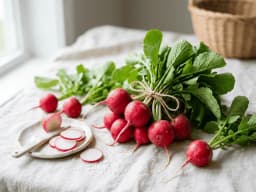
Can dogs eat radishes?
Safe in moderationPet-specific grocery-radish data are limited. ASPCA's wild-radish warning applies to horses, not dogs; identify the plant and exposure.


Medically reviewed by Dr. Athena Gaffud, DVM · Last reviewed
Can Dogs Eat Radishes?
Pet-specific grocery-radish data are limited. A small exposure to common radish root or greens is not the same as a proven safe serving, and it should not be confused with ASPCA's horse-only wild-radish listing.
- 1Direct dog data for grocery radish, Raphanus sativus, are limited.
- 2ASPCA's wild-radish record covers Raphanus raphanistrum and lists toxicity to horses, not dogs.
- 3Grocery-radish greens are not recognized as a canine toxin.
- 4No slice count or body-size serving has been validated for dogs.
- 5Identify the plant, preparation, amount, dog, and signs before making a safety claim.

Treats should stay under 10% of your dog's daily calories. JustFoodForDogs makes the rest of it.
- Recipes developed by veterinary nutritionists
- Whole-food ingredients you can recognise
- Fresh meals delivered to your door
Webvet may earn a commission when you click through to JustFoodForDogs, at no extra cost to you.
Are grocery radishes safe for dogs?
No characteristic canine poisoning syndrome from a small grocery-radish exposure is established here, but absence from a poison list cannot prove safety. ASPCA expressly says its plant database is a guide and is not all-inclusive. Poison databases are most useful when the plant identity and listed species match the exposure. They are not exhaustive feeding guides, and a missing entry is not a certificate of safety. Conversely, a horse listing should not be generalized to dogs without evidence. If the radish came from a garden, field, bouquet, or foraging area, photograph the entire plant, leaves, flowers, seed pods, and root before discarding it.


This is an optional dog treat. Review its current label, ingredients, calories, and feeding directions, and count it within the total daily extras.
Webvet may earn a commission when you click through to Chewy, at no extra cost to you.
Use the botanical identity when possible. Common grocery radish is Raphanus sativus, while ASPCA's wild-radish page identifies Raphanus raphanistrum and limits its listed toxicity to horses.
Radish root and greens require cautious, separate language
Grocery-radish leaves are not established as poisonous to dogs or as a food that reliably causes stomach upset. Do not tell owners to discard them because of an unsupported toxicity claim. Radish greens are eaten by people and may be fibrous or unfamiliar to a dog, but edibility for people also does not prove a canine serving. The evidence-based correction is narrow: do not call the greens a canine toxin or guarantee stomach upset. Use common food hygiene, remove wilted or spoiled material, and assess the dog that actually ate them. Confirm what plant the dog reached. Grocery red radish roots, daikon, radish greens, wild radish, horseradish, and ornamental or unidentified yard plants are not interchangeable. Photograph the whole plant, leaves, flowers, roots, and package; preserve a sample when safe. A garden incident may also involve fertilizer, herbicide, pesticide, mulch, compost, or another species. The ASPCA wild-radish entry concerns a named plant and horse toxicity, so it should not be used to classify an unidentified root or set a dog serving for cultivated radish.
Root and greens differ in texture, fiber, and preparation, and an individual dog may not tolerate a food. That supports monitoring and appropriate piece size, not a predicted vomiting, gas, or diarrhea outcome.
How much radish can a dog have?


This is an optional dog treat. Review its current label, ingredients, calories, and feeding directions, and count it within the total daily extras.
Webvet may earn a commission when you click through to Chewy, at no extra cost to you.
There is no evidence-based radish serving by dog size. If an optional taste is considered, it must fit the individual calorie plan, medical diet, chewing behavior, and total treat allowance.
| Decision factor | What to record |
|---|---|
| Plant identity | Common grocery radish, wild radish, horseradish, or another plant |
| Part and preparation | Root, greens, raw, cooked, pickled, or seasoned |
| Amount and dog | Best estimate, dog weight, chewing behavior, and medical history |
| Clinical response | Vomiting, diarrhea, pain, choking, weakness, or other signs |
Preparing an optional grocery-radish taste
Wash produce, remove soil and damaged material, and cut it into a texture the individual dog can chew. Cooking changes texture and flavor but does not transform an unstudied food into a proven therapeutic treat. Introduce only one unfamiliar optional food at a time and do not season a test piece. That makes any intolerance easier to interpret. A refusal needs no correction; radish has no established role that justifies persuading a dog to eat it.
Pickled, roasted, salad, and restaurant radishes vary in sodium, oil, sugar, vinegar, onion, garlic, and other ingredients. Assess the actual recipe instead of assigning all prepared radish one risk level. Prepared radishes can be more complicated than the vegetable. Kimchi and pickles may contain garlic, onion, substantial sodium, spicy ingredients, or fermentation products; restaurant salads may include dressings, raisins, nuts, skewers, or packaging. Keep the recipe and container. The exposure should be triaged from confirmed ingredients and quantity, not from the root vegetable's name.
Nutrients do not prove clinical benefits
Radish contains water, fiber, vitamins, minerals, plant compounds, and calories. A nutrient list does not establish immune, nerve, muscle, digestive, dental, or antioxidant benefits from a dog treat portion. Prepared radish dishes often matter more than the plain root. Pickled radish, kimchi, slaws, salads, sandwiches, dips, and roasted mixtures may contain salt, vinegar, chili, onion, garlic, sweeteners, raisins, or rich sauces. Check the full recipe or label and report the maximum amount missing. Firm rounds or large pieces should be considered in light of the dog's size, chewing, gagging, and swallowing behavior rather than assigned a universal choking outcome. Seek prompt advice for breathing difficulty, repeated vomiting, marked pain, weakness, tremors, collapse, a large unknown exposure, or swallowed packaging.

If a dog ate radish
After a small grocery-radish exposure in a well dog, remove access and observe. Save a photo or sample and seek advice for uncertain plant identity, a large amount, choking, repeated vomiting, diarrhea, abdominal pain, weakness, or another concerning sign. Most owner decisions after a small food exposure depend on the dog's behavior and evolving signs. Observe breathing, swallowing, appetite, energy, vomiting, stool, abdominal comfort, and any facial swelling or skin reaction. A comfortable dog with normal behavior after a small identified grocery-radish exposure differs from a dog that ate an unknown wild plant or is repeatedly ill.
Wild radish and similarly named foods
Wild radish, grocery radish, and horseradish are not interchangeable names. A plant found outdoors should be identified before applying food guidance, and a prepared horseradish product needs its own ingredient review. For outdoor plants, do not rely on a phone application's guess when illness is developing. A veterinarian, poison service, extension specialist, or botanist may need clear photographs and location details to narrow the identity.
Choosing another optional treat
Carrot, cucumber, green bean, and other produce are not automatically safer or more beneficial without comparing the exact food, preparation, amount, dog, and diet. Choose a familiar option the dog tolerates. A photograph of the product and plant can prevent confusion between radish, horseradish, turnip, and an unknown garden root. If signs develop, keep the sample away from other pets and bring the identification details to the clinic.


This is an optional dog treat. Review its current label, ingredients, calories, and feeding directions, and count it within the total daily extras.
Webvet may earn a commission when you click through to Chewy, at no extra cost to you.
Frequently asked questions
Can dogs eat radishes raw or cooked?
Direct canine data are limited for raw and cooked grocery radish. Cooking changes texture, but neither form has a validated dog serving.
Can dogs eat white radish or daikon?
Grocery-radish greens are not established as a canine toxin. Identify the plant and monitor the individual exposure.
Can dogs eat radish greens or leaves?
ASPCA's wild-radish page lists toxicity to horses, not dogs, and covers a different species from common grocery radish.
Is radish skin safe for dogs?
No slice or body-size serving is evidence based. Keep any optional extra within the dog's complete calorie plan.
Can dogs eat horseradish?
Pickled and seasoned products vary. Check sodium, onion, garlic, oil, sugar, and the total amount.
More safe treats
More vegetables for dogs
Sources
- ASPCA: Wild Radish
ASPCA's wild-radish record identifies Raphanus raphanistrum and lists toxicity to horses, not dogs or cats; it does not establish grocery-radish toxicity.
- ASPCA: Toxic and Non-Toxic Plants
ASPCA says its plant list is a guide and not all-inclusive, so absence from the list cannot by itself prove safety.
- AAHA: Nutritional Risk Factors
Noncomplete foods above 10 percent of daily calories can dilute essential nutrients; individual medical and life-stage factors require assessment.
- Merck Veterinary Manual: Gastrointestinal Obstruction in Small Animals
Foreign-body and choking concerns depend on object and patient characteristics; a food texture does not guarantee obstruction.
Reviewed by Dr. Athena Gaffud, DVM
General guidance based on credible veterinary sources; not a diagnosis or a substitute for your veterinarian. If your pet ate something toxic or is unwell, contact your vet or a pet poison line right away.