Cat Purring Effect on Humans: What Science Actually Shows
Discover the intriguing healing powers of cats, from their heart-healthy companionship to the therapeutic vibrations of their purr.


BVMS MRCVS
Medically reviewed by Dr. Pippa Elliott, BVMS MRCVS · Last reviewed

This article contains affiliate links. Webvet may earn a commission when you buy through them, at no extra cost to you.
The cat purring effect on humans is real, and it is smaller and stranger than the internet says. A purring cat genuinely changes how people feel. What a purr does not do is mend bone or treat disease.
Almost every claim you will read about purring sits in that gap. The most repeated one, that a purr vibrates in a frequency range known to heal bones, traces back to research on vibration platforms and to one conference talk about big cats. Neither involved a cat healing a person.
Below is what the research actually found, where it stops, and what living with a cat gives you instead. It also covers the part most articles leave out: purring is not proof that your cat is comfortable.
The Cat and Human Bond: What It Actually Does for You
Living with a cat is an arrangement, not a treatment. The effects people describe are small and cumulative: something warm to touch, a reason to be home at a certain hour, another presence in a quiet house.

Those effects are hard to measure and easy to overstate. Almost all research on pets and human wellbeing is observational, so it can show that owners and non-owners differ without showing that the cat caused the difference.
That is not a reason to dismiss the benefit. It is a reason to describe it accurately. The practical version is simple: protect the contact you enjoy by keeping their claws trimmed, and give your cat a spot it likes in the room where you spend your evenings.
A cat's purr reliably changes how people feel, and many owners find it calming. What it does not do is heal bone. The frequency claims come from vibration research done on people, not from any study of cats healing humans.
Why Do Cats Purr in the First Place?
A purr is a low, continuous sound made in the larynx on both the inhale and the exhale, which is why it never breaks the way a meow does. The standard explanation used to be that it needed rhythmic nerve signals driving the laryngeal muscles.
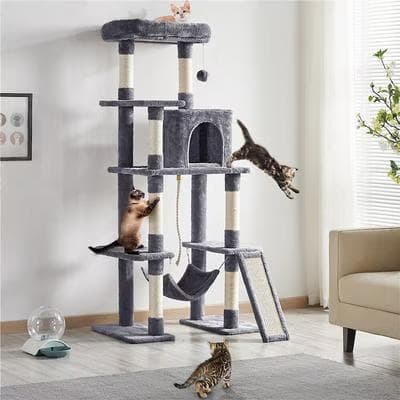
63-inch multi-level cat tree with plush perches, a condo, a hammock, sisal scratching posts, and a dangling toy. Dark gray.
Webvet may earn a commission when you click through to Chewy, at no extra cost to you.
That is now in doubt. A 2023 study in Current Biology tested eight excised cat larynges, and all eight produced self-sustaining sound at 25 to 30 Hz with no neural input and no muscle contraction. The authors traced it to connective tissue pads inside the vocal folds.
Cats also purr in more situations than most owners realize:
- With their kittens. Kittens purr in their first days and queens purr while nursing, when kittens can barely see or hear.
- At you, for food. A 2009 Current Biology study found a solicitation purr with a high-pitched cry embedded in it at around 380 Hz. Fifty listeners rated it more urgent and less pleasant than an ordinary purr.
- When they are not happy at all. Cats purr when frightened, ill or injured, and queens purr through labor.
One sound doing that many jobs is a poor basis for a single interpretation.
What Frequency Is a Cat's Purr?
The healing story starts with a real number that then gets stretched a very long way.

A domestic cat's purr has a very low fundamental frequency. The 2023 larynx study measured 25 to 30 Hz, below the lowest note most human voices reach. The much-quoted range of 25 to 150 Hz comes from somewhere else.
That wider range traces to a 2001 presentation to the Acoustical Society of America, which recorded 44 cats across several species, including cheetahs, ocelots, pumas and servals. It was a conference abstract proposing a hypothesis, not a study of anything healing.
What Purr Frequency Research Proves, and What It Does Not
Three separate things get merged every time this claim is repeated:
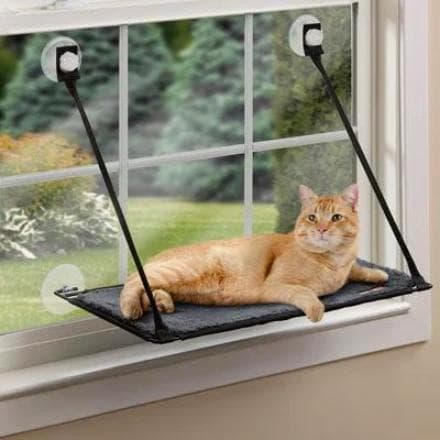
Webvet may earn a commission when you click through to Chewy, at no extra cost to you.
- The measurement. A domestic cat's purr really does sit at a very low frequency. That part is solid.
- The human research. Whole-body vibration has been tested on people for bone density, standing on a vibrating plate.
- The leap. A cat purring nearby is assumed to deliver the same thing. Nobody has tested that.
The human half is weaker than the claim needs. A randomized trial in Annals of Internal Medicine in 2011 put 202 postmenopausal women on vibration platforms at 30 or 90 Hz for twelve months. It changed neither bone density nor bone structure.
So the claim asks you to accept that a cat lying near you delivers through the air what a platform failed to deliver under the soles of the feet in a controlled trial. No published study has tested a purr as a treatment for anything in a person.
| Common claim | What the evidence shows | Verdict |
|---|---|---|
| A purr sits in a frequency range used in bone research | Purrs measure about 25 to 30 Hz, and bone-density platforms have used 30 and 90 Hz | Partly true |
| Being near a purring cat heals broken bones | Those platforms pressed against the body, and the largest trial found no effect | Not supported |
| Cat owners have lower rates of fatal heart attack | A 2009 analysis found lower risk only among people who had previously owned a cat | Suggestive, not causal |
| Purring always means a cat is happy | Cats purr when frightened, ill or injured, and queens purr during labor | False |
| Cats purr in a way designed to get a response from you | A 2009 study found a solicitation purr with an embedded cry listeners rate as urgent | True |
| A cat can replace treatment for anxiety or depression | The AVMA defines animal-assisted therapy as delivered or directed by health professionals | False |
A Cat's Touch: Felines as Emotional Anchors
Cats are often described as reading their owners' emotions. The research is more modest. In a 2016 study in Animal Cognition, cats were only slightly sensitive to human emotional expressions, and mainly to their own owner rather than a stranger.

What holds up better is what a cat's proximity does for you. The benefits owners report most consistently are worth having on their own terms:
- Something to touch: stroking an animal is warm, repetitive and undemanding, and owners describe it as calming with real consistency. That is a reported effect, not a measured one.
- Less time alone: for people living by themselves, a cat is another set of movements and sounds in the house, and something that reacts when they come home.
- A reason to get up: cats need feeding, cleaning up after and letting in and out, which gives an unstructured day a shape.
- Company that asks little back: a cat needs no conversation and no explanation, which is part of why people find them easy to be around when they are unwell.
None of this requires the cat to understand what you are going through. The comfort is real whether or not your cat knows why you are on the sofa at two in the afternoon.
 $65 · no membership
Have a health question about your cat?
A licensed vet can assess your cat over video and prescribe online when it's appropriate.
 Talk to a vet
- Licensed vets
- All 50 states
- same-day Rx
Webvet may earn a commission if you book.
Cats, Blood Pressure and Heart Health: What the Studies Found
The study everyone cites is a 2009 analysis of the second National Health and Nutrition Examination Survey mortality follow-up, in the Journal of Vascular and Interventional Neurology. It tracked 4,435 adults for about 13 years, and it recorded cat ownership in three categories: never, past and present.

Probiotic supplement with Bifidobacterium longum BL999 that supports cats in maintaining calm behavior plus digestive and immune health. One daily sachet.
Webvet may earn a commission when you click through to Chewy, at no extra cost to you.
That third category is the one everyone drops, and it is where the result lives.
- People who had previously owned a cat had a lower relative risk of death from heart attack, RR 0.63, roughly 37 percent below people who never owned one.
- People who currently owned a cat showed no significant difference, RR 0.87, interval 0.60 to 1.3.
- For cardiovascular disease overall, even the past-ownership result missed significance, RR 0.74, interval 0.55 to 1.0.
So the one clear finding is that former cat owners died of heart attacks less often, which is an awkward result for anyone arguing that living with a cat protects your heart. The design was observational and cannot show cause.
What the American Heart Association actually said
Its 2013 scientific statement concluded that pet ownership, particularly dog ownership, is probably associated with reduced cardiovascular risk, and attributed much of that to the physical activity of walking a dog. Cats do not come with a walk.
The same statement carries a caution that rarely gets quoted: a pet should not be adopted for the primary purpose of reducing cardiovascular risk.
Has anyone tested the purr itself?
The closest attempt is a 2020 randomized, sham-controlled trial in Archives of Medical Science, which put 94 stressed volunteers in a virtual reality headset carrying a slowed, digitally altered cat purr.
Heart rate variability did shift toward a calmer profile. But the sham headset carried a similar sequence, so what separated the groups was the binaural processing and the synchronization to breathing, not the purr.
Beyond Humans: What Purring Does for Cats
Purring is not aimed at us. It is a cat signal we happen to overhear, and it was doing its job between cats long before humans were in the room.

A soupy, lickable bisque treat that tempts a cat who has gone off solid food. The high-moisture, aromatic texture is easy to lap up and hard for a picky or recovering cat to resist, and it sneaks in extra hydration.
Webvet may earn a commission when you click through to Chewy, at no extra cost to you.

Kittens purr in their first days of life and queens purr while nursing, at a stage when kittens can barely see or hear. In free-living colonies, related females share dens and help raise each other's kittens, so a close-contact signal earns its keep.
Stories about cats comforting injured wildlife or adopting orphaned puppies circulate widely. Read them as anecdotes rather than evidence:
- A cat that settles beside a sick animal may simply be choosing a warm, quiet, undisturbed spot.
- Nursing another animal's young does happen, and the hormonal state of a lactating queen explains it more economically than compassion does.
- Nothing in the feline behavior literature supports the idea that cats deliberately protect weaker animals from harm.
What you can act on is duller and more useful. The strongest lever you control is predictability: meals at consistent times, a litter tray cleaned on schedule, and resources nobody has to compete for.
Cats and Energy Healing: What People Believe and What Can Be Measured
Energy healing is the idea that a practitioner, or in this version a cat, can influence an invisible energy field around the body. No such field has been detected, and no study has shown a cat responding to one.

The observation underneath the claim is not invented, though. Cats really do gravitate toward people who are ill, grieving or simply flat, and owners notice because it feels pointed.
Nothing unmeasurable is needed to explain that. Consider what changes about a person who is unwell:
They are still, warm and horizontal for hours, which describes an excellent cat resting site.
- They are home more, and at hours when the house is usually empty.
- They move less suddenly, talk less and reach out less, which is the human behavior cats approach most readily.
- Their routine has changed, and cats respond strongly to changes in the household pattern.
None of that has been tested against the energy explanation, which is the honest answer: nobody has run that study. It also does not make the comfort any less real to the person on the sofa.
What actually lowers a cat's stress
The feline environmental needs guidelines from the American Association of Feline Practitioners and International Society of Feline Medicine set out five pillars:
- A safe place. Somewhere the cat can retreat to and not be followed, ideally raised.
- Separated key resources. Food, water, litter trays, scratching posts and resting spots, spaced apart. In a multi-cat home, give each cat its own bowl rather than one shared station.
- Chances to hunt and play. Short, frequent sessions that end in a catch.
- Predictable, positive handling. Contact on the cat's terms, at a rate the cat sets.
- Respect for the cat's nose. Skip scented cleaners on their things and use an unscented clumping litter, since smell is a common reason cats start avoiding the tray.
When a Purr Is Not a Happy Sound
Purring is a self-soothing behavior as much as a social one. Cornell's Feline Health Center puts it plainly: cats purr when they are frightened, ill or even injured, and mother cats often purr while in labor and giving birth.
Cats are also skilled at hiding illness. Put those two facts together and a steady purr can be the most reassuring sound in a room where something is badly wrong.
Read the whole cat instead. The signals that a cat is genuinely comfortable are postural, not acoustic:
- Loose, sprawled posture rather than a tight tuck with the paws hidden
- Slow blinking, the eyes softening rather than fixed
- Ears forward and mobile, not flattened or rotated back
- A tail that rests or sways rather than clamping to the body
- Normal appetite, grooming and use of the litter tray
Any sudden change in those, purring or not, is worth a call to your vet.
Who Should Be Careful Around Cats
A page about the upside of cats owes you the other side.
- Allergy. Reactions come from proteins in a cat's dander, skin flakes, saliva and urine rather than from fur, which is why no cat is genuinely hypoallergenic.
- Cat scratch disease. Bartonella henselae passes to people through scratches and bites, most often from kittens, so end play before the claws come out.
- Pregnancy. The CDC advises pregnant people to let someone else change the litter tray, or to wear disposable gloves and wash afterward, and to change it daily, since Toxoplasma takes one to five days to become infectious.
- A weakened immune system. Anyone immunocompromised should take the same litter precautions and avoid stray cats and kittens.
So, Are Cats Truly Nature's Healers?
No, and the honest answer is more useful than the marketing one. Here is what survives once the unsupported claims are stripped out:

- Purring is a low-frequency sound a cat makes for its own reasons. It has never been shown to heal a human being.
- Cats respond to their own owners more than to strangers, but only modestly, and not by diagnosing your mood.
- Cat ownership is linked in observational research to better cardiovascular outcomes, most clearly among people who used to own one.
- The comfort of stroking a settled cat is reported by owners with great consistency, and it is worth having on exactly those terms.
- Routine and a predictable environment are the levers you actually control, and they matter more to your cat than to you.
Enjoy the purr for what it is: the sound of a cat that has settled, and sometimes of one that has not. It is good company. It is not medicine.
Cat Purring FAQs
Frequently Asked Questions
Do cats heal you when they purr?
Not in any medical sense. Sitting with a purring cat is calming for most people, and cat ownership is linked in observational research to better cardiovascular outcomes. No study has shown that a purr mends tissue, heals bone or treats disease in a person.
What frequency is a cat's purr?
Very low. A 2023 Current Biology study measured excised cat larynges producing 25 to 30 Hz. The repeated 25 to 150 Hz figure comes from a 2001 conference presentation on 44 cats of several species, not domestic cats alone.
Can a cat's purr heal broken bones?
There is no evidence for it. The claim borrows from vibration-platform research on people, and the largest trial of that, 202 women over twelve months at 30 or 90 Hz, found no change in bone density.
Why do cats purr when they are dying?
Purring is a self-soothing behavior, not only a happy one. Cats purr when frightened, ill or injured, and queens purr through labor, which is why it should never be read as reassurance. If your cat is purring but hiding, breathing with effort or refusing food, call your vet.
Is it good for cats to purr on you?
For most cats, yes. A cat that settles on you and purrs is usually relaxed and bonded to you. Purring alone is not proof of comfort, so read the whole cat: loose posture, slow blinking and a soft tail say contentment far more reliably.
Are cats healers to humans?
Cats are companions, not clinicians. What owners reliably report is routine, touch, less time alone and a calming presence. The AVMA defines animal-assisted therapy as delivered or directed by health professionals, which is care with an animal in it, not care replaced by one.
$65 · no membershipHave a health question about your cat?
A licensed vet can assess your cat over video and prescribe online when it's appropriate.
Talk to a vet- Licensed vets
- All 50 states
- same-day Rx
Webvet may earn a commission if you book.

Wendy Toth is an entrepreneurial writer, editor, and mom of two humans, two dogs and one cat. She’s currently Content Director here at PetFul. For the last 15 years she has held positions at Parents Magazine, NBC, PetSmart, and GreatPetCare, where she was co-founder. Her writing has appeared in many national outlets including Pet Lab Co., Retail Me Not, Ask Men, Wild Society Nutrition, and The New York Times. Because she loves her work so much, she’s obsessed with helping others find career fulfillment, and covers it regularly at PowerSuiting.
Veterinarian · BVMS MRCVS
Dr. Pippa Elliott, BVMS, MRCVS, is a veterinarian with nearly 30 years of experience in companion animal practice. Dr. Elliott earned her Bachelor of Veterinary Medicine and Surgery from the University of Glasgow. She was also designated a Member of the Royal College of Veterinary Surgeons. Married with 2 grown-up kids, Dr. Elliott has a naughty Puggle named Poggle, 3 cats and a bearded dragon.


