Do Cats Know When Another Cat Is Dying? A Vet-Backed Answer
A Deep Dive into Feline Reactions to Sickness and Death


BVMS MRCVS

This article contains affiliate links. Webvet may earn a commission when you buy through them, at no extra cost to you.
Cats do notice when another cat is dying, but not the way people imagine. They register change, not death. A sick cat's scent, grooming, movement and routine all shift, and cats are unusually good at monitoring exactly those things in each other.
What no evidence supports is a cat grasping death as a concept, or sensing a specific moment of death before it happens. Here is what the research actually shows, what a surviving cat is likely to do afterwards, and the point at which grief-like behaviour needs a vet.
Why Every Cat Reacts Differently
Cats are not interchangeable, and neither are their reactions. Personality matters, but so does the specific relationship: how long the two cats lived together, how much of the day they actually spent together, and how well they got on.

One cat will hover, call and refuse to settle. Another will carry on as though nothing has happened. Both are normal, and a cat that shows no visible reaction is not a cold cat.
What a Cat Actually Senses When Another Cat Is Dying
A cat cannot know that a companion is going to die. What a cat can do is notice, in fine detail, that the other animal has changed. Illness alters almost everything cats use to keep track of one another.

Webvet may earn a commission when you click through to Chewy, at no extra cost to you.
Here is what a housemate actually registers:
- Scent. Cats identify each other and their shared territory largely by smell, refreshing that scent map by rubbing their face and body on surfaces. Illness, medication, wounds and reduced grooming all change how a cat smells.
- Grooming. A sick cat stops keeping itself tidy. Vets look for exactly this: a messy or greasy coat, mats of fur, clumps of loose hair.
- Movement and posture. Less jumping and climbing, a hunched sit, a head that no longer lifts properly, long stretches spent in one spot.
- The social back and forth. Fewer greetings, less mutual grooming, less play, more time spent apart.
- Routine. Meals at odd hours, a housemate sleeping somewhere new, carrier trips, and unfamiliar clinic smells coming home on the other cat's coat.
None of that requires a concept of death. It requires an animal that is very good at monitoring other cats, which is exactly what a cat is.
It is also why a cat can seem to know before you do. Your cat is not predicting anything. It is reacting to a change that has already started.
A Spectrum of Responses: Can Cats Sense Death?
Have you ever caught a worried looking cat hovering around their sick buddy?

Or maybe your cat is the type to give an ailing cat a wide berth.
Reactions can differ. And much like with humans, those reactions depend largely on the cat’s personality as well as other possible factors. For instance:
- Some cats might show aggression or aloofness in the face of another cat’s illness.
- In other scenarios, there might be a sense of heightened concern.
- Some cats could exhibit attachment behaviors, staying close to their sick friend more than usual.
- Other cats might choose to isolate themselves from the scene.
None of it tells you what the cat understands. It tells you the cat has noticed a change, which is a smaller and far better supported claim. A cat that pulls away is not being callous, and it copes best when it has a safe retreat of its own to do it from.
How Long Before Death Do Cats Notice?
No study has ever measured how far in advance a cat registers that a housemate is dying. Any article that hands you a number of hours or days is inventing it.
The honest answer is narrower and more useful. Cats respond to changes they can detect, and in most illnesses those changes build slowly. Appetite drops. Grooming slips. The sick cat moves less, sleeps somewhere new and stops joining in.
A housemate has usually been reacting to that for days or weeks before the last day arrives, which is why owners so often feel their cat knew first.
One limitation runs through all of this work. When a death is anticipated, a surviving cat may be responding to weeks of illness cues rather than to the death itself, and the two are difficult to separate after the fact.
There is no evidence that cats sense a specific moment of death in advance. What they track is the gradual change in a sick housemate's scent, grooming, movement and routine, which usually begins well before the final days.
A sudden death works differently. When a cat is hit by a car, or collapses from an illness it had been hiding, there is nothing to build up to. What owners describe then is the disappearance itself: the calling, the searching, the repeated checking of the other cat's favourite spots.
How Cats Behave Around a Dying Housemate
The two accounts below are owner observations, not evidence. They are worth reading because they show the range of what people actually see at close quarters, which almost no published work captures.

Probiotic supplement with Bifidobacterium longum BL999 that supports cats in maintaining calm behavior plus digestive and immune health. One daily sachet.
Webvet may earn a commission when you click through to Chewy, at no extra cost to you.

Owner Account 1: Solstice the Abyssinian
Consider the case of Solstice, an Abyssinian, a breed renowned for its intellect. As Solstice was dying of kidney failure, “the other cats rallied round her,” recalls T.J. Banks, who writes about cat behaviors.
“They seemed to understand that she was ill, but they took it all in their furry stride. They’d sit with her on the counter, watching the birds at the feeders, or sun themselves with her in the breezeway,” Banks says.
Owner Account 2: Topaz the Flame Point Siamese
Banks offers up another example of empathic behavior among her cats. She says Topaz, a flame point Siamese, was given unexpected tenderness by the other cats in the house while Topaz was dealing with heart and kidney problems. The other cats would check in on him and even sometimes wash him.
“On some level, [they] seemed to sense that [Topaz] was dying,” Banks says. “A hospice nurse couldn’t have been more caring and compassionate.”
What These Accounts Do and Do Not Show
Can cats sense the death of another cat?
Two households, two very different cats, and in both the survivors stayed close rather than withdrawing. That is one possible response out of several, reported by a single observer.
What it cannot show is empathy in any measurable sense. A cat settling beside a sick housemate is consistent with several explanations, and one person's account cannot separate them.
That gap is real. Only two studies have ever examined how domestic cats respond to the death of a companion animal, which is why so much of what circulates online is anecdote dressed up as fact.
The Veterinary Experts’ Opinions
Can cats tell when another cat is sick? Thomas D. Morganti, DVM, of Avon Veterinary Clinic hypothesizes that the same caregiving instincts in mother cats when tending to kittens are also exhibited by adult cats who need extra care.

Dr. Morganti suggests that such instinctual behaviors might not be merely confined to mother-kitten interactions but could potentially extend to any interaction involving a sick or dying cat within the group.
On that reading, a cat's response to a sick or dying housemate is not purely emotional. It may also be instinct, showing up in a context it did not evolve for. It remains a hypothesis rather than a finding.
Do cats know when another cat dies? Arnold Plotnick, DVM, ACVIM, says it’s not uncommon for cats to demonstrate changes in behavior that might be indicative of mourning.
He suggests that each cat grieves in a unique manner, akin to humans. While some cats exhibit immediate and noticeable changes, others may manifest subtler shifts over a longer period.
Following the loss of a fellow cat, these displays can include alterations in:
- Appetite
- Social interaction
- Energy levels
Dr. Plotnick's own emphasis is on the physical stakes rather than the emotional ones. In his account the changes worth watching closely are the ones that act on the body, and appetite sits at the top of that list.
What the 2024 Cat Grief Study Found
For a long time there was almost nothing to go on but anecdote. That changed in 2024, when Brittany Greene and Jennifer Vonk of Oakland University published only the second study ever conducted on how domestic cats respond to the death of another pet in the home.
Webvet may earn a commission when you click through to Chewy, at no extra cost to you.
They surveyed 412 cat caregivers about 452 surviving cats. Of those cats, 281 had lost another cat and 171 had lost a dog.
On average, caregivers reported that after the death their cats:
- Slept, ate and played less
- Hid more and spent more time alone
- Sought more attention from people and from other pets
- Appeared to be looking for the animal that had gone
The relationship mattered. The more time the two animals had spent doing things together in an average day, the more grief-like behaviour and fearfulness owners reported. The better the two had got on, the larger the drop in sleeping, eating and playing. The longer they had lived together, the more the survivor sought attention afterwards.
Three things made no reliable difference to how much behaviour changed:
- Whether the surviving cat witnessed the death
- Whether the two animals were related
- How many other cats and dogs lived in the home
The caveat the headlines skipped
This study measured what owners said, not what cats did. The authors name that as their most serious limitation: they relied on caregiver reports rather than direct observation of the animals before and after the death.
It matters, because the owner's own grief tracked the results. Caregivers grieving hardest were likelier to report increases in their cat's sleeping, hiding and time alone. The authors say this may reflect owners projecting their grief onto the surviving animal.
The fair reading is this. Something changes in most surviving cats, the change is larger when the two animals were genuinely close, and how much of it is grief rather than perception is still open.
What Cat Colonies Really Tell Us About Feline Social Life
Free-living cats do form social groups, and those groups are often used to argue that cats look after each other. The reality is narrower. The Merck Veterinary Manual describes groups built around multiple generations of related females, who may all help care for the young.

- Mutual grooming between familiar cats, which maintains a shared group scent
- Hunting alone. Most domestic cats hunt by themselves, and they do not bring food back for adult members of the group
- Sharing space rather than sharing duty. Cats in a group rest together and use the same shelter, which reflects tolerance and familiarity, not a sense of responsibility
What Healthy Cats Actually Do Around a Sick Cat
When a cat in a group becomes ill, owners commonly describe three things. None has been shown to be deliberate care, and each has simpler explanations:
- Staying closer, resting or sleeping near the sick cat
- Playing with the sick cat less, which may simply be the sick cat no longer starting games
- Grooming the sick cat more, which one veterinarian has suggested may draw on the same instincts queens use with kittens
Grief-Like Behaviour After a Loss
After a loss, owners report more vocalising, changes in eating and sleeping, and cats seeking extra contact with their people. Whether that amounts to grief as humans experience it is precisely the question researchers have not been able to settle.
How long it lasts varies widely. In the 2016 study of 152 cats, increased vocalising and territorial changes ran for a median of two months or less, while changes in affectionate behaviour ran longer, at a median of two to six months.
Signs a Cat Is Grieving After a Companion Dies
There is no single grief pattern in cats, and plenty of cats show nothing obvious at all. The changes owners report most often are these:

Webvet may earn a commission when you click through to Chewy, at no extra cost to you.
- Eating less, or picking at food and walking away
- A changed sleep pattern, in either direction
- Hiding, or spending far more time alone
- Calling, and checking the other cat's usual spots
- Following you around and asking for more contact than usual
- Litter box changes, including accidents outside the box
- A scruffier coat, or the opposite, over-grooming one patch
Read that list again and the problem jumps out. It is also a list of sick-cat signs. Cats have evolved to hide illness and pain, so a cat that is quietly nauseated, painful or blocked looks a great deal like a cat that is quietly sad.
The survivor is often close in age to the cat that just died, which makes an undiagnosed problem more likely rather than less. So the useful question is not whether your cat is grieving. It is when this stops being grief and becomes a vet visit.
| Behaviour change | Typical grieving pattern | When to call your vet |
|---|---|---|
| Eating less | Smaller meals for a few days, then a gradual return to normal portions | Not eating properly for 24 hours, or intake still down after three days |
| Sleep pattern changes | Sleeping more or less than usual, but still coming out to eat and use the box | Will not come out at all to eat, drink or use the litter box |
| Vocalising or searching | Calling and checking the other cat's usual spots for days to a few weeks | Constant yowling, pacing or night calling that never settles |
| Clinginess | Follows you more, sleeps closer, asks for more contact | Sudden aggression, or panic and destruction whenever left alone |
| Litter box changes | An accident or two during the first unsettled days | Straining, blood in the urine, or repeated trips producing little or no urine |
| Grooming changes | A slightly scruffy coat for a week or two | Bald patches, broken hair or raw skin from over-grooming |
One line in that table needs spelling out. A male cat straining in the box and producing little or no urine may have a urethral blockage.
That is an emergency. The Merck Veterinary Manual notes that cats with a complete blockage may die within two to three days without treatment, so it is a same-day clinic visit, never a wait-and-see.
Offering Support: Helping Cats Navigate the Challenges of Illness and Loss
Most of what genuinely helps a surviving cat is unglamorous, and it involves doing less rather than more.

The three things that actually help:
- Watch the food. Note whether the bowl is really emptying, so you know within a day if your cat has stopped eating rather than a week later
- Hold the routine identical. Same meal times, same play times, same box in the same place with an unscented, low dust litter, and no new furniture for now
- Leave the scent alone. Cats orient by smell, and the AAFP and ISFM environmental guidelines warn that stripping familiar odours out of a cat's core area causes stress, so hold off on washing the other cat's bedding
Give it time before you judge how your cat is coping. The first fortnight after a death is the least representative stretch of your cat's year.
This is also the wrong week to redecorate. The AAFP and ISFM house-soiling guidelines note that bringing new furniture, a new person or a new pet into a cat's environment changes the collective odour of the place, which is one of the things that tips an unsettled cat into soiling or marking.
Should You Let Your Surviving Cat See the Body?
You will find confident advice in both directions. The evidence supports neither.
Two studies have looked at this. The 2016 survey by Walker, Waran and Phillips, covering 152 cats, reported no difference between animals that saw their companion's body and those that did not. The 2024 Oakland University study found the same about witnessing the death itself.
The charity Cats Protection puts it plainly: no studies suggest that seeing the body aids a cat's grieving process.
So treat it as a decision for you, not one that changes your cat's outcome. If you do it:
- Keep it short and quiet, with no other pets in the room
- Let the cat approach on its own, and never lift it onto or against the body
- Stop at once if the cat is frightened, hisses or wants to leave
- Skip it if the death involved an infectious illness
Cats Protection also warns that a body may simply smell wrong to the surviving cat and upset it. And if the death happened at the clinic and there was never a choice to make, you have not cost your cat anything. The searching that owners find so painful gets reported either way.
Should You Get Another Cat After One Dies?
Not yet, in most cases. A new cat is a stressor before it is a comfort.
Start with an honest read of the relationship that ended. Cats are not obligate social animals, and Cats Protection is direct about it: cats do not need feline company to be happy. If your two cats merely tolerated each other, slept apart and ate apart, the survivor may do perfectly well as an only cat.
If they were genuinely bonded, groomed each other and slept touching, a second cat may eventually suit the household. Wait until:
- Appetite is back to normal portions
- Sleep and litter box habits have resettled
- The calling and searching have stopped
- Your own household routine is steady again
When the time comes, go slowly. The AAFP and ISFM environmental guidelines call for a gradual process of increasing familiarity whenever a new cat joins a household that already has one. In practice: a separate room first, scent swapping with bedding before any meeting, then short supervised sessions, then shared space.
Give the new cat its own everything, starting with its own bowl in its own spot, its own tray and its own bed. Those guidelines are explicit that in a multi-cat home each key resource belongs in its own location, out of sight of the others.
A new cat will not replace the one that died, and it will not fix your cat's grief. Bring one home when you want a cat, not to medicate a loss.
What We Can and Cannot Say About Cats and Loss
Here is the honest summary. Cats notice when a housemate is sick or gone, and their behaviour changes measurably afterwards. Why it changes is unsettled, and the only two studies on the subject both rest on what owners reported rather than on what anyone observed.
That uncertainty is not a reason to dismiss what you are seeing. A cat that stops eating, hides for days or abandons the litter box has a real problem, whatever the correct label for it turns out to be.
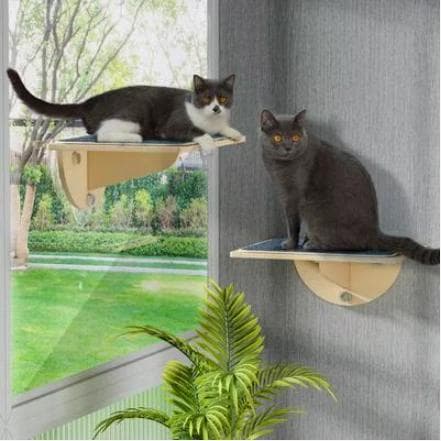
So treat the behaviour rather than the label. Hold the routine, keep an eye on the food bowl, and give your surviving cat a quiet high spot of its own to watch the house from while it works out what has changed.
Feature Photo by Lidia LI/Pexels
FAQs
How do cats react to another cat dying?
Reactions vary, and some cats show no obvious change at all. In the 2024 Oakland University survey covering 452 surviving cats, caregivers reported that on average their cats slept, ate and played less, hid more, spent more time alone, sought more attention from people, and appeared to look for the animal that had gone. Changes usually appear over days rather than all at once.
How long can cats tell when another cat is dying?
No study has measured a warning window, so any specific number of hours or days is guesswork. What cats respond to are changes they can actually detect: a housemate's altered scent, reduced grooming, lower energy and withdrawal. Those build across the final days or weeks of an illness, which is why a cat can seem to know in advance.
What happens if you have two cats and one dies?
Expect some change in the survivor for days to weeks: a dip in appetite, more hiding or a disrupted sleep pattern, calling around the house, and often much closer contact with you. Keep feeding, play and litter box routines exactly as they were. Call your vet if your cat has not eaten properly for 24 hours.
What happens right before a cat dies?
There is no reliable published checklist for a cat's final hours, and cats are unusually good at concealing how ill they are. What veterinarians describe in the days beforehand is a cat that eats and drinks less, stops grooming so the coat turns messy or matted, grows weak and withdrawn, and looks for a quiet place out of the way. Any change in breathing needs same-day veterinary attention, and your vet or a veterinary hospice service can tell you where your cat is in that process and how to keep her comfortable.
Do cats know when other cats are sick?
Cats notice when a housemate is unwell, because illness changes the things cats monitor in each other: scent, posture, activity, grooming and the usual exchange of greetings. Responses range from staying close and grooming the sick cat to avoiding it entirely, and some cats get more assertive toward a weakened housemate, which is why a sick cat needs protected space to rest and eat.
How long do cats mourn the loss of another cat?
The 2016 study that tracked duration found that in cats, increased vocalising and territorial changes lasted a median of two months or less, while changes in affectionate behaviour ran longer, at a median of two to six months. There is no fixed schedule. A cat still eating poorly, hiding constantly or calling at night after two weeks should be examined, because pain and illness look a great deal like grief.

Wendy Toth is an entrepreneurial writer, editor, and mom of two humans, two dogs and one cat. She’s currently Content Director here at PetFul. For the last 15 years she has held positions at Parents Magazine, NBC, PetSmart, and GreatPetCare, where she was co-founder. Her writing has appeared in many national outlets including Pet Lab Co., Retail Me Not, Ask Men, Wild Society Nutrition, and The New York Times. Because she loves her work so much, she’s obsessed with helping others find career fulfillment, and covers it regularly at PowerSuiting.
Veterinarian · BVMS MRCVS
Dr. Pippa Elliott, BVMS, MRCVS, is a veterinarian with nearly 30 years of experience in companion animal practice. Dr. Elliott earned her Bachelor of Veterinary Medicine and Surgery from the University of Glasgow. She was also designated a Member of the Royal College of Veterinary Surgeons. Married with 2 grown-up kids, Dr. Elliott has a naughty Puggle named Poggle, 3 cats and a bearded dragon.


