Tortoiseshell Cat: Coat Patterns, Genetics, and Personality
Tortoiseshell is a coat pattern, not a breed. Identify dilute and long-haired torties, understand their sex-linked coloring, and assess personality through the individual cat rather than a stereotype.

BVMS MRCVS
Medically reviewed by Dr. Pippa Elliott, BVMS MRCVS · Last reviewed

This article contains affiliate links. Webvet may earn a commission when you buy through them, at no extra cost to you.
A tortoiseshell cat has a coat that mixes orange with dark pigment, often in a mottled patchwork. Tortoiseshell is a color pattern, not a breed. The same description can apply to a shorthaired domestic cat, a longhaired cat, or a pedigreed cat whose breed permits those colors.
The pattern is strongly associated with female cats because of sex-linked color inheritance. It does not establish a cat's ancestry, health, or temperament. Those are separate questions, even when a striking coat makes you curious about all three.

 Sponsored
Want a vet's take on your pet's skin or coat?
Talk to a licensed vet at Dutch over video, often the same day. They can recommend treatment and prescribe it when it's appropriate.
Use code Pets60
Plans start at $12/month · covers up to 5 pets
- Licensed vets in most states
- Rx for 150+ conditions
- 4.7 on Trustpilot
What is a tortoiseshell cat?
The typical tortoiseshell coat contains intermingled black and orange areas. They may look like tiny flecks, larger patches, or a mixture across different parts of the body. A face split into contrasting colors can be striking, but a neat half-and-half face is not required for a cat to be a tortie.
An observed coat can tell you about visible pigment and pattern. It cannot identify an individual cat’s breed, chromosome arrangement, or personality. Learn individual behavior through patient interaction, not a color stereotype.
What makes tortoiseshell cats special is the interaction of pigment and development that produces their patchwork. The pattern is a useful description, not a separate class of pet with one set of needs. A tortie still needs care suited to its age, health, coat length, and living situation.
Start with the whole coat when identifying one. Orange can be confined to a small patch on a paw, cheek, or flank. Dark fur may appear brown in warm light. A photograph that hides half the body can therefore make a tortie look solid-colored or show a misleading balance of colors.

Webvet may earn a commission when you click through to Chewy, at no extra cost to you.
Describe what you can actually see
- Identify the orange or cream areas and the dark or blue-gray areas.
- Note whether the colors are intermingled, separated into patches, or both.
- Look for white areas and visible tabby markings.
- Record coat length separately from color.
These observations are enough for a useful description without guessing a pedigree. “Longhaired dilute tortoiseshell” says what a person can see. “Rare purebred tortoiseshell” makes additional claims that appearance alone cannot substantiate.

Retracting pins make it easier to clear collected hair after light slicker grooming.
Webvet may earn a commission when you click through to Chewy, at no extra cost to you.
Dilute, long-haired, and Persian tortoiseshell cats
A dilute tortoiseshell has blue-gray and cream in place of the more intense black and orange combination. That does not mean the coat is unhealthy or needs a supplement. Dilution describes inherited pigment variation. The UC Davis Veterinary Genetics Laboratory's feline coat-color resources explain how different genes influence the resulting colors.

Coat length is a different feature. A tortoiseshell cat can have short hair or long hair, and a dilute tortoiseshell can also be longhaired. Long fur may soften the edges of patches, so a close look at the flank and tail can be more informative than a distant face photograph.
Does long hair mean Persian ancestry?
No. A long coat by itself does not identify a tortoiseshell Persian cat. A documented Persian can have tortoiseshell coloration, but many longhaired domestic cats have it as well. Breed identification relies on more than a single visible trait, and an adoption listing may use descriptive words rather than verified pedigree information.

If Persian ancestry matters to your decision, ask what records support it. If your main concern is everyday care, ask instead how the cat tolerates brushing, whether it develops mats, and whether it has any ongoing eye, skin, breathing, or dental concerns. Those answers help you prepare for the actual cat rather than an assumed breed profile.
For longhaired tortoiseshell kittens, introduce gentle grooming in short sessions while they are comfortable. Pay attention to places where friction and moisture can encourage tangles. If a mat is close to the skin or pulling painfully, ask a professional for help; trying to cut it out with household scissors can injure the cat.
Why tortoiseshell cats are usually female
The genetic basis of orange coloration is linked to the X chromosome. Female cats typically have two X chromosomes, and X-inactivation, the silencing of one copy in each developing cell, can produce areas with different pigment. This is why tortoiseshell coloration is much more common in females than males.
The UC Davis Veterinary Genetics Laboratory glossary describes this mosaic expression. A simplified explanation is useful, but it should not become an absolute claim that a tortoiseshell cat must be female. Rare males can display the pattern through unusual genetic circumstances.
Are tortoiseshell cats rare?
Female tortoiseshell cats are not exceptionally rare simply because of their coat. You can encounter them among ordinary domestic cats as well as permitted pedigree backgrounds. The exact appearance of any individual may be unusual, but an attractive or asymmetrical pattern does not automatically establish scarcity in the wider cat population.
Male tortoiseshell cats are much less common. Some have an additional X chromosome, although a coat photograph cannot identify the underlying explanation. Avoid applying a fixed male-percentage claim to a particular shelter or breeding population unless the source actually measured that population.
- A veterinarian can confirm sex when records or photographs leave it uncertain.
- A male tortoiseshell's fertility or medical outlook requires individual information.
- An unusual color is not a reason to skip routine preventive care or assume a specific disorder.
It is also not proof of a high monetary value. A seller may emphasize a rare male tortoiseshell, but the useful questions remain the cat's welfare, health history, documented background, and placement needs. Do not make breeding assumptions from an internet rarity statistic.
 Sponsored
Vet care that's always there
Unlimited video calls and messaging with licensed vets for less than a typical vet visit. One membership covers up to five pets.
Use code Pets60
Plans start at $12/month · covers up to 5 pets
- Licensed vets in most states
- Rx for 150+ conditions
- 4.7 on Trustpilot
Tortitude and individual personality
“Tortitude” is a popular nickname for the idea that tortoiseshell cats are especially strong-willed or feisty. Owners' stories can be entertaining, but they are not a reliable way to predict how a new cat will behave. Tortoiseshell cat personality varies between individuals, just as it does with other coat patterns. Socialization and prior experiences help shape how a cat responds to people and handling.

Teaser wand with a feathered bird charm and catnip to trigger your cat's chase-and-pounce instinct.
Webvet may earn a commission when you click through to Chewy, at no extra cost to you.
A study of coat color and aggressive behaviors used owners' internet-survey reports. Reported associations are different from a demonstration that coat color causes aggression. They also do not establish whether a particular cat will enjoy handling, adapt to another animal, or seek human company.
| Observation or claim | What it can support | What it cannot establish |
|---|---|---|
| Observed coat has orange and dark patches | A tortoiseshell-pattern description | A behavior diagnosis |
| A caregiver reports dislike of being picked up | A handling preference worth respecting | That all torties dislike handling |
| Cat approaches and stays near you | Useful information about this interaction | A guarantee of behavior in every setting |
| A color-behavior survey finds an association | A research question or population pattern | The cause of individual behavior |

Use context instead of a stereotype
If a tortie swats when picked up, ask whether the handling is uncomfortable, frightening, or unwanted. If the reaction is new, pain or another medical problem may need assessment. Calling it “just tortitude” can prevent you from noticing a meaningful change.
Give the cat choices during play and contact. Start with a toy rather than hands, leave an easy escape route, and pause when the cat turns away or becomes tense. A cat that chooses to return gives you more useful feedback than one being held through an interaction.
Ask a shelter or foster caregiver specific questions:
- What does the cat do after it has settled into a familiar room?
- Which kinds of touch does it seek or avoid?
- How does it respond to visitors, noise, and changes in routine?
- What is known about its history with other animals?
This approach is useful whether someone describes a female tortoiseshell as affectionate, independent, or difficult. Those labels summarize impressions. Concrete examples help you decide what support the cat will need and whether your household is a comfortable fit.
Webvet may earn a commission when you click through to Chewy, at no extra cost to you.
Jealousy and affection are interpretations, not coat traits
A tortoiseshell that interrupts attention to another animal is not necessarily showing jealousy in the human sense. Look at what changed: access to a resting spot, play, food, or contact with a familiar person. Provide enough resources and predictable individual interaction, and seek qualified help for conflict or a sudden behavior change rather than blaming the coat.
There is also no single “highest” form of cat affection. Voluntarily approaching, resting nearby, gentle contact, and choosing to remain during an interaction can all be useful signs of comfort. Some cats dislike laps yet consistently seek company. Judge the pattern over time and respect the cat's choices instead of testing its bond by forcing a particular display.
Adoption, price, and everyday care
Tortoiseshell cat price depends on the placement arrangement and the individual animal, not on one universal color-based rate. Adoption fees may cover veterinary services and support the organization. Pedigree prices involve a different set of claims and records. Ask what is included instead of comparing numbers without context.
A tortoiseshell Persian may have documented breed ancestry, whereas a long-haired tortoiseshell available for adoption may simply be a domestic longhair. Neither description alone tells you whether the cat will need less veterinary care, tolerate children, or be easy to groom. Learn about those practical matters before deciding.
Prepare for the individual cat
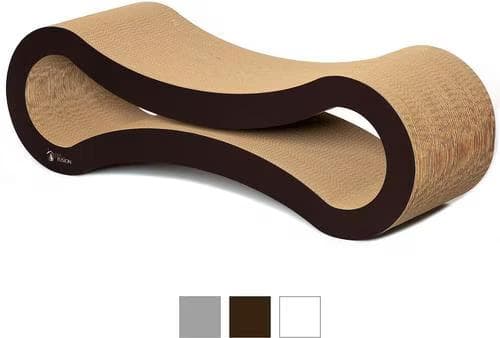
A PetFusion scratcher lounge offers a horizontal scratching surface. Choose it only if that shape and material fit the cat’s preferences; there is no special scratching requirement linked to tortoiseshell coloring.
- Provide accessible food, water, litter facilities, scratching surfaces, hiding places, and resting locations.
- Ask which food and litter the cat currently uses so the transition can be gradual where appropriate.
- Arrange routine veterinary care and request the available medical records.
- Choose grooming tools and session length according to coat condition and tolerance.
- Give a new arrival a quiet introduction before expecting it to explore a busy household.
There is no special tortoiseshell diet or health schedule based solely on the pattern. A long-haired coat can change grooming needs, and a documented breed or medical condition can change care recommendations, but those are separate from being tortie. If someone offers a “color-specific” remedy, ask which actual problem it is supposed to address.
The average lifespan of a tortie is not a separate coat-color statistic that predicts how long your cat will live. Age, existing illness, safe housing, and access to appropriate care are more useful considerations. For an unusual male tortoiseshell with a confirmed genetic condition, ask the veterinarian what that specific finding means instead of applying a general online lifespan number.
An allergy concern also needs a separate decision. A tortoiseshell is not more or less guaranteed to be safe for an allergic person because of the orange or dark areas. Read about hypoallergenic cat claims before choosing a cat on the assumption that a particular look will prevent symptoms.
Play and resting choices
A Frisco feather wand is one option for supervised interactive play. Let the cat choose whether to engage, and put stringed toys away after the session.
How tortoiseshell differs from calico and tabby
Is a tortoise shell cat a calico? Not necessarily. Tortoiseshell and calico describe related coat patterns, but the amount and arrangement of white usually distinguish them. A tortoiseshell usually has orange and dark fur intermingled with little or no white. A calico commonly has more obvious white areas alongside orange and dark patches. Informal descriptions can overlap when a mottled cat has some white, so focus on the visible markings rather than treating the labels as mutually exclusive diagnoses.
The calico cat guide provides the fuller comparison, including classic and dilute calicos. That distinction can help with an adoption description, but it does not reveal whether one cat will be calmer, friendlier, or healthier than another.

A tabby describes markings such as stripes rather than the same orange-and-dark mixture. A cat can show both tortoiseshell coloration and tabby markings; “torbie” is a common shorthand for that combination. Look for tabby markings in the non-orange areas as well as orange patches, since orange fur often shows visible striping.
In a tortoiseshell-versus-calico kitten comparison, small size, long fur, and the angle of the photograph can obscure the relevant white or striped areas. It is fine to use a plain description while the distinction remains uncertain. The cat does not need a perfect coat label to receive appropriate care or become a good companion.
Questions about living with a tortoiseshell cat
Frequently Asked Questions
Are tortie cats cuddly?
Some torties enjoy close physical contact, while others prefer company without being held. Individual preference is more informative than coat color. Let the cat initiate contact, pause regularly, and watch whether it chooses to stay. Consent to touch can also vary with the body area, time of day, and how comfortable the cat feels in its surroundings.
Are tortoiseshell cats clingy?
There is no dependable coat-based rule that torties are clingy. Consider the cat's daily routine and its normal level of contact. A change from baseline, especially alongside altered appetite, activity, vocalization, or litter habits, deserves attention. A new arrival may also seek reassurance while adjusting; predictable care and an appropriate veterinary assessment are more useful than a color stereotype.
Do tortoiseshell cats pick one person?
A tortoiseshell may spend more time with a familiar caregiver, but that preference can reflect experience and positive interactions rather than coloration. Other household members can build trust through quiet company, play, and respectful handling. Avoid forcing contact to make the cat “share” affection; give it opportunities to develop relationships at its own pace.

Editor
The Webvet Editorial Team is the in-house group of pet-care editors and writers behind Webvet, operated by Smart Pet Collective. The team researches, writes, and maintains Webvet's pet health, behavior, and medication content. Every article follows a defined editorial process: research from reputable veterinary and scientific sources, careful drafting, mandatory review of medical content by a credentialed veterinarian, and dated publication. Health and medication articles are medically reviewed by a licensed veterinary professional before they go live and are kept current over time.
Veterinarian · BVMS MRCVS
Dr. Pippa Elliott, BVMS, MRCVS, is a veterinarian with nearly 30 years of experience in companion animal practice. Dr. Elliott earned her Bachelor of Veterinary Medicine and Surgery from the University of Glasgow. She was also designated a Member of the Royal College of Veterinary Surgeons. Married with 2 grown-up kids, Dr. Elliott has a naughty Puggle named Poggle, 3 cats and a bearded dragon.


