Do Dogs Watch TV? What Dogs See and What They Like to Watch
Most dogs can see a TV, and many react to animals and movement on screen. Here is what dog vision research and owner surveys show, why some dogs ignore the TV, and when leaving it on helps.


BVMS MRCVS

This article contains affiliate links. Webvet may earn a commission when you buy through them, at no extra cost to you.
Do dogs watch TV? Many do. Most dogs can see a television picture, and in owner surveys a large majority react to at least some of what is on screen, especially other animals and fast movement. Most dogs watch in short bursts rather than sitting through a whole program.
Whether your dog watches TV depends on age, eyesight, personality and what is playing. Some dogs track every squirrel on screen while others ignore the TV completely, and both are normal.
Here is what research shows about how dogs see a screen, what grabs their attention, and whether leaving the TV on helps a dog who is home alone.
Is My Dog Actually Watching TV?
Probably, if your dog's eyes, ears and body follow what happens on the screen. In a 2023 University of Wisconsin-Madison survey of 1,246 dog owners, 86 percent said their dog watched screen content.
Of those dogs, 78 percent approached the screen and 76 percent barked, whined or made other sounds at it (Donohue and colleagues, 2023).
Both that survey and a 2025 Auburn University survey drew owners who chose to take part, so the true share of dogs that watch TV is probably lower. Still, screen watching is common. Signs your dog is really watching include:
- Eyes and head tracking an animal or ball as it moves across the screen
- Ears swinging forward, or a head tilt at barking, whining or a doorbell
- Walking up to the TV, pawing at it or sniffing the screen
- Barking, whining or growling at animals on screen
- Looking behind or beside the TV when something moves off the edge of the picture
- Glancing back at the screen when a familiar sound plays

A dog that lies with its back to the screen, sleeps through nature shows or only perks up at a doorbell is probably listening more than watching. Reading your dog's body language in context tells you more than any single reaction, and a quick head tilt at an on-screen sound often signals focused attention.
How long do dogs watch? Usually not long:
- About half of the watchers in the Wisconsin survey paid attention for 1 to 5 minutes at a time.
- The Auburn team's survey of 453 TV-watching dogs put the average at about 14 minutes (Montgomery and colleagues, 2025).
If your dog watches TV all the time but is easy to call away, that usually reflects a visually driven or easily excited dog rather than a problem. A dog that cannot be interrupted or stares at a blank screen needs a closer look, covered in the FAQ below.
You only see part of the story from the couch. A pet camera shows whether your dog watches the TV you leave on, naps, or paces by the door while you are out, and a 360-degree model can pan between the screen and your dog's favorite resting spot.
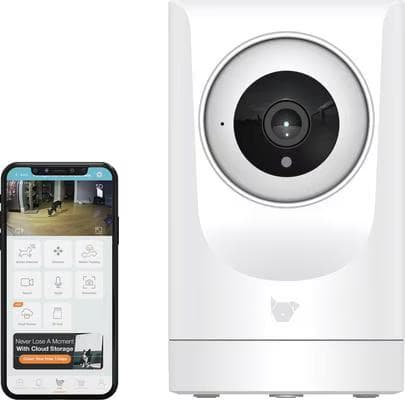
A 360-degree Wi-Fi pet camera you can check from your phone to see whether your dog is watching the screen, napping or pacing while you're out.
Webvet may earn a commission when you click through to Chewy, at no extra cost to you.
Do Dogs Know the TV Isn't Real?
Dogs recognize at least some of what they see on a screen. In one study, nine pet dogs sorted photos of dog faces from faces of people and dozens of other species on a computer screen, whatever the breed (Autier-Dérian and colleagues, 2013). A dog on TV likely registers as "dog."
Do dogs understand TV the way people do? No. Dogs do not comprehend plots or dialogue, and a screen offers no smell, no real depth and no response when a dog barks at it. Those missing cues are a big reason most dogs lose interest quickly.
Some behavior suggests dogs half expect on-screen things to exist in the room:
- 27 percent of watchers in the Wisconsin survey looked behind or beside the screen
- In the Auburn study, excitable dogs were more likely to follow on-screen objects as if they were physically there
- Many dogs sniff the screen, find nothing, and walk away
So what do dogs think when they watch TV? No one can measure it directly, but the best evidence suggests they respond to familiar shapes, movements and sounds rather than following a story.
What Do Dogs Like to Watch on TV?
Do dogs like watching TV? Plenty do, and they are picky viewers. Other animals top the list. In the Wisconsin survey, dogs engaged most often with animal content, and other dogs were the most popular animals on screen. The Auburn study also found most dogs reacted more to animals than to people or objects on screen.
What tends to hold a dog's attention:
- Other dogs barking, playing or running
- Prey-like animals such as squirrels, birds, rabbits and cats
- Fast, sweeping movement, like a ball in flight or an animal crossing the frame
- Familiar sounds such as barking, squeaky toys, doorbells and knocking
- Some cartoons, the most common answer when owners listed other content; many owners said their dogs watched cartoon animals, so a show like Bluey may catch some dogs' attention, though real animals are the more reliable draw
Movement matters more than sound. In the Wisconsin survey, 90 percent of owners said movement attracted their dog, compared with 78 percent for sound. That helps explain why a dog may ignore a talk show but leap up for a nature program.
Why do dogs watch TV at all? Screens tap the same instincts that make dogs track movement outdoors. A running animal looks like something to chase, and barking sounds like a dog nearby. Like other pets, many dogs seem to enjoy short sessions and are entertained by them.
If on-screen squirrels and foxes send your dog into a frenzy, give that chase-and-shake drive a real outlet after the show. A no-stuffing squeaky plush shaped like a woodland animal lets your dog grab, shake and carry "prey" without pulling stuffing loose. Supervise play and put the toy away once it tears.

No-stuffing squeaky plush toys that satisfy a dog's urge to shake and carry prey, with no stuffing to shred and scatter.
Webvet may earn a commission when you click through to Chewy, at no extra cost to you.
Can Dogs See TV? How Dog Vision Handles a Screen
Yes, dogs can see TV, but a TV picture looks different to a dog than it does to you. Dogs pick up movement well, see a narrower range of colors, and resolve less fine detail. Here is what a TV screen looks like to a dog, one difference at a time.

Color. Dogs have two types of color-sensing cone cells instead of the three most people have. One type is most sensitive to blue light and the other to yellow-green light (Siniscalchi and colleagues, 2017).
This dichromatic vision means dogs see mostly blues, yellows and grays and struggle to tell red from green, much like a person with red-green color blindness. The same study tested dogs with an animated running cat on a screen, which shows dogs do respond to moving images. Petful has a closer look at what colors dogs can see.
Detail. The same researchers note that dogs see fine detail roughly four to eight times less sharply than people, so small or distant images look softer to them. Many dogs move closer to the TV, and a big screen near a dog's eye level is easier to follow than a small one mounted high on a wall.
| Feature | Dogs | People | What it means for TV images |
|---|---|---|---|
| Color | Two cone types; blues and yellows stand out | Three cone types; full color range | Blue sky and yellow tones read better than red on green |
| Detail | Roughly 4 to 8 times less sharp | Sharp central detail | Bigger, closer screens are easier to follow |
| Flicker | Up to about 80 Hz reported | About 60 Hz | Higher refresh rates may look smoother to a dog |
| Brightness | About 2 times worse at telling shades apart | Finer brightness discrimination | High-contrast scenes are easier to pick out |
| Motion | Movement drew 90 percent of watchers | Follows story and dialogue | Moving animals grab attention fastest |
Flicker and motion. Dogs detect flicker at faster rates than people. Flicker fusion rates of up to about 80 Hz have been reported in dogs, compared with roughly 60 Hz in people (Völter, Karl and Huber, 2020). That difference is a commonly cited reason older TVs held less interest for dogs.
Modern screens still work for them. In the same study, dogs watching a 60 Hz monitor tracked a flying disc across the screen and looked toward the catcher before the disc arrived.
Phones, tablets and computer screens. Dogs can see smaller screens too, but a phone image is tiny from where a dog sits and loses more detail. Television was by far the most common screen in the Wisconsin survey, well ahead of laptops and tablets. Many animals, cats included, notice screens for the same reason: movement.
Why Does My Dog Bark at the TV?
A dog that barks at the TV is reacting to what it sees and hears: another dog barking, an animal running, a doorbell or a knock. To many dogs, those cues mean a real intruder or playmate is close by.
Excitement, frustration at not reaching the animal, and alarm can all come out as barking. In the Auburn study, more fearful or anxious dogs were more likely to react to non-animal sounds such as car horns and doorbells.
Some dogs bark at you, not the screen, when you settle in to watch. That is usually a request for attention or play, so ignoring the barking and rewarding quiet works better than scolding.
How to Stop Your Dog Barking at the TV
- Note the triggers, such as dogs on screen, doorbells or sirens, and skip or mute those scenes for now.
- Lower the volume and let your dog settle farther from the screen, where triggers feel less intense.
- When your dog barks at a trigger, calmly say "Quiet" and reward the silence with a steady stream of tiny, pea-sized treats (ASPCA).
- Reward calm looks at the screen with praise or a treat, so on-screen dogs start to predict good things.
- Over several sessions, raise the volume or move closer only as fast as your dog stays quiet.
Soft, small rewards make this step-by-step plan easier because you will hand out a lot of them. Treats such as Pet Botanics Training Reward break into small pieces, and our guide to dog training treats explains how to keep rewards within your dog's daily calories.

Soft, pea-sized training treats made with peanut butter and oats. Small enough to reward often while keeping treats inside the 10% of daily calories vets recommend.
Webvet may earn a commission when you click through to Chewy, at no extra cost to you.
Should You Leave the TV On for Your Dog?
Do dogs prefer TV or silence? It varies, but for many dogs a TV or radio on low works better than total silence. Calm sound has been linked to more resting in kennel studies and masks outside noises like traffic. Dogs that startle at sudden TV sounds or bark at on-screen animals rest better in silence.
So do dogs like the TV on when they are alone? Some clearly do, but no large study has let dogs choose between TV and silence. Watch your dog: settling or napping near the sound means the TV is fine, while leaving the room, pacing or barking means quiet suits it better.
Research on TV and sound for dogs gives a mixed picture:
- In a small study that let two dogs move freely between three screens playing different videos, watching nothing came out as the dogs' favored option in all but one session (Hirskyj-Douglas, Read and Cassidy, 2016).
- When researchers showed TV programs to 50 dogs in a rescue shelter, the dogs spent only 10.8 percent of their time looking at the screens, and their interest faded over time.
- Yet those shelter dogs barked and moved around less during every screen condition, even a blank screen, than with no screen at all (Graham, Wells and Hepper, 2005).
- Classical music and audiobooks have been linked to more resting and less barking in kennels.
- Heavy metal has been linked to more barking and body shaking.
- The calming effect faded when the same playlist was repeated (Lindig, McGreevy and Crean, 2020).
- 1Leave the TV on at low volume if your dog settles, naps or startles less at outside noise while it plays.
- 2Choose calm sound, such as quiet talk, soft music or an audiobook, over action scenes, barking dogs or doorbells.
- 3Turn it off if your dog barks, paces or stares at the screen the whole time you are gone.
- 4Rotate what plays, because the calming effect of the same sounds can fade with repetition.
What TV channel should you leave on for your dog? There is no single best channel. Pick low-key programming without sudden bangs, sirens or barking, and do a test run while you are home to see how your dog reacts.

Background sound works best alongside something to do. The ASPCA suggests offering a food puzzle that takes 20 to 30 minutes to finish each time you leave.
A thin layer of a xylitol-free spread such as Poochie Butter Peanut Butter Pumpkin Lickable Dog Treat inside a stuffable toy makes a longer lick-and-chew job. Never use a peanut butter that contains xylitol, which is dangerous for dogs (FDA).
Serving breakfast in a maze-style slow feeder turns a meal into a foraging task that keeps a dog busy while you head out.

A maze-pattern slow-feeder bowl that makes fast eaters work for each bite, reducing the gulping and swallowed air that trigger regurgitation and vomiting. Holds up to 4 cups.
Webvet may earn a commission when you click through to Chewy, at no extra cost to you.
Some owners also plug in a pheromone diffuser such as the Tranquil Tails Pheromone Calming Diffuser for Dogs. Results vary from dog to dog, and our guide to dog calming diffusers covers what they can and cannot do.
That diffuser's standard pads are scented with essential oils. The ASPCA says an oil diffuser is unlikely to be a problem when used briefly in an area pets cannot reach, and suggests avoiding one for pets with breathing problems (ASPCA). For a dog left alone with it, choose the unscented refill pads.
Does Leaving the TV On Help a Dog With Anxiety?
For mild restlessness, background sound may help a little. For true separation anxiety, it is not enough. Separation anxiety is panic about being left alone, and a TV cannot teach a panicked dog that being alone is safe.
Moderate or severe cases usually need professional help from a certified applied animal behaviorist or a board-certified veterinary behaviorist, and some dogs benefit from anti-anxiety medication that a veterinarian prescribes (ASPCA).
For milder worry and other signs of stress, our guide to anxiety relief for dogs covers what helps.
Why Some Dogs Watch TV and Others Don't
Do all dogs watch TV? No. Even in surveys of interested owners, roughly 12 to 14 percent of dogs were not reported to watch screens, and that is not a problem. Research points to a few factors that explain why some dogs watch TV and others ignore it:
| Factor | What studies found | What it means for your dog |
|---|---|---|
| Age | Younger dogs watched more often; watchers had a median age of 4 and non-watchers 5 | Puppies and young dogs tend to show more screen interest |
| Eyesight | Dogs with better-rated vision watched more often and for longer | A senior dog may lose interest as vision changes |
| Personality | Excitable dogs followed on-screen objects more; anxious dogs reacted more to doorbells and horns | Match what plays to your dog's temperament |
| Breed group | Sporting and herding breeds were over-represented among watchers | Sight-and-chase breeds may notice more, but individuals vary |
| Screen type | Television was the screen most dogs watched | A big screen at eye level gets the most attention |
Why doesn't my dog watch TV? Often it simply relies more on its nose and ears than its eyes. Scent-driven dogs may sniff the screen, find nothing there, and move on.
Dogs with weakening or cloudy eyes may not see enough detail to care. If a senior dog also misses toys or bumps into furniture, ask your veterinarian to check its eyes, and see our guide to cloudy eyes in senior dogs.
Do puppies watch TV? Young dogs in the Wisconsin survey watched more often than older dogs, so a puppy staring at the screen is common. Keep sessions short, because real-world socialization with people, dogs and new places matters far more at that age.
Are Dogs That Watch TV Smarter?
No study shows that dogs who watch TV are smarter or more intelligent than dogs who ignore it. In research, the factors linked to screen interest are age, eyesight, personality and possibly breed type, not problem-solving ability.
A dog that ignores the TV may lean on its nose, and one that watches every show may simply be more visual or more easily excited. If you are curious about your dog's problem-solving, food puzzles and training progress tell you far more than screen habits.
What Dog Breeds Watch TV?
Which breeds watch TV most? In the Wisconsin survey, sporting breeds such as retrievers and spaniels and herding breeds such as border collies and shepherds were over-represented among dogs that watched screens.
The researchers suggested these highly cooperative breeds may pay more attention to things their people are watching. Scent hounds such as beagles are often described as less interested, although that has not been measured directly.

Breed is not destiny. The Wisconsin team found no significant differences between breed groups in which content dogs liked, and the Auburn team found breed group did not significantly change how dogs responded. Your dog's own reactions tell you more than its breed.
DogTV and Other Programs Made for Dogs
DogTV is a subscription streaming service with programming made for dogs. Its lineup includes calming programs, livelier stimulation programs, and sound programs meant to help dogs get used to noises.
The company says it adjusts video colors toward what dogs can see (DogTV). It lists a limited free option alongside paid plans, so a free trial run with your own dog is the easiest way to judge it.
Free pet TV for dogs is also easy to find on streaming apps and video sites:
- Squirrel and bird feeder videos, the classic squirrel TV for dogs
- Videos of rabbits, farm animals and other dogs playing
- Slow nature scenes with soft sound for calming
- Short sensory clips, such as bugs crawling across the screen, for a burst of stimulation before a walk
Is DogTV good for dogs? For many dogs it is a harmless, sometimes calming background, but independent research comparing dog channels with ordinary nature programming is thin. Is DogTV bad for dogs? Not for most, although energetic clips of dogs barking or playing can wind up a reactive dog.
Which is the best dog TV for dogs? Whichever one your dog enjoys watching calmly. Try a few for short sessions, notice which ones your dog likes, and skip anything that triggers barking or pacing.
Is TV Good for Dogs? How to Keep Screen Time Healthy
Is TV good for dogs? In moderation, it is harmless for most dogs and can be a small source of enrichment.
Is it bad for dogs to watch TV? Only when it replaces exercise, sniffing, play and time with you, or when a dog becomes fixated on the screen or stressed by it. For most dogs, it is okay to watch TV as long as those basics come first.
Healthy screen time habits:
- Treat TV as enrichment, not a substitute for exercise, walks and play.
- Keep dog screen time short, and watch your dog's reaction rather than the clock.
- Keep the volume comfortable, and skip programs full of sudden bangs or sirens.
- Make it easy for your dog to walk away from the screen whenever it wants.
- Follow exciting clips with a real outlet, such as a game of fetch or tug with a Frisco Fetch Colorful Ball Knot Rope Dog Toy.
- 1Most dogs can see TV, and many enjoy short bursts of animal content.
- 2Watch your dog, not the clock: calm interest is fine, frantic barking or staring is a signal to change what plays.
- 3Background TV or music can soften outside noise, but it does not treat separation anxiety.
- 4Walks, sniffing, play and time with you still matter far more than anything on a screen.
How to Get Your Dog Interested in TV
You cannot make a dog watch TV, but you can make it easier to try. Pick a time when your dog is relaxed but awake, such as after a walk rather than right before dinner:
- Pick a short video of dogs, squirrels or birds moving across the frame.
- Let your dog sit a few feet from the screen at roughly eye level.
- Play the sound at a normal volume and see whether animal noises draw a look.
- Sit with your dog and reward interest with calm praise.
- Keep the first sessions to a few minutes; if your dog walks away, that is an answer too.
More Questions About Dogs and TV
Frequently Asked Questions
Do cats and dogs watch TV differently?
Both species can see TV, and in both, individual differences are large. Why do some cats watch TV when the dog in the same house does not? Similar factors likely apply: age, eyesight, personality and how strongly each animal is drawn to movement rather than scent.
A cat that stalks birds on screen and a dog that ignores them are both normal. Our guide to how cats see the world covers feline vision and screens.
Can the TV be too loud for my dog?
Yes. Loud or sudden sounds such as explosions, sirens and doorbells can startle a dog or set off barking, especially in a dog with noise sensitivity. Keep a comfortable volume, about the level of normal conversation.
Watch for signs of stress such as flattened ears, a tucked tail, trembling or leaving the room, and always leave your dog a way to move to a quieter spot.
What if my dog seems obsessed with the TV?
Screen fixation can become a problem. Talk to your veterinarian if your dog stares at a blank screen, chases lights, reflections or shadows, or cannot be interrupted when a screen is on.
Light or shadow chasing and freezing and staring are among the compulsive behaviors described in dogs, and painful or neurologic conditions can cause similar signs (VCA Animal Hospitals). Limit screen access while you get advice.
Can TV sounds help my dog get used to fireworks or doorbells?
They can if used carefully. This kind of noise desensitization means starting recordings at a low volume that keeps your dog relaxed, pairing them with treats or play, and raising the volume gradually over many sessions.
Going too fast can make a fear worse, so stop if your dog reacts and work with a behavior professional for strong fears (VCA Animal Hospitals).

Wendy Toth is an entrepreneurial writer, editor, and mom of two humans, two dogs and one cat. She’s currently Content Director here at PetFul. For the last 15 years she has held positions at Parents Magazine, NBC, PetSmart, and GreatPetCare, where she was co-founder. Her writing has appeared in many national outlets including Pet Lab Co., Retail Me Not, Ask Men, Wild Society Nutrition, and The New York Times. Because she loves her work so much, she’s obsessed with helping others find career fulfillment, and covers it regularly at PowerSuiting.
Veterinarian · BVMS MRCVS
Dr. Pippa Elliott, BVMS, MRCVS, is a veterinarian with nearly 30 years of experience in companion animal practice. Dr. Elliott earned her Bachelor of Veterinary Medicine and Surgery from the University of Glasgow. She was also designated a Member of the Royal College of Veterinary Surgeons. Married with 2 grown-up kids, Dr. Elliott has a naughty Puggle named Poggle, 3 cats and a bearded dragon.


