Dog symptom
Urinating in the house in dogs
Reviewed by the Webvet Veterinarian Team · Last reviewed June 22, 2026
A housetrained pet (or a cat avoiding the litter box) suddenly having accidents is often medical — a urinary infection, bladder problem, or something making it painful or urgent to go — not just 'bad behavior.'
Common causes of urinating in the house in dogs
- Urinary tract infection or bladder inflammation (cystitis/FLUTD)
- Bladder stones or crystals
- Increased thirst from kidney disease or diabetes
- Stress, or in cats, litter box aversion
Who's most at risk
- Cats (stress cystitis, FLUTD)
- Senior pets
- Overweight or low-water-intake pets
- Multi-cat homes (litter box competition)
What you can do at home
- Note frequency, amount, and any straining or blood
- Keep litter boxes clean and plentiful (one per cat, plus one)
- Don't punish accidents — it adds stress and hides the real cause
When to see a vet
- Straining, blood in urine, or frequent tiny amounts (can be an emergency — see 'straining to urinate')
- Drinking a lot more than usual
- Pain, lethargy, or accidents alongside other signs
- A sudden change in a reliably trained pet
When it's more serious
- That suggests a urinary problem (a straining male cat is an emergency) — see a vet today.
- Accidents plus increased thirst can signal kidney disease or diabetes — get bloodwork.
- A sudden change usually has a medical cause — a urine test is the place to start.
What your vet may do
- Urinalysis and possibly a urine culture
- Bloodwork to check kidneys and blood sugar
- Imaging for stones or bladder problems
- Treat infection or inflammation; address stress for cats
Questions to ask your vet
- Is there an infection or stones?
- Could this be increased thirst from a disease?
- Is it medical or behavioral — and how do we tell?
- What litter box setup helps my cat?

Frequently asked questions
What causes urinating in the house in dogs?
A housetrained pet (or a cat avoiding the litter box) suddenly having accidents is often medical — a urinary infection, bladder problem, or something making it painful or urgent to go — not just 'bad behavior.' Common causes include: Urinary tract infection or bladder inflammation (cystitis/FLUTD); Bladder stones or crystals; Increased thirst from kidney disease or diabetes; Stress, or in cats, litter box aversion.
Is urinating in the house in dogs an emergency?
Book a veterinary visit soon. See a vet right away if: Straining, blood in urine, or frequent tiny amounts (can be an emergency — see 'straining to urinate'); Drinking a lot more than usual; Pain, lethargy, or accidents alongside other signs; A sudden change in a reliably trained pet.
What can I do at home for a dog with urinating in the house?
Note frequency, amount, and any straining or blood. Keep litter boxes clean and plentiful (one per cat, plus one). Don't punish accidents — it adds stress and hides the real cause.
A closer look at urinating in the house in dogs
When a housetrained dog suddenly starts leaving puddles indoors, it is tempting to read it as disobedience or spite. In reality, the single most useful thing an owner can do is treat a sudden change in a reliably trained dog as a medical question first and a behavior question second. Dogs do not soil the house to make a point. A change in where, when, or how often your dog urinates usually means something has changed inside the dog, and that something is far easier to fix once you know what it is.
- 1A sudden shift in a trained dog is usually medical, not naughty, until a urine test proves otherwise.
- 2A urinalysis is almost always step one, because it separates infection, crystals, dilute urine, and inflammation quickly and cheaply.
- 3Drinking noticeably more water alongside the accidents points toward kidney disease, diabetes, or Cushing's, and deserves bloodwork.
- 4Leaking while asleep or relaxed is often true incontinence, common in spayed females, and is treatable.
- 5Punishment makes house-soiling worse, never better, and hides the real cause.

Cranberry chews support urinary tract health once your vet has ruled out infection and stones.
Webvet may earn a commission when you click through to Chewy, at no extra cost to you.
What is actually happening when a trained dog pees indoors
House-soiling is a symptom, not a diagnosis, and it shows up through a handful of very different mechanisms. Sometimes the bladder itself is irritated, as with a urinary tract infection or inflammation of the bladder wall, so the dog feels a constant, urgent need to go and cannot make it outside in time. Sometimes the body is simply producing far more urine than usual, which happens when the kidneys are struggling, when diabetes spills sugar into the urine, or when a hormonal disorder like Cushing's disease drives up thirst. In those cases the dog is drinking and urinating more overall, and the accidents are just the visible overflow. And sometimes the plumbing works but the control valve leaks, which is what true urinary incontinence looks like.

Behavior is real too, but in veterinary medicine it is a diagnosis of exclusion. Territorial marking, stress-related soiling, separation anxiety, and an incompletely housetrained young dog all cause indoor urination. The problem is that they look almost identical from the outside to a medical cause, so a vet cannot responsibly call something behavioral until the physical possibilities have been ruled out. That order of operations, body first and behavior second, is the backbone of how this symptom is worked up.
Reading the clues: what the accidents are telling you
The details you notice at home genuinely change the direction of the investigation, so it is worth becoming a careful observer before the vet visit. Small, frequent puddles with visible straining or a spot of blood point toward the bladder, whether that is an infection, inflammation, or stones. Large, soaking accidents from a dog who is also emptying the water bowl point toward the kidneys, diabetes, or a hormonal cause. A wet patch that appears only where your dog was lying, with no awareness on the dog's part, is the signature of incontinence rather than a housetraining failure. And a few small deposits left neatly against vertical surfaces, especially in an intact male, look more like marking than a full bladder emptying.
| What you notice | What it often points to | How soon to act |
|---|---|---|
| Straining, tiny amounts, or blood | Bladder infection, inflammation, or stones | See a vet promptly (a straining male dog can be an emergency) |
| Drinking a lot more, large accidents | Kidney disease, diabetes, or Cushing's | Book bloodwork soon |
| Leaking while asleep or relaxed | Urinary incontinence (often spayed females) | Routine vet visit; usually very treatable |
| Small marks on vertical surfaces | Territorial marking (often intact males) | Rule out medical first, then address behavior |
| Confusion, night pacing in a senior | Cognitive decline (canine dementia) | Routine vet visit to confirm and manage |
How vets pinpoint the cause in dogs
The workup almost always begins with a urinalysis, and for good reason. A single urine sample tells your vet whether there is infection, blood, crystals, sugar, or protein, and how concentrated the urine is. Concentration is a quietly powerful clue: dilute urine suggests the kidneys or a hormone problem, while highly concentrated urine with signs of inflammation points at the bladder. If the sample suggests infection, a urine culture identifies the exact bacteria so the right antibiotic is chosen rather than guessed at. This is why a vet will often ask you to bring in a fresh sample, or will collect one during the visit, before anything else is decided.
From there the path branches based on what the urine shows and what your vet feels on the physical exam. Bloodwork checks kidney values and blood sugar and screens for the hormonal disorders that increase thirst. Imaging, usually an ultrasound or radiographs, looks for bladder stones, thickened bladder walls, or masses. In an older dog, or one with other subtle changes, this broader screen doubles as a general health check, which is part of why owners often find the visit reassuring even when the news is a diagnosis. The goal throughout is to land on a specific, treatable cause rather than to manage a mystery.

Male, female, young, and senior: the patterns differ
Sex, age, and reproductive status shape what is most likely. Urinary tract infections are more common in female dogs because of their shorter urethra, so a spayed female with sudden urgency is a classic candidate for a bladder infection. Intact males are the most likely to mark, leaving small deposits to communicate rather than to empty a full bladder, and this can flare when a new pet, person, or piece of furniture changes the household. Spayed females are also the group most affected by hormone-responsive incontinence, where a relaxed or sleeping dog leaks without meaning to. If your dog is straining hard, producing only drops, or crying out, do not wait: a blocked urethra, especially in a male dog, is a genuine emergency, and the straining to urinate guide explains why that situation cannot be watched at home.
Senior dogs add two more possibilities. Age-related cognitive dysfunction, sometimes called canine dementia, can erode a dog's housetraining along with disrupting sleep and orientation, so an older dog who paces at night and forgets learned routines may be showing more than a bladder problem. Arthritis matters too: a stiff, sore dog may simply be unable to get up and reach the door in time, which reads like a housetraining lapse but is really a mobility one. These overlapping senior issues are a good reason to have an older dog examined rather than assume the accidents are just old age.
How to help at home safely
While you arrange a vet visit, the most valuable thing you can do is gather information. Keep a simple log of when accidents happen, roughly how much urine there is, whether you see straining or blood, and how much your dog is drinking. Note whether accidents cluster overnight, after long stretches alone, or whenever the household is disrupted, because timing helps separate a medical urgency from a stress or routine problem. Offer more frequent outdoor trips so a dog with a genuine physical urgency has every chance to get outside, and never restrict water to reduce accidents, since a dog drinking more may be doing so because of a disease that dehydration would only worsen.

Washable pads make the accidents manageable while you and your vet work out the cause. They are a stopgap, not a solution.
Webvet may earn a commission when you click through to Chewy, at no extra cost to you.
Cleaning matters more than most owners expect. Ordinary household cleaners leave behind odor compounds that a dog's nose still registers as a bathroom, which invites repeat visits to the same spot. An enzymatic pet cleaner breaks down those compounds so the location stops advertising itself. This is quiet management rather than a cure, but it stops one accident from setting a pattern while you get to the underlying cause.

What to expect at the vet visit and afterward
Treatment follows the diagnosis, so the visit is genuinely about finding the answer rather than reaching for a one-size-fits-all fix. A bladder infection is usually treated with a course of antibiotics, and signs often improve within a few days, though finishing the full course is what prevents a relapse. Bladder stones may be dissolved with a prescription diet or removed, depending on their type. Incontinence in a spayed female frequently responds well to medication that tightens the bladder sphincter, turning a frustrating nightly problem into a managed one. Diabetes, kidney disease, and Cushing's are longer-term conditions, but each has established management, and catching them because of a few accidents is often a fortunate early warning. If your vet prescribes medication, the Webvet Rx database can help you understand what has been dispensed, though the dose and plan always come from your veterinarian.
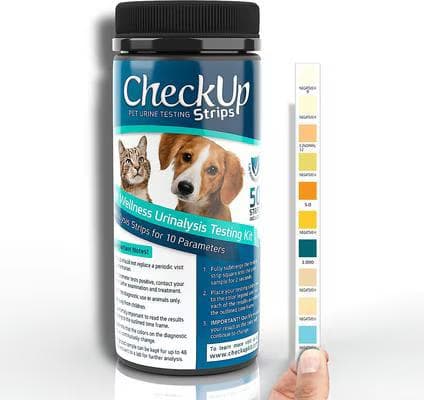
Before you call it behaviour, rule out the medical causes. These strips screen for glucose, blood, and protein, so you can walk into the vet with real numbers.
Webvet may earn a commission when you click through to Chewy, at no extra cost to you.
Recovery and cost vary with the cause. A straightforward infection is inexpensive and resolves in about a week. A stone that needs surgery or a lifelong condition like diabetes costs more and asks for ongoing follow-up, including repeat urine tests to confirm the problem has truly cleared. Once a genuinely behavioral or marking cause has been confirmed by exclusion, the plan shifts to consistency, neutering where appropriate, reducing household stressors, and rewarding outdoor habits. What ties every version together is that the sooner the real cause is identified, the shorter and cheaper the road back tends to be.
Lowering the risk going forward
You cannot prevent every cause, but a few habits tilt the odds. Keep fresh water available and encourage steady drinking, which supports a healthier, less concentrated urine that is less friendly to infection and crystals. Give frequent, predictable potty breaks, especially for puppies, seniors, and dogs left alone for long stretches. Keep your dog at a lean body weight, since overweight dogs face higher rates of several relevant conditions. And treat any change in urination as an early signal worth checking rather than waiting for it to become routine, because the same urinalysis that solves a mystery today is also one of the best general health screens your dog can have.


Disposable diapers manage true incontinence while the medical workup happens, especially leaking during sleep.
Webvet may earn a commission when you click through to Chewy, at no extra cost to you.
The reassuring takeaway is that a dog urinating in the house is far more often a solvable health question than a broken relationship. Notice the pattern, resist the urge to punish, and let a urine test point the way. Whether the answer turns out to be a treatable infection, a manageable chronic condition, or a genuinely behavioral habit uncovered only after the body was cleared, your dog is far better served by curiosity and a vet visit than by frustration, and the great majority get back to clean, comfortable routines once the real cause is addressed.
Sources
Reviewed by the Webvet Veterinarian Team
This guide is general information, not a diagnosis, and does not replace an exam by your veterinarian. If your pet is in distress, contact your vet or an emergency clinic right away.