My cat ate string: what to do
Needs a vetUrgent. If your cat ate string, go to a vet now and never pull on it. String is a linear foreign body that can anchor and saw through the intestine.
Go to a veterinarian or emergency clinic now
Arrange an immediate physical examination; a poison line cannot rule out an obstruction.


Medically reviewed by Dr. Athena Gaffud, DVM · Last reviewed
What to do right now
- Arrange an immediate veterinary examination. Tell the clinic what may have been swallowed and when.
- Leave any visible string in place. Do not force the mouth open or reach under the tongue.
- Check for a missing needle, spool, or ribbon so you can describe any attached object.
- Ask the clinic about feeding while arranging the visit. Do not give food or home remedies to push the string through.
What not to do
- Do not pull string from the mouth or anus; an anchored strand can damage the intestine.
- Do not wait to see if it passes or assume normal behavior proves it has passed.
- Do not induce vomiting or give food, laxatives, or other home remedies to push it through.
What to tell the vet or poison line
- What kind of string it was, roughly how long, and whether a needle was attached.
- When your cat swallowed it, or when you first noticed it missing.
- Whether you can see string under the tongue or at the anus, and whether anyone pulled on it.
- Any vomiting, hiding, straining, or refusal to eat since then.
- 1If your cat ate string, contact a vet for an immediate assessment, even if your cat seems fine. Never pull visible string.
- 2A linear foreign body can anchor while intestine gathers along it, causing obstruction or perforation.
- 3Signs and timing vary. A normal appearance does not prove the string has passed.
If your cat ate string, arrange an immediate veterinary assessment. Thread, floss, ribbon, tinsel, and wand toy cord can act as linear foreign bodies. You cannot tell from outside whether an end has caught or whether the intestine is being damaged. A cat that looks normal still needs assessment.
The rule that matters most: leave any visible string alone, because pulling an anchored end can slice the intestine.
Optional equipment or enrichment for your cat. Check suitability, condition, and directions, and supervise use. This product does not treat a hazardous exposure.
Webvet may earn a commission when you click through to Chewy, at no extra cost to you.
What to do right now
What do I do if my cat ate a piece of string? Call your vet or the nearest emergency clinic and describe the suspected ingestion. Note when it happened, the material, and roughly how much is missing. Do not force the mouth open or delay the visit to look under the tongue; leave any visible string alone.
Do not give food or treats to push the string through. Ask the clinic about feeding while arranging the visit. If the cord came from a wand toy, bring the toy so the vet can assess the material and missing length. The examination may include the mouth, abdomen, and diagnostic imaging.

What not to do: never pull the string
Never pull the string from the mouth or anus: an anchored strand can injure the intestine when tension is applied. Do not give food, treats, oil, butter, laxatives, or hairball paste to push it through. Do not induce vomiting at home. Your veterinarian must assess the object and choose an appropriate plan.
Why string is worse than other objects: the linear foreign body
A solid object passes or sticks in one place; string behaves differently. As Merck describes it, one end catches at the base of the tongue or in the stomach while the rest travels down the intestine on the normal waves of gut movement. The anchored end cannot follow, so the intestine climbs the strand and gathers into tight folds, like fabric on a drawstring. The folded gut is obstructed, and each wave presses the taut strand into the wall until it saws through.
Optional equipment or enrichment for your cat. Check suitability, condition, and directions, and supervise use. This product does not treat a hazardous exposure.
Webvet may earn a commission when you click through to Chewy, at no extra cost to you.
Once there is a hole, intestinal contents leak into the abdomen; ACVS notes this quickly leads to peritonitis and sepsis. A needle on the thread adds a puncture risk, and shows on an X-ray even when the thread does not.
How much is dangerous: risk factors, not lengths
No length establishes safety or guarantees trouble. Tell your vet about the material, approximate length, any attached needle or hook, and every missing component. Whether an end is anchored and whether the intestine is involved are questions for the veterinary assessment.
Optional equipment or enrichment for your cat. Check suitability, condition, and directions, and supervise use. This product does not treat a hazardous exposure.
Webvet may earn a commission when you click through to Chewy, at no extra cost to you.
| Swallowed | Specific concern | Action | Tell the vet |
|---|---|---|---|
| Thread with a needle | A needle adds a puncture hazard | Seek veterinary assessment now | Is the needle missing? |
| Tinsel or plastic strands | Long strands can act as linear foreign bodies | Seek veterinary assessment now | What material and amount are missing? |
| Hair ties or elastic cord | Swallowed loops, cord, or attached parts may obstruct | Seek veterinary assessment now | How many; any metal parts? |
| Wand toy cord | Cord and attached components may be swallowed together | Seek veterinary assessment now | Cord length; is an end piece missing? |
| Dental floss or fishing line | Fine strands; hooks add a puncture hazard | Seek veterinary assessment now | Is a hook or sinker missing? |
| Yarn, ribbon, or balloon string | Soft material can still become a linear foreign body | Seek veterinary assessment now | Length; any weight or wire attached? |
"My cat ate string but is acting normal": the trap
Acting normal does not rule out a linear foreign body. A cat may continue eating or appear comfortable despite a problem. Vomiting, refusing food, or hiding can signal illness, but these signs do not prove the intestine has folded. Tell the veterinarian about suspected ingestion without waiting for symptoms.

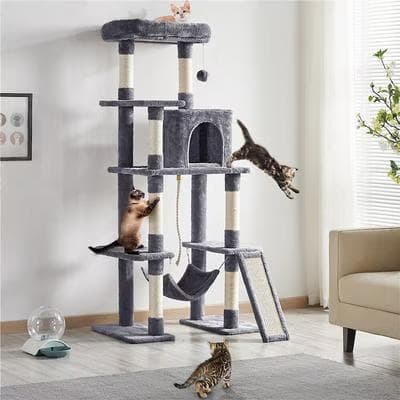
Optional equipment or enrichment for your cat. Check suitability, condition, and directions, and supervise use. This product does not treat a hazardous exposure.
Webvet may earn a commission when you click through to Chewy, at no extra cost to you.
Pooped it out? Do not pull a strand at the anus, and a piece in the box proves only that piece passed. If passage was not confirmed, tell your veterinarian about the suspected ingestion even if your cat currently seems well. Recurrent vomiting or a smaller appetite also needs assessment. Our symptom checker can help you describe signs, but it cannot exclude an obstruction.
Symptoms and when they start: the timeline to obstruction
How long after eating string will a cat show symptoms? Signs and timing vary. Some cats initially look normal; others drool or paw at the mouth, vomit, stop eating, hide, or show abdominal pain. These signs cannot tell an owner exactly where the string is. Suspected ingestion needs prompt examination, and worsening weakness, pain, or collapse is an emergency.
String often is not visible on plain radiographs. Your veterinarian looks for indirect signs of obstruction and may use ultrasound or other investigations. A normal-looking cat or a single unrevealing image does not by itself confirm passage. Tell the clinic about every missing piece, especially any attached needle or hook.

What the vet will do (and the outlook)
The veterinarian chooses removal methods after assessing the object's location and whether it extends into the intestine. Merck cautions against endoscopy for suspected linear foreign bodies because it cannot assess the entire intestine. Surgical exploration may be needed; the surgeon also checks the bowel for damage and removes injured tissue when necessary.
How to get a cat to pass string? Do not attempt to manage passage at home without the veterinarian's direction. The plan depends on examination and imaging. ACVS describes generally good outcomes after gastrointestinal foreign-body surgery, but that is not a survival guarantee for every string case. Perforation, infection, or damaged bowel makes treatment more difficult.
Prevention and safer alternatives
Store sewing supplies, ribbon, floss, and fishing line in closed containers. Put a wand toy away after supervised play and inspect it for damage. Remove balloon strings and loose strands entirely from reach; cutting them shorter does not establish safety. A cat tree or suitable treat puzzle can offer routine enrichment after the exposure has been assessed. Our plants toxic to cats guide covers household plants to keep inaccessible.

Frequently Asked Questions
My cat ate a small piece of string. Do I still need a vet?
Yes, call. A short piece often passes, but nobody can tell from outside whether an end has anchored, and a threaded needle or tinsel is never a small risk.
Can I cut the string hanging from my cat's mouth?
Leave it and go in. The clinic can trim and remove it safely; cutting near the tongue yourself risks the cat swallowing the rest, and pulling risks the intestine.
My cat ate string and is throwing up. What does that mean?
Vomiting after suspected string ingestion can indicate a serious problem, including obstruction. It does not prove one particular mechanism or location. Go to a veterinarian or emergency clinic now and leave any visible string alone.
What if my cat ate balloon string or ribbon?
Same rules. Curling ribbon, wired ribbon, and balloon string are long linear foreign bodies. Call now and note the length and whether a weight or wire was attached.
How much does surgery cost for a cat that ate string?
Costs depend on the clinic, investigations, removal method, and any bowel damage or infection. Endoscopy is not a required step before surgery. Ask the clinic for an estimate and discuss available care options while seeking prompt assessment.
Sources
- ACVS: Gastrointestinal Foreign Bodies
String can be found wrapped around the base of the tongue, linear foreign bodies can perforate the intestine and cause peritonitis, imaging is used for diagnosis, and a linear foreign body warrants surgical exploration.
- Merck Veterinary Manual: Gastrointestinal Obstruction in Small Animals
Cats typically ingest string, yarn, and dental floss, one end anchors at the tongue base or stomach while the rest bunches the intestines and saws through the wall, and a linear foreign body in the mouth must never be pulled.
Reviewed by Dr. Athena Gaffud, DVM
General guidance based on credible veterinary sources; not a diagnosis or a substitute for your veterinarian. If your pet ate something dangerous or is unwell, contact your vet or a pet poison line right away.